
Medicines
SmPC of 24/06/2026
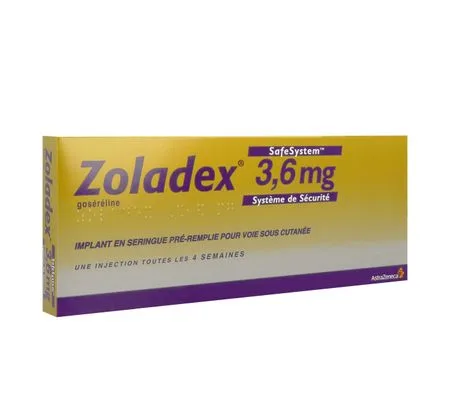
ZOLADEX 3,6 mg, implant in prefilled syringe for subcutaneous use
Composition
Goserelin base .............................................................................................................................3,6 mg
(As goserelin acetate)
For an implant.
Lactoglycolic copolymer.
Indications
Zoladex is indicated in adults in the:
- Treatment of metastatic prostate cancer.
- A favorable effect of the medicine is all the more marked and frequent when the patient has not previously received hormonal treatment.
- Adjuvant treatment to external radiotherapy in locally advanced prostate cancer (stage T3-T4 of the TNM classification or stage C of the AUA classification).
- Treatment of hormone-dependent metastatic breast cancer in premenopausal women when suppression of ovarian function is necessary.
Remark : This medicine is in no way adjuvant treatment for non-metastatic breast cancer.
Dosage and administration
Precautions must be taken when injecting Zoladex 3,6 mg into the anterior abdominal wall because of the proximity of the underlying inferior epigastric artery and its branches.
Particular caution must be exercised when administering Zoladex 3,6 mg to patients with a low BMI and/or receiving anticoagulant treatment (see section Warnings and precautions).
For correct administration, refer to the diagram of the method of administration enclosed in the box.
Dosage
Breast and prostate cancer:
One implant of goserelin acetate, containing 3,6 mg, will be injected subcutaneously into the anterior abdominal wall every 28 days.
In the indication: "adjuvant treatment to external radiotherapy in locally advanced prostate cancer," the duration of hormone therapy is set at 3 years.
Method of administration
Before injection, it should be ensured that part of the implant is visible in the syringe window.
Precautions to take before handling or administering the medicine:
The plunger must not be removed when the needle is in place, and it is essential to push it fully to inject the implant into the subcutaneous tissue.
Contraindications
Hypersensitivity to the active substance or to any of the excipients listed in section Composition or to any of the components of the implant.
Pregnancy and breastfeeding (see section Fertility, pregnancy and breastfeeding).
Warnings and precautions
The use of Zoladex 3,6 mg is not indicated in children because the safety and efficacy of this product have not been established for this patient group.
There is an increased risk of incident depression (which may be severe) in patients treated with GnRH agonists, such as goserelin. Patients should be informed accordingly and treated appropriately if symptoms appear.
Injection site injuries have been reported with Zoladex 3,6 mg, including pain, haematomas, haemorrhages, and vascular injuries. Patients showing signs or symptoms of abdominal haemorrhage should be monitored. In very rare cases, administration errors have caused vascular injury and haemorrhagic shock requiring blood transfusions and surgical intervention. Particular caution should be exercised when administering Zoladex 3,6 mg to patients with a low BMI and/or receiving anticoagulant therapy (see section Dosage and administration).
Androgen deprivation therapy may prolong the QT interval.
For patients with a history or risk factors of QT interval prolongation, and for patients receiving medicinal products that may prolong the QT interval (see section Interactions), physicians should assess the benefit-risk balance, taking into account the risk of torsade de pointes before initiating Zoladex.
Treatment with Zoladex may give positive reactions in anti-doping tests.
In men:
The use of Zoladex 3,6 mg in men at particular risk of ureteral obstruction or spinal cord compression should be considered with caution, and these patients should be closely monitored during the first month of treatment.
Initial use of an anti-androgen (e.g. cyproterone acetate 300 mg per day for three days before and three weeks after starting treatment with Zoladex) should be considered when initiating treatment with an LHRH analogue, as it has been reported to prevent possible sequelae of the initial increase in serum testosterone. In the presence of spinal cord compression or renal insufficiency due to ureteral obstruction, standard treatment specific to these complications must be initiated.
The use of LHRH agonists may lead to a decrease in bone mineral density. Preliminary data obtained in men indicate that the use of a bisphosphonate in combination with an LHRH agonist could reduce the loss of bone mineral density.
Particular caution is required in patients with additional risk factors for osteoporosis (e.g. chronic excessive alcohol consumption, smoking, long-term treatment with anticonvulsants or corticosteroids, family history of osteoporosis).
Mood disturbances, including depression, have been reported. Depressed patients and hypertensive patients should be closely monitored.
A decrease in glucose tolerance has been observed in men receiving LHRH agonists. It may manifest as diabetes or, in patients who already have diabetes mellitus, as a loss of glycaemic control. Monitoring of blood glucose should therefore be considered.
An increase in cases of heart failure and myocardial infarction has been observed in an epidemiological study in patients treated with LHRH agonists for prostate cancer. The risk appears to be increased when LHRH agonists are combined with anti-androgens.
Monitoring measures targeted at cardiovascular risk factors are necessary. In patients presenting these risk factors and/or pre-existing cardiovascular disease, management and treatment of the risk factors is necessary. See Section Adverse effects.
In women:
Breast cancer
Decrease in bone mineral density.
The use of LHRH agonists may lead to a decrease in bone mineral density. After two years of treatment for early breast cancer, the mean loss of bone mineral density was 6,2 % and 11,5 % at the femoral neck and lumbar spine respectively. This loss has been shown to be partly reversible during follow-up after one year without treatment, with recovery of 3,4 % and 6,4 % compared with baseline at the femoral neck and lumbar spine respectively, although this recovery is based on very limited data.
For the majority of women, currently available data suggest that recovery of bone loss occurs after treatment is stopped.
Preliminary data suggest that the use of Zoladex in combination with tamoxifen in patients with breast cancer may reduce bone demineralisation.
Withdrawal bleeding
At the start of treatment with Zoladex, some women may experience vaginal bleeding of variable duration and intensity. This vaginal bleeding generally occurs during the first month after starting treatment. Such bleeding is probably due to oestrogen withdrawal and should stop spontaneously. If it persists, its cause should be investigated.
The use of Zoladex may lead to increased cervical resistance; caution is therefore advised when dilating the cervix.
Women of childbearing potential must use non-hormonal contraceptive methods during treatment with Zoladex and until menses resume after treatment with Zoladex is stopped.
Mood disorders, including depression, have been reported. Depressed patients and hypertensive patients should be carefully monitored.
Interactions
Associations requiring precautions for use
As androgen suppression treatment may lead to prolongation of the QT interval, concomitant use of Zoladex with medicinal products known to prolong the QT interval, or medicinal products that can induce torsade de pointes such as class Ia antiarrhythmics (e.g. quinidine, disopyramide) or class III antiarrhythmics (e.g. amiodarone, sotalol, dofetilide, ibutilide), methadone, moxifloxacin, antipsychotics, etc., should be evaluated with caution (see section Warnings and precautions)
Fertility, pregnancy and breastfeeding
Pregnancy
Zoladex must not be used during pregnancy, as intercurrent use of LHRH agonists is associated with a theoretical risk of abortion or foetal abnormality.
Fertility
Before treatment, women of potential childbearing age should be carefully examined to exclude any pregnancy. Non-hormonal contraceptive methods must be used during treatment until menses resume.
Breast-feeding
Zoladex must not be used during breastfeeding.
Driving and using machines
Zoladex 3,6 mg has no or negligible influence on the ability to drive vehicles and use machines.
Adverse effects
The following frequency categories are based on all adverse reactions from clinical studies, post-marketing studies and spontaneous reports.
In this section, adverse reactions are defined as follows: very common (≥ 1/10), common (≥ 1/100 to < 1/10), uncommon (≥ 1/1 000 to < 1/100), rare (≥ 1/10 000 to < 1/1 000), and very rare (< 1/10 000), not known (cannot be estimated from the available data).
|
System organ class |
Frequency |
Men |
Women |
|
Benign, malignant and unspecified tumours (including cysts and polyps) |
Very rare |
Pituitary tumour |
Pituitary tumour |
|
Frequency not known |
NA |
Degeneration of uterine fibroids |
|
|
Immune system disorders |
Uncommon |
Drug hypersensitivity |
Drug hypersensitivity |
|
Rare |
Anaphylactic reaction |
Anaphylactic reaction |
|
|
Endocrine disorders |
Very rare |
Pituitary haemorrhage |
Pituitary haemorrhage |
|
Metabolism and nutrition disorders |
Common |
Decreased glucose tolerancea |
NA |
|
Uncommon |
Hypercalcemia |
||
|
Psychiatric disorders |
Very common |
Decreased libidob |
Decreased libidob |
|
Uncommon |
Mood alteration, depression (short-term use) |
Mood alteration, depression (short-term use) |
|
|
Common |
Mood alteration, depression (long-term use) |
Mood alteration, depression (long-term use) |
|
|
Very rare |
Psychotic disorder |
Psychotic disorder |
|
|
Nervous system disorders |
Common |
Paresthesias |
Paresthesias |
|
Compression of the spinal cord |
NA |
||
|
NA |
Headache |
||
|
Vascular disorders |
Very common |
Hot flushes,
|
Hot flushes,
|
|
Common |
变化 blood pressure variationc |
变化 blood pressure variationc |
|
|
Cardiac disorders |
Common |
Heart failuref
|
|
|
Frequency not known |
Prolongation of the QT interval (see sections Warnings and precautions and Interactions) |
Prolongation of the QT interval (see sections Warnings and precautions and Interactions) |
|
|
Skin and subcutaneous tissue disorders |
Very common |
Hyperhidrosisb |
Acnei
|
|
Common |
Rashd |
Rashd
|
|
|
Frequency not known |
Alopeciah |
||
|
Musculoskeletal, systemic and bone disorders |
Common |
Bone paine |
NA |
|
Arthralgia |
|||
|
Uncommon |
Arthralgia |
||
|
Renal and urinary disorders |
Uncommon |
Obstruction of the ureter |
NA |
|
Disorders of the reproductive system and breast |
Very common |
Impotence |
NA |
|
NA |
Vulvovaginal dryness |
||
|
NA |
Increase in breast volume |
||
|
Common |
Gynaecomastia |
NA |
|
|
Uncommon |
Breast tenderness |
NA |
|
|
Rare |
NA |
Ovarian cyst |
|
|
Frequency not known |
NA |
Withdrawal bleeding (see section Warnings and precautions) |
|
|
General disorders and administration site conditions |
Very common |
Injection site reactions |
|
|
Common |
Injection site reactions |
Increase in tumour volume, painful tumour |
|
|
Investigations |
Common |
Loss of bone mineral density (see section Warnings and precautions), weight gain |
Loss of bone mineral density (see section Warnings and precautions), weight gain |
a A decrease in glucose tolerance has been observed in men receiving LHRH agonists. It may manifest as diabetes or, in patients who already have diabetes mellitus, as loss of glycaemic control.
b Pharmacological effects that only rarely require discontinuation of treatment. Hot flushes and sweating may continue after stopping treatment with Zoladex.
c May manifest as hypotension or hypertension and are sometimes observed in patients who have received goserelin. These changes are usually transient, disappearing during treatment or after discontinuation of goserelin treatment. In rare cases, these changes have been severe enough to require medical intervention, including discontinuation of goserelin treatment.
d Generally mild, often regressing without requiring discontinuation of treatment.
e Initially, patients with prostate cancer may experience a temporary increase in bone pain, which can be managed with symptomatic treatment.
f An increase in cases of heart failure and myocardial infarction has been observed in an epidemiological study in patients treated with LHRH agonists for prostate cancer. The risk appears to be increased when LHRH agonists are combined with anti-androgens.
g Hair loss has been reported in women. It is usually mild but may be severe in some cases.
h Particularly loss of body hair, which is an expected effect of the decrease in androgen levels.
i The onset of acne has generally been observed the month following the start of treatment with goserelin.
Post-marketing experience
A small number of cases of changes in the blood count, liver dysfunction, pulmonary embolism and interstitial pneumonia have been reported with the use of Zoladex.
At the start of treatment, patients with breast cancer may experience a temporary worsening of signs and symptoms, which can be managed with symptomatic treatment.
Rarely, patients with metastatic breast cancer have developed hypercalcaemia at the start of treatment. Hypercalcaemia should be ruled out in the presence of suggestive signs (e.g. thirst, etc.).
Rarely, some women enter menopause during treatment with LHRH analogues and their periods do not return after treatment is stopped. It is not determined whether this is an effect of treatment with Zoladex or a consequence of their gynaecological conditions.
Reporting of suspected adverse reactions
Reporting suspected adverse reactions after authorisation of the medicinal product is important. It allows continued monitoring of the benefit/risk balance of the medicinal product. Healthcare professionals are asked to report any suspected adverse reactions via the national reporting system: National Agency for the Safety of Medicines and Health Products (ANSM) and the network of Regional Pharmacovigilance Centres - Website: https://signalement.social-sante.gouv.fr/.
Overdose
Experience with overdose is limited in humans. In cases where Zoladex was administered before the scheduled date, or when a dose of goserelin higher than the planned dose was administered, no clinically significant adverse effects were observed. Tests performed in animals suggest that, at higher doses of goserelin, no effects other than the desired therapeutic effects on sex hormone concentrations and the reproductive organs will be visible. In case of overdose, treatment should be symptomatic.
Pharmacodynamics
Pharmacotherapeutic class: GONADOTROPHIN-RELEASING HORMONE ANALOGUE, ATC code: L02AE03
Goserelin is a synthetic decapeptide analogue and agonist of natural LH-RH.
Chronic administration of goserelin acetate causes, after about three weeks, a marked reduction in pituitary LH and plasma testosterone levels to the level usually observed in men who have undergone surgical castration.
This is maintained throughout the duration of treatment.
In men, at the start of treatment with goserelin acetate, the initial stimulation of LH secretion causes a transient rise in plasma testosterone.
However, within one week, the plasma testosterone concentration returns to its initial level.
In women, an initial stimulation of LH, FSH and estradiol secretion is also observed.
Plasma estradiol concentrations drop about 21 days after the first injection and remain at a level comparable to that observed in postmenopausal women when the treatment is administered every 4 weeks.
Pharmacokinetics
Goserelin has a serum elimination half-life of about 7 hours in patients with prostate cancer and 2 to 4 hours in subjects with normal renal function (natural LH-RH has a half-life of 13 minutes).
The half-life of goserelin increases in subjects with renal impairment to about 12 hours.
In hepatically impaired patients, maximum concentrations and areas under the curve are significantly higher compared with healthy subjects.
The implant formulation of goserelin acetate releases the active substance continuously, with the peak serum concentration occurring about 2 weeks after administration.
No accumulation is observed when the implant is administered every 4 weeks.
Preclinical safety
Upon long-term administration, an increase in the incidence of benign pituitary tumours was observed in male rats, comparable to that already noted in this species following surgical castration. No link has been established with use in humans.
In mice, long-term administration of doses higher than the therapeutic dose in humans resulted in hyperplasia of the islet cells of the Islets of Langerhans and benign pyloric proliferation, a phenomenon spontaneous in this species.
The possible clinical implication is unknown.
SPECIAL PRECAUTIONS FOR DISPOSAL AND OTHER HANDLING
For correct administration, refer to the diagram of the method of administration enclosed in the box.
Check the integrity of the pouch before use.
The goserelin implant is used as soon as the pouch is opened. Particular caution must be exercised when administering Zoladex 3,6 mg to patients with a low BMI and/or receiving anticoagulant treatment (see section Warnings and precautions).
The presence of the safety system (SafesystemTM) is intended to protect healthcare personnel against the risk of accidental needlestick injury.
Any unused medicinal product or waste material should be disposed of in accordance with local requirements.
Prescription, supply and reimbursement
| Marketing authorisation (AMM) |
|
| Price: |
|
Collection.
TOUR CARPE DIEM 31 PLACE DES COROLLES
92400 COURBEVOIE
Tel: 01 41 29 40 61 adv.france@astrazeneca.com
https://www.astrazeneca.fr/
Source: VIDAL · Updated on 11/11/2026. This information does not replace advice from a healthcare professional.