Medicines
RCP of 21/09/2026
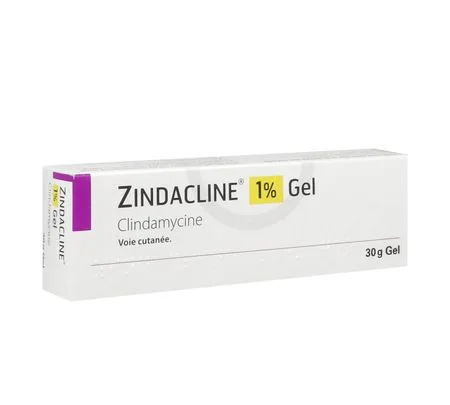
ZINDACLINE 1 %, gel
Composition
Clindamycin................................................................................................................................................1,000 g
In the form of clindamycin phosphate............................................................................................1,188 g
For 100 g.
Excipients with known effect: this medicine contains propylene glycol (40 % w/w) and ethanol (20 % w/w)
Ethanol at 96 per cent, zinc acetate dihydrate, sodium hydroxide at 30 per cent (p/p), hydroxyethylcellulose, propylene glycol, purified water.
Dosage and administration
Dosage
Adults and adolescents
Apply a thin layer of ZINDACLINE once daily on the affected surfaces. It is appropriate to assess the response to treatment after 6-8 weeks and the duration of treatment should not exceed 12 weeks.
Paediatric population
ZINDACLINE is not indicated in children aged less than 12 years.
Method of administration
Preparation for cutaneous use.
Contraindications
ZINDACLINE is contraindicated in patients with a history of hypersensitivity to the active substance, clindamycin, or to any excipient of the medicine. Although cross-sensitisation with lincomycin has not been demonstrated, it is recommended not to use ZINDACLINE in patients who have shown sensitivity to lincomycin.
Warnings and precautions
Like most antibiotics, clindamycin in oral and parenteral form has been responsible for serious pseudomembranous colitis. Topical clindamycin has been very rarely associated with pseudomembranous colitis. However, treatment should be immediately discontinued if diarrhoea occurs.
Studies have shown that one or more toxins produced by Clostridium difficile are the main cause of antibiotic-associated colitis. The colitis is usually characterised by severe and persistent diarrhoea and by abdominal cramps. If drug-induced colitis occurs, appropriate diagnostic and therapeutic measures (such as discontinuation of ZINDACLINE and, if necessary, initiation of antibiotic treatment with metronidazole or vancomycin) should be taken immediately.
Responses to treatment may only appear after 4 to 6 weeks.
Despite the low risk of systemic absorption after administration of ZINDACLINE, the possibility of occurrence of gastrointestinal adverse effects must be taken into account when considering prescribing the treatment to patients with a history of antibiotic-associated colitis, enteritis, haemorrhagic rectocolitis or Crohn's disease.
Prolonged use of clindamycin may cause resistance and/or proliferation of non-susceptible bacterial or fungal species, however, this possibility remains rare.
Cross-resistance may develop with other antibiotics, such as lincomycin and erythromycin. See section Interactions.
Avoid any contact with the eyes or nasal and buccal mucous membranes. In case of accidental contact with the eyes or mucous membranes, rinse the affected area abundantly with cold water.
This medicine contains 400 mg of propylene glycol per g equivalent to 40 % per tube. Propylene glycol may cause skin irritation.
This medicine contains 200 mg of alcohol (ethanol) per g equivalent to 20 % per tube. This may cause a burning sensation on damaged skin.
The irritant power of ZINDACLINE may be increased if the product is used under an occlusive dressing.
Interactions
An antagonism between erythromycin and clindamycin has been observed in vitro, while a synergy has been demonstrated with metronidazole. Both antagonistic and synergistic effects have been described with aminoglycosides.
Fertility, pregnancy and breastfeeding
No clinical data are available regarding the effects of clindamycin in cutaneous application during pregnancy. Data relating to a limited number of pregnant women who received clindamycin by other routes indicate the absence of adverse effects on pregnancy or on the health of the fetus/newborn. Studies conducted in animals have not identified any direct or indirect deleterious effect on gestation, embryonic/fetal development, delivery or postnatal development. Caution is nevertheless required if this product is prescribed to a pregnant woman.
Clindamycin is detected in breast milk after oral or parenteral administration. In humans, it is not known whether clindamycin is excreted in breast milk after the use of ZINDACLINE. As a general rule, patients should not breastfeed if they are taking a medicine since many medicines are excreted in breast milk.
Before prescribing it to a pregnant or breastfeeding woman, the potential benefits and risks of this product should be carefully weighed. The risk of sensitization or diarrhea occurring in the infant cannot be ruled out.
Adverse effects
Approximately 10 % of patients may develop an adverse effect. These adverse effects are typical of irritant dermatitis. The incidence of these adverse effects is likely to increase if the gel is used in excessive quantities. In case of irritation, the use of an emollient may be useful.
The adverse effects reported with ZINDACLINE during clinical trials are as follows:
• Common adverse effects: (> 1/100, < 1/10): Dry skin, erythema, burning sensation of the skin, irritation around the eyes, exacerbation of acne, pruritus.
• Uncommon adverse effects (> 1/1 000, < 1/100): Skin pain, scaly skin rashes.
Although no cases of severe diarrhea or pseudomembranous colitis have been reported in clinical trials with ZINDACLINE, and only a small proportion of clindamycin is absorbed percutaneously, pseudomembranous colitis has been very rarely reported with other topical products containing clindamycin. Therefore, there is a theoretical risk of pseudomembranous colitis with ZINDACLINE (see section Warnings and precautions).
Reporting of suspected adverse reactions
Reporting suspected adverse reactions after authorization of the medicinal product is important. It allows continued monitoring of the benefit/risk balance of the medicinal product. Healthcare professionals report any suspected adverse reaction via the national reporting system: Agence nationale de sécurité du médicament et des produits de santé (ANSM) and network of Regional Pharmacovigilance Centres - Website: https://signalement.social-sante.gouv.fr/.
Overdose
No cases of overdose are expected under normal conditions of use. Irritant dermatitis may appear when large quantities of ZINDACLINE are applied. The use of a suitable moisturizing cream may be beneficial in these cases. During subsequent applications, a thin layer of ZINDACLINE must be applied in accordance with the recommended posology (see section Dosage and administration).
Pharmacodynamics
Pharmacotherapeutic group: Topical anti-acne agent (Anti-infective), ATC code: D10A-F01.
ZINDACLINE contains clindamycin phosphate, which is hydrolyzed in the skin to clindamycin, the active substance. Clindamycin is an antibiotic of the lincosamide family that has a primarily bacteriostatic action against Gram-positive aerobic bacteria and a broad spectrum of anaerobic bacteria.
After cutaneous application of clindamycin phosphate, clindamycin is detected in comedone samples at levels sufficient to be active against most strains of Propionibacterium (P. acnes. There is thus a reduction in the number of P. acnes, one of the etiological factors of the pathology, on the surface of the skin and within the follicles.
As with any other antibiotic, prolonged use of clindamycin in cutaneous application may induce resistance.
Pharmacokinetics
The formulation of ZINDACLINE results in a decrease in the systemic absorption of clindamycin. A study in vitro conducted with ZINDACLINE on normal human skin showed that the in vitro absorption of radiolabeled clindamycin phosphate from the ZINDACLINE formulation represents less than 5% of the applied dose.
After cutaneous application of ZINDACLINE, in patients suffering from acne, at a dose of 8 g/day for 5 days, i.e. at rates largely exceeding the maximum expected clinical dose, a very small amount (median less than 2 ng/ml) of clindamycin is detected in plasma.
Clindamycin phosphate is metabolized to clindamycin (the active substance) in the skin and clindamycin itself is then metabolized, mainly in the liver, by N-demethylation, sulfoxidation and hydrolysis, and excreted mainly in the bile.
Preclinical safety
Preclinical data concerning clindamycin, based on conventional studies of safety pharmacology, repeated dose toxicity, genotoxicity or reproductive toxicity, have not revealed any particular risk for humans.
Prescription, supply and reimbursement
| Marketing Authorisation |
|
LES FJORDS – OSLO BUILDING 19 NORWAY AVENUE
91953 VILLEBON-SUR-YVETTE
Tel: 01 69 59 23 00 medipha@medipha-sante.fr
https://www.medipha-sante.fr/
Source: VIDAL · Updated on 10/11/2026. This information does not replace advice from a healthcare professional.