
Medicines
SmPC of 20/10/2026
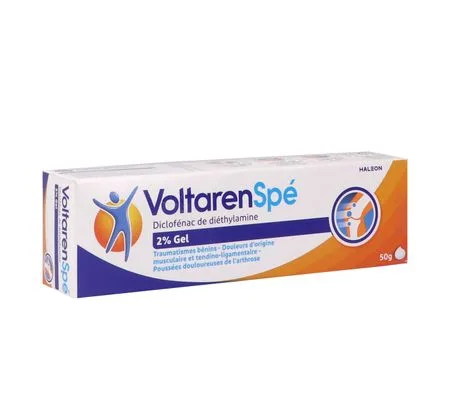
VOLTARENSPE 2 %, gel
Forms and presentations
Gel (homogeneous, white to almost white).
Tube containing 50 g of gel. Box of 1.
Composition
For 100 g of gel:
Diethylamine diclofenac: 2,32 g
Quantity corresponding to sodium diclofenac: 2,00 g
Excipients with known effect: Propylene glycol (E1520) (50 mg/g of gel), butylhydroxytoluene (E321) (0,2 mg/g of gel), linalool, D-limonene
Butylhydroxytoluene (E321), carbomers, cocoyl caprylocaprate, diethylamine, isopropyl alcohol, liquid paraffin, macrogol cetostearyl ether, oleic alcohol, propylene glycol (E1520), eucalyptus perfume*, purified water.
* composition of eucalyptus perfume: cineole, methyl dihydrojasmonate, racemic camphor, eucalyptus essential oil (Eucalyptus globulus), linalool, cetalox, racemic rose oxide, dipropylene glycol, laevo-borneol, caryophyllene, pine essential oil, terpineol, orange terpenes (D-limonene), alpha-pinene, elemi essential oil, camphene, C-9 acetate, linalool oxide
Indications
In adults (from 15 years of age):
- Short-term local treatment of minor trauma: sprain, contusion;
- Local adjunctive treatment of pain of muscular and tendino-ligamentous origin;
- Symptomatic treatment of painful flare-ups of osteoarthritis, after at least one medical opinion.
Dosage and administration
Dosage
Reserved for adults (from 15 years of age).
The dosage depends on the indication.
The occurrence of undesirable effects can be minimised by using the lowest possible dose for the shortest treatment duration necessary to relieve symptoms (see section Warnings and precautions).
- Minor trauma: sprain, contusion : 1 local application, 2 times a day (morning and evening), for a maximum duration of 4 days. If the pain persists beyond this, a doctor must be consulted. On medical advice, the maximum duration of treatment is 7 days. The dose administered at each application must not exceed 2,5 g of gel (i.e. approximately 6 cm of gel).
- Pain of muscular and tendinous-ligamentous origin : As adjunctive treatment: 1 local application, 2 times a day (morning and evening), for a maximum duration of 7 days. If the pain persists beyond this, a doctor must be consulted. On medical advice, the maximum duration of treatment is 14 days. The dose administered at each application must not exceed 2,5 g of gel (i.e. approximately 6 cm of gel).
- Painful flare-ups of osteoarthritis : Only after at least one medical opinion. 1 local application, 2 times a day (morning and evening), for a duration of 7 days. Treatment may be continued, if needed, for a maximum duration of 14 days. If the pain persists beyond this, a doctor must be consulted. The dose administered at each application must not exceed 4 g of gel (i.e. approximately 10 cm of gel).
Special populations
Paediatric population
VOLTARENSPE 2 %, gel is contraindicated in children under the age of 15 years (see section Contraindications).
Elderly patients
This medicine should be used with caution in elderly people who are more prone to adverse effects (see sections Warnings and precautions and Adverse effects).
Method of administration
Cutaneous use.
EXTERNAL USE. Apply the gel by gentle, prolonged massage over the painful or inflammatory area.
After application:
- Hands should be wiped with absorbent paper (for example), then washed, unless it is the site to be treated. The absorbent paper must be disposed of in the bin after use and not in the toilet, to prevent the product from reaching the wastewater network.
- If too large a quantity of gel is applied, the excess must be wiped off with absorbent paper.
- Before dressing or applying a non-occlusive bandage, it is advisable to let the gel dry for a few minutes on the skin.
- If patients need to shower or take a bath, they must apply the product afterwards.
Contraindications
This medicine is contraindicated in the following cases:
- Hypersensitivity to diclofenac, to substances of similar activity such as other NSAIDs, aspirin, or to any of the excipients mentioned in section Composition.
- Pregnancy, from the beginning of the 6th month (24 weeks of amenorrhoea) (see section Fertility, pregnancy and breastfeeding).
- Damaged skin, whatever the lesion: weeping dermatoses, eczema, infected lesion, burn or wound,
- History of asthma, angioedema, urticaria or acute rhinitis triggered by diclofenac or a substance with similar activity such as acetylsalicylic acid or other non-steroidal anti-inflammatory drugs (NSAIDs).
- In children and adolescents under 15 years of age.
Warnings and precautions
Special warnings
The occurrence of possible adverse effects similar to those observed with systemic diclofenac must be taken into account during prolonged use of VOLTARENSPE 2 %, gel at a dosage or for a duration greater than that recommended, or during use over a large skin surface.
In order to minimise the occurrence of adverse effects, it is recommended to use the minimum effective dose to control symptoms for the shortest possible period.
Do not apply to mucous membranes or to the eyes, do not ingest. Apply only to the painful area and to unbroken skin (see section Contraindications).
The appearance of a skin rash after application requires immediate discontinuation of treatment.
In order to reduce any risk of photosensitization, patients must be advised to avoid any exposure to solar radiation (sun or UV tanning booths).
Bronchospasm may occur in patients with bronchial asthma, allergic disease or allergy to acetylsalicylic acid or to another NSAID, or with a history of these conditions (see section Contraindications). In order to minimize the occurrence of adverse effects, it is recommended to use the minimum effective dose to control symptoms for the shortest possible period.
This medicine must not be used under an occlusive dressing.
VOLTARENSPE 2 %, gel should be used with caution in patients with a history of gastroduodenal ulcer, renal or hepatic insufficiency, hemorrhagic diathesis or intestinal inflammation; isolated cases have been reported with topical diclofenac.
This medicine contains propylene glycol (E1520) (50 mg/g of gel). It also contains butylhydroxytoluene (E321) (0,2 mg/g of gel), which may cause local skin reactions (for example contact dermatitis), or irritation of the eyes and mucous membranes.
This medicine contains a perfume containing d-limonene and linalool, which may cause allergic reactions. In addition to allergic reactions in sensitized patients, non-sensitized patients may become sensitized.
Special precautions for use
Given the insufficient data on safety and efficacy in children, diclofenac, administered as a gel, is reserved for adults and adolescents over 15 years of age.
Wearing gloves by the physiotherapist, in case of intensive use, is recommended.
Interactions
Due to the low systemic absorption during normal use of the gel, drug interactions reported for oral diclofenac are unlikely.
Fertility, pregnancy and breastfeeding
Pregnancy
There are no clinical data on the use of VOLTARENSPE 2 %, gel during pregnancy. Even though systemic exposure to VOLTARENSPE 2 %, gel following topical administration is lower compared to that observed after oral administration, the risk of possible harmful effects in the embryo or fetus is not known.
During the first 5 months of pregnancy, VOLTARENSPE 2 %, gel should not be used unless absolutely necessary. If used, the dose should be the lowest and the duration of treatment as short as possible.
From the beginning of the 6th months of pregnancy (24 weeks of amenorrhea), systemic use of prostaglandin synthesis inhibitors such as diclofenac may induce cardiopulmonary and renal toxicity in the fetus. At the end of pregnancy, prolonged bleeding time in the mother and child may occur, and labor may be delayed.
Consequently, any use of VOLTARENSPE 2 %, gel is contraindicated from the beginning of the sixth month of pregnancy (24 weeks of amenorrhea) (see section Contraindications).
Breast-feeding
As NSAIDs pass into breast milk, this medicine is not recommended for women who are breastfeeding.
In case of breastfeeding, this medicine must under no circumstances be applied to the breast.
Fertility
Like all NSAIDs, use of this medicinal product may temporarily impair female fertility by affecting ovulation; it is therefore not recommended in women wishing to conceive. In women having difficulty conceiving or undergoing fertility investigations, discontinuation of treatment should be considered.
Driving and using machines
VOLTARENSPE 2 %, gel has no effect on the ability to drive vehicles or use machines.
Adverse effects
Rare cases of allergic reactions at the application site may occur.
Adverse effects are classified according to the MedDRA system organ classification and by decreasing order of frequency with the following conventions: very common (≥ 1/10); common (≥ 1/100 to < 1/10); uncommon (≥ 1/1 000 to < 1/100); rare (≥ 1/10 000 to < 1/1 000); very rare (< 1/10 000), frequency not known (cannot be estimated from the available data).
Within each system organ class, adverse effects are presented in order of decreasing seriousness:
|
System organ class |
Adverse reaction |
Frequency |
|
Infections and infestations |
Pustular rash |
Very rare |
|
Immune system disorders |
Angioedema (Quincke's edema), hypersensitivity (including urticaria) |
Very rare |
|
Respiratory, thoracic and mediastinal disorders |
Asthma attack* |
Very rare |
|
Skin and subcutaneous tissue disorders |
Dermatitis (including contact dermatitis), skin rashes, erythema, eczema, pruritus. |
Common |
|
Bullous dermatitis |
Rare |
|
|
Photosensitivity reaction, purpura, ulcerations at the administration site |
Very rare |
|
|
Burning sensation at the application site
|
Not known |
* The occurrence of an asthma attack may be linked in some subjects to an allergy to aspirin or to an NSAID. In this case, VOLTARENSPE 2 %, gel is contraindicated.
Other systemic effects of NSAIDs : they depend on the transdermal passage of the active ingredient and therefore on the quantity of gel applied, the area treated, the degree of skin integrity, the duration of treatment and whether or not an occlusive dressing is used (digestive, renal effects).
Reporting of suspected adverse reactions
Reporting suspected adverse reactions after authorisation of the medicinal product is important. It allows continued monitoring of the benefit/risk balance of the medicinal product. Healthcare professionals are asked to report any suspected adverse reactions via the national reporting system: National Agency for the Safety of Medicines and Health Products (ANSM) and the network of Regional Pharmacovigilance Centres - Website: https://signalement.social-sante.gouv.fr/.
Overdose
As diclofenac is poorly absorbed through the skin, an overdose of this NSAID through topical application is unlikely. Nevertheless, in case of overdose, wipe with absorbent paper, then rinse thoroughly with water.
In case of accidental or intentional ingestion, clinical effects of oral diclofenac overdose may occur. The therapeutic measures required are those generally adopted for NSAID poisoning. The recommendations to follow will be those given by the regional Poison Control Centre, depending on the quantities ingested and the characteristics of the patient.
Pharmacodynamics
Pharmacotherapeutic class: NON-STEROIDAL ANTI-INFLAMMATORY DRUG FOR TOPICAL USE, ATC code: M02AA15.
Diclofenac is a non-steroidal anti-inflammatory drug (NSAID), derived from phenylacetic acid of the arylcarboxylic acid group, with analgesic, anti-inflammatory and antipyretic properties. As with all NSAIDs, the exact mechanism of action of diclofenac is not fully elucidated but rests essentially on inhibition of prostaglandin biosynthesis, substances playing a major role in the genesis of inflammation, pain and fever, through inhibition of both cyclooxygenases (COX-1 and COX-2).
In gel form, it has local anti-inflammatory and analgesic activity.
Pharmacokinetics
Absorption
The transdermal passage of the active ingredient is proportional to the treated surface area, the quantity of gel applied and the degree of skin hydration.
Applied locally in gel form, diclofenac is absorbed through the skin.
After repeated administration, the systemic passage of diclofenac gel dosed at 2,32 % (2 applications per day) is equivalent to that of the gel dosed at 1,16 % (4 applications per day), for cutaneous application to a surface of approximately 400 cm2. The relative bioavailability of diclofenac gel 2,32 % (AUC ratio) compared with that of the oral form is 4,5 % on day 7 (for an equivalent dose of diclofenac sodium). Absorption was not modified by a dressing permeable to moisture and vapour.
VOLTARENSPE 2 %, gel contains a penetration enhancer (oleic alcohol at 0,75 %). In an in vitro study of penetration through the skin barrier, this formulation was compared with diethylamine diclofenac at 1,16 g/100 g in gel form, both applied at 20 mg/cm2 in a single dose. The results demonstrated a cumulative skin permeability of diclofenac approximately 3 times higher for VOLTARENSPE 2 %, gel (6,11 ± 1,27 μg/cm2) than for diclofenac at 1,16/100 g (2,07 ± 0,38 μg/cm2) after 24 hours. These results were confirmed in another in vitro study.
Distribution
Diclofenac is 99,7 % bound to serum proteins, mainly to albumin (99,4 %).
Concentrations were measured in plasma, synovial fluid and synovial tissue after topical administration at the knee and hand joints. The maximum plasma concentrations are approximately 100 times lower than those after taking the same amount orally.
Diclofenac accumulates in the skin, acting as a reservoir from which the drug is released over a prolonged period into the underlying tissues. From the skin and underlying tissues, diclofenac is distributed preferentially to deep inflamed tissues (such as the joint) rather than to the blood circulation.
Concentrations measured in synovial fluid, as well as in synovial tissue, are 20 times higher than plasma concentrations.
Metabolism
Biotransformation of diclofenac occurs mainly by single or multiple hydroxylation followed by glucuronoconjugation, or by glucuronoconjugation of the intact molecule.
Elimination
Diclofenac and its metabolites are mainly excreted in the urine.
The total systemic plasma clearance of diclofenac is 263 ± 56 ml/min (mean ± standard deviation), the terminal plasma half-life is 1 to 2 hours. Four of the metabolites, including the two active ones, also have a short plasma half-life of 1 to 3 hours. One of the metabolites, 3'-hydroxy-4'-methoxy-diclofenac, has a markedly longer half-life, but this metabolite is practically inactive.
Characteristics in certain patient groups
No accumulation of diclofenac and its metabolites is expected in patients with renal impairment. In patients with chronic hepatitis or non-decompensated cirrhosis, the kinetics and metabolism of diclofenac are the same as in patients without hepatic impairment.
Preclinical safety
Acute toxicity, repeated-dose toxicity, genotoxicity and carcinogenicity studies revealed no risk associated with the use of diclofenac at therapeutic doses in humans. No teratogenic potential of diclofenac was detected in mice, rats or rabbits. Diclofenac had no effect on fertility in rats; the prenatal, perinatal and postnatal development of the offspring was not affected.
Studies have demonstrated that diclofenac diethylamine 2,32 g/100 g in gel form is well tolerated. No phototoxic potential was observed with diclofenac diethylamine 2,32 g/100 g in gel form, and the latter does not cause skin sensitisation.
Prescription, supply and reimbursement
| Marketing authorisation (AMM) |
|
HALEON FRANCE
23, rue François-Jacob
92500 Rueil-Malmaison
Source: VIDAL · Updated on 11/11/2026. This information does not replace advice from a healthcare professional.