
Medicines
SmPC of 16/01/2025
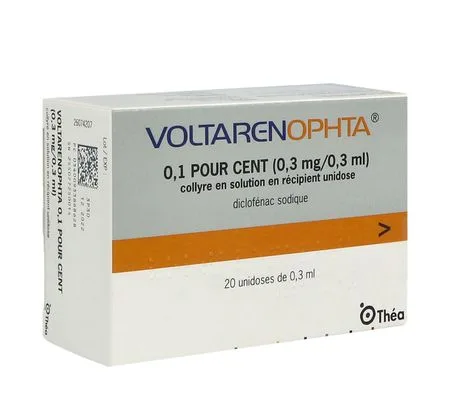
VOLTARENOPHTA 0,1 PERCENT (0,3 mg/0,3 ml), eye drops in solution in single-dose container
Forms and presentations
Eye drops in solution.
Single-dose container containing 0,3 ml of solution. Box of 20.
Composition
For a single-dose container:
Diclofenac sodium: 0,3 mg
Excipients with known effect : polyoxyethylated castor oil (CREMOPHOR EL) (15,0 mg/0,3 ml)
Polyoxyethylated castor oil (CREMOPHOR EL), tromethamine, boric acid, water for injectable preparations.
Indications
- Inhibition of miosis during cataract surgery.
- Prevention of inflammatory manifestations associated with surgical procedures for cataract and anterior segment of the eye.
- Treatment of ocular pain associated with photorefractive keratectomy during the first 24 hours post-operatively.
Dosage and administration
Dosage
In adults
Inhibition of miosis during cataract surgery and prevention of inflammatory manifestations associated with cataract and anterior segment surgical procedures of the eye:
- pre-operatively: up to 5 times 1 drop within the 3 hours preceding the procedure;
- post-operatively: 3 times 1 drop immediately after the end of the procedure, then 3 to 5 times 1 drop per day, for as long as necessary.
Treatment of ocular pain associated with photorefractive keratectomy during the first 24 hours post-operatively:
- pre-operatively: 2 drops within the hour preceding the operation;
- post-operatively: 2 drops within the hour following the operation, then 4 drops within the 24 hours following the operation.
In children
No specific study has been performed.
Method of administration
Ophthalmic use.
Instil one drop of eye drops into the lower conjunctival sac of the eye to be treated while looking upward and gently pulling the lower eyelid downward.
The contents of the single-dose container remain sterile until first opening. The single-dose container must be discarded immediately after use and unused contents of single-dose containers must not be stored.
In case of concomitant treatment with another eye drop, wait at least 15 minutes between the two instillations.
After instillation of the eye drops, systemic absorption may be reduced by lacrimal punctal occlusion or by closing the eyelids for 5 minutes. This method may help reduce systemic adverse effects and increase local activity.
Contraindications
This medicine is contraindicated in cases of:
- hypersensitivity to diclofenac or to any of the excipients of the product mentioned in the section Composition,
- history of allergy or asthma triggered by taking diclofenac or substances with similar activity such as aspirin or other non-steroidal anti-inflammatory drugs (NSAIDs), substances that inhibit prostaglandin synthesis.
Warnings and precautions
Precautions for use
- Do not inject, do not swallow.
- The eye drops must not be administered by peri- or intraocular injection.
- Patients with asthma associated with chronic rhinitis, chronic sinusitis and/or nasal polyposis have a higher risk of allergic manifestations when taking aspirin and/or non-steroidal anti-inflammatory drugs than the rest of the population.
- The administration of this eye drop may cause an asthma attack, especially in certain patients allergic to aspirin or to an NSAID (see section Contraindications).
- In the event of hypersensitivity reactions such as itching and redness, or signs suggestive of allergy to this medicine, in particular an asthma attack or sudden swelling of the face and neck, treatment must be discontinued.
- This medicine contains castor oil and may cause severe allergic reactions (for example: eczema).
- In case of infection risk or in the presence of infection, appropriate treatment must be prescribed.
- During treatment with VOLTARENOPHTA, wearing contact lenses is not recommended.
- In case of concomitant treatment with another eye drop, to avoid dilution of the active ingredients, space instillations by 15 minutes.
- Do not touch the eye with the tip of the single-dose container.
- The single-dose container must be discarded immediately after use and must not be kept for reuse during subsequent administrations.
Interactions
The combination of a topical NSAID with a topical corticosteroid could increase the risk of developing corneal complications. Therefore, precautions must be taken.
The effectiveness of an eye drop may be affected by the simultaneous instillation of another eye drop (see section Warnings and precautions).
Fertility, pregnancy and breastfeeding
Pregnancy
There is no clinical data concerning the use of VOLTARENOPHTA during pregnancy. Even though systemic exposure to VOLTARENOPHTA after topical administration is lower compared to that observed following oral administration, the risk of possible harmful effects in the embryo or foetus is not known.
During the first 5 months of pregnancy (before 24 weeks of amenorrhoea), VOLTARENOPHTA must not be used unless absolutely necessary. If used, the dose must be the lowest and the duration of treatment as short as possible.
From the 6th month of pregnancy (24 weeks of amenorrhoea), systemic use of prostaglandin synthesis inhibitors such as VOLTARENOPHTA may induce cardiopulmonary and renal toxicity in the foetus. At the end of pregnancy, prolonged bleeding time in the mother and child may occur, and labour may be delayed. VOLTARENOPHTA is therefore not recommended from the 6th month of pregnancy.
Breast-feeding
As NSAIDs pass into breast milk, this medicine is not recommended for women who are breastfeeding.
Fertility
Like all NSAIDs, use of this medicinal product may temporarily impair female fertility by affecting ovulation; it is therefore not recommended in women wishing to conceive. In women having difficulty conceiving or undergoing fertility investigations, discontinuation of treatment should be considered.
Driving and using machines
Possibility of blurred vision related to instillation of the eye drop. In this case, driving vehicles or using machines should be avoided until symptoms stop.
Adverse effects
Adverse reactions identified after marketing are listed below. The frequency category corresponding to these adverse reactions is not known and cannot be estimated from available data.
Eye disorders
Very common: ocular pain
Unknown frequency:
Transient, mild to moderate sensation of eye irritation, eye itching, eye hyperaemia, and transient blurred vision immediately after instillation.
Punctate keratitis or other corneal disorders have been observed: thinning, oedema, corneal ulcers, corneal epithelium abnormalities that could become sight-threatening, have been reported, especially in at-risk patients such as those using corticosteroids or those with concomitant disease such as rheumatoid arthritis or infections.
Most patients had been treated for a prolonged period of time.
Respiratory, thoracic and mediastinal disorders
Unknown frequency:
Dyspnoea and exacerbated asthma.
Allergic reactions such as: conjunctival hyperaemia, allergic conjunctivitis, eyelid oedema, urticaria, rash, contact eczema, erythema, pruritus, cough and rhinitis, photosensitivity.
Reporting of suspected adverse reactions
Reporting suspected adverse reactions after authorisation of the medicinal product is important. It allows continued monitoring of the benefit/risk balance of the medicinal product. Healthcare professionals are asked to report any suspected adverse reactions via the national reporting system: National Agency for the Safety of Medicines and Health Products (ANSM) and the network of Regional Pharmacovigilance Centres - Website: https://signalement.social-sante.gouv.fr/.
Overdose
There have been no cases of overdose with VOLTARENOPHTA. However, unintentional oral ingestion carries a minimal risk of adverse effects since a single-dose unit of 0,3 ml contains only 0,3 mg of diclofenac sodium, corresponding to 0,2 % of the recommended maximum daily dose.
Pharmacodynamics
Pharmacotherapeutic class: NON-STEROIDAL ANTI-INFLAMMATORY for local use, cATC code: S01BC03 (S = sensory organs).
Diclofenac sodium is an inhibitor of prostaglandin synthetase.
Pharmacokinetics
In rabbits, peak maximum concentrations of labelled diclofenac appear, both in the conjunctiva and in the cornea, 30 minutes after instillation; elimination is rapid and practically complete after 6 hours.
In humans, penetration of diclofenac into the anterior chamber has been demonstrated.
After ocular administration, plasma levels of diclofenac are not measurable.
Preclinical safety
Toxicity studies after single and repeated administration, mutagenesis and carcinogenesis studies did not reveal any particular toxic risk.
Regarding reproduction studies, in rats, doses toxic to the mother were associated with dystocia, prolonged gestation, decreased foetal survival and delayed uterine development.
No effect was observed in local tolerance studies with the various formulations of VOLTARENOPHTA.
Special storage precautions
Store at a temperature not exceeding 25 °C.
Do not store the single-dose unit after opening.
SPECIAL PRECAUTIONS FOR DISPOSAL AND OTHER HANDLING
For proper use of the eye drops, certain precautions must be taken.
Wash hands thoroughly before proceeding with instillation.
Avoid contact of the tip with the eye or eyelids.
Instil one drop of eye drops into the lower conjunctival sac of the eye to be treated while looking upward and gently pulling the lower eyelid downward.
Discard the single-dose unit immediately after use and do not store it after opening for later use.
Source: VIDAL · Updated on 11/11/2026. This information does not replace advice from a healthcare professional.