
Medicines
SmPC of 12/01/2024
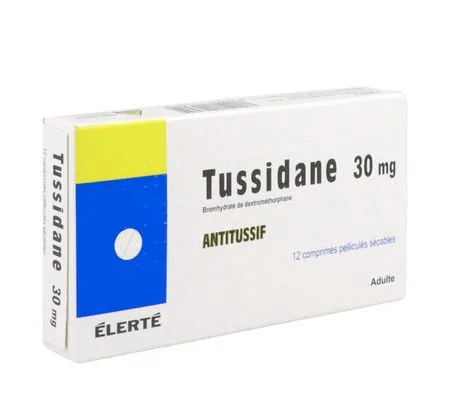
TUSSIDANE 30 mg, scored film-coated tablet
Composition
Dextromethorphan hydrobromide.................................................................................................................... 30,00 mg
For one scored film-coated tablet.
Microcrystalline cellulose, anhydrous colloidal silica, magnesium stearate, maize starch.
Film coating : basic butylated methacrylate copolymer (solution at 12,5 per cent), talc, titanium dioxide (E171), magnesium stearate, macrogol 6000.
Indications
Short-term treatment of dry and irritative coughs in adults and adolescents over 15 years of age.
Dosage and administration
Dosage
Oral use
FOR ADULTS AND ADOLESCENTS OVER 15 YEARS OF AGE
In adults, the unit dose of dextromethorphan hydrobromide is 15 to 30 mg, the maximum daily dose is 120 mg.
The usual dosage of dextromethorphan is 1/2 tablet to 1 tablet 3 to 4 times a day, not exceeding 4 tablets per day.
In elderly subjects or in cases of hepatic impairment: the initial dosage will be halved compared with the recommended dosage, and may be increased if necessary depending on tolerance and needs.
The duration of treatment should not exceed 5 days without medical advice.
Method of administration
Treatment should be limited to the times when the cough occurs, without exceeding the recommended doses.
The tablets are to be swallowed with a glass of water.
Contraindications
This medicine is contraindicated in the following situations:
• Hypersensitivity to the active substance or to any of the components of the tablet (see section Composition).
• Respiratory insufficiency.
• Cough in asthmatics.
• Combination with cinacalcet or with irreversible MAOI-type antidepressants (see section Interactions).
• Child under 15 years.
• Breastfeeding.
Warnings and precautions
Special warnings
Productive coughs, which are a fundamental element of bronchopulmonary defence, are to be respected.
It is illogical to combine an expectorant or a mucolytic with an antitussive.
Before prescribing an antitussive treatment, it is advisable to ensure that the causes of the cough that require specific aetiological treatment have been investigated.
If the cough persists despite an antitussive given at the usual dose, the doses should not be increased; instead, the clinical situation should be re-examined.
Taking this medicine is not recommended with reversible MAO-A inhibitors, including linezolid and methylene blue, or with sodium oxybate (see section Interactions).
Taking alcohol (drinks or as an excipient) is not recommended (see section Interactions).
Dextromethorphan may cause hallucinations at supratherapeutic doses. Cases of abuse of dextromethorphan for recreational and hallucinogenic purposes, sometimes in combination with alcohol, have been reported. Caution is particularly recommended in adolescents and young adults, as well as in patients with a history of abuse of medicines or psychoactive substances. The occurrence in these patients of signs or symptoms suggesting misuse or diversion of dextromethorphan should be closely monitored.
Dextromethorphan is metabolised by the hepatic cytochrome P450 2D6. The activity of this enzyme is genetically determined. About 10% of the general population are slow metabolisers of CYP2D6. Slow metabolisers and patients who concomitantly use CYP2D6 inhibitors may show exacerbated and/or prolonged effects of dextromethorphan. Caution is therefore required in patients who are slow metabolisers of CYP2D6 or who concomitantly take CYP2D6 inhibitors (see also section Interactions).
Precautions for use
In cases of hepatic insufficiency, the initial dosage will be reduced by 50 % and may possibly be increased by a quarter, depending on tolerance and needs.
Interactions
Sedative medicinal products
It must be taken into account that many medicines or substances can add up their central nervous system depressant effects and contribute to decreased alertness. These include morphine derivatives (analgesics, antitussives and substitution treatments), neuroleptics, barbiturates, benzodiazepines, anxiolytics other than benzodiazepines (for example, meprobamate), hypnotics, sedative antidepressants (amitriptyline, doxepin, mianserin, mirtazapine, trimipramine), sedative H1 antihistamines, centrally acting antihypertensives, baclofen and thalidomide.
Contraindicated combinations (see section Contraindications)
+ Irreversible MAOIs
Risk of serotonin syndrome: diarrhoea, tachycardia, sweating, tremors, confusion or even coma.
+ Cinacalcet
Very large increase in plasma concentrations of dextromethorphan with risk of overdose, due to decreased hepatic metabolism of it by cinacalcet.
Contraindicated combinations (see section Warnings and precautions)
+ reversible MAO-A inhibitors, linezolid and methylene blue
Risk of serotonin syndrome: diarrhoea, tachycardia, sweating, tremors, confusion or even coma.
+ Alcohol (beverage or excipient)
Alcohol increases the sedative effect of dextromethorphan. Impaired alertness may make driving vehicles and using machinery dangerous.
Avoid taking alcoholic beverages and other medicines containing alcohol.
+ Sodium oxybate
Increased central depression. Impaired alertness may make driving vehicles and using machines dangerous.
Associations to be taken into account
+ Other sedative medicines (see introductory paragraph)
Increased central depression. Impaired alertness may make driving vehicles and using machines dangerous.
+ Agonist morphine-type analgesics
Increased risk of respiratory depression, which may be fatal in the event of overdose.
+ Methadone
Increased risk of respiratory depression, which may be fatal in the event of overdose.
+ Barbiturates, benzodiazepines and related drugs
Increased risk of respiratory depression, which may be fatal in the event of overdose.
+ CYP2D6 inhibitors
Dextromethorphan is metabolised by CYP2D6 and undergoes significant first-pass metabolism. Concomitant use of potent inhibitors of the enzyme CYP2D6 may increase blood concentrations of dextromethorphan several times above normal. This results in an increased risk of occurrence of undesirable effects of dextromethorphan (agitation, confusion, tremors, insomnia, diarrhoea and respiratory distress) and of onset of a serotonergic syndrome. Potent inhibitors of CYP2D6 include fluoxetine, paroxetine, quinidine and terbinafine. With concomitant administration with quinidine, plasma concentrations of dextromethorphan increased up to 20-fold, leading to an increase in the occurrence of undesirable effects of dextromethorphan at the central nervous system level. Amiodarone, flecainide and propafenone, sertraline, bupropion, methadone, cinacalcet, haloperidol and perphenazine also exert similar effects on the metabolism of dextromethorphan. If concomitant administration of CYP2D6 inhibitors and dextromethorphan cannot be avoided, the patient must be monitored and it may be necessary to reduce the dose of dextromethorphan.
Fertility, pregnancy and breastfeeding
Pregnancy
Although dextromethorphan has been widely used for many years, the clinical data available on its use during pregnancy are limited. There is no reliable data on teratogenesis in animals (see section Preclinical safety).
However, administration of centrally acting antitussives at the end of pregnancy, at high doses, even in short-term treatment, may result in respiratory depression in the newborn.
During the last three months of pregnancy, chronic intake of dextromethorphan by the mother, regardless of the dose, may cause withdrawal syndrome in the newborn.
Consequently, occasional use of dextromethorphan should be considered during pregnancy only if necessary.
Breast-feeding
Dextromethorphan and its active metabolite (dextrorphan) pass into breast milk. The dose observed in the breastfed infant corresponds to less than 1% of the dose of dextromethorphan administered to the mother. A few cases of hypotonia and respiratory pauses have been described in infants following ingestion by mothers of other centrally acting antitussives at supra-therapeutic doses.
Consequently, taking this medicine is contraindicated during breastfeeding.
Fertility
Animal studies have not shown any impact on fertility (see section Preclinical safety). There are no data on the effects of dextromethorphan on fertility in humans.
Driving and using machines
Attention is drawn, particularly to vehicle drivers and machine operators, to the risks of drowsiness and dizziness associated with the use of this medicine.
Adverse effects
Possible drowsiness, dizziness, nausea, vomiting, constipation, allergic reactions such as pruritic rash, urticaria, Quincke's edema, exceptionally, bronchospasm.
Cases of abuse for recreational and hallucinogenic purposes have been reported, particularly in adolescents and young adults as well as in patients with a history of medicine or psychoactive substance abuse (see section Warnings and precautions).
Reporting of suspected adverse reactions
Reporting suspected adverse reactions after authorisation of the medicinal product is important. It allows continued monitoring of the benefit/risk balance of the medicinal product. Healthcare professionals are asked to report any suspected adverse reaction via the national reporting system: National Agency for the Safety of Medicines and Health Products (ANSM) and the network of Regional Centres of Pharmacovigilance - Website: https://signalement.social-sante.gouv.fr/.
In addition, healthcare professionals report any cases of abuse or serious drug dependence via the national reporting system: National Agency for the Safety of Medicines and Health Products (ANSM) and the network of Centres for Evaluation and Information on Drug Dependence (CEIP) - Website: https://signalement.social-sante.gouv.fr/.
Overdose
Clinical
The symptoms observed in cases of acute overdose are mainly related to action on NMDA receptors; an anticholinergic or opioid syndrome is possible.
These symptoms include: nausea and vomiting, tachycardia and arterial hypertension, urinary retention, mydriasis and accommodation disorders, neuropsychiatric signs: vertigo, ataxia, hallucinations, nystagmus, drowsiness, confusion, agitation, hyperexcitability and hypertonia.
Severe overdoses may lead to convulsions, hyperthermia, coma and respiratory depression.
Treatment
In case of acute overdose, immediate hospital monitoring is recommended with, if necessary, symptomatic treatment, for example:
• benzodiazepines in case of convulsions;
• intravenous naloxone in case of respiratory depression.
Activated charcoal may be administered in the absence of contraindication, ideally within one hour of ingestion.
Gastric lavage should not be performed because of possible hypoxia during the procedure, increasing the risk of convulsions.
Cases of abuse for recreational purposes have been reported particularly in adolescents and young adults and in patients with a history of medicine or psychotropic substance abuse (see section Warnings and precautions.).
Pharmacodynamics
Pharmacotherapeutic class: ANTITUSSIVES, EXCEPT COMBINATIONS WITH EXPECTORANTS, OPIUM ALKALOIDS AND DERIVATIVES, ATC code: R05DA09.
Morphinic antitussive derivative with central action. At therapeutic doses, it does not cause depression of the respiratory centres; on the other hand, it may cause tolerance, abuse and dependence.
Pharmacokinetics
Dextromethorphan is well absorbed from the digestive tract. It is partially metabolised in the liver and excreted in unchanged form or as a demethylated metabolite.
After oral administration, dextromethorphan undergoes rapid and extensive first-pass hepatic metabolism. In healthy volunteers, the predominant metabolic pathway observed is O-demethylation via CYP2D6, whose level of activity depends on genotype.
Different oxidation phenotypes have been observed, causing significant interindividual variability in pharmacokinetics. Unmetabolised dextromethorphan, together with the three demethylated morphinan metabolites, dextrorphan (also referred to as 3-hydroxy-N-methylmorphinan), 3-hydroxymorphinan and 3-methoxymorphinan, have been identified as conjugated products in urine.
Dextrorphan, which also exerts an antitussive action, is the main metabolite. Some subjects have slowed metabolism leading to prolonged presence of unchanged dextromethorphan in blood and urine.
Preclinical safety
In rats, no effect on fertility was shown in a study carried out with a dextromethorphan/quinidine combination up to the maximum dose corresponding to a dextromethorphan intake of 50 mg/kg/day (i.e. 3,6 times the maximum therapeutic dose based on body surface area).
Prescription, supply and reimbursement
| Marketing authorisation (AMM) |
|
| Price: |
|
Collection.
181-183 RUE ANDRÉ KARMAN
93300 AUBERVILLIERS CEDEX
Tel: 01 48 34 75 03 laboratoire-elerte@orange.fr
https://www.elerte.fr/
Source: VIDAL · Updated on 11/11/2026. This information does not replace advice from a healthcare professional.