
Medicines
Update of 27/07/2026
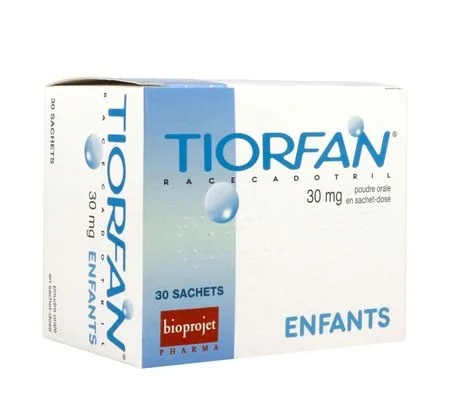
TIORFAN® oral powder in sachet-dose 30 mg Children, 10 mg Infants
racecadotril
Forms and presentations
Oral powder for children at 30 mg (white, with a characteristic apricot odour): 3 g of powder in sachet-dose (PE/Paper/Aluminium), box of 30.Oral powder for infants at 10 mg (white, with a characteristic apricot odour): 1 g of powder in sachet-dose (PE/Paper/Aluminium), box of 16.
Composition
| Children's powder 30 mg: | per sachet-dose |
| Racecadotril
|
30 mg |
| Infant powder 10 mg: | per sachet-dose |
| Racecadotril
|
10 mg |
Excipient with known effect: sucrose (2,9 g per child sachet 30 mg; 966,5 mg per infant sachet 10 mg), sorbitol (0,2 mg per infant sachet 10 mg).
Indications
In addition to oral rehydration and dietary measures, symptomatic treatment of acute diarrhoea in children and infants.The importance of rehydration with oral rehydration solution or by intravenous route must be adapted according to the intensity of the diarrhoea, the age and the particularities of the child (associated diseases...).
Dosage and administration
Oral use.
Tiorfan 30 mg is indicated in children weighing greater than or equal to 13 kg.
Tiorfan 10 mg is indicated in infants from one month and weighing less than 13 kg.
DosageThe usual daily dosage is established according to body weight on the basis of 1,5 mg/kg per dose, up to a maximum of three doses distributed over the day.
In practice:
Number of sachet(s) per dose according to the body weight of the child or infant:
| Age | Number of sachets |
| Infant weighing less than 9 kg | 1 sachet of 10 mg, 3 times per day |
| Infant weighing 9 to 13 kg | 2 sachets of 10 mg, 3 times per day |
| Child weighing 13 to 27 kg | 1 sachet of 30 mg, 3 times per day |
| Child weighing more than 27 kg | 2 sachets of 30 mg, 3 times per day |
Method of administration:
The powder may be mixed either into food or into a glass of water or a feeding bottle, stirring well and having the entire mixture swallowed immediately.
On the first day: an initial dose straight away, then depending on the time of the first dose, up to a maximum of three doses spread over the day, counting the initial dose straight away as one of these three doses. Doses should preferably be taken at the start of the three main meals.
Following days: three doses spread over the day, preferably at the start of the three main meals.
The maximum daily dose is three doses.
Treatment will be continued until two consecutive formed stools are passed, without exceeding 7 days.
Special populations:
No study has been conducted in infants under 3 months of age.
No study has been conducted in children and infants suffering from hepatic or renal impairment (see Warnings and Precautions for Use).
Contraindications
- Hypersensitivity to the active substance or to any of the excipients listed in section Composition.
Warnings and precautions
Treatment with Tiorfan is only an adjuvant therapy, in addition to oral rehydration, and in no case replaces it. Rehydration must be systematic in infants/children presenting with acute diarrhoea, in order to prevent or treat dehydration, and must be adapted so as to compensate for hydroelectrolytic losses.
The treatment of acute diarrhoea in children is essentially based on correcting water and electrolyte losses by using oral rehydration solutions and early refeeding, the modalities of which depend on the child's age and the type of diet prior to the diarrhoea.
In cases of severe or prolonged diarrhoea, significant vomiting or refusal to feed, intravenous rehydration should be considered.
The presence of blood or pus in the stools with fever may be a sign of diarrhoea caused by an invasive pathogen or of other ongoing diseases. In cases of infectious diarrhoea with clinical manifestations suggesting an invasive process, use antibacterials with good systemic diffusion.
Racecadotril has not been evaluated in diarrhoea associated with antibiotics. Therefore, racecadotril must not be used in these cases.
Due to potentially reduced bioavailability, racecadotril should not be administered in cases of prolonged or uncontrollable vomiting.
Renal and hepatic impairment:
In cases of renal or hepatic impairment, Tiorfan should not be administered due to the absence of data.
Excipients:
This medicine contains sucrose. Patients with fructose intolerance, glucose-galactose malabsorption syndrome or sucrase/isomaltase deficiency (rare hereditary diseases) must not take this medicine.
This medicine contains 2,899 g of sucrose per sachet (oral powder for children) or approximately 0,966 g of sucrose per sachet (oral powder for infants). If the amount of sucrose (a source of glucose and fructose) in the daily dose of this medicine exceeds 5 g per day, this must be taken into account in the daily sugar allowance in cases of a low-sugar diet or diabetes.
This medicine contains 0,2 mg of sorbitol per sachet (oral powder for infants).
Hypersensitivity:
Skin reactions have been reported with the use of this medicine. In most cases, these reactions are mild and do not require any treatment. However, in some situations, these reactions may be severe and life-threatening; a link with the intake of racecadotril cannot be entirely ruled out. If severe skin reactions occur, treatment with racecadotril must be stopped immediately.
Cases of hypersensitivity and Quincke's oedema have been reported in patients treated with racecadotril. These events may occur at any time during treatment.
Angioedema of the face, extremities, lips, and mucous membranes may occur.
When angioedema is associated with obstruction of the upper airways, such as at the level of the tongue, glottis and/or larynx, emergency treatment must be administered immediately.
Racecadotril must be discontinued and the patient must be subject to close medical monitoring with initiation of appropriate follow-up until complete and lasting disappearance of symptoms. Racecadotril must not be reintroduced.
Bradykinin-mediated angioedema:
Racecadotril or certain therapeutic classes are likely to cause a vascular reaction of the angioedema type affecting the face and neck, resulting from inhibition of the degradation of bradykinin (see Undesirable effects).
The consequences of angioedema may sometimes be fatal, due to airway obstruction. Angioedema may occur independently of a simultaneous combination of these medicines, in case the patient had previously been exposed to one of the two agents. The history of occurrence of this effect should be investigated and the need for this type of combination should be weighed.
The combination of racecadotril with certain medicines that increase bradykinin concentration, in particular angiotensin-converting enzyme (ACE) inhibitors (e.g.: perindopril and ramipril), increases the risk of bradykinin-mediated angioedema (see Interactions).
Therefore, a rigorous assessment of the benefit/risk ratio is necessary before initiating treatment with racecadotril in patients taking angiotensin-converting enzyme inhibitors (see Interactions).
Severe cutaneous adverse reactions (SCAR):
Severe cutaneous adverse reactions (SCAR), including drug reaction with eosinophilia and systemic symptoms (DRESS), which may be life-threatening or fatal, have been reported with racecadotril treatment. Patients should be informed of the signs and symptoms and closely monitored for skin reactions. If signs and symptoms suggestive of DRESS appear, racecadotril must be stopped immediately and an alternative treatment considered. If DRESS develops in a patient during administration of racecadotril, treatment with racecadotril must under no circumstances be resumed in this patient.
Interactions
Combination not recommended :
Bradykinin-related medicines and angioedema
Certain medicines or therapeutic classes are likely to cause a vascular reaction of the angioedema type affecting the face and neck, resulting from inhibition of the degradation of bradykinin. The medicines most frequently involved are ACE inhibitors (e.g.: perindopril, ramipril), and to a lesser extent angiotensin II receptor antagonists (e.g.: candesartan, irbesartan), so-called mTOR inhibitor immunosuppressants, gliptin-class antidiabetic agents, racecadotril, estramustine, sacubitril and recombinant alteplase.
The consequences of angioedema may sometimes be fatal, due to airway obstruction. Angioedema may occur independently of a simultaneous combination of these medicines, in case the patient had previously been exposed to one of the two agents. The history of occurrence of this effect should be investigated and the need for this type of combination should be weighed.
Association not recommended (see also Warnings and Precautions for use)
+ Other medicines at risk of bradykinin-mediated angioedema (see the section "Medicines, bradykinin and angioedema")
+ Others
Concomitant intake of racecadotril with loperamide or nifuroxazide does not modify the pharmacokinetics of racecadotril.
Fertility, pregnancy and breastfeeding
Pregnancy:Animal studies have shown no direct or indirect harmful effects regarding reproductive toxicity. Clinical data on the use of racecadotril during pregnancy are very limited. Consequently, as a precaution, it is preferable to avoid using Tiorfan during pregnancy, whatever the stage of pregnancy.
Breastfeeding:
In the absence of data on the passage of racecadotril into milk and because of its pharmacological properties and the immaturity of the digestive tract of the newborn, Tiorfan should not be administered during breastfeeding.
Fertility:No effect on fertility was observed in fertility studies conducted in male and female rats.
Driving and using machines
Racecadotril has no or negligible influence on the ability to drive vehicles and use machines.Adverse effects
Clinical trials conducted during acute diarrhoea provided safety data in 860 infants and children treated with racecadotril and 441 treated with placebo.
The adverse effects listed below were observed more frequently with racecadotril than with placebo during clinical trials, or were reported during the marketing period.
Adverse effects are listed according to the main MedDRA system organ classes. Within each system organ class, adverse effects are presented by frequency. Within each frequency group, adverse effects are presented in order of decreasing seriousness. The frequency of adverse effects was defined according to the following convention: very common (> 1/10); common (> 1/100 to < 1/10); uncommon (> 1/1000 to < 1/100); rare (> 1/10 000 to < 1/1000); very rare (< 1/10 000); frequency not known (cannot be estimated from the available data).
Serious cutaneous adverse reactions (SCARs), including drug reaction with eosinophilia and systemic symptoms (DRESS), have been reported with treatment with racecadotril (see Warnings and Precautions for Use).
| System Organ Classes | Frequency | Adverse reaction |
| Skin and subcutaneous tissue disorders (see Warnings and Precautions for Use) | Uncommon | Rash, erythema. |
| Frequency not known | Urticaria, angioedema, oedema of the tongue, face, lip, eyelid, erythema multiforme, erythema nodosum, papular rash, pruritus, prurigo, drug reaction with eosinophilia and systemic symptoms (DRESS) syndrome | |
| Immune system disorder | Frequency not known | Anaphylactic shock |
Reporting suspected adverse reactions after authorisation of the medicinal product is important. It allows continuous monitoring of the benefit/risk balance of the medicinal product. Healthcare professionals should report any suspected adverse reaction via the national reporting system: National Agency for the Safety of Medicines and Health Products (ANSM) and the network of Regional Pharmacovigilance Centres. Website: https://signalement.social-sante.gouv.fr.
Overdose
In the reported cases of overdose, patients did not present any adverse effects.
Pharmacodynamics
Pharmacotherapeutic class: Other antidiarrhoeals (intestinal antisecretory agent). ATC code: A07XA04 (A: alimentary tract and metabolism).
Racecadotril is a prodrug that must be hydrolysed into its active metabolite, thiorphan, which is an inhibitor of enkephalinase, a cell membrane enzyme present in various tissues, including the intestinal epithelium.
This enzyme contributes to the hydrolysis of exogenous and endogenous peptides, such as enkephalins.
Racecadotril thus protects enkephalins from enzymatic degradation, thereby prolonging their action at the enkephalinergic synapses of the small intestine, thus reducing hypersecretion.
Racecadotril is a pure intestinal antisecretory agent. It reduces the intestinal hypersecretion of water and electrolytes induced by cholera toxin or inflammation, without any effect on basal secretion. It exerts antidiarrhoeal activity, without modification of intestinal transit time.
In two clinical studies conducted in children, racecadotril reduced stool weights by 40% and 46%, respectively, within the first 48 hours.
A significant reduction in the duration of diarrhoea and in the need for rehydration was also observed.
A meta-analysis (9 randomised clinical trials, racecadotril versus placebo, in addition to oral rehydration solution) collected individual data from 1384 boys and girls suffering from acute diarrhoea of varying severity, treated as outpatients or inpatients.
The mean age was 12 months (interquartile range: 6 to 39 months).
A total of 714 patients were under 1 year old and 670 patients were over 1 year old. Mean weight ranged from 7,4 kg to 12,2 kg depending on the studies. The overall mean duration of diarrhoea after inclusion was 2,81 days in the placebo group and 1,75 day for racecadotril.
When administered orally, the activity of racecadotril remains peripheral, with no effect on the central nervous system.
A randomised, crossover clinical study showed that racecadotril 100 mg at the therapeutic dose (1 capsule) or at a higher dose (4 capsules) does not induce QT/QTc prolongation in 56 healthy adult volunteers (unlike the effect observed with moxifloxacin, used as a positive control).
Pharmacokinetics
Absorption:
After oral administration, racecadotril is rapidly absorbed. Activity on plasma enkephalinase appears as early as the thirtieth minute.
The bioavailability of racecadotril is not modified by meals, but the peak of activity is delayed by approximately 1 hour and a half.
Distribution:
Following oral administration of racecadotril labelled with 14C in healthy volunteers, the concentration of racecadotril was approximately 200 times higher in plasma than in blood cells and approximately 3 times higher in plasma than in total blood volume. Racecadotril does not bind significantly to blood cells.
In plasma, the mean apparent volume of distribution of 66,4 L/kg demonstrates a moderate distribution of 14C in other tissues.
Ninety percent of the active metabolite of racecadotril, thiorphan, (RS)-N-(1-oxo-2-(mercaptomethyl)-3-phenylpropyl) glycine, is bound to plasma proteins, mainly albumin.
The pharmacokinetic properties of racecadotril are not modified upon administration of repeated doses or in elderly subjects.
The amplitude and duration of action of racecadotril are related to the dose administered. The peak concentration is approximately 2 h 30 and corresponds to an inhibition of 90 % of enzymatic activity for the administered dose of 1,5 mg/kg.
For a dose of 100 mg, the duration of activity on plasma enkephalinase is approximately 8 hours.
Biotransformation:
The biological half-life of racecadotril, determined from plasma inhibition of enkephalinase, is 3 hours.
Racecadotril is rapidly hydrolysed to thiorphan (RS)-N-(1-oxo-2-(mercaptomethyl)-3-phenylpropyl) glycine, its active metabolite, which is itself transformed into the inactive metabolites S-methylthiorphan sulfoxide, S-methylthiorphan, 2-methanesulfinylmethyl propionic acid and 2-methylsulfanylmethyl propionic acid, all of which were formed at more than 10 % of the systemic exposure of the parent molecule.
Other minor metabolites have also been detected and quantified in urine and faeces.
Repeated administration of racecadotril does not induce accumulation in the body.
The data in vitro show that racecadotril/tiorphan and its four major inactive metabolites do not act significantly as inhibitors of the cytochrome CYP 3A4, 2D6, 2C9, 1A2 and 2C19 isoforms.
The data in vitro show that racecadotril/tiorphan and its four major inactive metabolites do not act significantly as inducers of the cytochrome CYP isoforms (family 3A, 2A6, 2B6, 2C9/2C19, family 1A, 2E1) and of the enzymes that bind glucuronyltransferase.
Racecadotril does not alter the protein binding of highly protein-bound products, such as tolbutamide, warfarin, niflumic acid, digoxin or phenytoin.
In patients with hepatic impairment (cirrhosis, Child-Pugh B), the kinetic profile of the metabolite shows the same Tmax and T½, and lower Cmax (- 65 %) and areas under the curve (- 29 %), compared with healthy subjects.
In patients with severe renal impairment (creatinine clearance between 11 and 39 ml/min), the kinetic profile of the metabolite shows a lower Cmax (- 49 %) and larger areas under the curve (+ 15 %) and T½, compared with healthy volunteers (creatinine clearance > 70 ml/min).
In the paediatric population, the pharmacodynamic results are similar to those in the adult population, with Cmax reached 2 hours 30 minutes after administration. There is no accumulation after administration of repeated doses every 8 hours, for 7 days.
Elimination:
Racecadotril is eliminated via its active and inactive metabolites. Elimination occurs mainly via the renal route (81,4 %) and, to a lesser extent, via the faecal route (approximately 8 %). Excretion via the pulmonary route is not significant (less than 1 % of the dose).
Preclinical safety
Chronic toxicity studies of 4 weeks performed in monkeys and dogs, useful for assessing the duration of treatment in humans, showed no effect at doses up to 1250 mg/kg/day and 200 mg/kg, which correspond to safety margins of 625 and 62 (compared with humans) respectively.
Racecadotril was not shown to be immunotoxic in mice treated for 1 month.
Longer-term exposure (1 year) in monkeys showed generalised infections and reduced antibody responses to vaccination (at a dose of 500 mg/kg/day), and no infection/immune depression at 120 mg/kg/day.
Similarly, in dogs treated at a dose of 200 mg/kg/day for 26 weeks, some infectious/immune reactions were detected. Their clinical significance is unknown: refer to the section Adverse effects.
No mutagenic or clastogenic effect of racecadotril was detected in standard tests. in vivo and in vitro.
Carcinogenicity tests were not performed because this is a short-term treatment.
Reproductive and developmental toxicity studies (pre-embryonic development and fertility, prenatal and postnatal development, embryo-foetal development studies) revealed no particular effect of racecadotril.
Other preclinical effects (such as severe anaemia, probably aplastic, increased diuresis, ketonuria, diarrhoea) were observed only at exposures considerably higher than the maximum exposure in humans. Their clinical significance is not known.
A toxicity study conducted in juvenile rats revealed no significant effect due to racecadotril at doses up to 160 mg/kg/day, which corresponds to a dose 35 times higher than the recommended paediatric dose (example: 4,5 mg/kg/day).
Despite the immaturity of renal function in children under 1 year, higher exposure levels are not expected in these children.
Other safety pharmacology studies did not reveal any harmful effect on the central nervous system, the cardiovascular system or respiratory functions.
In animals, racecadotril enhances the effect of butylhyoscine on intestinal transit and on the anticonvulsant effect of phenytoin.
Storage conditions
- Shelf life
-
- 3 years in climatic zones I and II.
- 2 years in climatic zones III and IV.
- 3 years in climatic zones I and II.
This medicine does not require any particular storage precautions.
HANDLING/DISPOSAL INSTRUCTIONS
No special requirements for disposal.
Any unused medicinal product or waste material should be disposed of in accordance with local requirements.
Prescription, supply and reimbursement
LIST I| Marketing authorisation (AMM) | 3400935211422 (1999, SmPC rev 26.03.2024) child 30 mg. |
| 3400935211132 (1999, SmPC rev 26.03.2024) infant 10 mg. |
| Price: | 6,17 euros (30 child sachets 30 mg). |
| 6,55 euros (16 infant sachets 10 mg). | |
| Social Security reimbursement at 30%. Collect. | |
BIOPROJET Pharma
115, rue d'Aboukir. 75002 Paris
Tel: 01 47 03 66 33
Pharmacovigilance:
E-mail: pharmacovigilance@bioprojet.com
https://www.bioprojet.com/
Source: VIDAL · Updated on 11/11/2026. This information does not replace advice from a healthcare professional.