
Medicines
Update of 09/03/2026
TANGANIL® Ge tablet
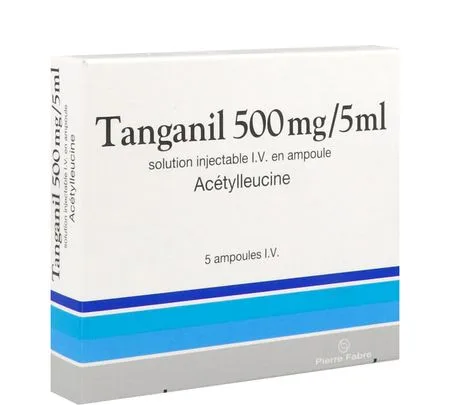
TANGANIL® solution for injection IV
acetylleucine
Forms and presentations
Tablet at 500 mg (oblong; white):Box of 30, under blister (PVC, aluminium).
Hospital model: Box of 60, under blister (PVC, aluminium).
Solution (clear aqueous, practically colourless and without visible particles) for IV injection at 500 mg/5 ml: Ampoules* of 5 ml, box of 5.
* The ampoules are fitted with a one point cut OPC opening system (see Handling and disposal instructions).
Composition
| Lozenge: | per tablet |
| Acetylleucine
|
500 mg |
Excipients with known effect: wheat starch (88 mg per tablet).
| Injectable solution: | per ampoule |
| Acetylleucine
|
500 mg |
Indications
This medicine is indicated for the symptomatic treatment of vertigo crisis in adults.Dosage and administration
- Tanganil Ge tablet:
-
- Dosage
- The recommended dose in adults is 1,5 to 2 g per day, i.e. 3 to 4 tablets per day in 2 intakes morning and evening.
- The duration of treatment varies depending on clinical progress (between 10 days and 5 to 6 weeks); at the start of treatment or in case of failure, the dose may be increased without harm up to 3 g and even 4 g per day, i.e. 6 to 8 tablets per day.
-
- Method of administration:
- Oral route. To be taken with a large glass of water.
- Tanganil solution for injection:
-
- Dosage
- 2 ampoules per day (up to 4 if necessary). The duration of treatment varies depending on clinical progress.
-
- Method of administration:
- Direct intravenous use.
Contraindications
- Hypersensitivity to the active substance or to any of the excipients listed in section Composition.
- Tanganil Ge tablet: in patients with an allergy to wheat (other than coeliac disease) (see Warnings and Precautions for Use).
Warnings and precautions
Hypersensitivity reactions (which may be severe, for example anaphylactoid shock, laryngeal oedema) have been observed. Treatment must be discontinued at the first signs of a hypersensitivity reaction after administration of acetylleucine (see Undesirable effects).
- Tanganil Ge tablet:
- This medicine contains a very low gluten content (from wheat starch). It is considered "gluten-free" and is therefore unlikely to cause problems in cases of coeliac disease.
- A tablet does not contain more than 8,8 micrograms of gluten.
- If you have an allergy to wheat (different from coeliac disease), you must not take this medicine (see Contraindications).
Interactions
No interaction studies have been performed.
Fertility, pregnancy and breastfeeding
Pregnancy:There are no data or there are limited data on the use of acetylleucine in pregnant women. There are no animal data regarding reproductive toxicity (see Preclinical safety). As a precaution, it is preferable to avoid using Tanganil during pregnancy.
Breastfeeding:
It is not known whether acetylleucine and its metabolites are excreted in human milk. A risk to the breastfed child cannot be excluded. Tanganil must not be used during breastfeeding.
Fertility:There are no data on the effects of acetylleucine on fertility.
Driving and using machines
Tanganil has no or negligible influence on the ability to drive vehicles and use machines.Adverse effects
Undesirable effects are classified below by MedDRA system organ class and by frequency. Frequency is defined according to the following convention: very common (≥ 1/10), common (≥ 1/100 and < 1/10), uncommon (≥ 1/1 000 and < 1/100), rare (≥ 1/10 000 and < 1/1 000), very rare (< 1/10 000), frequency not known (cannot be estimated from available data).
- Tanganil Ge tablet:
-
SYSTEM ORGAN CLASS
(MedDRA Classification)Very rare (< 1/10 000) Frequency not known Immune system disorders Hypersensitivity reactions, anaphylactoid shock and laryngeal oedema Gastrointestinal disorders Abdominal pain Skin and subcutaneous tissue disorders Skin reactions (sometimes associated with pruritus), erythema, urticaria
- Tanganil solution for injection:
-
SYSTEM ORGAN CLASS
(MedDRA Classification)Very rare (< 1/10 000) Frequency not known Immune system disorders Hypersensitivity reactions, anaphylactoid shock and laryngeal oedema Skin and subcutaneous tissue disorders Skin reactions (sometimes associated with pruritus), erythema, urticaria General disorders and administration site conditions Injection site reactions (such as pain, oedema or haematoma)
Reporting suspected adverse reactions after authorisation of the medicinal product is important. It allows continuous monitoring of the benefit/risk balance of the medicinal product. Healthcare professionals should report any suspected adverse reaction via the national reporting system: National Agency for the Safety of Medicines and Health Products (ANSM) and the network of Regional Pharmacovigilance Centres. Website: https://signalement.social-sante.gouv.fr.
Overdose
Information on overdoses with acetylleucine is limited.
In case of overdose, symptomatic treatment should be given if necessary.
Pharmacodynamics
Pharmacotherapeutic class: Antivertigo agent (ATC code: N07CA04).
Antivertigo agent of unknown mechanism of action.
Pharmacokinetics
- Tanganil Ge tablet:
- After oral administration, the peak plasma concentration of acetylleucine is reached after approximately 2 hours.
- Tanganil solution for injection:
- After intravenous administration of 1 g of Tanganil, bicompartmental kinetics are observed with a very rapid distribution phase (mean half-life of 0,11 hour) and a rapid elimination phase (mean half-life of 1,08 hour).
Preclinical safety
Non-clinical data reveal no significant risk for humans based on conventional acute and repeated-dose toxicity studies.
No toxicity data are available to assess the effects of the product on fertility and embryo-foetal development.
Storage conditions
- Tanganil Ge tablet:
-
- Shelf life
- 3 years.
- No special precautions for storage.
- Tanganil solution for injection:
-
- Shelf life before opening:
- 5 years.
- No special precautions for storage.
-
- Shelf life after opening:
- The product must be used immediately.
HANDLING/DISPOSAL INSTRUCTIONS
- Tanganil Ge tablet:
- No special requirements.
- Tanganil solution for injection:
-
- Method for opening OPC (one point cut) ampoules for use by healthcare professionals trained in this route of administration:
- Before opening the ampoule, make sure there is no solution remaining in the upper part of the ampoule.
-
The ampoules are fitted with an OPC opening system and must be broken according to the following instructions:
- With one hand, hold the body of the ampoule firmly, coloured point facing you.
- With the other hand, grasp the upper part of the ampoule (index finger placed behind the neck of the ampoule and thumb on the coloured point).
- Holding each part of the ampoule firmly, snap off the upper part with a sharp jerk, applying pressure in the direction opposite the coloured point.
- With one hand, hold the body of the ampoule firmly, coloured point facing you.
Prescription, supply and reimbursement
| Marketing authorisation (AMM) | 3400927400209 (2013, SmPC rev 03.02.2026) 30 tablets. |
| 3400927401039 (2013, SmPC rev 03.02.2026) 60 tablets. | |
| 3400932722594 (1992, SmPC rev 03.02.2026) injectable solution. |
| Price: | 2,95 euros (30 tablets). |
| 2,31 euros (5 injectable ampoules). | |
| Social Security reimbursement at 30%. Collect. | |
| Hospital model (box of 60 tablets): Collect. | |
PIERRE FABRE MÉDICAMENT
Parc industriel de la Chartreuse. 81100 Castres
Medical info:
Pharmacovigilance: Tel: 01 49 10 96 18
Customer Service:
Tel: 0811 022 022
Fax: 0811 021 012
https://www.pierre-fabre.com
Source: VIDAL · Updated on 11/11/2026. This information does not replace advice from a healthcare professional.