Medicines
Update of 20/01/2026
SYNACTHÈNE®
tetracosactide
Forms and presentations
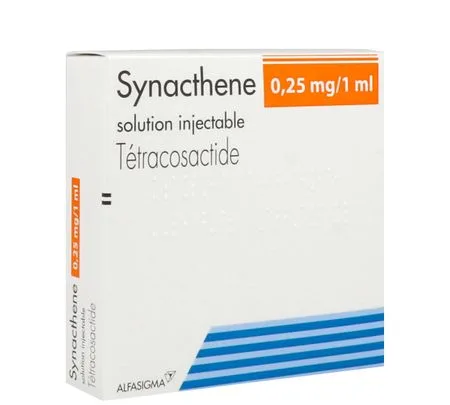
Injectable solution IM or IV at 0,25 mg/1 ml : Ampoule of 1 ml, unit box.Composition
| per ampoule | |
| Tetracosactide
|
0,25 mg |
Indications
- Therapeutic indication :
- Treatment of 2e intention of West syndrome (or infantile spasms), in case of ineffectiveness of oral corticosteroid treatments.
- Diagnostic indication :
- Dynamic exploration of the adrenal cortex, notably in case of adrenal cortex deficiency or deficiency in 21-ß-hydroxylase.
Dosage and administration
Dosage- In endocrinology :
- Diagnostic indication (dynamic exploration of the adrenal cortex, notably in case of adrenal cortex deficiency or deficiency in 21-ß-hydroxylase) :
- Synacthene test 60 minutes :
- This test is based on the measurement of the plasma concentration of cortisol and that of 17-hydroxyprogesterone in case of suspicion of enzymatic block, immediately before and exactly at 30 and at 60 minutes after the injection of 0,25 mg (1 ml) of Synacthene IM or IV.
- In case of adrenal insufficiency, baseline cortisol is low or collapsed and the response to stimulation is null or weak (generally < 20 µg/100 ml).
- In case of enzymatic block in 21-ß-hydroxylase, plasma 17-hydroxyprogesterone is normal or elevated at baseline and is very elevated 1 hour after the injection of Synacthene 0,25 mg/1 ml (generally > 10 ng/100 ml). In the context of a search for this deficiency in a woman, the test is to be performed in the early follicular phase.
- In neurology :
- Treatment of 2e intention of West syndrome (or infantile spasms), in case of ineffectiveness of oral corticosteroid treatments :
- In the child, the dosage is 0,1 mg/kg/day for 15 days, then a progressive decrease of the doses over 15 days must be carried out until a dosage of 0,8 mg/day.
- Synacthene 0,25 mg/1 ml is suitable for the treatment of the newborn.
- The durations of treatment usually vary from 3 weeks to 6 months depending on the response.
Mode of administration :
Intramuscular or intravenous injection.
- In endocrinology :
- Synacthène 0,25 mg/1 ml may be administered intramuscularly or intravenously.
- In neurology :
- Synacthène 0,25 mg/1 ml will be administered by intramuscular injection or by intravenous infusion in a 5 % glucose solution or 0,9 % NaCl.
- During an intravenous infusion, the infusion solution must be prepared extemporaneously.
Contraindications
- In endocrinology and in neurology:
-
This medicine is generally contraindicated in the following situations:
- Hypersensitivity to the active substance or to any of the excipients mentioned in the section Composition.
- Coagulation disorders in case of intramuscular injection.
- Hypersensitivity to the active substance or to any of the excipients mentioned in the section Composition.
- In neurology :
-
This medicine is generally contraindicated in the following situations:
- Any infectious condition.
- Certain evolving viral infections (particularly hepatitis, herpes, chickenpox, shingles).
- Psychotic states not yet controlled by treatment.
- Live vaccines.
- Any infectious condition.
Warnings and precautions
Warnings:
- In endocrinology and in neurology:
-
- Tetracosactide may cause allergic reactions, especially in patients with an allergic condition, asthma or family history of asthma, urticaria, atopic dermatitis. In rare cases, they may be serious and manifest as anaphylactic reactions generally occurring within 30 minutes following the injection.
- Tetracosactide may cause allergic reactions, especially in patients with an allergic condition, asthma or family history of asthma, urticaria, atopic dermatitis. In rare cases, they may be serious and manifest as anaphylactic reactions generally occurring within 30 minutes following the injection.
- In neurology :
-
- In case of gastroduodenal ulcer, corticosteroid therapy is not contraindicated if an anti-ulcer treatment is associated.
In case of ulcer history, corticosteroid therapy may be prescribed, with clinical monitoring and, if necessary, fibroscopic. - Corticosteroid therapy may promote the occurrence of various infectious complications due in particular to bacteria, yeasts and parasites. The occurrence of malignant strongyloidiasis is an important risk. All subjects coming from an endemic area (tropical, subtropical regions, southern Europe) must have a coprological examination and systematic eradication treatment before corticosteroid therapy.
Evolving signs of an infection may be masked by corticosteroid therapy. It is important, before starting treatment, to rule out any possibility of visceral focus, particularly tuberculous, and to monitor, during treatment, the appearance of infectious pathologies. In case of old tuberculosis, prophylactic anti-tuberculous treatment is necessary if there are significant radiological sequelae and if it cannot be ensured that a well-conducted treatment of 6 months with rifampicin has been given. - The use of corticosteroid therapy requires particularly adapted monitoring, particularly in cases of ulcerative colitis (risk of perforation), diverticulitis, recent intestinal anastomoses, renal failure, hepatic failure, osteoporosis, myasthenia gravis.
- In case of gastroduodenal ulcer, corticosteroid therapy is not contraindicated if an anti-ulcer treatment is associated.
- In endocrinology and in neurology:
-
- As with any therapy involving a risk of anaphylactic reaction, tetracosactide will be administered under medical supervision and the patient monitored accordingly.
- Anaphylactic reactions will be avoided to a large extent if the medication is interrupted as soon as the first local or general hypersensitivity reactions appear, such as: flushing, urticaria, pruritus, facial erythema, malaise, dyspnea.
- In case of a serious accident, it is recommended to immediately take emergency measures, namely 0,1 to 0,5 mg of adrenaline intravenously, as well as high-dose corticosteroids intravenously, repeatedly if necessary.
- As with any therapy involving a risk of anaphylactic reaction, tetracosactide will be administered under medical supervision and the patient monitored accordingly.
- In neurology :
-
- Echocardiographic monitoring must be carried out regularly in the infant and young child. Indeed, during prolonged treatments at high dose, a few exceptional cases of reversible myocardial hypertrophy have been observed.
- Growth monitoring is necessary, especially if the treatment is of long duration.
- Hydrosodium retention is usual, partly responsible for a possible elevation of blood pressure. Sodium intake will be reduced. In case of water retention or signs of adrenocortical hyperfunction, the dosage will be reduced, either by decreasing the dose or by spacing the injections, or the treatment will be temporarily interrupted.
- Potassium supplementation is justified only for high-dose treatments, prescribed for a long duration, or in case of risk of rhythm disorders or associations with a hypokalemic treatment.
- When corticosteroid therapy is indispensable, diabetes and arterial hypertension are not contraindications, but the treatment may cause their imbalance. It is appropriate to reassess their management.
- Patients must avoid contact with subjects suffering from chickenpox or measles.
- Echocardiographic monitoring must be carried out regularly in the infant and young child. Indeed, during prolonged treatments at high dose, a few exceptional cases of reversible myocardial hypertrophy have been observed.
- In endocrinology :
- Attention is drawn to athletes, this specialty containing an active ingredient that may induce a positive reaction in tests performed during anti-doping controls.
Excipients with notable effect:
This medicine contains less than 1 mmol (23 mg) of sodium per ampoule, that is to say that it is essentially « without sodium ».
Interactions
Not recommended associations:
- Medicines causing torsades de pointes (astémizole, bépridil, érythromycine IV, halofantrine, pentamidine, sparfloxacine, sultopride, terfénadine, vincamine): use substances not presenting the disadvantage of causing torsades de pointes in case of hypokalaemia.
Associations subject to precautions for use:
- Acide acétylsalicylique by general route and, by extrapolation, other salicylates: decrease in salicylaemia during treatment with corticotherapy, by increase in elimination of salicylates. Risk of salicylate overdose after stopping corticosteroid treatment. Adapt salicylate doses during the association and after stopping treatment with corticotherapy.
- Antiarrhythmics causing torsades de pointes (amiodarone, brétylium, disopyramide, quinidiniques, sotalol): hypokalaemia is a predisposing factor, as is bradycardia and pre-existing long QT interval. Prevent hypokalaemia, correct if necessary; monitor the QT interval. In case of torsade, do not administer an antiarrhythmic (electrosystolic pacing).
- Oral anticoagulants: possible impact of corticotherapy on the metabolism of the oral anticoagulant and on that of coagulation factors. Haemorrhagic risk specific to corticotherapy (digestive mucosa, vascular fragility) at high doses or in prolonged treatment exceeding 10 days. When the association is justified, reinforce monitoring: biological control on 8e day, then every 15 days during corticotherapy and after its discontinuation.
- Other hypokalaemiants (hypokalaemiant diuretics alone or in combination, stimulant laxatives, amphotéricine B IV): increased risk of hypokalaemia by additive effect. Monitor kalaemia, correct if necessary, especially in case of digitalis therapy.
- Digitalis: hypokalaemia favouring the toxic effects of digitalis. Monitor kalaemia, correct if necessary and possibly ECG.
- Parenteral heparins: aggravation by heparin of the haemorrhagic risk specific to corticotherapy (digestive mucosa, vascular fragility) at high doses or in prolonged treatment exceeding 10 days. The association must be justified; reinforce monitoring.
- Enzyme inducers (carbamazépine, phénobarbital, phénytoïne, primidone, rifabutine, rifampicine): decrease in plasma levels and efficacy of corticosteroids by increase in their hepatic metabolism. The consequences are particularly important in addisonians and in case of transplantation. Clinical and biological monitoring, adaptation of corticosteroid dosage during the association and after discontinuation of the enzyme inducer.
- Insuline, metformine, sulfamides hypoglycémiants: elevation of glycaemia with sometimes ketosis (decrease in carbohydrate tolerance by corticosteroids). Inform the patient and reinforce blood and urine self-monitoring, especially at the start of treatment. Possibly adapt the dosage of the antidiabetic during treatment with corticosteroids and after its discontinuation.
- Isoniazide (described for prednisolone): decrease in plasma levels of isoniazide. Mechanism invoked: increase in hepatic metabolism of isoniazide and decrease in that of glucocorticoids. Clinical and biological monitoring.
Associations to be taken into account:
- Antihypertensives: decrease in the antihypertensive effect (hydro-sodium retention of corticosteroids).
- Interféron alpha: risk of inhibition of the action of interferon.
- Live attenuated vaccines: risk of generalised disease possibly fatal. This risk is increased in subjects already immunocompromised by the underlying disease. Use an inactivated vaccine when it exists (poliomyelitis).
Fertility, pregnancy and breastfeeding
Pregnancy:There are no reliable data on teratogenesis in animals.
In clinical practice, there are currently no sufficiently relevant data to assess a possible malformative or foetotoxic effect of tetracosactide when administered during pregnancy.
Consequently, the use of this medicine should only be considered during pregnancy if necessary, that is to say in compliance with the validated indication.
Breastfeeding:
Tetracosactide being destroyed at the intestinal level, the infant is not exposed to the pharmacological effects of the molecule. Consequently, breastfeeding is possible.
Adverse effects
Tetracosactide may cause all the side effects of corticotherapy, as well as certain specific allergic effects.
- In endocrinology and in neurology:
- Tetracosactide may cause severe hypersensitivity reactions in allergic subjects (anaphylactic shock) (cf Warnings and Precautions for Use).
- In neurology :
-
- Hydro-electrolytic disorders: hypokalaemia, metabolic alkalosis, hydro-sodium retention, arterial hypertension, congestive heart failure.
- Endocrine and metabolic disorders: iatrogenic Cushing's syndrome, inertia of ACTH secretion, decreased glucose tolerance, revelation of latent diabetes, growth arrest in children, menstrual irregularities.
- Musculoskeletal disorders: muscular atrophy preceded by muscle weakness (increase in protein catabolism), osteoporosis, pathological fractures, in particular vertebral compressions, aseptic osteonecrosis of the femoral heads.
- Digestive disorders: gastroduodenal ulcers, ulceration of the small intestine, perforations and digestive hemorrhages; acute pancreatitis has been reported, especially in children.
- Skin disorders: acne, purpura, ecchymosis, hypertrichosis, delayed wound healing.
- Ocular disorders: certain forms of glaucoma and cataract.
- Cardiac rhythm disorders have been described, related to intravenous administration.
- Hydro-electrolytic disorders: hypokalaemia, metabolic alkalosis, hydro-sodium retention, arterial hypertension, congestive heart failure.
Reporting of suspected adverse reactions after authorization of the medicinal product is important. It allows continuous monitoring of the benefit/risk balance of the medicinal product. Healthcare professionals report any suspected adverse reaction via the national reporting system: Agence nationale de sécurité du médicament et des produits de santé (ANSM) and network of Regional Pharmacovigilance Centres. Website: https://signalement.social-sante.gouv.fr.
Overdose
In case of overdose, sodium and water retention may be observed, accompanied by hypernatremia with hypokalemia.
Management: reduction of doses.
Acute intoxication can hardly be considered due to the presentation in injectable form; however, in exceptional cases: immediate hospitalization in a specialized center.
Symptomatic treatment, in the absence of a known antidote.
Pharmacodynamics
Pharmacotherapeutic class: Corticotropic hormone (H: Systemic hormones), ATC code: H01AA02.
Polypeptide possessing the ACTH-stimulating properties on the adrenal cortex.
Synthetic corticotropin with constant action, tetracosactide acts via a specific receptor on the plasma membrane of adrenal cells.
The activation of this membrane structure results in the formation of cyclic adenosine monophosphate (cAMP) which, by activating protein kinase, stimulates the secretion of natural adrenocortical hormones through various enzymatic activation pathways:
- glucocorticoids, which provide endogenous corticosteroid therapy;
- androgenic and estrogenic protein-anabolic hormones;
- aldosterone, only during the first days of continuous administration.
Pharmacokinetics
Tetracosactide has an apparent volume of distribution of approximately 0,4 l/kg.
In serum, tetracosactide is first transformed by serum endopeptidases (such as trypsin, plasmin, thrombin and kallikrein) into inactive oligopeptides, then by aminopeptidases into free amino acids.
After an intravenous dose of labeled tetracosactide, 95 to 100 % of the radioactivity is excreted in the urine during the first 24 hours.
INCOMPATIBILITIES
Do not mix with blood and plasma transfusions (risk of degradation by polypeptidases).
Storage conditions
- Shelf life
- 3 years.
Store protected from light and at a temperature between 2 °C and 8 °C.
After opening: the product must be used immediately.
HANDLING/DISPOSAL MODALITIES
Shake before use.
Any unused medicinal product or waste must be disposed of in accordance with current regulations.
Prescription, supply and reimbursement
LIST I| MA | 3400931828693 (1998, SPC rev 31.12.2025). |
| Price : | 7,44 euros (1 ampoule of 0,25 mg/1 ml). |
| Soc. Sec. Reimb. at 65 %. Collect. | |
Marketing Authorisation Holder : Alfasigma S.p.A., Via Ragazzi del'99, N.5, 40133 Bologna (BO), Italy.
ALFASIGMA FRANCE
Bords de Seine 1
3, esplanade du Foncet, 92130 Issy-les-Moulineaux
Tel : 01 45 21 02 69. Fax : 01 41 90 69 76
E-mail : info.fr@alfasigma.com
www.alfasigma.fr
Source: VIDAL · Updated on 10/11/2026. This information does not replace advice from a healthcare professional.