
Medicines
SmPC of the 11/03/2025
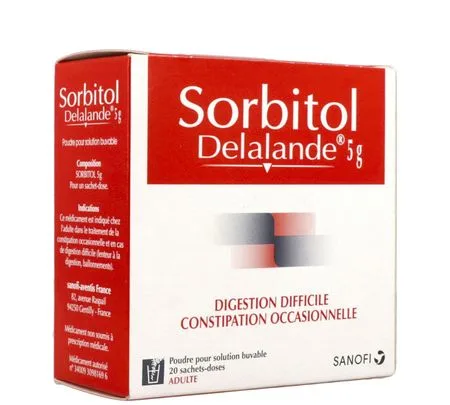
SORBITOL DELALANDE 5 g, powder for oral solution in sachet-dose
Composition
Sorbitol..................................................................................................................................................................5 g
For one sachet-dose of 5 g.
None.
Indications
• Treatment of occasional constipation in adults.
• Adjunctive treatment of dyspeptic disorders (difficult digestion, bloating) in adults.
Dosage and administration
RESERVED FOR ADULTS.
Dissolve the contents of the sachet in half a glass of water.
• Treatment of occasional constipation:
- 1 sachet in the morning on an empty stomach
The maximum duration of treatment by the patient without medical advice is limited to 1 week.
• Adjunctive treatment of dyspeptic disorders (difficult digestion, bloating):
- 1 to 3 sachets per day to be taken before meals or at the time of disorders.
The maximum duration of treatment by the patient without medical advice is limited to 1 week.
Contraindications
This medicine is contraindicated in the following situations:
• Hypersensitivity to the active substance,
• Organic inflammatory colopathies (ulcerative colitis, Crohn's disease...), obstructive or sub-obstructive syndrome, abdominal pain syndrome of undetermined cause, constipation due to the taking of certain medicines,
• In case of obstruction of the bile ducts or severe hepatocellular insufficiency,
• In case of association with sodium polystyrene sulfonate (sodium sulfo-cationic resin, KAYEXALATE) or calcium polystyrene sulfonate (calcium sulfo-cationic resin, such as RESIKALI) (see section Interactions).
Warnings and precautions
Special warnings
Prolonged use is not recommended.
Use in patients with fructose intolerance (rare hereditary disease) is not recommended.
Occasional constipation
Occasional constipation may be linked to a recent change in lifestyle (travel). The medicine may be an aid in short-term treatment.
Patients are advised to seek medical advice before starting or continuing treatment in case of:
• Recent constipation unexplained by a change in lifestyle.
• Constipation accompanied by vomiting and cessation of passage of gas (occlusion), abdominal pain, fever, bloating (abdominal swelling), blood in the stools, weight loss.
Indeed, these signs may be symptoms of a more serious disease,
• Persistence of symptoms or when constipation is accompanied by other disorders such as: persistent abdominal pain, alternating constipation/diarrhoea episodes, mucus, involuntary defecation (involuntary loss of stool).
Drug treatment of constipation is only an adjunct to dietary and lifestyle measures:
• Increasing dietary intake of plant fibres and fluids.
• Advice on physical activity and retraining of evacuation.
Difficult digestion
Patients are advised to seek medical advice before starting or continuing treatment in case of:
• Diarrhoea,
• abdominal pain,
• vomiting.
Precautions for use
Administer with caution in cases of megacolon due to impaired colonic motility and in bedridden subjects (risk of faecaloma).
In cases of colitis, avoid taking medicines on an empty stomach and reduce the dosage.
In elderly people, ensure that daily water intake is sufficient.
Interactions
Contraindicated combination
+ Sodium polystyrene sulfonate (sodium sulfo-cationic resin such as Kayexalate) (oral and rectal route)
Risk of colonic necrosis, possibly fatal.
+ Calcium polystyrene sulfonate (calcium sulfo-cationic resin such as Resikali) (oral and rectal route)
Risk of colonic necrosis, possibly fatal.
Absorption of laxatives may affect the absorption of other medicines administered simultaneously.
Fertility, pregnancy and breastfeeding
Animal studies have not shown any teratogenic effect. In the absence of a teratogenic effect in animals, a malformative effect in humans is not expected. Indeed, to date, substances responsible for malformations in humans have been shown to be teratogenic in animals in well-conducted studies in two species.
In clinical practice, no particular malformative or foetotoxic effect has appeared to date. However, monitoring of pregnancies exposed to sorbitol is insufficient to exclude any risk.
Consequently, the use of sorbitol should be considered during pregnancy only if necessary.
Adverse effects
The following adverse effects have been reported during treatment, classified by frequency:
Very common (≥1/10); Common (≥1/100, <1/10); Uncommon (≥1/1000, <1/100); Rare (≥1/10 000, <1/1000); Very rare (<1/10000); Frequency not known (cannot be estimated from the available data).
|
System Organ Classes (SOC) |
Adverse effects |
Frequency |
|
Gastrointestinal disorders |
Diarrhoea*, abdominal pain*, flatulence |
Not known |
* In particular in subjects suffering from functional colopathies.
Frequency not known: Risk of diarrhoea and abdominal pain, in particular in subjects suffering from functional colopathies.
Possibility of abdominal flatulence.
Reporting of suspected adverse reactions
Reporting suspected adverse reactions after authorisation of the medicinal product is important. It allows continued monitoring of the benefit/risk balance of the medicinal product. Healthcare professionals are asked to report any suspected adverse reactions via the national reporting system: National Agency for the Safety of Medicines and Health Products (ANSM) and the network of Regional Pharmacovigilance Centres - Website: https://signalement.social-sante.gouv.fr/.
Overdose
Overdose may intensify diarrhoea, abdominal bloating and flatulence, which disappear when treatment is temporarily interrupted. Excessive fluid loss during diarrhoea may require rehydration or correction of electrolyte disturbances.
Pharmacodynamics
Pharmacotherapeutic class: Osmotic laxative, Code: A06AD18.
(A: alimentary tract and metabolism).
Sorbitol stimulates the secretion of cholecystokinin-pancreozymin, which promotes contraction of the gallbladder and secretion of pancreatic juice.
It causes hyperhydration of the intestinal contents and accelerates digestive transit through its osmotic laxative effect.
Pharmacokinetics
Sorbitol is converted by a sorbitol dehydrogenase into fructose and then glucose.
A very small proportion of unmetabolised sorbitol is eliminated via the kidneys. The remainder is eliminated as CO2 in exhaled air.
Prescription, supply and reimbursement
| Marketing authorisation (AMM) |
|
Collection.
35 RUE DU VAL DE MARNE CS 91439
75214 PARIS CEDEX 13
Tel: 0 800 089 219 https://www.zentiva.com/
Source: VIDAL · Updated on 11/11/2026. This information does not replace advice from a healthcare professional.