
Medicines
SmPC of 06/06/2019
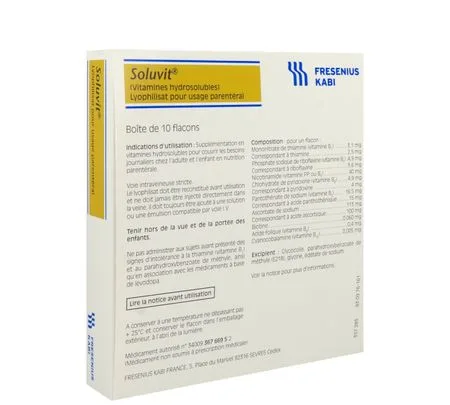
SOLUVIT, lyophilisate for parenteral use
Composition
Thiamine mononitrate (Vitamin B1) ......................................................................................3,100 mg
Quantity corresponding to thiamine.............................................................................................2,500 mg
Riboflavin sodium phosphate (Vitamin B2)........................................................................4,900 mg
Quantity corresponding to riboflavin..........................................................................................3,600 mg
Nicotinamide (Vitamin PP or B3) ...........................................................................................40,000 mg
Pyridoxine hydrochloride (Vitamin B6)..................................................................................4,900 mg
Quantity corresponding to pyridoxine..........................................................................................4,000 mg
Sodium pantothenate (Vitamin B5) ....................................................................................16,500 mg
Quantity corresponding to pantothenic acid........................................................................15,000 mg
Sodium ascorbate..............................................................................................................113,000 mg
Quantity corresponding to ascorbic acid...........................................................................100,000 mg
Biotin........................................................................................................................................0,060 mg
Folic acid (Vitamin B9) ........................................................................................................0,400 mg
Cyanocobalamin (Vitamin B12) ..............................................................................................0,005 mg
For one vial of lyophilisate
Excipient with known effect: methyl parahydroxybenzoate (E218)
Glycine, methyl parahydroxybenzoate (E218), sodium edetate.
Indications
Supplementation with water-soluble vitamins to cover daily requirements in adults and children receiving parenteral nutrition.
Dosage and administration
Dosage
In adults and children of 10 kg and above, the recommended dose corresponds to the vitamin intake of one reconstituted vial over 24 hours.
In children under 10 kg, the recommended dose corresponds to the vitamin intake of one millilitre of a reconstituted vial per kilogram of body weight over 24 hours.
Method of administration
Strictly intravenous route.
SOLUVIT, lyophilisate for parenteral use, must be reconstituted before use.
Reconstitution is performed by adding, under aseptic conditions, an injectable solution or lipid emulsion for intravenous infusion.
The reconstituted lyophilisate must never be injected directly into the vein, but must always be added to an I.V. infusion solution or emulsion, the compatibility of which with SOLUVIT has been determined beforehand.
Contraindications
- Hypersensitivity to the active substances or to any of the excipients listed in section Compositionin particular do not inject into subjects who have shown signs of intolerance to thiamine (vitamin B1) and methyl parahydroxybenzoate;
- Hypervitaminosis to any vitamin contained in this medicine.
Warnings and precautions
This medicine contains "Parahydroxybenzoate" and may cause allergic reactions (possibly delayed), and exceptionally, bronchospasm.
The infusion must be stopped immediately if signs or symptoms of a hypersensitivity reaction develop.
SOLUVIT, lyophilisate for parenteral use, does not contain any fat-soluble vitamin.
Vitamin and mineral intake from other sources must be taken into account (see sections Interactions and Overdose).
SOLUVIT containing folic acid may delay the diagnosis of pernicious anaemia.
The sensitivity of certain vitamins, in particular vitamins B2 and B6, to ultraviolet rays (e.g., direct or indirect sunlight) must be taken into account. Losses of vitamins B1 and C may increase with high oxygen levels in the solution. This factor must be considered if adequate vitamin B1 levels are not achieved.
Patients receiving multivitamin parenteral solutions as the sole source of vitamins over a prolonged period must be monitored to verify the adequacy of supplementation, in particular:
-
- vitamin B1 in dialysis patients
- vitamin B2 in patients with cancer
- vitamin B6 in patients with renal insufficiency
- vitamins whose individual requirements may be increased due to interactions with other medicinal products (see section Interactions).
Interference with clinical laboratory tests
Sodium ascorbate may interfere with blood and urine glucose monitoring systems (see section Interactions).
Biotin may interfere with laboratory tests based on the biotin/streptavidin interaction, leading to falsely underestimated or falsely overestimated results, depending on the test. The risk of interference is higher in children and in patients with renal insufficiency and increases with higher doses. When interpreting laboratory test results, possible biotin interference should be taken into account, particularly in the case of results discordant with the clinical presentation (for example, thyroid test results mimicking Graves' disease in asymptomatic patients taking biotin, or falsely negative troponin test results in patients with myocardial infarction taking biotin). Where interference is suspected, alternative tests not affected by biotin should be used.
Laboratory staff should be consulted when ordering laboratory tests for patients taking biotin.
Geriatric population:
In general, dose adjustments should be considered in elderly patients (dose reduction and/or extension of dosing intervals) due to their greater susceptibility to impaired hepatic, renal or cardiac function, concomitant diseases and drug treatments
SOLUVIT, lyophilisate for parenteral use must be reconstituted before use.
The reconstituted product must not be injected directly into a vein but always added to a solution or infusion emulsion compatible with SOLUVIT (see section Dosage and administration).
Before use, check that the vial is free of cracks or chips.
Do not store a partially used vial.
Interactions
Associations requiring precautions for use
(Related to the presence of sodium ascorbate)
+ DEFEROXAMINE
Increased risk of iron-induced cardiac failure due to increased iron mobilisation from supraphysiological supplementation with vitamin C. In case of haemochromatosis, give vitamin C only after starting treatment with deferoxamine. Monitor cardiac function in case of association. For specific precautions, refer to the summary of product characteristics of deferoxamine.
(Related to the presence of folic acid)
+ PHENOBARBITAL, PHENYTOIN, PRIMIDONE, FOSPHENYTOIN
Decrease in plasma concentrations of enzyme-inducing anticonvulsants due to increased hepatic metabolism; folates are one of the cofactors in the enzymatic reactions concerned, which increases the risk of convulsions.
Clinical monitoring, monitoring of plasma levels of phenobarbital, phenytoin, primidone or fosphenytoin. Adjust the dose of the antiepileptic during folic acid supplementation and after its discontinuation, if necessary.
Associations to be taken into account
(Related to the presence of pyridoxine)
+ ETHIONAMIDE
+ PYRIDOXINE ANTAGONISTS (including cycloserine, hydralazine, isoniazid, penicillamine, phenelzine)
May lead to pyridoxine deficiency.
(Related to the presence of folic acid)
+ FLUOROPYRIMIDINES (5-fluorouracil, capecitabine, tegafur)
Increased cytotoxicity of fluoropyrimidines when combined with folic acid.
+ FOLATE ANTAGONISTS (e.g., methotrexate, sulfasalazine, pyrimethamine, triamterene, trimethoprim) AND HIGH DOSES OF TEA CATECHINS:
Blocking of the conversion of folates to their active metabolites and reduced effectiveness of supplementation.
Interactions with other vitamin and/or mineral supplementation
Certain medicines may interact with certain vitamins and/or minerals at doses markedly higher than those provided by SOLUVIT, powder for solution for parenteral use. This must be taken into account in patients receiving vitamins and/or minerals from several sources; where appropriate, patients should be monitored for these interactions and managed appropriately.
Other forms of interactions
Depending on the reagents used, the presence of ascorbic acid in blood and urine may distort the results of some blood and urine glucose monitoring systems, in particular test strips and portable glucose meters (see section Warnings and precautions).
Fertility, pregnancy and breastfeeding
Pregnancy
Animal studies have not shown a teratogenic effect of the vitamins contained in SOLUVIT. In the absence of a teratogenic effect in animals, a malformative effect in humans is not expected. Indeed, to date, substances responsible for malformations in humans have been shown to be teratogenic in animals in well-conducted studies in two species.
In humans, there are no relevant clinical data on the use of SOLUVIT during pregnancy.
Consequently, SOLUVIT should be administered to pregnant women only if necessary.
Breast-feeding
Administration of SOLUVIT is not recommended during breast-feeding due to the risk of vitamin overdose in the newborn.
Adverse effects
The undesirable effects mentioned below, which may occur with SOLUVIT, powder for solution for parenteral use, are listed by system organ class and by frequency according to the following convention: very common (≥ 1/10); common (≥ 1/100, <1/10); uncommon (≥ 1/1 000, < 1/100); rare (≥ 1/10 000, < 1/1 000); very rare (< 1/10 000); and frequency not known (cannot be estimated from the available data).
Immune system disorders (frequency not known)
Given the presence of vitamins B1 (thiamine) and B9 (folic acid), anaphylactic reactions may be observed in subjects with an allergic predisposition (see section Contraindications).
Reporting of suspected adverse reactions
Reporting suspected adverse reactions after authorisation of the medicinal product is important. It allows continued monitoring of the benefit/risk balance of the medicinal product. Healthcare professionals are asked to report any suspected adverse reactions via the national reporting system: National Agency for the Safety of Medicines and Health Products (ANSM) and the network of Regional Pharmacovigilance Centres - Website:www.signalement-sante.gouv.fr.
Overdose
An overdose of water-soluble vitamins for parenteral use is not expected. No undesirable effects related to overdose have been reported to date.
Pharmacodynamics
Pharmacotherapeutic class: INTRAVENOUS SOLUTION ADDITIVES/VITAMINS, ATC code: B05XC
(B: Blood and haematopoietic organs)
SOLUVIT is a balanced association of water-soluble vitamins covering daily requirements during parenteral nutrition. SOLUVIT does not contain fat-soluble vitamins, which are nevertheless essential in cases of exclusive parenteral nutrition.
The pharmacodynamic properties of SOLUVIT are those of each of the 9 water-soluble vitamins in its composition. The main properties are as follows:
- Vitamin B1 (thiamine): in association with ATP, formation of a coenzyme involved in carbohydrate metabolism.
- Vitamin B2 (riboflavin): coenzyme action in cellular energy metabolism, tissue respiration systems and macronutrient metabolism.
- Vitamin B3 (PP): component of the coenzymes NAD and NADP involved in oxidation-reduction reactions essential for macronutrient metabolism and tissue respiration.
- Vitamin B5 (pantothenic acid): precursor of coenzyme A involved in the oxidative metabolism of carbohydrates, gluconeogenesis and the synthesis of fatty acids, sterols, steroid hormones and porphyrins.
- Vitamin B6 (pyridoxine): coenzyme in the metabolism of proteins, carbohydrates and fats.
- Vitamin B12: exogenous source necessary for the synthesis of nucleoproteins and myelin, cell reproduction, growth and maintenance of normal erythropoiesis.
- Vitamin C: antioxidant properties, essential for the formation and maintenance of intercellular substances and collagen, the biosynthesis of catecholamines, the synthesis of carnitine and steroids, and the metabolism of folic acid and tyrosine.
- Folic acid: exogenous source necessary for the synthesis of nucleoproteins and the maintenance of normal erythropoiesis.
- Biotin: bound to at least four enzymes, involved in energy metabolism including gluconeogenesis.
Pharmacokinetics
The pharmacokinetic properties of SOLUVIT are those of each of the 9 vitamins in its composition. The main properties are as follows:
- Vitamin B1 (thiamine): 80 to 96 % of an intravenous administration is excreted via the urine.
- Vitamin B2 (riboflavin): bound to proteins in plasma; plasma levels highly variable; excreted mainly via the urine in free form or as metabolites.
- Vitamin B3 (PP): found in acid or amide form in plasma; excreted in urine in free form or as metabolites.
- Vitamin B5 (pantothenic acid): present in free form or as coenzyme A in plasma and red blood cells; excreted via the urine.
- Vitamin B6 (pyridoxine): metabolised in the liver and eliminated via the urine.
- Vitamin B12: normal serum levels of 200-900 pg/ml; protein-bound; stored in the liver; distributed into breast milk; 50 to 90 % of intake is eliminated via the urine.
- Vitamin C: total renal tubular reabsorption at normal concentrations (8 to 14 mg/l). Above this, excess is excreted via the urine.
- Folic acid: normal serum concentration of 0,005-0,015 μg/ml; distribution in all tissues; metabolised and stored in the liver; at high doses, insufficient renal tubular reabsorption and excretion via the urine.
Biotin: found in free form or bound to proteins in plasma; stored mainly in the liver, and excreted essentially unchanged via the urine.
INCOMPATIBILITIES
This medicine must not be mixed with other medicines, except those mentioned in the section Dosage and administration
Special storage precautions
Store at a temperature not exceeding +25 °C and keep the vial in the outer packaging, protected from light.
SPECIAL PRECAUTIONS FOR DISPOSAL AND OTHER HANDLING
No particular requirements
Any unused medicinal product or waste material should be disposed of in accordance with local requirements.
Prescription, supply and reimbursement
| Marketing authorisation (AMM) |
|
| Price: |
|
- Supplementation with water-soluble vitamins in parenteral nutrition
Collection.
5 PLACE DU MARIVEL
92316 SEVRES
Tel: 01 41 14 26 00 internet.fkf@fresenius-kabi.com
http://www.fresenius-kabi.fr/
Source: VIDAL · Updated on 11/11/2026. This information does not replace advice from a healthcare professional.