
Medicines
SmPC of 24/08/2026
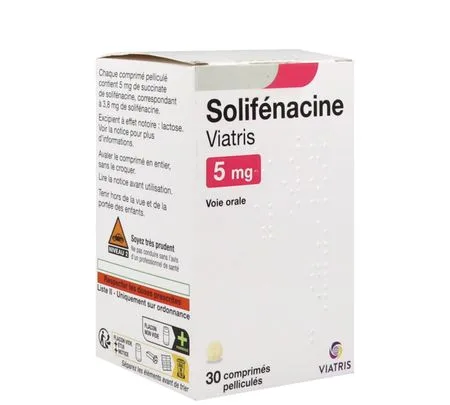
SOLIFENACINE VIATRIS 5 mg, film-coated tablet
Forms and presentations
Film-coated tablet.
Yellow, round, biconvex film-coated tablet, engraved "M" on one side and "SF" above "5" on the other, with an approximate diameter of 5,6 mm.
Composition
Each film-coated tablet contains 5 mg of solifenacin succinate, corresponding to 3,8 mg of solifenacin.
Excipients with known effect:
Each film-coated tablet contains 57 mg of lactose (as lactose monohydrate).
Core :
Lactose monohydrate
Maize starch
Hypromellose
Talc
Magnesium stearate
Film coating :
Hypromellose
Titanium dioxide (E171)
Propylene glycol
Yellow iron oxide (E172)
Indications
Symptomatic treatment of urinary urge incontinence and/or urinary frequency and urinary urgency that may be observed in patients suffering from overactive bladder.
Dosage and administration
Dosage
Adults, including elderly people
The recommended dose is 5 mg of solifenacin succinate once daily. If necessary, the dose may be increased to 10 mg of solifenacin succinate once daily.
Paediatric population
The safety and efficacy of solifenacin in children have not yet been established. Therefore, SOLIFENACINE VIATRIS must not be prescribed to children.
Renal impairment
No dose adjustment is necessary in case of mild to moderate renal impairment (creatinine clearance > 30 ml/min). In case of severe renal impairment (creatinine clearance ≤ 30 ml/min), treatment should be used with caution and the dose of 5 mg once daily must not be exceeded (see section Pharmacokinetics).
Hepatic impairment
No dose adjustment is necessary in cases of mild hepatic impairment. In cases of moderate hepatic impairment (Child-Pugh score of 7 to 9), treatment must be used with caution and the dose of 5 mg once daily must not be exceeded (see section Pharmacokinetics).
Potent inhibitors of the cytochrome P3 iso-enzyme 4A450
The maximum dose of solifenacin succinate must be limited to 5 mg when concomitantly administered with ketoconazole or another potent inhibitor of the CYP3A4 iso-enzyme used at therapeutic doses; for example ? ritonavir, nelfinavir, itraconazole (see section Interactions).
Method of administration
The SOLIFENACINE VIATRIS tablet must be taken orally and swallowed whole with water. The medicine may be taken either during or outside of meals.
Contraindications
Solifenacin is contraindicated in patients suffering from urinary retention, a severe gastrointestinal disorder (including toxic megacolon), myasthenia gravis or angle-closure glaucoma, as well as in patients at risk of these conditions.
Patients hypersensitive to the active substance or to any of the excipients listed in section Composition.
Patients undergoing haemodialysis (see section Pharmacokinetics).
Patients with severe hepatic impairment (see section Pharmacokinetics).
Patients with severe renal impairment or moderate hepatic impairment, treated with a potent CYP3A4 inhibitor such as ketoconazole (see section Interactions).
Warnings and precautions
Other causes of frequent micturition (cardiac failure or renal disease) must be evaluated before starting treatment with solifenacin. Appropriate antibacterial treatment must be initiated in case of urinary tract infection.
Solifenacin should be used with caution in the following situations:
• Clinically significant and decompensated bladder outflow obstruction with risk of urinary retention.
• Obstructive gastrointestinal disorders.
• Risk of decreased gastrointestinal motility.
• Severe renal impairment (creatinine clearance ≤ 30 ml/min; see sections Dosage and administration and Pharmacokinetics) ; in these patients, the dose of 5 mg per day must not be exceeded.
• Moderate hepatic impairment (Child-Pugh score of 7 to 9; see sections Dosage and administration and Pharmacokinetics) ; in these patients, the dose of 5 mg per day must not be exceeded.
• Concomitant use of a potent CYP3A4 iso-enzyme inhibitor such as ketoconazole (see sections Dosage and administration and Interactions).
• Hiatus hernia/gastro-oesophageal reflux and/or concomitant treatment with medicinal products (for example bisphosphonates) that may cause or aggravate oesophagitis.
• Autonomic neuropathy.
Prolongation of the QT interval and torsades de pointes have been observed in patients with risk factors, such as pre-existing long QT syndrome and hypokalaemia.
To date, safety and efficacy have not been established in cases of neurogenic detrusor overactivity.
Angioedema with airway obstruction has been reported in a few patients treated with solifenacin. In case of angioedema, solifenacin must be discontinued and appropriate treatment and/or measures must be taken.
Anaphylactic reactions have been reported in a few patients treated with solifenacin. In patients who develop anaphylactic reactions, solifenacin must be discontinued and appropriate treatment and/or measures must be taken.
The optimal effect of solifenacin may be assessed at the earliest after 4 weeks of treatment.
This medicine contains lactose. Its use is not recommended in patients with galactose intolerance, Lapp lactase deficiency or glucose-galactose malabsorption syndrome (rare hereditary diseases).
Interactions
Pharmacological interactions
Concomitant use of other medicinal products with anticholinergic properties may enhance therapeutic and adverse effects. An interval of approximately one week should be observed after the end of solifenacin treatment before initiating another anticholinergic treatment. The therapeutic effect of solifenacin may be reduced by concomitant administration of cholinergic receptor agonists.
Solifenacin may reduce the effect of medicinal products that stimulate gastrointestinal motility, such as metoclopramide and cisapride.
Pharmacokinetic interactions
In vitro studies have shown that at therapeutic concentrations solifenacin does not inhibit the CYP1A1/2, 2C9, 2C19, 2D6 or 3A4 iso-enzymes from human liver microsomes. It is therefore unlikely that solifenacin will alter the clearance of medicinal products metabolised by these CYP iso-enzymes.
Effect of other medicinal products on the pharmacokinetics of solifenacin
Solifenacin is metabolised by the CYP3A4 iso-enzyme. Concomitant administration of ketoconazole (at 200 mg/day), a potent inhibitor of this iso-enzyme, resulted in a doubling of the AUC of solifenacin, whereas at a dose of 400 mg/day of ketoconazole, a tripling of the AUC of solifenacin was observed. Consequently, the maximum dose of solifenacin succinate must therefore be limited to 5 mg per day in cases of concomitant administration of ketoconazole or another potent inhibitor of the CYP3A4 iso-enzyme used at therapeutic doses (for example ritonavir, nelfinavir, itraconazole) (see section Dosage and administration).
Concomitant administration of solifenacin and a potent inhibitor of the CYP3A4 iso-enzyme is contraindicated in patients with severe renal impairment or moderate hepatic impairment.
The effects of enzyme induction on the pharmacokinetic parameters of solifenacin and its metabolites have not been studied. Likewise, the effect of substrates with higher affinity for CYP3A4 on exposure to solifenacin has not been studied.
As solifenacin is metabolised by the CYP3A4 iso-enzyme, pharmacokinetic interactions are possible with other substrates with a higher affinity for this iso-enzyme (for example verapamil, diltiazem) and with inducers of it (for example rifampicin, phenytoin, carbamazepine).
Effect of solifenacin on the pharmacokinetics of other medicinal products
Oral contraceptives
After administration of solifenacin, no pharmacokinetic interaction between solifenacin and oral contraceptives has been observed (ethinylestradiol/levonorgestrel).
Warfarin
Administration of solifenacin did not alter the pharmacokinetics of R-warfarin or S-warfarin and did not affect their effect on the Quick time.
Digoxin
No effect on the pharmacokinetics of digoxin has been observed after administration of solifenacin.
Fertility, pregnancy and breastfeeding
Pregnancy
There are no clinical data on women who became pregnant while being treated with solifenacin. Animal studies have not shown direct harmful effects on fertility, embryonic/foetal development or parturition (see section Preclinical safety). The potential risk in women is unknown. Solifenacin should be prescribed with caution to pregnant women.
Breast-feeding
There are no data on the excretion of solifenacin in human milk. In mice, solifenacin and/or its metabolites were excreted in milk and caused developmental abnormalities in the newborns in proportion to the dose (see section Preclinical safety). The use of SOLIFENACIN VIATRIS should be avoided during breast-feeding.
Driving and using machines
Treatment may impair the ability to drive and use machines, as solifenacin, like other anticholinergics, may cause visual disturbances and, less frequently, drowsiness and fatigue (see section Adverse effects).
Adverse effects
Summary of the safety profile
Given the pharmacological effect of solifenacin, this medicine may cause anticholinergic-type undesirable effects of generally mild to moderate severity. The frequency of these undesirable effects is dose-dependent.
The most frequently reported undesirable effect with solifenacin succinate is dry mouth. It was observed in 11% of patients treated with 5 mg once daily, 22% of patients treated with 10 mg once daily and 4% of patients on placebo. Dry mouth was generally of mild intensity and only occasionally led to discontinuation of treatment. Overall, treatment compliance was very high (approximately 99%) and approximately 90% of patients treated with solifenacin succinate continued treatment until the end of the studies (12 weeks).
Tabulated list of adverse reactions
|
System organ class (MedDRA classification) |
Very common ≥ 1/10 |
Common ≥ 1/100,
|
Uncommon ≥ 1/1 000, < 1/100 |
Rare ≥ 1/10 000, < 1/1 000 |
Very rare < 1/10 000 |
Not known (frequency cannot be estimated from the available data) |
|
Infections and infestations |
|
|
Urinary tract infection, Cystitis |
|
|
|
|
Immune system disorders |
|
|
|
|
|
Anaphylactic reaction* |
|
Metabolism and nutrition disorders |
|
|
|
|
|
Decreased appetite* Hyperkalaemia* |
|
Psychiatric disorders |
|
|
|
|
Hallucinations* Confusional states* |
Delirium* |
|
Nervous system disorders |
|
|
Somnolence Dysgeusia |
Dizziness*, Headache* |
|
|
|
Eye disorders |
|
Blurred vision |
Dry eye |
|
|
Glaucoma* |
|
Cardiac disorders |
|
|
|
|
|
Torsade de pointes* Prolongation of the QT interval on electrocardiogram* Atrial fibrillation* Palpitations* Tachycardia* |
|
Respiratory, thoracic and mediastinal disorders |
|
|
Nasal dryness |
|
|
Dysphonia* |
|
Gastrointestinal disorders |
Dry mouth |
Constipation Nausea Dyspepsia Abdominal pain |
Gastro-oesophageal reflux Dry throat |
Colonic obstruction Faecaloma Vomiting* |
|
Ileus* Abdominal discomfort* |
|
Hepatobiliary disorders |
|
|
|
|
|
Hepatic disorders* Abnormal liver function test results* |
|
Skin and subcutaneous tissue disorders |
|
|
Dry skin |
Pruritus*, Rash*, |
Erythema multiforme* Urticaria* Angioedema* |
Exfoliative dermatitis* |
|
Musculoskeletal and systemic disorders |
|
|
|
|
|
Muscular weakness* |
|
Renal and urinary disorders |
|
|
Urinary disorders |
Urinary retention |
|
Renal failure* |
|
General disorders and administration site conditions |
|
|
Fatigue Peripheral oedema |
|
|
|
* observed after marketing
Reporting of suspected adverse reactions
Reporting suspected adverse reactions after authorisation of the medicinal product is important. It allows continued monitoring of the benefit/risk balance of the medicinal product. Healthcare professionals are asked to report any suspected adverse reactions via the national reporting system: National Agency for the Safety of Medicines and Health Products (ANSM) and the network of Regional Pharmacovigilance Centres - Website:https://signalement.social-sante.gouv.fr/.
Overdose
Symptoms
An overdose with solifenacin succinate may potentially lead to severe anticholinergic effects. A maximum dose of 280 mg of solifenacin succinate following accidental administration to a single patient over a period of 5 hours resulted in higher-function disturbances not leading to hospitalisation.
Treatment
In case of solifenacin succinate overdose, use activated charcoal. Gastric lavage is useful if performed within one hour, but must not induce vomiting.
As with other anticholinergics, symptoms may be treated as follows:
• Severe central anticholinergic effects such as hallucinations or marked excitation: with physostigmine or carbachol;
• Convulsions or significant excitation: with benzodiazepines;
• Respiratory failure: with artificial ventilation;
• Tachycardia: with beta-blockers;
• Urinary retention: by catheterisation;
• Mydriasis: by a pilocarpine eye drop and/or placing the patient in a dark room.
As with other antimuscarinics, in case of overdose, specific monitoring is required in patients at risk of QT prolongation (for example in cases of hypokalaemia, bradycardia and concomitant treatment with medicinal products prolonging the QT interval) or having significant pre-existing heart disease (for example myocardial ischaemia, arrhythmias, congestive heart failure).
Pharmacodynamics
Pharmacotherapeutic class: Urological, urinary antispasmodics, ATC code: G04BD08.
Mechanism of action
Solifenacin is a specific competitive antagonist of cholinergic receptors.
The bladder is innervated by cholinergic parasympathetic nerves. Acetylcholine contracts the detrusor, a smooth muscle, by acting on muscarinic receptors, mainly on their M3. In vitro and in vivo pharmacological studies have shown that solifenacin is a competitive inhibitor of muscarinic receptors belonging to the M3subtype. In addition, solifenacin has a specific antagonist activity on muscarinic receptors, its affinity for other receptors and ion channels studied being low or nil.
Pharmacodynamic effects
The effects of treatment with solifenacin succinate at doses of 5 mg and 10 mg were studied in several randomised, controlled, double-blind clinical trials in patients of both sexes suffering from overactive bladder.
Doses of 5 mg and 10 mg of solifenacin succinate resulted in statistically significant improvements in the primary and secondary endpoints compared with placebo. Efficacy was observed from the first week of treatment and stabilised over a period of 12 weeks. A long-term open-label study showed that efficacy persisted for at least 12 months. After 12 weeks of treatment, approximately 50 % of patients suffering from urinary incontinence before treatment no longer had episodes of incontinence. In addition, 35 % of patients had fewer than 8 micturitions per day.
Treatment of the symptoms of overactive bladder also improved a number of quality-of-life parameters, such as perception of general health status, impact of incontinence, limitation in daily activities, limitations in physical or social activities, emotions, perception of symptom severity, severity criteria, and impact on sleep and vitality.
Results (pooled data) from four phase III controlled trials: treatment for 12 weeks
|
|
Placebo |
Solifenacin succinate
|
Solifenacin succinate
|
Tolterodine
|
|
Number of micturitions per 24 hours |
||||
|
Mean baseline value |
11,9 |
12,1 |
11,9 |
12,1 |
|
Mean reduction from baseline |
1,4 |
2,3 |
2,7 |
1,9 |
|
Change (in %) from baseline |
(12 %) |
(19 %) |
(23 %) |
(16 %) |
|
n |
1138 |
552 |
1158 |
250 |
|
P-value* |
|
< 0,001 |
< 0,001 |
0,004 |
|
Number of episodes of urgency micturition per 24 hours |
||||
|
Mean baseline value |
6,3 |
5,9 |
6,2 |
5,4 |
|
Mean reduction from baseline |
2,0 |
2,9 |
3,4 |
2,1 |
|
Change (in %) from baseline |
(32 %) |
(49 %) |
(55 %) |
(39 %) |
|
n |
1124 |
548 |
1151 |
250 |
|
P-value* |
|
< 0,001 |
< 0,001 |
0,031 |
|
Number of episodes of incontinence per 24 hours |
||||
|
Mean baseline value |
2,9 |
2,6 |
2,9 |
2,3 |
|
Mean reduction from baseline |
1,1 |
1,5 |
1,8 |
1,1 |
|
Change (in %) from baseline |
(38 %) |
(58 %) |
(62 %) |
(48 %) |
|
n |
781 |
314 |
778 |
157 |
|
P-value* |
|
< 0,001 |
< 0,001 |
0,009 |
|
Number of episodes of nocturia per 24 hours |
||||
|
Mean baseline value |
1,8 |
2,0 |
1,8 |
1,9 |
|
Mean reduction from baseline |
0,4 |
0,6 |
0,6 |
0,5 |
|
Change (in %) from baseline |
(22 %) |
(30 %) |
(33 %) |
(26 %) |
|
n |
1005 |
494 |
1035 |
232 |
|
P-value* |
|
0,025 |
< 0,001 |
0,199 |
|
Volume voided per micturition |
||||
|
Mean baseline value |
166 ml |
146 ml |
163 ml |
147 ml |
|
Mean increase from baseline |
9 ml |
32 ml |
43 ml |
24 ml |
|
Change (in %) from baseline |
(5 %) |
(21 %) |
(26 %) |
(16 %) |
|
n |
1135 |
552 |
1156 |
250 |
|
P-value* |
|
< 0,001 |
< 0,001 |
< 0,001 |
|
Number of protections used per 24 hours |
||||
|
Mean baseline value |
3,0 |
2,8 |
2,7 |
2,7 |
|
Mean reduction from baseline |
0,8 |
1,3 |
1,3 |
1,0 |
|
Change (in %) from baseline |
(27 %) |
(46 %) |
(48 %) |
(37 %) |
|
n |
238 |
236 |
242 |
250 |
|
P-value* |
|
< 0,001 |
< 0,001 |
0,010 |
Note : Solifenacin succinate at a dose of 10 mg and placebo were used in the 4 pivotal studies. Solifenacin succinate at a dose of 5 mg was also used in 2 studies, as was tolterodine at a dose of 2 mg twice daily in one study.
As not all parameters and all groups were studied in each of the studies, the number of patients indicated varies depending on the parameter and the group.
*p value for comparison to placebo.
Pharmacokinetics
Absorption
After taking solifenacin succinate tablets, the maximum plasma concentrations of solifenacin (Cmax) are reached after 3 to 8 hours. The value of tmax is independent of the dose. The value of Cmax and that of the area under the curve (AUC) increase proportionally to the dose in the dose range from 5 to 40 mg.
The absolute bioavailability is approximately 90%.
Food intake does not modify the maximum concentration or the AUC of solifenacin.
Distribution
After intravenous administration, the apparent volume of distribution of solifenacin is approximately 600 litres. Solifenacin is highly (approximately 98%) bound to plasma proteins, essentially to α1-acid glycoprotein.
Biotransformation
Solifenacin is extensively metabolised in the liver, essentially by the 3A4 isoenzyme of cytochrome P450 (CYP3A4). However, other metabolic pathways may contribute to the metabolism of solifenacin. The systemic clearance of solifenacin is approximately 9,5 l/h and the elimination half-life of solifenacin is 45 to 68 hours. After oral administration, one pharmacologically active metabolite (4R-hydroxy solifenacin) and three inactive metabolites (N-glucuronide, N-oxide and 4R-hydroxy-N-oxide of solifenacin) were identified in plasma, in addition to solifenacin.
Elimination
After a single administration of 10 mg of solifenacin labelled with 14C, approximately 70% of the radioactivity was recovered in urine and 23% in faeces within 26 days. In urine, approximately 11% of the radioactivity was found as unchanged active substance; approximately 18% as the N-oxide metabolite, 9% as the 4R-hydroxy-N-oxide metabolite and 8% as the 4R-hydroxy metabolite (active metabolite).
Linearity/non-linearity
Pharmacokinetics are linear within the therapeutic dose range.
Other special populations
Elderly
No dose adjustment is necessary based on age. Studies have shown that after administration of solifenacin succinate (5 mg and 10 mg once daily), exposure to solifenacin (expressed as AUC) was comparable in healthy elderly subjects (between 65 and 80 years) and healthy young subjects (under 55 years). In elderly subjects, the mean rate of absorption, expressed as tmax, was slightly slower and the elimination half-life was increased by approximately 20%. These differences, which are minor, were considered clinically negligible.
The pharmacokinetics of solifenacin have not been studied in children and adolescents.
Sex
The pharmacokinetics of solifenacin are not modified by sex.
Ethnic origin
The pharmacokinetics of solifenacin are not modified by race.
Renal impairment
In patients with mild to moderate renal impairment, the AUC and the Cmax of solifenacin are not significantly different from those observed in healthy subjects. In patients with severe renal impairment (creatinine clearance ≤ 30 ml/min), exposure to solifenacin was significantly higher than in controls, with increases in Cmax of approximately 30%, in AUC of more than 100% and in t½ of more than 60%.
There is a statistically significant relationship between creatinine clearance and solifenacin clearance.
The pharmacokinetics of solifenacin have not been studied in haemodialysed patients.
Hepatic impairment
In cases of moderate hepatic impairment (Child-Pugh score of 7 to 9), the Cmax value is unchanged, the AUC increases by 60% and t½ is doubled. The pharmacokinetics of solifenacin have not been studied in patients with severe hepatic impairment.
Preclinical safety
Preclinical data from conventional safety pharmacology, repeated-dose toxicity, fertility, embryo-foetal development, genotoxicity and carcinogenicity studies revealed no particular risk for humans. In a pre- and postnatal development study in mice, administration of solifenacin to mothers during lactation resulted in a dose-dependent decrease in post-partum survival rate and pup weight, as well as a slowing of growth and weight development at clinically relevant degrees. An increase in dose-related mortality, without precursor clinical signs, occurred in young mice treated from day 10th or on day 21th after birth with doses reaching a pharmacological effect; both groups had higher mortality compared with adult mice. In young mice treated from day 10th after birth, plasma exposure was higher than in adult mice; from day 21th day after their birth, systemic exposure was comparable to that of adult mice. The clinical implications of the increased mortality in young mice are not known.
Shelf life
Blister packs : 3 years.
HDPE bottles: 2 years. After first opening, use within 100 days.
Prescription, supply and reimbursement
| Marketing authorisation (AMM) |
|
| Price: |
|
- Indication(s) appearing in the MA at the date of publication of this order (30Plq/1, Fl/30)
Collection.
1 RUE DE TURIN
69007 LYON
Tel: 04 37 25 75 00 https://www.viatris.fr/
Source: VIDAL · Updated on 11/11/2026. This information does not replace advice from a healthcare professional.