
Medicines
Update of the 19/03/2024
SOFTACORT®
hydrocortisone
Forms and presentations
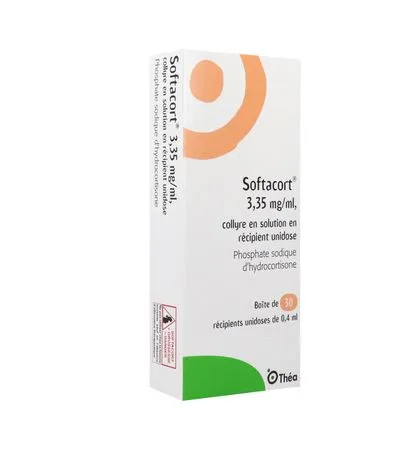
Eye drops in solution at 3,35 mg/ml (almost clear, colourless to slightly yellow, practically free of particles): Single-dose containers of 0,4 ml under sachets of 10, Box of 30.Composition
| per mL | |
| Hydrocortisone sodium phosphate
|
3,35 mg |
pH: 6,9 - 7,5.
Osmolality: 280 - 320 mOsmol/kg.
One drop contains approximately 0,12 mg of hydrocortisone sodium phosphate.
Indications
Treatment of moderate, non-infectious conjunctival conditions of allergic or inflammatory origin.Dosage and administration
DosageThe recommended dose is 2 drops 2 to 4 times a day into the affected eye.
The duration of treatment usually varies from a few days to a maximum of 14 days. A gradual reduction to administration every two days is recommended in order to avoid relapse.
In case of insufficient response, a more potent corticosteroid should be used.
Paediatric population:
The safety and efficacy in the paediatric population have not been established. See Warnings and Precautions for use.
Elderly:
No dose adjustment is necessary in elderly people.
Method of administration:
Ophthalmic use.
One single-dose container contains a sufficient quantity of eye drops to treat both eyes.
For single use only.
This medicine is a sterile solution that does not contain a preservative. The solution contained in the single-dose container must be administered immediately after opening into the affected eye or eyes (see Storage conditions).
Patients must be informed:
- to avoid any contact between the tip of the single-dose container and the eye or eyelid,
- to use the eye drops in solution immediately after first opening the single-dose container and to discard the single-dose container after use.
Naso-lacrimal occlusion by compressing the lacrimal duct for one minute may help reduce systemic absorption.
If several eye drops in solution are used, the instillations must be spaced at least 5 minutes apart.
Contraindications
- Hypersensitivity to the active substance or to any of the excipients listed in section Composition.
- Known ocular hypertension related to the administration of glucocorticoids and other forms of ocular hypertension.
- Acute viral infection Herpes simplex or most other viral corneal infections at the ulceration stage (except in combination with antiviral chemotherapy specific to the herpes virus), conjunctivitis with ulcerative keratitis from the initial stage (positive fluorescein test).
- Ocular tuberculosis.
- Ocular mycosis.
- Acute purulent ocular infection, purulent conjunctivitis or purulent blepharitis, stye or herpes virus infection that may be masked or worsened by the administration of anti-inflammatory medicinal products.
Warnings and precautions
Topical corticosteroids must never be administered in the presence of an undiagnosed red eye.
This medicinal product is not recommended for the treatment of herpetic keratitis, but it may be used if necessary only in combination with antiviral treatment and under the close supervision of an ophthalmologist.
A pathological thinning of the cornea and sclera may increase the risk of perforation when using topical corticosteroids.
A fungal infection should be suspected in case of corneal ulceration when a corticosteroid is or has been used for a prolonged period.
Patients treated with a hydrocortisone eye drop should be monitored frequently. Prolonged use of corticosteroids has been shown to cause ocular hypertension or glaucoma, particularly in patients with a history of increased IOP related to corticosteroid administration or with pre-existing high IOP or glaucoma (see ContraindicationsAdverse effects) and the development of cataract, particularly in children and elderly people.
The use of corticosteroids may also cause opportunistic ocular infections related to suppression of the host response or delayed healing. In addition, topical corticosteroids administered by the ophthalmic route may promote, worsen or mask the signs and symptoms of opportunistic ocular infections.
Wearing contact lenses should be avoided during treatment with an eye drop containing corticosteroids.
Visual disturbances:
Visual disturbances may occur during systemic or local corticosteroid therapy. In case of blurred vision or the appearance of any other visual symptom during corticosteroid therapy, an ophthalmological examination is required to look for, in particular, cataract, glaucoma, or a rarer lesion such as central serous chorioretinopathy, described with the administration of systemic or local corticosteroids.
Corneal calcification:
This medicine contains 0,227 mg of phosphates per drop (see Undesirable effects).
Paediatric population:
In children, continuous long-term treatment with corticosteroids may produce adrenal insufficiency (see Posology and Method of administration).
In children, ocular hypertension related to the use of topical corticosteroids is more frequent, more severe and faster than that reported in adults.
Interactions
No interaction studies have been performed.
An increased risk of systemic side effects is expected in case of concomitant treatment (or combination treatment) with CYP3A inhibitors, including products containing cobicistat. The combination should be avoided unless the benefit outweighs the increased risk of systemic corticosteroid-related side effects, in which case patients should be monitored for systemic side effects related to corticosteroid use.
Fertility, pregnancy and breastfeeding
Pregnancy:There is little or no data on the use of Softacort in pregnant women. Corticosteroids cross the placenta. Animal studies have shown reproductive toxicity with the formation of cleft palate (see Preclinical safety). The clinical relevance of these observations is unknown. After systemic administration of corticosteroids at higher doses, effects on the fetus/newborn have been reported (intrauterine growth retardation, inhibition of adrenocortical function). Nevertheless, these effects have not been reported with ophthalmic use.
The use of Softacort is not recommended during pregnancy, except in cases of absolute necessity.
Breastfeeding:
Systemically administered glucocorticoids are excreted in breast milk and may cause growth arrest or suppression of endogenous corticosteroid production, or may have other undesirable effects.
It is not known whether Softacort is excreted in breast milk.
A risk to newborns/infants cannot be excluded.
Fertility:There is no data on any potential effect of hydrocortisone sodium phosphate 3,35 mg/ml on fertility.
Driving and using machines
No study on the effect of this medicine on the ability to drive and use machines has been performed.Temporary blurred vision or other visual disturbances may affect the ability to drive vehicles and use machines. If blurred vision occurs, the patient must wait until their vision has returned to normal before driving vehicles or using machines.
Adverse effects
List of adverse reactions:
Undesirable effects are classified according to the following frequency categories: very common (≥ 1/10); common (≥ 1/100, < 1/10); uncommon (≥ 1/1 000, < 1/100); rare (≥ 1/10 000, < 1/1 000); very rare (< 1/10 000); frequency not known (cannot be estimated from the available data).
Hydrocortisone:
Eye disorders:
- Frequency not known: Burning*, stinging*.
Effects of the corticosteroid class:
The following undesirable effects have not been observed with hydrocortisone, but have occurred with other topical corticosteroids.
Eye disorders:
- Frequency not known: Allergic and hypersensitivity reactions, delayed wound healing, posterior subcapsular cataract*, opportunistic infections (infection by the virus Herpes simplex, fungal infections, see Warnings and Precautions for Use), glaucoma*, mydriasis, ptosis, corticosteroid-induced uveitis, changes in corneal thickness*, crystalline keratopathy, blurred vision (see Warnings and Precautions for Use).
A few rare cases of corneal calcification have been reported in association with the use of phosphate-containing drops in some patients with severely damaged corneas.
Description of certain adverse effects:
A burning sensation and stinging may occur immediately after instillation. These manifestations are generally mild, short-lived and have no consequences.
It has been shown that prolonged use of corticosteroids can cause ocular hypertension or glaucoma (particularly in patients with a history of increased intraocular pressure following corticosteroid use or with pre-existing high intraocular pressure or glaucoma, or a family history of elevated IOP or glaucoma) or also the formation of a cataract. Children and elderly patients may be particularly sensitive to the corticosteroid-induced increase in intraocular pressure (see Warnings and Precautions for Use).
The increase in intraocular pressure induced by topical corticosteroid treatment has generally been observed during the 2 first weeks of treatment (see Warnings and Precautions for Use).
Diabetics are also more likely to develop subcapsular cataract following topical corticosteroid administration.
In diseases causing thinning of the cornea, topical use of corticosteroids may in some cases lead to perforation (see Warnings and Precautions for Use).
Reporting of suspected adverse reactions:Reporting suspected adverse reactions after authorisation of the medicinal product is important. It allows continuous monitoring of the benefit/risk balance of the medicinal product. Healthcare professionals should report any suspected adverse reaction via the national reporting system: National Agency for the Safety of Medicines and Health Products (ANSM) and the network of Regional Pharmacovigilance Centres. Website: https://signalement.social-sante.gouv.fr.
Overdose
In case of overdose during local administration, with prolonged ocular irritation, the eye or eyes should be rinsed with sterile water.
Prolonged overdose may lead to ocular hypertension. In this case, it is necessary to discontinue treatment.
The symptomatology due to accidental ingestion is not known. Nevertheless, as with other corticosteroids, the physician may consider gastric lavage or induction of vomiting.
Pharmacodynamics
Pharmacotherapeutic class: Anti-inflammatories - non-associated corticosteroids, ATC code: S01BA02.
Mechanism of action:
Hydrocortisone or cortisol is a glucocorticoid secreted by the adrenal glands and endowed with anti-inflammatory activity capable of triggering secretion and inducing the synthesis of a specific inhibitor of PLA2 (lipocortin), which blocks the arachidonic acid cascade and the formation of phlogogenic factors, such as prostaglandins, thromboxanes, and leukotrienes (SRS-A). This mechanism of action explains the anti-inflammatory and anti-allergic properties of hydrocortisone.
Pharmacokinetics
A pharmacokinetic study conducted in rabbits with Softacort demonstrated that, after administration, hydrocortisone spreads rapidly into the aqueous humour, cornea and conjunctiva. Penetration of hydrocortisone is highest in the cornea, then in the conjunctiva, and is very low in the aqueous humour. A low passage of hydrocortisone into the systemic circulation was also observed (< 2 % of the instilled dose).
Preclinical safety
Repeated systemic administration of hydrocortisone over a prolonged period in animals resulted in decreased weight gain, increased neoglucogenesis and hyperglycaemia, thymolysis and ocular hypertension.
Reproductive toxicity:
In mice, ophthalmic administration of hydrocortisone has been shown to cause foetal resorptions and the formation of palatal clefts. In rabbits, ophthalmic administration of hydrocortisone caused foetal resorptions and multiple anomalies affecting the head and abdomen.
In addition, inhibition of intrauterine growth and alterations in the functional development of the central nervous system have been reported following corticosteroid administration to animals during gestation.
INCOMPATIBILITIES
Incompatibility with other medicinal products has not been studied.
Storage conditions
- Shelf life
- 2 years in the outer packaging.
- Store at a temperature not exceeding 25 °C.
- Store the single-dose containers in the sachet, protected from light.
- After first opening of the sachet: use the single-dose containers within one month.
- After opening the single-dose container: use immediately and discard the single-dose container after use.
- As sterility cannot be maintained after opening the single-dose container, any remaining contents must be discarded immediately after administration.
HANDLING/DISPOSAL INSTRUCTIONS
Any unused medicinal product or waste material should be disposed of in accordance with local requirements.
Prescription, supply and reimbursement
LIST I| Marketing authorisation (AMM) | 3400930095645 (2017, SmPC rev 22.11.2023) 30 single-dose containers. |
| Not reimbursed by Social Security. | |
| Collection. |
THÉA PHARMA
37, rue Georges-Besse
63100 Clermont-Ferrand
http://www.theapharma.fr
Source: VIDAL · Updated on 11/11/2026. This information does not replace advice from a healthcare professional.