
Medicines
SmPC of 07/05/2024
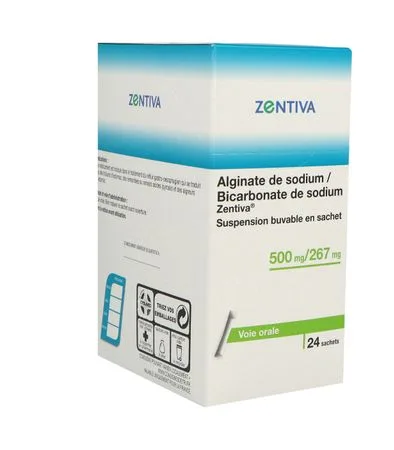
SODIUM ALGINATE/SODIUM BICARBONATE ZENTIVA 500 mg/267 mg, oral suspension in sachet
Composition
Sodium alginate...................................................................................................................................... 500,00 mg
Sodium bicarbonate................................................................................................................................267,00 mg
Per sachet of 10 ml.
Excipients with known effect: methyl parahydroxybenzoate (40 mg/sachet), propyl parahydroxybenzoate (6 mg/sachet), sodium (6 mmol or 138 mg/sachet).
Calcium carbonate, carbomer (974P), sodium saccharin, sodium methyl parahydroxybenzoate (E218), sodium propyl parahydroxybenzoate (E216), peppermint essential oil, sodium hydroxide, purified water.
Dosage and administration
Adults and children over 12 years:
1 sachet 3 times a day after the 3 main meals and possibly at bedtime in the evening.
This dosage may be doubled in cases of severe reflux or oesophageal inflammation.
Contraindications
Hypersensitivity to the active substances or to any of the excipients listed in section Composition.
Warnings and precautions
This medicine contains 138 mg (i.e. 6 mmol) of sodium per 10 ml sachet, which is equivalent to 7% of the maximum daily dietary intake of sodium recommended by the WHO.
The maximum daily dose of this medicine is equivalent to 56% of the maximum daily dietary intake of sodium recommended by the WHO.
SODIUM ALGINATE/SODIUM BICARBONATE ZENTIVA is considered a medicine with a high sodium content. This should be taken into particular consideration in patients following a low-sodium diet, for example in cases of congestive heart failure or renal failure.
This medicine contains propyl parahydroxybenzoate and methyl parahydroxybenzoate and may cause allergic reactions (possibly delayed).
This medicine contains calcium. Each sachet contains 160 mg of calcium carbonate. Precautions must be taken in patients with hypercalcaemia, nephrocalcinosis and renal calculi.
Interactions
Associations requiring precautions for use
As a precaution, an interval of 2 hours (if possible) should be considered between taking SODIUM ALGINATE/SODIUM BICARBONATE and other medicines, such as acetylsalicylic acid, H2 antihistamines, lansoprazole, bisphosphonates, cationic resins, certain antibiotics (fluoroquinolones, tetracyclines, lincosamides), digitalis glycosides, glucocorticoids, thyroid hormones, thiazide and related diuretics, phenothiazine neuroleptics, sulpiride, certain beta-blockers, penicillamine, ions (iron, phosphorus, fluoride), zinc, strontium, chloroquine, dolutegravir, elvitegravir, fexofenadine, ledipasvir, rosuvastatin, teriflunomide, ulipristal, estramustine.
Fertility, pregnancy and breastfeeding
Pregnancy
Clinical studies conducted in more than 500 pregnant women, as well as a large amount of data from post-marketing experience, have not revealed any malformative or toxic effect of the active substances on the foetus or newborn.
SODIUM ALGINATE/SODIUM BICARBONATE may be used during pregnancy if necessary.
Breast-feeding
No effect of the active substances has been demonstrated in newborns/infants breastfed by a treated woman. SODIUM ALGINATE/SODIUM BICARBONATE may be used during breastfeeding.
Fertility
Clinical data do not suggest that SODIUM ALGINATE/SODIUM BICARBONATE has an effect on human fertility at therapeutic doses.
Driving and using machines
SODIUM ALGINATE/SODIUM BICARBONATE has no effect or negligible effect on the ability to drive vehicles and use machines.
Adverse effects
Adverse effects are classified below by frequency, using the following convention: very common (≥1/10), common (≥1/100, <1/10), uncommon (≥1/1,000, < 1/100), rare (≥1/10,000, <1/1,000), very rare (<1/10,000), frequency not known (cannot be estimated from the available data).
|
System organ class |
Frequency |
Adverse effects |
|
Immune system disorders |
Very rare |
Anaphylactic and anaphylactoid reactions Hypersensitivity reactions such as urticaria |
|
Respiratory, thoracic and mediastinal disorders |
Very rare |
Respiratory effects such as bronchospasm |
Reporting of suspected adverse reactions
Reporting suspected adverse reactions after authorisation of the medicinal product is important. It allows continued monitoring of the benefit/risk balance of the medicinal product. Healthcare professionals are asked to report any suspected adverse reactions via the national reporting system: National Agency for the Safety of Medicines and Health Products (ANSM) and the network of Regional Pharmacovigilance Centres - Website: https://signalement.social-sante.gouv.fr..
Overdose
Symptoms
The possible symptoms of an overdose are minor; gastrointestinal discomfort may be felt.
Treatment
In case of overdose, treatment is symptomatic.
Pharmacodynamics
Pharmacotherapeutic class: other medicines for peptic ulcer and gastro-oesophageal reflux disease (GORD) - ATC code: A02BX.
The physico-chemical characteristics of the SODIUM ALGINATE/SODIUM BICARBONATE gel, formed on contact with acidic gastric fluid, give it the following 3 properties:
• its lightness allows it to float above the gastric contents at the level of the gastro-oesophageal junction,
• its viscosity and cohesiveness form a physical barrier that opposes reflux (reduction in the number of reflux episodes). In cases of severe reflux, the gel regurgitates first into the oesophagus and interposes itself between the oesophageal wall and the irritating gastric fluid,
• its alkaline pH replaces the acidic pH of the refluxed fluid. Gastric pH-metry shows that administration of SODIUM ALGINATE/SODIUM BICARBONATE increases the pH by 2 units at the cardia but does not modify the pH in the rest of the stomach.
Its pharmacological efficacy is confirmed by oesophageal pH-metry studies which show that SODIUM ALGINATE/SODIUM BICARBONATE significantly reduces the overall percentage of time spent at acidic pH in the oesophagus (pH < 4), as well as the number and average duration of reflux episodes.
The efficacy of SODIUM ALGINATE/SODIUM BICARBONATE on reflux symptoms has notably been established in patients who previously had grade I or II oesophagitis that had healed.
Pharmacokinetics
SODIUM ALGINATE/SODIUM BICARBONATE immediately transforms in the stomach on contact with acidic fluid into a light, foamy (release of carbon dioxide bubbles), viscous gel (alginate precipitate), with a pH close to neutral.
This gel persists for a prolonged period (2 to 4 hours) in the upper part of the stomach and is evacuated progressively as gastric emptying occurs. It does not modify transit.
Alginates (non-absorbable polysaccharides) are completely eliminated via the digestive tract.
Preclinical safety
No significant pre-clinical data have been reported. The patient may experience abdominal distension.
Prescription, supply and reimbursement
| Marketing authorisation (AMM) |
|
| Price: |
|
- Indication(s) appearing in the marketing authorisation at the date of publication of this decree
Collection.
35 RUE DU VAL DE MARNE CS 91439
75214 PARIS CEDEX 13
Tel: 0 800 089 219 https://www.zentiva.com/
Source: VIDAL · Updated on 10/11/2026. This information does not replace advice from a healthcare professional.