
Medicines
SmPC of 22/04/2025
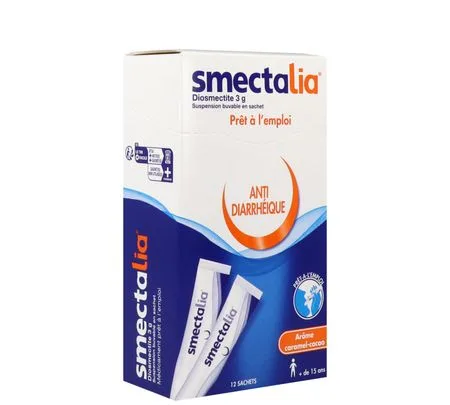
SMECTALIA 3 g, oral suspension in sachet
Composition
For one sachet:
Diosmectite: 3,000 g
Excipients with known effect:
Each sachet contains 13 mg of ethanol, 22,5 mg of propylene glycol (E1520), 15 mg of sodium benzoate, and sugar in the flavoring.
Xanthan gum, hydrochloric acid, potassium sorbate, sodium benzoate, sucralose, caramel-cocoa flavoring*, purified water.
* Composition of the caramel-cocoa flavoring: mixture of natural flavoring preparations, flavoring substances and natural flavoring substances, caramel coloring (E 150d), caramelized sugar syrup, propylene glycol (E1520), water, ethanol, caffeine.
Indications
Short-term treatment of acute diarrhoea in adults and children over 15 years. This treatment is a complement to dietary measures.
Dosage and administration
Dosage
1 sachet (3 g) then 1 sachet after each new unformed stool, without exceeding 6 sachets per day.
The maximum duration of treatment is 3 days.
Method of administration:
Oral use.
To make the suspension more fluid, it is recommended to knead the sachet between the fingers before opening it.
The contents of the sachet may be swallowed neat or diluted in a little water before use.
Preferably administer away from meals.
Contraindications
Hypersensitivity to the active substance or to any of the excipients listed in section Composition.
Warnings and precautions
Diosmectite should be used with caution in patients with a history of severe chronic constipation.
The use of SMECTALIA is not recommended in infants and children under 15 years of age.
In adults and children over 15 years, chronic use of SMECTALIA should be avoided. The treatment does not replace rehydration if this proves necessary.
The extent of rehydration by oral rehydration solution or by intravenous route must be adapted according to the intensity of the diarrhoea, the age and the particularities of the patient.
The patient should be informed of the need to:
- rehydrate by drinking plenty of fluids, salted or sweetened, in order to compensate for fluid losses due to diarrhoea (the average daily water ration for an adult is 2 litres);
- maintain food intake for the duration of the diarrhoea:
- excluding certain foods and particularly raw vegetables, fruit, green vegetables, spicy dishes, as well as iced foods or drinks;
- by favouring grilled meats and rice.
This medicine contains 13 mg of alcohol (ethanol) in each sachet. The quantity contained in one sachet of this medicine is equivalent to less than 0.325 ml of beer or 0.13 ml of wine.
This medicine contains 22,5 mg of propylene glycol (E 1520) in each sachet.
This medicine contains 15 mg of sodium benzoate per sachet.
Patients with fructose intolerance, glucose-galactose malabsorption syndrome or sucrase/isomaltase deficiency (rare hereditary disorders) must not take this medicine.
Interactions
As the adsorbent properties of this product may interfere with the timing and/or rate of absorption of another substance, it is recommended to administer any other medicine at a distance from SMECTALIA (more than 2 hours, if possible).
Fertility, pregnancy and breastfeeding
Pregnancy
There are no data or there are limited data (fewer than 300 pregnancies) on the use of SMECTALIA in pregnant women.
Studies performed in animals are insufficient to allow a conclusion regarding reproductive toxicity.
SMECTALIA is not recommended during pregnancy.
Breast-feeding
There are limited data on the use of SMECTALIA during breastfeeding.
SMECTALIA is not recommended during breastfeeding.
Fertility
The effect on human fertility has not been studied.
Driving and using machines
SMECTALIA has no or negligible effect on the ability to drive vehicles and use machines.
Adverse effects
The most frequently reported adverse effect during treatment is constipation, which occurs in approximately 7 % of adults and 1 % of children. If constipation occurs, treatment with diosmectite must be stopped, and reintroduced if necessary at a lower dose.
The adverse effects reported during clinical studies and post-marketing surveillance are listed below. Their frequency is defined according to the following convention: very common (≥ 1/10); common (≥ 1/100 to < 1/10); uncommon (≥ 1/1 000 to < 1/100); rare (≥ 1/10 000 to < 1/1 000); frequency not known (cannot be estimated from the available data).
|
System Organ Class |
Frequency |
Adverse reaction |
|
Gastrointestinal disorders |
Common |
Constipation |
|
Uncommon |
Vomiting |
|
|
Skin and subcutaneous tissue disorders |
Uncommon |
Eruption |
|
Rare |
Urticaria |
|
|
Frequency not known |
Angioedema, pruritus |
|
|
Immune system disorders |
Frequency not known |
Hypersensitivity |
Reporting of suspected adverse reactions
Reporting suspected adverse reactions after authorisation of the medicinal product is important. It allows continued monitoring of the benefit/risk balance of the medicinal product. Healthcare professionals are asked to report any suspected adverse reactions via the national reporting system: National Agency for the Safety of Medicines and Health Products (ANSM) and the network of Regional Pharmacovigilance Centres - Website: https://signalement.social-sante.gouv.fr/.
Pharmacodynamics
Pharmacotherapeutic class: other intestinal adsorbents, ATC code: A07BC05.
It has been demonstrated in clinical pharmacology that diosmectite:
- Adsorbs intestinal gases in adults
- Restores normal mucosal permeability, in a clinical study conducted in children with gastroenteritis.
Due to its layered structure and high plastic viscosity, diosmectite has a significant covering capacity on the digestive mucosa.
Pharmacokinetics
Given the structure of diosmectite, SMECTALIA remains on the luminal side of the digestive epithelium. It is neither absorbed nor metabolised.
Diosmectite is eliminated in the stools through the natural process of intestinal transit.
Preclinical safety
Preclinical safety data, obtained from conventional acute and repeated-dose toxicity studies and genotoxicity studies, did not reveal any particular risk for humans.
Prescription, supply and reimbursement
| Marketing authorisation (AMM) |
|
Not reimbursed by Social Security.
MAYOLY PHARMA FRANCE
3, Renault Square. 92500 Rueil-Malmaison
Medical information:
Tel: 01 58 33 51 16
Source: VIDAL · Updated on 11/11/2026. This information does not replace advice from a healthcare professional.