
Medicines
SmPC of 30/04/2024
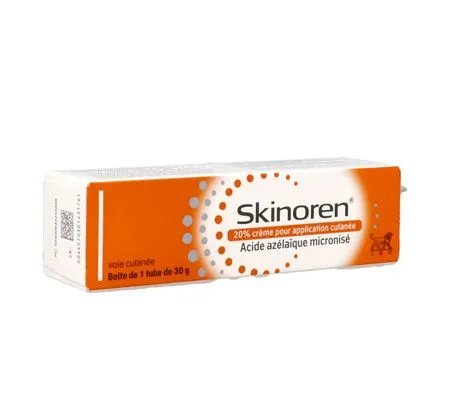
SKINOREN 20 %, cream for cutaneous application
Composition
Micronised azelaic acid(1) .......................................................................................................20,000 g
(1) Micronised azelaic acid: heptane 1,7 dicarboxylic acid
For 100 g of cream
Excipients with known effect: 100 g of cream contain 12,50 g of propylene glycol, 0,20 g of benzoic acid and 1,15 g of cetostearyl alcohol.
Benzoic acid (E210)
Purified water
Glycerol at 85 %
Stearic macrogolglycerides
Cetostearyl alcohol
Glycerol monostearate 40-55
Cetearyl octanoate + isopropyl myristate (PCL Liquid)
Propylene glycol
Indications
Local treatment of acne vulgaris.
Official recommendations concerning the appropriate use of antibacterial agents should be taken into account.
Dosage and administration
Dosage
- Apply SKINOREN to acne lesions of the skin, 2 times a day, morning and evening, and massage in gently.
- Approximately 2,5 cm of cream is sufficient to cover the entire face.
- Cleanse the skin thoroughly with clear water, or with a non-irritating toilet product, and dry before applying SKINOREN.
- Avoid concomitant use of any cosmetic or therapeutic product likely to be irritating.
- It is essential to apply SKINOREN regularly, throughout the duration of treatment.
- The duration of use of SKINOREN varies between individuals, depending on the severity of the acne. Initial improvement generally appears after 4 weeks and increases with continued treatment, which, for optimal results, should be continued for several months.
In case of skin intolerance occurring (see section Adverse effects), the amount of cream applied should be reduced or the frequency of administration reduced to one application per day until the symptoms disappear. If necessary, treatment should be temporarily interrupted.
Paediatric population
Use in adolescents (aged 12 to 18 years) : It is not necessary to adjust the dose of SKINOREN when used in adolescents aged 12 to 18 years.
The safety and efficacy of SKINOREN in children aged less than 12 years have not been established.
Elderly patients
No specific study has been carried out in patients older than 65 years.
Patients with hepatic impairment
No specific studies have been conducted in patients with impaired hepatic function.
Patients with renal impairment
No specific studies have been conducted in patients with impaired renal function.
Method of administration
SKINOREN is for cutaneous use only.
Contraindications
Hypersensitivity to the active substance or to any of the excipients listed in section Composition.
Warnings and precautions
Care must be taken to avoid any contact with the eyes, mouth and any other mucous membrane when using SKINOREN, and patients must be informed of this (see section Preclinical safety). In case of accidental contact with the eyes, mouth and/or mucous membranes, abundant rinsing with water must be performed. If eye irritation persists, patients must consult a doctor. Hands must be washed after each application of SKINOREN.
SKINOREN contains 2 mg of benzoic acid per gram of cream. Benzoic acid may cause local irritation.
SKINOREN contains 125 mg of propylene glycol per g of cream.
SKINOREN contains cetostearyl alcohol, which may cause local skin reactions (for example contact dermatitis).
Worsening of asthma in patients treated with azelaic acid has been reported in rare cases during post-marketing surveillance.
The use of alcohol-based make-up removers, tinctures and astringents, abrasive and exfoliating agents is not recommended in patients using azelaic acid.
Fertility, pregnancy and breastfeeding
Pregnancy
There are no adequate and well-controlled studies of cutaneous administration of azelaic acid in pregnant women.
Studies carried out in animals have shown a risk of effects on pregnancy, embryo-foetal development, parturition or post-natal development. Nevertheless, the maximum dose without observed harmful effect in animals varies, depending on the studies, from 3 to 32 times the maximum recommended human dose based on body surface area (see section Preclinical safety).
Caution is required when prescribing azelaic acid to a pregnant woman.
Breast-feeding
In vivo, the excretion of azelaic acid into breast milk has not been demonstrated. Nevertheless, passage of this substance into breast milk has been shown in vitro by an equilibrium dialysis technique.
However, the passage of azelaic acid into breast milk is not likely to cause a significant change in the baseline level of azelaic acid in breast milk. Azelaic acid does not concentrate in milk and after cutaneous application, less than 4 % of azelaic acid is absorbed into the systemic circulation, which does not increase endogenous exposure beyond the physiological level.
However, caution is required when SKINOREN is administered to a breast-feeding woman.
Children must not be brought into contact with the treated area (skin/breast).
Fertility
There are no data on the effects of SKINOREN on human fertility. The results of studies carried out in animals have not shown effects on fertility in male or female rats (see section Preclinical safety).
Driving and using machines
SKINOREN has no or negligible effect on the ability to drive vehicles and use machines.
Adverse effects
Based on clinical trials and post-marketing surveillance data, the most frequently observed adverse effects were: burning, pruritus, and erythema at the application site.
The frequencies of adverse effects observed during clinical studies and from post-marketing surveillance, listed in the table below, are defined according to MedDRA frequency conventions:
Very common (≥ 1/10),
Common (≥ 1/100 to < 1/10),
Uncommon (≥ 1/1,000 to < 1/100),
Rare (≥ 1/10,000 to < 1/1,000),
Very rare (< 1/10,000),
Frequency not determinable (cannot be estimated from the available data).
|
System Organ Class |
Very common |
Common |
Uncommon |
Rare |
|
Immune system disorders |
drug hypersensitivity (which may occur with one or more of the following adverse effects: |
|||
|
angioedema1, |
||||
|
contact dermatitis1, |
||||
|
swelling of the eyes1, |
||||
|
swelling of the face1) |
||||
|
worsening of asthma (see section Warnings and precautions) |
||||
|
Skin and subcutaneous tissue disorders |
seborrhoea |
urticaria1, |
||
|
cheilitis |
||||
|
skin depigmentation |
skin rash1 |
|||
|
acne |
||||
|
General disorders and administration site conditions |
burning at the application site |
pain at the application site |
paraesthesia at the application site |
|
|
pruritus at the application site |
exfoliation at the application site |
dermatitis at the application site |
heat at the application site |
|
|
erythema at the application site |
dryness at the application site |
discomfort at the application site |
vesicles at the application site |
|
|
change in skin colour at the application site |
oedema at the application site |
eczema at the application site |
||
|
irritation at the application site |
ulcer at the application site |
1 These adverse effects have been reported during post-marketing use of SKINOREN.
Local skin irritations regress during treatment (see management in section Dosage and administration).
Paediatric population
In clinical studies including adolescents aged 12 to 18 years (454/1 336 ; 34 %), the local tolerance of SKINOREN was the same in the paediatric and adult populations.
Reporting of suspected adverse reactions
Reporting suspected adverse reactions after authorisation of the medicinal product is important. It allows continued monitoring of the benefit/risk balance of the medicinal product. Healthcare professionals are asked to report any suspected adverse reactions via the national reporting system: French National Agency for the Safety of Medicines and Health Products (ANSM) and network of Regional Pharmacovigilance Centres - Website: https://signalement.social-sante.gouv.fr/.
Overdose
SKINOREN is intended for external use only.
Due to the very low local and systemic toxicity of azelaic acid, intoxication is unlikely.
Animal studies have shown that vomiting is possible following accidental ingestion of large quantities.
However, no organ toxicity is to be feared.
Pharmacodynamics
Pharmacotherapeutic class: other anti-acne preparations for topical use, ATC code: D10AX03.
The antimicrobial activity of azelaic acid and its influence on follicular hyperkeratosis explain the effect of SKINOREN in the treatment of acne.
Azelaic acid has an anti-bacterial effect on the Propionibacterium acnes, the main cause of inflammatory phenomena. SKINOREN significantly reduces the number of Propionibacterium acnes and Staphylococcus epidermidis as well as the quantity of free fatty acids in the lipids of the skin surface.
Azelaic acid inhibits the proliferation of keratinocytes in culture by inhibiting DNA synthesis. It accelerates the lysis of comedones induced by tetradecane in the experimental rabbit ear model. SKINOREN would act on the different stages of keratinisation of the pilosebaceous follicle and on keratinocyte differentiation (filaggrin).
Clinical data on continuous use for up to one year are available.
Pharmacokinetics
After cutaneous administration of the cream, azelaic acid penetrates all layers of the skin; 3,6 % of the administered dose is absorbed. Penetration is faster if the skin is damaged.
Due to the low percutaneous absorption, passage into breast milk is negligible, and the dose of azelaic acid absorbed by the child is less than 200 μg per day, which corresponds to 0,01 % of the maximum doses applied (i.e., 5 g 2 times per day) (see also section Fertility, pregnancy and breastfeeding).
A portion of the azelaic acid absorbed through the skin is eliminated unchanged in the urine. The other portion is metabolised by beta-oxidation into short-chain dicarboxylic acids (C7 and C5), which are also eliminated in the urine.
Preclinical safety
Non-clinical data from conventional safety pharmacology, repeated-dose toxicity, genotoxicity, and reproductive and developmental toxicity studies did not reveal any particular risk for humans.
Systemic tolerance studies after repeated oral and cutaneous administration of azelaic acid and the excipients contained in the cream did not reveal any expected adverse effects, even under extreme conditions of use such as application over a large surface area and/or under occlusion.
In embryo-foetal development studies in rats, rabbits and monkeys, orally administered azelaic acid during the period of organogenesis showed embryotoxicity at doses associated with maternal toxicity. No teratogenic effect was observed. The maximum dose without observed adverse effect (NOAEL) for embryo-foetal development corresponded to 32 times the maximum recommended human dose (MRHD) based on body surface area (BSA) in rats, 6,5 times in rabbits and 19 times in monkeys (see section Fertility, pregnancy and breastfeeding).
In a peri- and post-natal development study in rats, azelaic acid administered orally from the 15th to post-partum day 21th day post-partum showed slight disturbances in the post-natal development of the foetuses at doses associated with maternal toxicity. In this study, the maximum dose without observed adverse effect corresponded to 3 times the maximum recommended human dose based on body surface area. No effect on sexual maturation of the foetuses was observed during this study.
Animal reproductive toxicology studies do not indicate any particular risks resulting from the use of SKINOREN at the therapeutic dose.
Studies in vitro and in vivo with azelaic acid did not reveal mutagenic effects on germ cells and somatic cells. No specific carcinogenesis study has been conducted on azelaic acid in cream form. Such studies are not considered necessary because azelaic acid is present in normal mammalian metabolism and no carcinogenic potential is expected, given the chemical nature of this substance and the available preclinical data. Indeed, the latter show an absence of toxicity on target organs, an absence of proliferation and an absence of induction of genotoxicity/mutagenicity.
Experimental animal studies on the local cutaneous tolerance of SKINOREN in rabbits revealed slight intolerance reactions.
Contact of SKINOREN with the eyes should be avoided due to its moderate to severe irritant effect detected during tolerance studies on the eyes of rabbits and monkeys.
No comedogenic reaction of SKINOREN cream was demonstrated on the rabbit ear.
No sensitising effect of the active substance was found in the maximisation test in guinea pigs.
Single intravenous administration of azelaic acid showed no effects on the nervous system (Irwin test), cardiovascular function, intermediary metabolism, smooth muscles, or hepatic and renal function.
Shelf life
3 years
After first opening of the tube, the medicinal product must be stored for a maximum of 6 months.
Prescription, supply and reimbursement
| Marketing authorisation (AMM) |
|
IMMEUBLE AMPERE E + LA DÉFENSE 34-40 RUE HENRI REGNAULT
92400 COURBEVOIE-LA-DÉFENSE
Tél : 01 30 14 40 00 leo.group@leo-pharma.com
https://www.leo-pharma.fr/
Source: VIDAL · Updated on 11/11/2026. This information does not replace advice from a healthcare professional.