
Medicines
SmPC of 17/09/2025
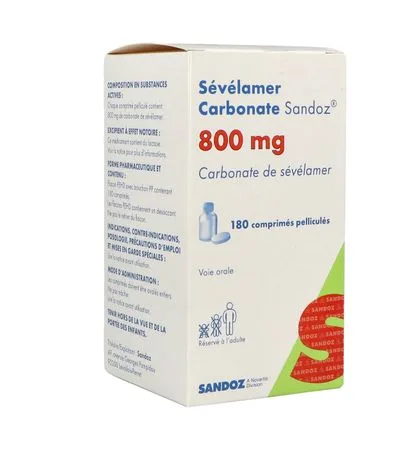
SEVELAMER CARBONATE SANDOZ 800 mg, film-coated tablet
Forms and presentations
Film-coated tablet.
Oval, film-coated tablets, white to off-white (20 mm x 7 mm) without a break bar. The tablets are engraved "SVL" on one side.
Composition
Each film-coated tablet contains 800 mg of sevelamer carbonate.
Excipient with known effect : Each film-coated tablet contains 271,94 mg of lactose.
Tablet core
Lactose monohydrate, anhydrous colloidal silica, zinc stearate.
Film coating
Hypromellose (E464), diacetylated monoglycerides.
Indications
SEVELAMER CARBONATE SANDOZ is indicated for the control of hyperphosphataemia in adult patients on haemodialysis or peritoneal dialysis.
SEVELAMER CARBONATE SANDOZ is also indicated for the control of hyperphosphataemia in adult patients with chronic kidney disease (CKD) not on dialysis, whose serum phosphate level is greater than or equal to 1,78 mmol/l.
SEVELAMER CARBONATE SANDOZ should be used as part of a multiple therapeutic approach, which may include a calcium supplement, 1,25-dihydroxy vitamin D3 or an analogue, to prevent the development of renal osteodystrophy.
Dosage and administration
Dosage
Initial dose
The recommended initial dose of sevelamer carbonate is 2,4 g or 4,8 g per day depending on clinical needs and serum phosphate level. SEVELAMER CARBONATE SANDOZ should be taken three times a day with meals.
|
Patient's serum phosphate level |
Total daily dose of sevelamer carbonate to be taken three times a day with meals |
|
1,78 – 2,42 mmol/l (5,5 – 7,5 mg/dl) |
2,4 g* |
|
> 2,42 mmol/l (> 7,5 mg/dl) |
4,8 g* |
*With subsequent dose increase, see section "Dose titration and maintenance dosage".
In patients previously on phosphate binders (sevelamer hydrochloride or calcium-based binders), SEVELAMER CARBONATE SANDOZ should be administered at an equivalent dose in grams while monitoring serum phosphate levels until optimal daily doses are achieved.
Dose escalation and maintenance dosage
Serum phosphate levels should be monitored and the dose of sevelamer carbonate increased in steps of 0,8 g three times a day (2,4 g per day) every 2-4 weeks until an acceptable serum phosphate level is achieved. Thereafter, regular monitoring should be maintained.
Patients taking SEVELAMER CARBONATE SANDOZ should follow the diet prescribed to them.
In clinical practice, treatment should be continuous in order to balance serum phosphate levels, and the expected daily dose is, on average, approximately 6 g per day.
Special populations
Elderly patients
No dose adjustment is necessary in elderly patients.
Patients with hepatic impairment
No studies have been conducted in patients with hepatic impairment.
Paediatric population
The safety and efficacy of SEVELAMER CARBONATE SANDOZ in children under 6 years of age or whose body surface area (BSA) is less than 0.75 m² have not been established.2 have not been established. No data are available.
The safety and efficacy of SEVELAMER CARBONATE SANDOZ in children over 6 years of age and whose BSA is greater than 0,75 m² have been evaluated. The data currently available are described in section Pharmacodynamics.
For the paediatric population, since the tablets are not suitable, the oral suspension must be administered.
Method of administration
Oral use.
Tablets must be swallowed whole, without being crushed, chewed, or cut into pieces before administration. SEVELAMER CARBONATE SANDOZ must be taken during a meal or a snack and must not be taken on an empty stomach.
Contraindications
• hypersensitivity to the active substance or to any of the excipients listed in section Composition,
• hypophosphataemia,
• intestinal obstruction.
Warnings and precautions
The safety and efficacy of SEVELAMER CARBONATE SANDOZ have not been studied in adults with non-dialysed chronic kidney disease whose serum phosphate level is less than 1,78 mmol/L. Therefore, sevelamer is currently not recommended in these patients.
The safety and efficacy of SEVELAMER CARBONATE SANDOZ have not been established in patients with the following disorders:
• dysphagia,
• swallowing disorders,
• severe gastrointestinal motility disorders including untreated or severe gastroparesis, and retention of gastric contents and abnormal or irregular stools,
• active inflammatory bowel disease,
• major gastrointestinal surgery.
Treatment of these patients with SEVELAMER CARBONATE SANDOZ should be initiated only after careful assessment of the benefit/risk ratio. If treatment is initiated, patients with these disorders should be monitored. Treatment with SEVELAMER CARBONATE SANDOZ should be re-evaluated in patients who develop constipation or other severe gastrointestinal symptoms.
Intestinal obstruction and ileus/subileus
In very rare cases, intestinal obstruction and ileus/subileus have been observed in patients taking sevelamer hydrochloride (capsules/tablets), which contains the same active molecular moiety as sevelamer carbonate. Constipation may be a precursor symptom. Constipated patients should be closely monitored during treatment with SEVELAMER CARBONATE SANDOZ. Treatment with SEVELAMER CARBONATE SANDOZ should be re-evaluated in patients if constipation or severe gastrointestinal symptoms occur.
Fat-soluble vitamins and folate deficiency
Patients with chronic kidney disease may have low levels of the fat-soluble vitamins A, D, E and K, depending on dietary intake and the severity of their disease. Binding of dietary fat-soluble vitamins by SEVELAMER CARBONATE SANDOZ cannot be excluded. In patients taking sevelamer who do not take vitamin supplements, serum concentrations of vitamins A, D, E and K should be assessed regularly. Vitamin supplements should be given as needed, and vitamin D supplements (approximately 400 IU of native vitamin D per day) are recommended for patients with non-dialysed chronic kidney disease. These supplements may be incorporated into a multivitamin preparation to be taken at a distance from the dose of SEVELAMER CARBONATE SANDOZ. In patients on peritoneal dialysis, additional monitoring of fat-soluble vitamins and folic acid is recommended, as concentrations of vitamins A, D, E and K were not measured in these patients during clinical studies.
Currently available data do not allow exclusion of the possibility of folate deficiency during long-term treatment with SEVELAMER CARBONATE SANDOZ. In patients taking sevelamer who do not receive folic acid supplementation, folate levels should be assessed regularly.
Hypocalcaemia/hypercalcaemia
Patients with CKD are at risk of developing hypocalcaemia or hypercalcaemia. SEVELAMER CARBONATE SANDOZ does not contain calcium. Serum calcium should therefore be monitored at regular intervals and calcium supplementation should be given if necessary.
Metabolic acidosis
Patients with CKD are susceptible to developing metabolic acidosis. Good clinical practice therefore recommends monitoring serum bicarbonate levels.
Peritonitis
Dialysis patients are subject to certain infection risks inherent to the dialysis technique used. Peritonitis is a known complication in patients on peritoneal dialysis. In a clinical study on sevelamer hydrochloride, a greater number of cases of peritonitis were reported in the sevelamer group than in the control group. Patients on peritoneal dialysis must be closely monitored to ensure compliance with aseptic conditions, as well as the identification and prompt management of any signs and symptoms associated with peritonitis.
Difficulty swallowing and risk of choking
Rare cases of difficulty swallowing SEVELAMER CARBONATE SANDOZ tablets have been reported. For the most part, these involved patients with a comorbidity, including swallowing disorders or esophageal abnormalities. The ability to swallow properly should be closely monitored in patients with comorbidities. Administration of sevelamer carbonate powder should be considered in patients with a history of swallowing difficulties.
Hypothyroidism
Closer monitoring of patients with hypothyroidism receiving sevelamer carbonate concomitantly with levothyroxine is recommended (see section Interactions).
Hyperparathyroidism
SEVELAMER CARBONATE SANDOZ is not indicated for the control of hyperparathyroidism. In patients with secondary hyperparathyroidism, SEVELAMER CARBONATE SANDOZ should be used as part of a multiple therapeutic approach, which may include calcium supplements, vitamin 1,25-dihydroxy D3 or an analogue, to reduce intact parathyroid hormone (iPTH) levels.
Gastrointestinal inflammatory disorders
Cases of severe inflammatory disorders affecting various parts of the gastrointestinal tract (including serious complications such as hemorrhage, perforation, ulceration, necrosis, colitis and colonic mass/cecal mass) associated with the presence of sevelamer crystals have been reported (see section Adverse effects). Inflammatory disorders may resolve upon discontinuation of sevelamer. Treatment with sevelamer carbonate should be reassessed in patients presenting with severe gastrointestinal symptoms.
Lactose intolerance
SEVELAMER CARBONATE SANDOZ contains lactose. Patients with rare hereditary problems of galactose intolerance, such as total lactase deficiency or glucose-galactose malabsorption syndrome, must not take this medicine.
Interactions
Dialysis
No interaction study has been performed in dialysis patients.
Ciprofloxacin
In interaction studies in healthy volunteers, sevelamer hydrochloride, which contains the same active molecular moiety as SEVELAMER CARBONATE SANDOZ, decreased the bioavailability of ciprofloxacin by approximately 50% when both medicines were administered concomitantly, in a single-dose study. Therefore, SEVELAMER CARBONATE SANDOZ must not be administered at the same time as ciprofloxacin.
Ciclosporin, mycophenolate mofetil and tacrolimus in transplant patients
A decrease in ciclosporin, mycophenolate mofetil and tacrolimus levels has been reported in transplant patients when administered concomitantly with sevelamer hydrochloride, without clinical consequences (e.g., graft rejection). The possibility of an interaction therefore cannot be excluded, and close monitoring of blood concentrations of ciclosporin, mycophenolate mofetil and tacrolimus should be considered when co-administered with SEVELAMER CARBONATE SANDOZ and after its discontinuation.
Levothyroxine
Very rare cases of hypothyroidism have been reported in patients receiving sevelamer hydrochloride, which contains the same active molecular moiety as sevelamer carbonate, concomitantly with levothyroxine. Closer monitoring of thyroid-stimulating hormone (TSH) levels is therefore recommended in patients receiving sevelamer carbonate and levothyroxine.
Antiarrhythmics and anticonvulsants
Patients receiving antiarrhythmics for arrhythmia or anticonvulsants for convulsive disorders were excluded from clinical trials. A possible reduction in absorption therefore cannot be excluded. Antiarrhythmics should be taken at least one hour before or three hours after SEVELAMER CARBONATE SANDOZ, and blood monitoring may be considered.
Digoxin, warfarin, enalapril or metoprolol
In interaction studies in healthy volunteers, sevelamer hydrochloride, which contains the same active molecular moiety as sevelamer carbonate, had no effect on the bioavailability of digoxin, warfarin, enalapril or metoprolol.
Proton pump inhibitors
Since marketing, very rare cases of elevated phosphate concentrations have been reported in patients treated concomitantly with proton pump inhibitors and sevelamer carbonate. PPIs should be prescribed with caution in patients treated in combination with sevelamer. Serum phosphate levels should be monitored and the sevelamer dose adjusted accordingly.
Bioavailability
SEVELAMER CARBONATE SANDOZ is not absorbed and may affect the bioavailability of other medicines. Medicines whose reduced bioavailability may have a significant clinical impact on their tolerability or efficacy must be administered at least one hour before or three hours after taking SEVELAMER CARBONATE SANDOZ. If this is not possible, monitoring of blood levels should be considered by the physician.
Fertility, pregnancy and breastfeeding
Pregnancy
There are no or very limited data on the use of sevelamer in pregnant women. Animal studies have shown reproductive toxicity when sevelamer was administered at high doses to rats (see section Preclinical safety). Sevelamer has also been shown to reduce the absorption of several vitamins, including folic acid (see sections Warnings and precautions and Preclinical safety). The potential clinical risk is not known. SEVELAMER CARBONATE SANDOZ should only be administered to pregnant women if absolutely necessary, after careful assessment of the benefit/risk ratio, both for the mother and for the foetus.
Breast-feeding
There is no data on the excretion of sevelamer/metabolites in human milk. As sevelamer is not absorbed, its excretion in human milk is unlikely. The decision whether to continue or discontinue breast-feeding, or to continue or interrupt treatment with SEVELAMER CARBONATE SANDOZ, should take into account the benefit of breast-feeding for the child and the benefit of treatment with SEVELAMER CARBONATE SANDOZ for the mother.
Fertility
There is no data on the effect of sevelamer on fertility in humans. Animal studies have shown that sevelamer had no effect on the fertility of male and female rats exposed to doses equivalent in humans to twice the maximum dose of 13 g/day used in clinical trials, based on a comparison of relative body surface areas.
Driving and using machines
Sevelamer carbonate has negligible or no effect on the ability to drive and use machines.
Adverse effects
Summary of the safety profile
The most frequent adverse reactions (≥ 5 % of patients) all belonged to the system organ class 'Gastrointestinal disorders'. Most of these adverse reactions were of mild to moderate intensity.
Tabulated list of adverse reactions
The safety of sevelamer (as carbonate or hydrochloride) has been studied in numerous clinical trials, involving a total of 969 haemodialysis patients treated over a period of 4 to 50 weeks (724 patients treated with sevelamer hydrochloride and 245 with sevelamer carbonate), 97 peritoneal dialysis patients treated over a period of 12 weeks (all treated with sevelamer hydrochloride) and 128 patients with chronic kidney disease not on dialysis treated over a period of 8 to 12 weeks (79 patients treated with sevelamer hydrochloride and 49 with sevelamer carbonate).
Adverse reactions occurring in clinical trials or reported spontaneously since marketing are listed by frequency in the table below. The frequency classification of adverse events is as follows: very common (≥ 1/10), common (≥ 1/100, < 1/10), uncommon (≥ 1/1000, < 1/100), rare (≥ 1/10 000, < 1/1000), very rare (< 1/10 000), not known (cannot be estimated from the available data).
|
System organ class |
Very common |
Common |
Very rare |
Frequency not known |
|
Immune system disorders |
|
|
Hypersensitivity* |
|
|
Gastrointestinal disorders |
Nausea, vomiting, upper abdominal pain, constipation |
Diarrhoea, dyspepsia, flatulence, abdominal pain |
|
Intestinal obstruction, ileus/subileus, intestinal perforation1, gastrointestinal hemorrhage*1, intestinal ulceration*1, gastrointestinal necrosis*1, colitis*1, intestinal mass*1, |
|
Skin and subcutaneous tissue disorders |
|
|
|
Pruritus, skin rash |
|
Investigations |
|
|
|
Crystal deposition in the intestine*1 |
*post-marketing
1See the warning on gastrointestinal inflammatory disorders in section Warnings and precautions
Paediatric population
In general, the safety profile for children and adolescents (from 6 to 18 years) is similar to the safety profile in adults
Reporting of suspected adverse reactions
Reporting suspected adverse reactions after authorisation of the medicinal product is important. It allows continued monitoring of the benefit/risk balance of the medicinal product. Healthcare professionals should report any suspected adverse reaction via the national reporting system: National Agency for the Safety of Medicines and Health Products (ANSM) and the network of Regional Centres of Pharmacovigilance – Website: www.signalement.social-sante.gouv.fr.
Overdose
Sevelamer hydrochloride, which contains the same active molecular fragment as sevelamer carbonate, was administered to healthy volunteers at doses up to 14 grams per day for eight days, without undesirable effects. In patients with chronic renal failure, the maximum mean daily dose studied was 14,4 grams of sevelamer carbonate as a single dose. The symptoms observed in case of overdose are similar to the undesirable effects listed in section Adverse effects, mainly including constipation and other known gastrointestinal disorders. Appropriate symptomatic treatment must be instituted.
Pharmacodynamics
Pharmacotherapeutic class: Medicinal products for hyperkalaemia and hyperphosphataemia, ATC code: V03AE02.
Mechanism of action
SEVELAMER CARBONATE SANDOZ contains sevelamer, a non-absorbed, cross-linked phosphate-binding polymer, free of metal and calcium. Sevelamer contains several amines separated by a carbon atom from the polymer backbone, which are protonated in the stomach. These protonated amines bind negative ions, such as dietary phosphates, in the intestines.
Pharmacodynamic effect
Through the binding of phosphates in the gastrointestinal tract and the reduction of absorption, sevelamer reduces the serum phosphate concentration. Regular monitoring of serum phosphate levels must always be carried out during administration of a phosphate binder.
Clinical efficacy and safety
In two randomised clinical studies (crossover designs), sevelamer carbonate in tablets or powder administered three times daily demonstrated therapeutic equivalence with sevelamer hydrochloride. It is therefore effective in controlling serum phosphate levels in haemodialysed patients with chronic renal failure.
The first study demonstrated that sevelamer carbonate tablets administered three times daily were equivalent to sevelamer hydrochloride tablets administered three times daily in 79 haemodialysed patients treated over two randomised treatment periods of 8 weeks (the time-weighted mean serum phosphate concentrations were 1,5 ± 0,3 mmol/l for sevelamer carbonate and sevelamer hydrochloride). The second study demonstrated that sevelamer carbonate powder administered three times daily was equivalent to sevelamer hydrochloride tablets administered three times daily in 31 haemodialysed patients with hyperphosphataemia (defined as a serum phosphate level ≥ 1,78 mmol/l) over two randomised treatment periods of 4 weeks (the time-weighted mean serum phosphate concentrations were 1,6 ± 0,5 mmol/l for sevelamer carbonate powder and 1,7 ± 0,4 mmol/l for sevelamer hydrochloride tablets).
In clinical trials conducted in haemodialysed patients, sevelamer alone did not have a consistent and clinically significant effect on serum intact parathyroid hormone (iPTH) concentration. Nevertheless, during a 12-week study conducted in patients on peritoneal dialysis, reductions in iPTH comparable to those in patients on calcium acetate were observed. In patients with secondary hyperparathyroidism, SEVELAMER CARBONATE SANDOZ must be used as part of a multiple therapeutic approach, which may include calcium supplements, vitamin 1,25-dihydroxy D3 or an analogue, to reduce intact parathyroid hormone (iPTH) levels.
Sevelamer binds bile acids in vitro and in vivo in animal models. Binding of bile acids by ion-exchange resins is a well-known method for lowering cholesterol levels. In clinical trials with sevelamer, mean total cholesterol and LDL cholesterol levels decreased by 15-39%. The decrease in cholesterol levels was observed after 2 weeks of treatment and was maintained during prolonged treatment. Triglyceride, HDL cholesterol and albumin levels did not change after treatment with sevelamer.
Since sevelamer binds bile acids, it may disturb the absorption of fat-soluble vitamins such as vitamins A, D, E and K.
Sevelamer does not contain calcium and reduces the incidence of hypercalcaemic episodes compared with calcium-based phosphate binders alone. The effects of sevelamer on phosphate and calcium have been shown to be maintained throughout a study with one year of follow-up. This information is drawn from studies in which sevelamer hydrochloride was used.
Paediatric population
The safety and efficacy of sevelamer carbonate in the hyperphosphataemic paediatric population with CKD were evaluated in a multicentre study with a randomised, placebo-controlled fixed-dose period of 2 weeks, followed by an open-label, single-arm dose-titration period of 6 months. A total of 101 patients (aged 6 to 18 years with a body surface area between 0,8 m2 and 2,4 m2) were randomised in the study. Forty-nine (49) patients received sevelamer carbonate and 51 patients received placebo during the fixed-dose period of 2 weeks. Thereafter, all patients received sevelamer carbonate during the dose-titration period of 26 weeks. The primary efficacy endpoint was met, meaning that sevelamer carbonate reduced serum phosphate levels by a mean difference of -0,90 mg/dL (least squares method) compared with placebo, and the secondary efficacy endpoints were also met. In paediatric patients with hyperphosphataemia secondary to CKD, sevelamer carbonate significantly reduced serum phosphate levels compared with placebo during the fixed-dose period of 2 weeks. The therapeutic response was maintained in paediatric patients receiving sevelamer carbonate during the open-label dose-titration period of 6 months. 27 % of paediatric patients reached a serum phosphate level appropriate for their age at the end of treatment. In the subgroup of patients on haemodialysis and that of peritoneal dialysis, these figures were 23 % and 15 %, respectively. The therapeutic response during the fixed-dose period of 2 weeks was not affected by body surface area; however, no therapeutic response was observed in paediatric patients with a phosphate level below 7,0 mg/dL. The majority of adverse effects reported as related, or possibly related, to sevelamer carbonate were gastrointestinal in nature. No new risk or signal was identified with the use of sevelamer carbonate during the study.
Pharmacokinetics
No pharmacokinetic study has been performed on sevelamer carbonate. Sevelamer hydrochloride, which contains the same active molecular moiety as sevelamer carbonate, is not absorbed from the gastrointestinal tract, as was confirmed in an absorption study conducted in healthy volunteers.
In a one-year clinical trial, no signs of sevelamer accumulation were observed. However, the potential absorption and accumulation of sevelamer during long-term chronic treatment (> one year) cannot be fully excluded.
Preclinical safety
Preclinical data from conventional safety pharmacology, repeated-dose toxicity or genotoxicity studies on sevelamer did not reveal any particular risk for humans.
Carcinogenicity studies on oral sevelamer hydrochloride were conducted in mice (doses up to 9 g/kg/day) and in rats (0,3, 1 or 3 g/kg/day). An increased incidence of transitional cell papillomas of the bladder in male rats was observed in the high-dose group (equivalent to a human dose twice the maximum dose of 14,4 g used in trials). No increase in tumour incidence was observed in mice (dose equivalent to a human dose 3 times higher than the maximum dose used in the clinical trial).
In a cytogenetic test in vitro In mammals with metabolic activation, sevelamer hydrochloride caused a statistically significant increase in the number of structural chromosomal aberrations. Sevelamer hydrochloride was not mutagenic in the Ames bacterial mutation test.
In rats and dogs, sevelamer reduced the absorption of the fat-soluble vitamins D, E and K (clotting factors) and of folic acid.
Skeletal ossification deficits were observed at several sites in foetuses of female rats given intermediate and high doses of sevelamer (dose equivalent to a human dose below the maximum dose of 14,4 g used in the clinical trial). The effects may result from vitamin D depletion.
In pregnant female rabbits given oral doses of sevelamer hydrochloride by gavage during organogenesis, an increase in early foetal resorptions occurred in the high-dose group (dose equivalent to a human dose twice the maximum dose used in the clinical trial).
Sevelamer hydrochloride had no negative impact on the fertility of male and female rats in a dietary administration study in which females were treated for 14 days before mating and throughout gestation, and males for the 28 days preceding mating. The highest dose used in this study was 4,5 g/kg/day (human-equivalent dose of 2 times the maximum dose of 13 g/day used in clinical trials, based on comparison of relative body surface areas).
Prescription, supply and reimbursement
| Marketing authorisation (AMM) |
|
| Price: |
|
- Indication(s) appearing in the marketing authorisation at the date of publication of this decree
Collection.
9 PLACE MARIE-JEANNE BASSOT
92300 LEVALLOIS-PERRET
Tel: 01 49 64 48 00 Tel (Green number): 0800 455 799
serviceclient.pharmacie@sc-sandoz.com
https://www.sandoz.fr/contactez-nous/
Source: VIDAL · Updated on 11/11/2026. This information does not replace advice from a healthcare professional.