
Medicines
SmPC of 25/06/2024
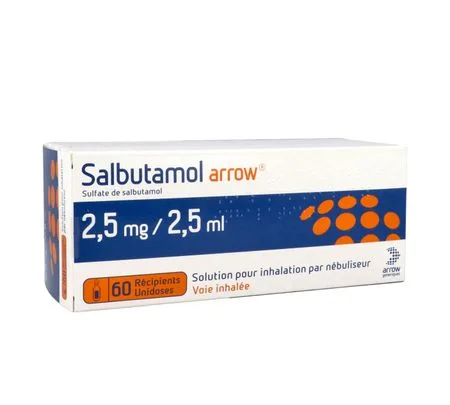
SALBUTAMOL ARROW 2,5 mg/2,5 ml, solution for inhalation by nebuliser in single-dose container
Composition
Salbutamol……………………………………………………………………….........................................2,5 mg
In the form of salbutamol sulfate
For a single-dose container of 2,5 mL
Sodium chloride, dilute sulfuric acid, purified water.
Indications
• Symptomatic treatment of severe acute asthma in adults, adolescents, children and infants.
• Treatment of acute exacerbations of chronic obstructive pulmonary disease in adults.
Remark : severe acute asthma requires hospitalisation in an intensive care unit. Oxygen therapy and systemic corticosteroid therapy should be considered in combination with bronchodilator treatment.
Dosage and administration
Dosage
The duration of action of salbutamol is 4 to 6 hours in most patients.
• Adults: the recommended initial dose of salbutamol is 2,5 mg, i.e. 1 single-dose unit of SALBUTAMOL ARROW 2,5 mg/2,5 mL by nebulisation. This dose may be increased up to 5 mg, i.e. 2 single-dose units of 2,5 mL by nebulisation (or 1 single-dose unit of SALBUTAMOL ARROW 5 mg/2,5 mL by nebulisation).
In adults, higher doses, up to 40 mg of salbutamol per day, may be administered under strict medical supervision in hospital for the treatment of severe bronchial obstruction.
• Children and infants: 50 to 150 µg of salbutamol/kg by nebulisation (i.e. 0,05 to 0,15 mL/kg of SALBUTAMOL ARROW 2,5 mg/2,5 mL), generally not exceeding 5 mg of salbutamol per nebulisation in children older than 18 months (i.e. 2 single-dose units of SALBUTAMOL ARROW 2,5 mg/2,5 mL), and 2,5 mg of salbutamol per nebulisation in infants younger than 18 months (i.e. 1 single-dose unit of SALBUTAMOL ARROW 2,5 mg/2,5 mL).
The bronchodilator duration of action of salbutamol by inhalation is 4 to 6 hours.
Under medical supervision, nebulisation may be repeated every 20 to 30 minutes depending on clinical response and tolerability of treatment, without generally exceeding 4 nebulisations per day.
Paediatric population
The clinical efficacy of salbutamol by nebulisation in infants younger than 18 months is uncertain. As transient hypoxia may occur, supplementary oxygen therapy should be implemented.
Method of administration
For inhalation use only.
This salbutamol solution must be administered by inhalation using a nebulisation device (nebuliser) fitted with a mouthpiece.
DO NOT INJECT - DO NOT DRINK THE CONTENTS OF THE SINGLE-DOSE CONTAINERS.
For the use and maintenance of the nebulisation device, follow the instructions provided by the manufacturer of the device used.
Many nebulisers on the market operate in continuous flow and the aerosol containing the medicine may be released into the environment. Salbutamol nebulisations should therefore be carried out in a properly ventilated room.
The solution is ready to use; however, if dilution is necessary, it must be carried out in sterile physiological saline.
Remove a single-dose container from the strip.
Open the container by vigorously twisting its upper end.
Squeeze the container to empty it into the reservoir of the nebuliser.
Assemble the nebuliser for administration according to the manufacturer's instructions.
Avoid eye contact with the aerosol generated by the nebuliser.
With pneumatic nebulisers, the flow of air or oxygen intended to pulse the solution will be adjusted according to the patient's condition and the recommendations of the nebulisation device manufacturer.
Nebulisation should generally not exceed 10 to 20 minutes.
The technique of use by the patient must be checked regularly.
After nebulisation, the unused solution remaining in the device chamber must be discarded. Cleaning and maintenance of the equipment should be carried out according to the manufacturer's recommendations.
Single-dose containers contain no preservative; they must be used immediately after opening. A new container must be used for each nebulisation.
The contents of partially opened or damaged single-dose containers must not be administered.
Contraindications
• Hypersensitivity to the active substance or to any of the excipients listed in section Composition.
• Intolerance to this medicine (occurrence of cough or bronchospasm immediately after inhalation of the product). In this case, this treatment should be discontinued and other therapies or other forms of administration prescribed.
Warnings and precautions
Warnings
Administration of salbutamol using a nebuliser should be reserved for severe acute situations requiring inhalation of a high dose of the product by the inhaled route. These situations require medical monitoring with the possibility of resuscitation (venous access and respiratory assistance); oxygen therapy and systemic corticosteroid therapy should generally be associated.
As with other inhaled treatments, paradoxical bronchospasm may occur, manifesting as an increase in dyspnoea and bronchial wheezing immediately after inhalation of the product. The bronchospasm will be treated with another presentation or another fast-acting inhaled bronchodilator (if available). Treatment with SALBUTAMOL ARROW must be discontinued and, if necessary, replaced by a fast-acting bronchodilator medicine.
Medicines with sympathomimetic activity, of which salbutamol is one, may cause cardiovascular effects. Cases of myocardial ischaemia associated with salbutamol have been reported through spontaneous notifications since marketing, as well as in the literature. Patients with severe underlying heart disease (for example, ischaemic heart disease, arrhythmias or severe heart failure) should be informed of the need to consult their doctor in case of chest pain or other symptoms suggestive of worsening of their heart disease. A cardiac origin of respiratory symptoms such as dyspnoea should also be considered.
Patients for whom regular anti-inflammatory treatment is prescribed (for example, inhaled corticosteroids) should be advised to continue taking their anti-inflammatory treatment even when symptoms improve, and when they do not need the inhaled salbutamol-based medicine.
An increase in the consumption of short-acting bronchodilators (in particular short-acting beta-2 agonists used to relieve symptoms) indicates deterioration of asthma control, and patients must be advised that in this case they should consult a doctor as soon as possible. The patient's therapeutic management should then be reassessed.
Overuse of short-acting beta-mimetic bronchodilators may mask the progression of the underlying disease and contribute to deterioration of asthma control, leading to an increased risk of severe asthma exacerbations and mortality.
Patients who take an inhaled salbutamol-based medicine "on demand" more than twice a week (in addition to administrations as preventive treatment of exercise-induced asthma) are at risk of salbutamol overuse and should therefore be reassessed (daytime symptoms, night-time awakenings, limitation of activities due to asthma) in order to readjust their treatment.
Precautions for use
In case of bronchial infection or abundant bronchorrhea, appropriate treatment is necessary in order to promote optimal distribution of the product in the airways.
Salbutamol should be used with caution in patients who have received high doses of other sympathomimetic medicines.
Salbutamol by nebulisation should be administered with caution in cases of hyperthyroidism, cardiovascular disorders, in particular obstructive cardiomyopathy, coronary disorders, arrhythmias, arterial hypertension, and in cases of diabetes.
High doses of beta-2 mimetics (in particular by the parenteral route or by nebulisation) may cause potentially serious hypokalaemia, which may promote the occurrence of cardiac arrhythmias. Monitoring of kalaemia is recommended where possible, in particular during simultaneous administration of hypokalaemic therapies, in cases of hypoxia or in subjects in whom the risk of torsades de pointes is increased (long QT or treatments likely to increase the QTc).
Like other beta-adrenergic receptor agonists, salbutamol may induce an increase in blood glucose. Cases of ketoacidosis have been reported in diabetic patients. Concomitant administration of corticosteroids may increase these effects.
Cases of lactic acidosis have been very rarely reported in association with high doses of short-acting beta-2 agonists given intravenously or by inhaled nebulisation, mainly in patients treated for an acute exacerbation of their asthma (see 4.8 "Undesirable effects"). An increase in lactic acid levels may lead to dyspnoea and compensatory hyperventilation, which may be wrongly interpreted as a sign of treatment failure in asthma leading to inappropriate increase of the short-acting beta-agonist treatment. Therefore, the risk of lactic acidosis should be carefully monitored, particularly in severe situations.
Interactions
Combinations not recommended
+ Non-selective beta-blockers
Salbutamol and non-selective beta-blockers, such as propranolol, should generally not be prescribed concomitantly.
+ Halogenated anaesthetics (halothane)
In case of obstetric intervention, increased uterine inertia with risk of haemorrhage; in addition, risk of occurrence of serious ventricular arrhythmias, due to increased cardiac reactivity.
Associations requiring precautions for use
+ Antidiabetics
Administration of beta-2 mimetics is associated with an increase in blood glucose, which may be interpreted as a decrease in the effect of antidiabetic treatment; therefore, it may be necessary to readjust the antidiabetic treatment (see section Warnings and precautions). Reinforce blood and urine monitoring.
Fertility, pregnancy and breastfeeding
Pregnancy
In clinical practice, there is a significant body of experience, with a sufficient number of documented pregnancies, to conclude on the safety of salbutamol during pregnancy.
Consequently, inhaled salbutamol may be administered during pregnancy.
When administered during pregnancy:
An acceleration of fetal heart rate may be observed in parallel with maternal tachycardia. It is exceptional for it to persist at birth.
Similarly, post-natal blood glucose values are only exceptionally disturbed.
In case of administration before delivery, take into account the peripheral vasodilator effect of beta-2 mimetics.
Breast-feeding
Beta-2 mimetics pass into breast milk.
Fertility
There is no information on the effects of salbutamol on human fertility. No undesirable effect on fertility has been demonstrated in animals (see section Preclinical safety).
Adverse effects
Side effects are listed below, by organ class and by frequency.
Frequencies are defined as very common (≥ 1/10), common (≥ 1/100 and < 1/10), uncommon (≥ 1/1000 and < 1/100), uncommon (≥ 1/10000 and < 1/1000) and very rare (< 1/10000) including isolated cases.
Very common and common effects have generally been described in clinical trials. Rare and very rare undesirable effects are generally derived from spontaneous reports after marketing.
|
Organ class |
Adverse effects |
Frequency |
|
Immune system disorders |
Hypersensitivity reactions including: angioneurotic edema, urticaria, pruritus, bronchospasm, hypotension, collapse |
Very rare |
|
Metabolism and nutrition disorders |
Hypokalemia* |
Very rare |
|
Lactic acidosis** |
Very rare |
|
|
Nervous system disorders |
Headache, tremor |
Common |
|
Psychiatric disorders |
Behavioural disorders: nervousness, agitation |
Very rare |
|
Cardiac disorders |
Tachycardia |
Common |
|
Palpitations |
Uncommon |
|
|
Cardiac arrhythmias (including atrial fibrillation, supraventricular tachycardia and extrasystoles) |
Very rare |
|
|
Myocardial ischaemia*** (see section Warnings and precautions) |
Not known |
|
|
Vascular disorders |
Peripheral vasodilation |
Very rare |
|
Respiratory, thoracic and mediastinal disorders |
Paradoxical bronchospasm**** |
Very rare |
|
Gastrointestinal disorders |
Irritation of the mouth and throat |
Uncommon |
|
Musculoskeletal and systemic disorders |
Muscle cramps |
Uncommon |
*Beta-2 mimetics at high doses may cause hyperglycaemia and hypokalaemia, reversible on discontinuation of treatment.
**Cases of lactic acidosis have been very rarely reported in patients receiving salbutamol intravenously or by nebulised inhalation for the treatment of acute asthma exacerbations.
***The frequency of occurrence of myocardial ischaemia cannot be determined because the reported cases come from spontaneous reports since marketing.
****As with other inhaled products, cough and, rarely, paradoxical bronchospasm may occur following inhalation. Do not repeat administration of this medicine and use another fast-acting bronchodilator to relieve the bronchospasm. Treatment should then be reassessed to consider, if appropriate, prescribing an alternative therapy.
Gastrointestinal disorders (nausea, vomiting) may also be observed.
Reporting of suspected adverse reactions
Reporting suspected adverse reactions after authorisation of the medicinal product is important. It allows continued monitoring of the benefit/risk balance of the medicinal product. Healthcare professionals are asked to report any suspected adverse reaction via the national reporting system: National Agency for the Safety of Medicines and Health Products (ANSM) and the network of Regional Centres of Pharmacovigilance - Website: https://signalement.social-sante.gouv.fr/
Overdose
The signs and symptoms of salbutamol overdose correspond to the exacerbation of the pharmacodynamic effects of beta-2 agonists (see sections Warnings and precautions and Adverse effects).
Hypokalaemia may occur following salbutamol overdose. Serum potassium should therefore be monitored in cases of overdose.
Nausea, vomiting and hyperglycaemia have been reported, particularly in children and when the overdose is due to oral salbutamol intake.
Cases of lactic acidosis have been reported with high doses of fast-acting beta-2 agonists. In case of overdose, serum lactate levels and the risk of lactic acidosis should therefore be monitored, particularly if tachypnoea persists or worsens despite disappearance of bronchospasm symptoms such as wheezing, which may be related to metabolic acidosis.
Management: monitoring and symptomatic treatment.
Pharmacodynamics
Pharmacotherapeutic class: short-acting, rapid-onset beta-2 mimetic bronchodilator for inhaled route, ATC code: R03AC02.
Salbutamol is a selective agonist of beta-2 receptors.
After inhalation, salbutamol exerts a stimulating action on the beta-2 receptors of bronchial smooth muscle, thus ensuring rapid bronchodilation, significant within a few minutes, and lasting for 4 to 6 hours.
Pharmacokinetics
After repeated nebulisations, the plasma concentrations observed at therapeutic doses are not negligible, but remain lower than those observed after administration per os or by injection.
There is no correlation between blood levels and efficacy.
After pulmonary absorption, elimination, mainly urinary, occurs essentially via the renal route in the form of sulfoconjugated derivatives (less than 2 % in unchanged form).
Preclinical safety
In a study on reproduction and fertility conducted in rats with oral doses of 2 and 50 mg/kg/day, no adverse effect was demonstrated on fertility, embryonic development, size, birth weight or growth of the offspring, with the exception of a reduction in the number of pups surviving until day 21 after birth at the dose of 50 mg/kg/day.
Prescription, supply and reimbursement
Prescription restricted to specialists in paediatrics and pneumology.
| Marketing authorisation (AMM) |
|
| Price: |
|
Collection.
26 AVENUE TONY GARNIER
69007 LYON
Tel: 04 72 72 60 72 Tel (toll-free): 0811 65 27 76
contact@laboratoire-arrow.com
http://www.laboratoire-arrow.com/
Source: VIDAL · Updated on 12/11/2026. This information does not replace advice from a healthcare professional.