
Medicines
SmPC of 26/08/2026
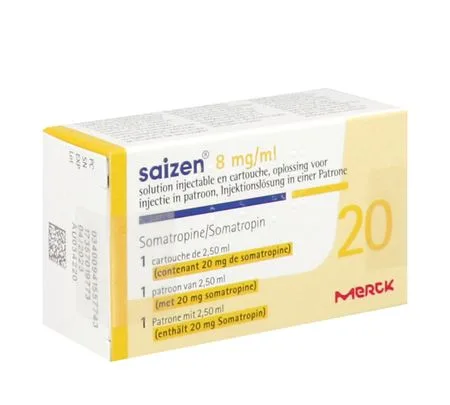
SAIZEN 8 mg/ml, solution for injection in cartridge
Forms and presentations
Injectable solution (clear to slightly opalescent, with a pH between 5,6 and 6,6 and an osmolality between 250 and 450 mOsm/kg).
Cartridge containing 1,50 ml of solution, with a red label. Box of 1.
Cartridge containing 2,50 ml of solution, with a yellow label. Box of 1.
Composition
Each SAIZEN cartridge contains 1,50 ml of solution (12 mg of somatropin*) or 2,50 ml of solution (20 mg of somatropin).
* Recombinant human growth hormone produced by recombinant DNA technology in mammalian cells.
1 ml of solution contains 8 mg of somatropin.
Sucrose, poloxamer 188, phenol, citric acid (for pH adjustment), sodium hydroxide (for pH adjustment), water for injections.
Indications
SAIZEN is indicated for the treatment of:
Children and adolescents:
- growth failure due to a deficiency or absence of endogenous growth hormone secretion, in children.
- growth failure in girls with gonadal dysgenesis (Turner syndrome) confirmed by chromosomal analysis.
- growth failure due to chronic renal insufficiency (CRI), in prepubertal children.
- growth failure (current height < -2,5 SD and adjusted target height < -1 SD) in children born small for gestational age with a birth weight and/or birth length < -2 SD, who have not caught up on their growth (growth velocity < 0 SD during the last year) at the age of 4 years or older.
Adults:
- Replacement therapy in adults with severe growth hormone deficiency documented by a single dynamic test demonstrating somatotropic deficiency. Patients must also meet the following criteria:
- Deficiency acquired during childhood:
Patients whose somatotropic deficiency was diagnosed during childhood must be re-evaluated and their somatotropic deficiency must be confirmed before starting replacement therapy with SAIZEN. - Deficiency acquired in adulthood:
Patients must have a somatotropic deficiency secondary to hypothalamic or pituitary disease and at least one other hormonal deficiency (except prolactin), and adequate replacement therapy must have been established before starting growth hormone replacement therapy.
- Deficiency acquired during childhood:
Dosage and administration
SAIZEN 8 mg/ml is intended for multidose use in a single patient.
Dosage
It is recommended to administer SAIZEN at bedtime according to the following dosage:
Paediatric population
The dose of SAIZEN must be adjusted for each patient according to body surface area (m2) or body weight (kg).
- Growth failure due to inadequate endogenous growth hormone secretion:
0,7 to 1,0 mg/m2 of body surface area per day or 0,025 to 0,035 mg/kg of body weight per day, administered subcutaneously. - Growth retardation in girls with gonadal dysgenesis (Turner syndrome):
1,4 mg/m2 of body surface area per day or 0,045 to 0,050 mg/kg of body weight per day, administered subcutaneously.
Concomitant treatment with non-androgenic anabolic steroids in patients with Turner syndrome may increase the response to treatment. - Growth retardation associated with chronic renal insufficiency (CRI) in prepubertal children:
1,4 mg/m2 of body surface area per day, corresponding to approximately 0,045 to 0,050 mg/kg of body weight per day, administered subcutaneously. - Growth retardation in children born small for gestational age:
the recommended daily dose is 0,035 mg/kg of body weight (or 1 mg/m2) administered subcutaneously.
Treatment must be discontinued when the patient has reached a satisfactory adult height or when the epiphyses have fused.
For growth retardation in children born small for gestational age, treatment is usually recommended until final height is reached. Treatment should be discontinued after the first year if the growth velocity is below +1 SD. It should be discontinued when final height is reached (growth velocity < 2 cm/year) and, when confirmation is necessary, if bone age is > 14 years (girls) or > 16 years (boys), corresponding to epiphyseal fusion.
Adults
- Growth hormone deficiency in adults:
At the start of somatropin treatment, it is recommended to administer low doses: 0,15 to 0,3 mg/day subcutaneously. The dose should then be gradually adjusted and monitored by the values of the growth factor level (IGF-1). The recommended maintenance dose of growth hormone rarely exceeds 1,0 mg/day. In general, the lowest effective dose should be administered.
Women may require higher doses than men; men showing an increase in IGF-1 sensitivity over time. There is therefore a risk that women, particularly those on oral estrogen replacement therapy, will be underdosed while men would be overdosed.
In older patients or those who are overweight, lower doses may be necessary.
Patients with renal or hepatic impairment
The data currently available are described in section Pharmacokinetics but no dosage recommendation can be made.
Method of administration
For administration of the SAIZEN injectable solution, follow the instructions in the leaflet and the instruction manual supplied with the chosen injector: the easypod auto-injector or the Aluetta injector pen.
The main users for whom easypod is intended are children from 7 years of age up to adulthood. Use of the device by a child must always be carried out under adult supervision.
For handling instructions, see section Disposal and handling.
Contraindications
Hypersensitivity to the active substance or to any of the excipients listed in section Composition.
Somatropin must not be used to stimulate growth in children whose epiphyses have fused.
Somatropin must not be used in the presence of evidence of tumour activity. Intracranial tumours must be inactive, and any anti-tumour treatment must be completed before starting growth hormone treatment. Treatment must be discontinued if signs of tumour growth appear.
Somatropin must not be used in cases of proliferative or preproliferative diabetic retinopathy.
Patients in acute critical condition, suffering from complications secondary to open-heart surgery, abdominal surgery, accidental polytrauma, acute respiratory failure or similar situations must not be treated with somatropin.
In children with chronic renal insufficiency, somatropin treatment must be discontinued in the event of kidney transplantation.
Warnings and precautions
Treatment must be carried out and monitored by a physician experienced in the diagnosis and treatment of patients with growth hormone deficiency.
The maximum recommended daily dose must not be exceeded (see section Dosage and administration).
Neoplasm
Patients with intra- or extracranial neoplasia in remission who receive growth hormone treatment should be examined carefully and at regular intervals by their physician.
When growth hormone deficiency is secondary to an intracranial tumour, patients should be examined frequently in order to monitor for progression or recurrence of the underlying tumour process.
In patients who have survived childhood cancer, an increased risk of a second neoplasm has been reported in those treated with somatropin after their first neoplasm. Intracranial tumours, in particular meningiomas in patients treated with head radiotherapy for their first neoplasm, were the most frequently observed second neoplasms.
Prader-Willi syndrome
SAIZEN is not indicated for the long-term treatment of paediatric patients with growth retardation secondary to genetically confirmed Prader-Willi syndrome, unless they also have growth hormone deficiency. Cases of sleep apnoea and sudden death have been reported after initiation of growth hormone treatment in paediatric patients with Prader-Willi syndrome who had one or more of the following risk factors: severe obesity, history of upper airway obstruction or sleep apnoea, or undiagnosed respiratory infection.
Leukaemia
Cases of leukaemia have been reported in a small number of patients with growth hormone deficiency, some of whom had been treated with somatropin. However, it has not been proven that the incidence of leukaemia is higher in individuals treated with growth hormone without predisposing factors.
Insulin sensitivity
As somatropin may reduce insulin sensitivity, patients should be monitored for signs of glucose intolerance. In patients with diabetes, the insulin dose may need to be adjusted if necessary after initiation of treatment with a product containing somatropin. Patients with diabetes or glucose intolerance should be closely monitored during somatropin treatment.
Retinopathy
Stable early retinopathy should not lead to discontinuation of replacement treatment with somatropin.
Thyroid function
Growth hormone increases the extrathyroidal conversion of T4 to T3 and may thus reveal subclinical hypothyroidism. Thyroid function should therefore be monitored in all patients. In patients with hypopituitarism, standard replacement therapy must be closely monitored when somatropin treatment is administered.
Benign intracranial hypertension
In case of severe or recurrent headaches, visual disturbances, nausea and/or vomiting, fundoscopy is advised to look for papilloedema. In case of confirmed papilloedema, a diagnosis of benign intracranial hypertension (or pseudotumor cerebri) should be considered and, if justified, treatment with SAIZEN should be discontinued. At present, there is not enough data to guide clinical decision-making in patients with normalised intracranial hypertension. If growth hormone treatment is reinstituted, close monitoring for signs of intracranial hypertension is necessary.
Pancreatitis
Although rare, pancreatitis should be considered in patients treated with somatropin, particularly in children who develop abdominal pain.
Scoliosis
It is known that scoliosis is more frequent in certain groups of patients treated with somatropin, for example in Turner syndrome. Furthermore, in children, rapid growth may lead to progression of scoliosis
It has not been demonstrated that somatropin increases the incidence or severity of scoliosis. Signs of scoliosis should be monitored during treatment.
Antibodies
As with all other medicinal products containing somatropin, a small percentage of patients are likely to develop anti-somatropin antibodies. The binding capacity of these antibodies is low and they have no effect on growth rate. Testing for anti-somatropin antibodies should be performed in all patients who do not respond to treatment.
Slipped capital femoral epiphysis and osteonecrosis in paediatric patients
Compared with the general population, patients with endocrine disorders, including growth hormone deficiency (GHD), as well as those with rapid growth, are at increased risk of slipped capital femoral epiphysis.
Cases of slipped upper femoral epiphysis or osteonecrosis of the femoral head (including Legg-Calvé-Perthes disease) have been reported in children treated with somatropin. Growth spurts may increase the risk of joint disorders, the hip being particularly stressed during the prepubertal growth spurt. Physicians and parents should be alerted to the onset of limping or hip or knee pain in children treated with SAIZEN.
Growth retardation secondary to chronic renal insufficiency
Patients with growth retardation secondary to chronic renal insufficiency should be examined periodically to detect any progression of renal osteodystrophy. Slipped capital femoral epiphysis or avascular necrosis of the femoral head may be observed in children with advanced renal osteodystrophy, but the relationship with growth hormone treatment has not been established. A hip X-ray should be performed before initiating treatment.
In children with chronic renal insufficiency, renal function should be reduced by at least 50 % compared with normal before starting treatment. In order to confirm growth retardation, growth should have been monitored for one year prior to initiation of treatment. Conservative management of renal insufficiency (including control of acidosis, hyperparathyroidism and nutritional status during the year preceding treatment) should have been established and maintained during treatment. Treatment should be discontinued in case of renal transplantation.
Children born small for gestational age
In small children born small for gestational age, other causes, medical or therapeutic, that may explain this growth retardation must be excluded before starting treatment.
In children born small for gestational age, it is recommended to measure fasting insulinaemia and glycaemia before starting treatment, then every year. In patients at increased risk of diabetes (for example, family history of diabetes, obesity, high body mass index, severe insulin resistance, acanthosis nigricans), an oral glucose tolerance test should be performed. If clinical diabetes appears, growth hormone must not be administered.
In children born small for gestational age, it is recommended to measure the IGF-1 level before starting treatment, then twice a year. If, on repeated measurements, IGF-1 levels are above +2 SD compared with standard values for age and pubertal stage, the IGF-1/IGFBP-3 ratio may be taken into consideration when considering a dose adjustment.
Experience with initiating treatment in children born small for gestational age in the prepubertal period is limited. Therefore, it is not recommended to start treatment just before puberty. Experience in children born small for gestational age with Silver-Russell syndrome is limited.
Part of the height gain obtained in short children born small for gestational age treated with somatropin may be lost if treatment is discontinued before final height is reached.
Fluid retention
Fluid retention is an expected effect in adult patients receiving growth hormone replacement therapy.
In case of persistent oedema or severe paraesthesia, the dose should be reduced in order to avoid the development of carpal tunnel syndrome.
Acute critical illness
In all patients developing an acute critical illness, the possible benefit of treatment with somatropin must be evaluated against the potentially incurred risk.
Interaction with glucocorticoids
Initiation of growth hormone replacement therapy may reveal peripheral adrenal insufficiency in some patients by decreasing the activity of 11 β-hydroxysteroid dehydrogenase type 1 (11 β-HSD1), an enzyme converting inactive cortisone into cortisol, and glucocorticoid replacement therapy may be necessary. Initiation of somatropin treatment in patients receiving glucocorticoid replacement therapy may lead to manifestations of corticotropic insufficiency. An adjustment of the glucocorticoid dose may be necessary (see section Interactions).
Use with oestrogen therapy
If oral oestrogen therapy is initiated in a woman on somatropin, an increase in the somatropin dose may be necessary to maintain serum IGF-1 levels within the normal range for her age. Conversely, if oral oestrogen therapy is stopped in a woman on somatropin, a decrease in the somatropin dose may be necessary to avoid excess growth hormone and/or adverse effects (see section Interactions).
General
Injection sites must be rotated to avoid lipoatrophy.
Growth hormone deficiency in adults is a long-term condition and must be treated as such, although experience in patients aged over 60 years and experience of long-term treatment are limited.
Excipients
This medicine contains less than 1 mmol of sodium (23 mg) per cartridge; in other words, it is essentially sodium-free.
Traceability
In order to improve the traceability of biological medicinal products, the name and batch number of the product administered must be clearly recorded.
Interactions
Concomitant administration of glucocorticoids inhibits the effects of somatropin on growth. In patients with corticotropin (ACTH) deficiency, the dose of glucocorticoid replacement therapy must be carefully adjusted to avoid any inhibitory effect on growth hormone.
Growth hormone decreases the conversion of cortisone to cortisol and may reveal as yet undiagnosed central hypoadrenalism or render low doses of replacement corticosteroids ineffective (see section Warnings and precautions).
For women receiving oestrogen replacement therapy, a higher dose of growth hormone may be needed to achieve treatment efficacy (see section Warnings and precautions).
Data from an interaction study in adults with growth hormone deficiency suggest that somatropin administration may increase the clearance of substances known to be metabolised by cytochrome P450 isoenzymes. The clearance of substances metabolised by cytochrome P450 3A4 (e.g. sex steroids, corticosteroids, anticonvulsants and ciclosporin) may be particularly increased, resulting in a decrease in plasma concentrations of these substances. The clinical significance of this effect is not known
Fertility, pregnancy and breastfeeding
Pregnancy
There are no clinical data available on exposure during pregnancy. Animal reproduction studies performed with somatropin-containing products have not shown an increased risk of adverse reactions in the embryo or foetus (see section Preclinical safety). However, medicines containing somatropin are not recommended either during pregnancy or in women of childbearing potential not using contraception.
Breast-feeding
No clinical studies have been carried out with somatropin in breastfeeding women. There is no data on the passage of somatropin into breast milk. Therefore, somatropin should be administered with caution in breastfeeding women.
Fertility
Non-clinical toxicity studies have shown that somatotropin did not induce any undesirable effect on either male or female fertility (see section Preclinical safety).
Driving and using machines
Medicines containing somatropin have no effect on the ability to drive vehicles and use machines.
Adverse effects
Up to 10 % of patients may experience redness and itching at the injection site. Fluid retention is an expected effect in adult patients receiving growth hormone replacement therapy. Oedema, joint swelling, arthralgia, myalgia and paraesthesia may be clinical manifestations of fluid retention. However, these symptoms or clinical signs are generally transient and dose-dependent.
Adult patients with growth hormone deficiency diagnosed in childhood reported adverse effects less frequently than those with growth hormone deficiency acquired in adulthood.
A small percentage of patients may develop anti-somatropin antibodies. To date, these antibodies have a reduced binding capacity and have not been associated with reduced growth, except in patients with genetic deletions. In very rare cases, where short stature is due to a deletion of the growth hormone gene complex, growth hormone treatment may induce the development of growth-limiting antibodies.
Cases of leukaemia have been reported in a small number of patients with growth hormone deficiency, some of whom had been treated with somatropin. However, it has not been proven that the incidence of leukaemia is higher in people treated with growth hormone without predisposing factors.
The frequency terminology used below is defined as follows: very common (≥ 1/10), common (≥ 1/100 to < 1/10), uncommon (≥ 1/1 000 to < 1/100), rare (≥ 1/10 000 to < 1/1 000), very rare (< 1/10 000), frequency not known (cannot be estimated from the available data).
Within each frequency group, undesirable effects are presented in order of decreasing seriousness.
|
System Organ Classes |
Common |
Uncommon |
Very rare |
Frequency not known |
|
Nervous system disorders |
Headache (isolated), carpal tunnel syndrome (in adults) |
Idiopathic intracranial hypertension (benign intracranial hypertension),
|
||
|
Musculoskeletal and systemic disorders |
Slipped capital femoral epiphysis (epiphysiolysis capitis femoris), or avascular necrosis of the femoral head (including Legg-Calvé-Perthes disease) (see section Warnings and precautions). |
|||
|
Immune system disorders |
Localised and generalised hypersensitivity reactions |
|||
|
Endocrine disorders |
Hypothyroidism |
|||
|
Metabolism and nutrition disorders |
In adults:
|
In children:
|
Insulin resistance that may lead to hyperinsulinism and, in rare cases, to hyperglycaemia |
|
|
Disorders of the reproductive system and breast |
Gynaecomastia |
|||
|
General disorders and administration site conditions |
Injection site reactions
|
|||
|
Gastrointestinal disorders |
Pancreatitis |
Reporting of suspected adverse reactions
Reporting suspected adverse reactions after authorisation of the medicinal product is important. It allows continued monitoring of the benefit/risk balance of the medicinal product. Healthcare professionals are asked to report any suspected adverse reactions via the national reporting system: National Agency for the Safety of Medicines and Health Products (ANSM) and the network of Regional Pharmacovigilance Centres - Website: https://signalement.social-sante.gouv.fr
Overdose
Exceeding the recommended doses may lead to adverse effects. Overdose may cause hypoglycaemia, followed by hyperglycaemia. In addition, overdose of somatropin is likely to trigger manifestations of water retention.
Pharmacodynamics
Pharmacotherapeutic class: anterior pituitary hormones and analogues, ATC code: H01AC01
SAIZEN contains a recombinant human growth hormone obtained by genetic engineering from mammalian cells.
It is a polypeptide formed of 191 amino acids, whose amino acid sequence, composition, peptide map, isoelectric point, molecular weight, isomeric structure and bioactivity are identical to those of human pituitary growth hormone.
The growth hormone is synthesised from a murine cell line, modified by the addition of the gene encoding pituitary growth hormone.
SAIZEN is an anabolic and anticatabolic agent that acts not only on growth but also on body composition and metabolism. It interacts with specific receptors on various cell types, such as myocytes, hepatocytes, adipocytes, lymphocytes and haematopoietic cells. Some of these effects are mediated by another category of hormones, the somatomedins (IGF-1 and IGF-2).
Depending on the dosage, administration of SAIZEN causes an increase in the levels of IGF-1, IGFBP-3, non-esterified fatty acids and glycerol, and a decrease in blood urea levels and urinary excretion of nitrogen, sodium and potassium. The duration of increased growth hormone levels may influence the magnitude of the effects. A relative saturation of the effects of SAIZEN at high doses is probable. This is not the case for blood glucose and urinary excretion of C-peptide, which are significantly elevated after high doses (20 mg).
In a randomised clinical trial, treatment of short prepubertal children born small for gestational age, at a dose of 0,067 mg/kg/day for 3 years, led to a mean height gain of +1,8 SD. Children who did not continue treatment after 3 years lost part of the therapeutic benefit; however, these patients retained a significant height gain of +0,7 SD when they reached final height (p < 0,01 compared with initial height). Patients who continued treatment after a variable observation period achieved a total height gain of +1,3 SD at final height (p < 0,001 compared with initial height). In this 2th group, the mean cumulative duration of treatment was 6,1 years.
In this group, the height gain at final height (+1,3 ± 1,1 SD) was significantly different (p < 0,05) from the height gain observed in the 1er group (+0,7 ± 0,8 SD) treated for 3 years on average.
A second clinical trial evaluated two distinct dosage regimens over 4 years. One group was treated with 0,067 mg/kg/day for 2 years and then observed without treatment for 2 years. The 2th group received 0,067 mg/kg/day during the 1year and 3th years and received no treatment during the 2th and 4th years. Regardless of the dosage regimen, the cumulative dose administered during the trial corresponded to 0,033 mg/kg/day over 4 years. At the end of the 4 years of the trial, both groups showed a comparable acceleration of growth, with significant height gains of +1,55 SD (p < 0,0001) and +1,43 SD (p < 0,0001), respectively. Long-term safety data are still limited.
Pharmacokinetics
The pharmacokinetics of SAIZEN are linear up to a dose of 2,67 mg (8 IU). At doses above 20 mg (60 IU), a certain degree of non-linearity cannot be ruled out, although it is not clinically relevant.
After intravenous administration to healthy volunteers, the volume of distribution at steady state is approximately 7 L, the total clearance is approximately 15 L/h, while the renal clearance is negligible and the elimination half-life of the medicinal product is 20 to 35 minutes.
After a single subcutaneous or intramuscular injection of SAIZEN, the apparent terminal half-life is markedly longer, approximately 2 to 4 hours, due to a limitation in the rate of absorption.
The absolute bioavailability for both routes is between 70 and 90 %.
Maximum serum concentrations of growth hormone are reached after approximately 4 hours and serum levels return to normal within 24 hours, indicating that no accumulation of growth hormone will occur during repeated administrations.
The SAIZEN injectable solutions (5,83 mg/ml and 8 mg/ml) administered subcutaneously are bioequivalent to the lyophilised formulation at 8 mg.
Renal impairment:
Somatropin clearance is known to be reduced in patients with renal impairment. However, the clinical relevance of this observation is not known.
In prepubertal children with growth failure due to chronic renal insufficiency, a specific dosage is recommended (see section Dosage and administration).
Hepatic impairment:
Somatropin clearance is known to be reduced in patients with hepatic impairment. However, as SAIZEN has not been studied in patients with hepatic impairment, the clinical relevance of this observation is not known.
Preclinical safety
Animal studies have shown very good local tolerance of the SAIZEN injectable solution after subcutaneous administration at a concentration of 8 mg/ml, for a volume of 1 ml/site. Preclinical data from conventional safety pharmacology, single and repeated dose toxicity and genotoxicity studies did not reveal any particular risk for humans. No formal carcinogenicity study has been performed. This is justified given the protein nature of the active substance and the negative result of the genotoxicity studies. The potential effects of somatropin on the growth of pre-existing tumours have been assessed through studies in vitro and in vivo in rats at doses of 15 mg/kg/day (more than 120 times the maximum usual daily therapeutic dose administered to adults and 60 times in children). These studies showed that recombinant growth hormone should not cause or stimulate tumours in patients.
Reproductive toxicology studies performed in rats and rabbits at doses up to 3,3 mg/kg/day (more than 25 times the maximum usual daily therapeutic dose administered to adults and 14 times in children) did not indicate adverse effects on embryofetal development, nor on the development or fertility of the F1 generation. The fertility of adult male and female rats was not impaired.
INCOMPATIBILITIES
In the absence of compatibility studies, this medicinal product must not be mixed with other medicinal products.
Shelf life
2 years.
The physical, chemical and microbiological in-use stability of the product has been demonstrated for a total of 28 days between 2 °C and 8 °C, of which a maximum of 7 days may be at a temperature less than or equal to 25 °C.
All other in-use storage times and conditions are the responsibility of the user.
Special storage precautions
Store the unused SAIZEN cartridge in a refrigerator (between 2 °C and 8 °C). Do not freeze. Keep in the original outer packaging, protected from light.
After first injection, the SAIZEN cartridge, the easypod auto-injector or the Aluetta injection pen containing the Saizen cartridge must be stored in a refrigerator (between 2 °C and 8 °C) for a maximum of 28 days, of which a maximum of 7 days may be outside the refrigerator at a temperature less than or equal to 25 °C (see section Shelf life). When stored outside the refrigerator for a maximum of 7 days, the SAIZEN cartridge must be returned to the refrigerator and used within 28 days after the first injection. When the easypod auto-injector or the Aluetta injection pen is used, the cartridge is left inside the device.
SPECIAL PRECAUTIONS FOR DISPOSAL AND OTHER HANDLING
The cartridge containing the SAIZEN 8 mg/ml solution must only be used with the easypod auto-injector or the Aluetta injection pen.
Saizen injection pens and cartridges are available in several presentations. Each Aluetta injection pen is colour-coded and must be used with the cartridge of the same colour in order to deliver the correct dose. The Aluetta 12 injection pen (red) must be used with the cartridge containing 12 mg of somatropin (red). The 20 injection pen (yellow) must be used with the cartridge containing 20 mg of somatropin (yellow).
For storage of injection devices containing a cartridge, see section Special storage precautions.
The injectable solution must be clear to slightly opalescent, free of particles and with no visible signs of deterioration. If it contains particles, it must not be injected.
Any unused product or waste must be disposed of in accordance with the regulations in force.
Prescription, supply and reimbursement
Annual initial hospital prescription restricted to specialists in paediatrics and/or endocrinology and metabolic diseases practising in specialised paediatric and/or endocrinology and metabolic disease departments.
| Marketing authorisation (AMM) |
|
| Price: |
|
Social security reimbursement at 100 % in all therapeutic indications. In the indication "Growth retardation in children born small for gestational age": social security reimbursement at 100 % for the child with a current height ≤ - 3 SD.
Collection.
MERCK SERONO
37, rue Saint-Romain. 69379 Lyon cdx 08
Tel: 04 72 78 25 25
Medical information/Pharmacovigilance:
E-mail: infoqualit@merckgroup.com
Website: www.merckserono.fr
Source: VIDAL · Updated on 11/11/2026. This information does not replace advice from a healthcare professional.