
Medicines
SmPC of 04/06/2025
RYALTRIS 25 µg/600 µg/dose, nasal spray suspension
Forms and presentations
Nasal spray suspension (white and homogeneous).
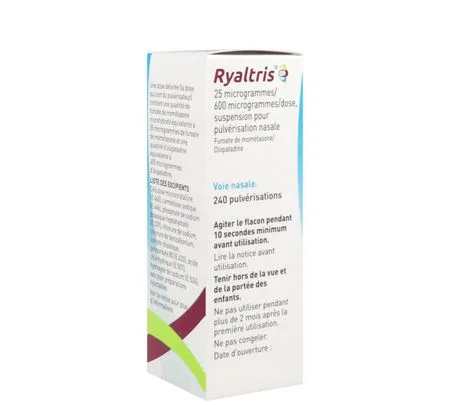
Bottle of 30 ml (240 sprays), with manual actuation device for the spray's metering pump.
Box of 1.
Composition
One delivered dose (the dose that comes out of the spray device) contains an amount of mometasone furoate monohydrate equivalent to 25 micrograms of mometasone furoate and an amount of olopatadine equivalent to 600 micrograms of olopatadine.
Excipient with known effect:
Each spray contains 0,02 mg of benzalkonium chloride.
Microcrystalline cellulose (E460), disodium phosphate heptahydrate (E339), sodium carmellose (E466), sodium chloride, benzalkonium chloride, glycerol, disodium edetate, polysorbate 80 (E433), hydrochloric acid (E507), sodium hydroxide (E524), water for injections
Indications
RYALTRIS is indicated, in adults and adolescents aged 12 years and older, for the treatment of moderate to severe nasal symptoms of allergic rhinitis.
Dosage and administration
Dosage
Adults and adolescents (aged 12 years and above)
The usual recommended dose is two sprays in each nostril, twice a day (morning and evening).
Children under 12 years of age
The use of RYALTRIS is not recommended in children under 12 years of age, as safety and efficacy have not been established in this age group.
Elderly patients
No dose adjustment is necessary in this population.
Renal and hepatic impairment
Although no data are available in patients with renal or hepatic impairment, no dose adjustment should be necessary in these populations given the absorption, metabolism and elimination of the active substances (see section Pharmacokinetics).
Method of administration
RYALTRIS must be administered by the nasal route only.
Before administering the first dose, shake the bottle well and perform 6 pump actuations (until a uniform spray is obtained). If the pump has not been used for 14 days or more, it must be re-primed with 2 actuations until a uniform spray is obtained, before any further use.
Shake the bottle for at least 10 seconds before each use. After use, carefully wipe the spray nozzle with a clean cloth or paper tissue and replace the cap so as to prevent the nozzle from clogging. The bottle must be discarded when the indicated number of doses has been reached, or within 2 months of first use.
Contraindications
Hypersensitivity to the active substances or to any of the excipients listed in section Composition.
RYALTRIS must not be used in the presence of an untreated localised infection of the nasal mucosa, such as herpes.
Due to the inhibitory effect of corticosteroids on wound healing, patients who have recently undergone nasal surgery or nasal trauma must refrain from using a nasal corticosteroid until healing has occurred.
Warnings and precautions
Local effects in the nasal passages
Cases of nasal ulceration and perforation of the nasal septum have been reported in patients following intranasal administration of antihistamines.
Cases of nasal septum perforation have been reported following intranasal administration of corticosteroids.
Patients using RYALTRIS for several months or a longer period should be regularly examined to detect any change in the nasal mucosa.
RYALTRIS is not recommended in cases of perforation of the nasal septum (see section Adverse effects).
Cases of epistaxis have been reported in some patients following intranasal administration of antihistamines and corticosteroids (see section Adverse effects).
During clinical studies involving intranasal administration of mometasone furoate, localised infections of the nose and pharynx by Candida albicans have occurred. When such an infection occurs, it may require treatment with an appropriate local therapy and discontinuation of RYALTRIS treatment. Patients using RYALTRIS for several months or longer should be examined regularly to detect any presence of infection by Candida or other signs of adverse effects on the nasal mucosa.
Visual disorders
Visual disturbances may be reported with the use of systemic and topical corticosteroids (including intranasal administration). If a patient presents with symptoms such as blurred vision or other visual disturbances, referral to an ophthalmologist should be considered to evaluate potential causes of visual disturbances, such as cataract, glaucoma or rare diseases such as central serous chorioretinopathy (CSCR), which have been reported after the use of systemic and topical corticosteroids.
Hypersensitivity reactions
Hypersensitivity reactions, including cases of wheezing, may occur after intranasal administration of mometasone furoate monohydrate and olopatadine hydrochloride. Discontinue administration of RYALTRIS if such reactions occur (see section Adverse effects).
Immunosuppression
Persons using immunosuppressive medicinal products, such as corticosteroids, are more susceptible to infections than healthy individuals. Chickenpox and measles, for example, may have a more severe, even fatal, course in susceptible children or adults using corticosteroids. Particular caution is required to avoid exposure in children or adults who have not had these diseases or who have not been adequately immunised against them. It is not known to what extent the dose, route of administration and duration of corticosteroid administration influence the risk of developing a generalised infection.
Corticosteroids should be used with caution, or avoided altogether, in patients with active or asymptomatic tuberculous infections of the respiratory tract, untreated localised or systemic fungal or bacterial infections, systemic viral or parasitic infections, or ocular herpes simplex, due to the risk of aggravation of these infections.
Systemic effects of corticosteroids
Potential systemic effects may include Cushing's syndrome, cushingoid features, adrenal suppression, growth retardation in children and adolescents, cataract, glaucoma and, more rarely, a range of psychological or behavioural effects, including psychomotor hyperactivity, sleep disorders, anxiety, depression or aggressiveness (particularly in children).
When intranasal corticosteroids are used at doses higher than the recommended doses or if they are used in persons sensitive to the recommended doses, systemic corticosteroid effects such as hypercorticism and adrenal suppression may occur. If such changes occur, the dose of RYALTRIS should be discontinued slowly, in accordance with accepted procedures for discontinuing oral corticosteroid therapy. Concomitant use of intranasal corticosteroids and other inhaled corticosteroids is likely to increase the risk of signs or symptoms of hypercorticism and/or suppression of the HPA axis.
If there is evidence supporting the use of doses above the recommended doses, additional systemic corticosteroid cover should be considered during periods of stress or elective surgery.
Replacing a systemic corticosteroid with a topical corticosteroid may be accompanied by signs of adrenal insufficiency, and some patients may experience withdrawal symptoms (e.g. joint and/or muscle pain, lassitude and depression). Patients previously treated long-term with systemic corticosteroids whose treatment is switched to topical corticosteroids should be closely monitored for acute adrenal insufficiency in response to stress. In patients who suffer from asthma or other clinical conditions requiring long-term systemic corticosteroid treatment, too rapid a reduction of systemic corticosteroids may result in a serious exacerbation of their symptoms.
Somnolence
Like other antihistamines, olopatadine may cause drowsiness in the same patients when absorbed systemically.
Patients should be advised to exercise caution when performing hazardous activities requiring high alertness and motor coordination, such as operating machinery or driving a vehicle, after administration of RYALTRIS. Concomitant use of RYALTRIS with alcohol or other central nervous system (CNS) depressants should be avoided due to the risk of potentiating the decrease in alertness and impairment of CNS performance.
Cases of drowsiness have been reported following administration of RYALTRIS in clinical studies (see section Adverse effects).
Antihistaminic effects
Concomitant use of olopatadine (e.g. eye drops) or other antihistamine medicinal products administered nasally, ocularly or orally may increase the risk of antihistaminic adverse effects.
Paediatric population
It is recommended to measure the height of children receiving long-term treatment with intranasal corticosteroids regularly. If growth is slowed, treatment should be reviewed with the aim of reducing the intranasal corticosteroid dose, if possible, to the lowest dose at which effective symptom control is maintained. In addition, referral of the patient to a paediatrician should be considered.
Excipients:
Each spray of RYALTRIS contains 0,02 mg of benzalkonium chloride. Benzalkonium chloride may cause irritation or swelling inside the nose, especially with prolonged use.
Interactions
No interaction studies have been performed with RYALTRIS.
All drug interactions resulting from the combination of olopatadine and mometasone furoate should be expected to reflect those of the individual components, as no pharmacokinetic interaction between olopatadine and mometasone furoate was observed when administered concomitantly.
Olopatadine :
No interaction between olopatadine and other medicinal products is expected (see section Pharmacokinetics).
Mometasone furoate :
Concomitant treatment with CYP3A inhibitors, including products containing cobicistat, is expected to increase the risk of systemic adverse effects. This combination should be avoided unless the benefit outweighs the increased risk of systemic corticosteroid adverse effects, in which case patients should be monitored for systemic corticosteroid adverse effects.
Fertility, pregnancy and breastfeeding
Pregnancy
Mometasone furoate:
There are no or limited data on the use of mometasone furoate in pregnant women. Animal studies have shown reproductive toxicity (see section Preclinical safety).
Olopatadine :
There are no or limited data on the use of intranasal olopatadine in pregnant women.
Animal studies have shown reproductive toxicity following systemic administration (see section Preclinical safety).
RYALTRIS should not be used during pregnancy unless the potential benefit to the mother justifies the potential risk to the mother, the foetus or the newborn. Newborns whose mothers received corticosteroids during pregnancy should be carefully monitored for possible hypoadrenalism.
Breast-feeding
Mometasone furoate:
It is not known whether mometasone furoate is excreted in human milk.
Olopatadine:
Available animal data show excretion of olopatadine in milk following oral administration (for further information, see section Preclinical safety). A risk to the newborn/infant cannot be excluded.
A decision must be made whether to discontinue breast-feeding or to discontinue/not initiate treatment with RYALTRIS, taking into account the benefit of breast-feeding for the child and the benefit of therapy for the woman.
Fertility
There are only limited data regarding fertility.
There are no clinical data on the effect of mometasone furoate on fertility. Animal studies have shown reproductive toxicity but no effect on fertility.
There are no clinical data on the effect of olopatadine on fertility.
Driving and using machines
In isolated cases, treatment with RYALTRIS may cause dizziness, lethargy and fatigue. In these cases, the ability to drive vehicles and use machines may be reduced. Alcohol may potentiate this effect.
Adverse effects
Summary of the safety profile
The adverse reactions most frequently reported during treatment with RYALTRIS were dysgeusia (a substance-specific unpleasant taste), epistaxis and nasal discomfort.
Tabulated list of adverse reactions
The following adverse reactions have been reported in clinical studies and post-marketing surveillance and are classified according to the following convention: very common (≥ 1/10), common (≥ 1/100 to < 1/10), uncommon (≥ 1/1 000 to < 1/100), rare (≥ 1/10 000 to < 1/1 000), very rare (< 1/10 000), or frequency not known (cannot be estimated from the available data).
|
Frequency |
Common |
Uncommon |
Rare |
Frequency not known |
|
System organ class |
||||
|
Infections and infestations |
Bacterial vaginosis |
Pharyngitis*
|
||
|
Immune system disorders |
Hypersensitivity, including anaphylactic reactions, angioedema, bronchospasm and dyspnoea* |
|||
|
Psychiatric disorders |
Anxiety
|
|||
|
Nervous system disorders |
Dysgeusia (unpleasant taste) |
Dizziness
|
Lethargy
|
|
|
Eye disorders |
Blurred vision
|
Cataract*
|
||
|
Ear and labyrinth disorders |
Earache |
|||
|
Respiratory, thoracic and mediastinal disorders |
Epistaxis
|
Nasal dryness |
Nasal inflammation
|
Perforation of the nasal septum* |
|
Gastrointestinal disorders |
Dry mouth
|
Constipation
|
||
|
General disorders and administration site conditions |
Fatigue |
|||
|
Injury, poisoning and procedural complications |
Laceration |
* reported with the use of corticosteroids.
Systemic effects of certain intranasally administered corticosteroids may occur, particularly when administered at high doses over prolonged periods (see section Warnings and precautions).
Paediatric population
Growth retardation has been reported in children receiving intranasal corticosteroids. Growth retardation may also be possible in adolescents (see section Warnings and precautions).
Reporting of suspected adverse reactions
Reporting suspected adverse reactions after authorisation of the medicinal product is important. It allows continued monitoring of the benefit/risk balance of the medicinal product. Healthcare professionals are asked to report any suspected adverse reactions via the national reporting system: National Agency for the Safety of Medicines and Health Products (ANSM) and the network of Regional Pharmacovigilance Centres - Website: https://signalement.social-sante.gouv.fr.
Overdose
No overdose reactions are anticipated with the intranasal route of administration.
No human data are available regarding overdose by accidental or deliberate ingestion.
Inhalation or oral administration of excessive doses of corticosteroids may lead to suppression of HPA axis function.
There are no known specific antidotes to the active substances of RYALTRIS.
In case of overdose, appropriate monitoring and symptomatic treatment of the patient should be implemented.
Pharmacodynamics
Pharmacotherapeutic class: Decongestants and other nasal preparations for topical use, combinations of corticosteroids/mometasone, ATC code: R01AD59.
Mechanism of action and pharmacodynamic effects
RYALTRIS contains olopatadine hydrochloride and mometasone furoate, which have different modes of action and exhibit synergistic effects in terms of improving the symptoms of allergic rhinitis.
Olopatadine is a potent selective antiallergic/antihistaminic agent that exerts its effects through several distinct mechanisms of action. It blocks the action of histamine (the main mediator of the allergic response in humans).
Mometasone furoate is a topical glucocorticoid that possesses anti-inflammatory properties.
It is likely that a significant part of the mechanism responsible for the antiallergic and anti-inflammatory effects of mometasone furoate lies in its ability to inhibit the release of mediators of allergic reactions. Mometasone furoate significantly inhibits the release of leukotrienes by leukocytes from allergic patients. In cell cultures, mometasone furoate has been shown to be extremely potent in inhibiting the synthesis and release of IL-1, IL-5, IL-6 and TNFα ; it is also a potent inhibitor of leukotriene production. Furthermore, it is an extremely potent inhibitor of the production of Th2 cytokines, IL-4 and IL-5, by human CD4+ T lymphocytes.
Clinical efficacy and safety
During 2 clinical studies (GSP 301-301 and GSP 301-304) conducted in adults and adolescents aged 12 years or older with allergic rhinitis, two sprays of RYALTRIS in each nostril twice daily improved nasal symptoms (namely, rhinorrhea, nasal congestion, sneezing and nasal itching) compared with placebo, olopatadine hydrochloride alone and mometasone furoate alone. Onset of action was observed within 15 minutes, defined as the first time point after treatment initiation at which Ryaltris showed a statistically significant and clinically relevant change from baseline for the instantaneous total nasal symptom score (namely rhinorrhea, nasal congestion, sneezing and nasal itching) compared with placebo. The results of these two clinical studies are summarized in Table 1 and Table 2 below.
|
Baseline values |
Change from baseline |
Treatment difference attributable to RYALTRIS |
||||
|
Treatment
|
N |
Mean |
Least squares mean |
Least squares mean |
CI at 95 % |
p-value |
|
RYALTRIS |
299 |
10,1 |
-3,48 |
-- |
-- |
-- |
|
Placebo |
283 |
10,2 |
-2,50 |
-0,98 |
(-1,38 ; -0,57) |
< 0,0001 |
|
Olopatadine hydrochloride |
294 |
10,3 |
-2,87 |
-0,61 |
(-1,01 ; -0,21) |
0,0029 |
|
Mometasone furoate |
294 |
10,2 |
-3,09 |
-0,39 |
(-0,79 ; 0,01) |
0,0587 |
|
Baseline values |
Change from baseline |
Treatment difference attributable to RYALTRIS |
||||
|
Treatment
|
N |
Mean |
Least squares mean |
Least squares mean |
CI at 95 % |
p-value |
|
RYALTRIS |
291 |
10,09 |
-3,52 |
-- |
-- |
-- |
|
Placebo |
290 |
10,32 |
-2,44 |
-1,09 |
(-1,49 ; -0,69) |
< 0,001 |
|
Olopatadine hydrochloride |
290 |
10,16 |
-3,08 |
-0,44 |
(-0,84 ; -0,05) |
0,028 |
|
Mometasone furoate |
293 |
10,20 |
-3,05 |
-0,47 |
(-0,86 ; -0,08) |
0,019 |
* Mean of rTNSS (morning and evening) for each day (maximum score = 12) over the 2-week treatment period.
† p-values are nominal
CI = confidence interval; LS = least squares; rTNSS = reduction in total nasal symptom score
Pharmacokinetics
Absorption
Following repeated intranasal administration of 2 sprays per nostril of RYALTRIS (2 400 micrograms of olopatadine and 100 micrograms of mometasone furoate) twice daily to patients with seasonal allergic rhinitis, the mean (± standard deviation) maximum plasma exposure (Cmax) was 19,80 ± 7,01 ng/mL for olopatadine and 9,92 ± 3,74 pg/mL for mometasone furoate, and the mean exposure over the entire dosing regimen (AUCtau) was 88,77 ± 23.87 ng*h/mL for olopatadine and 58,40 ± 27,00 pg*h/mL for mometasone furoate. The median time to maximum exposure after single-dose administration was 1 hour for olopatadine and for mometasone furoate.
There was no indication of pharmacokinetic interactions between mometasone furoate and olopatadine hydrochloride.
Distribution
Protein binding of olopatadine was reported as moderate, at approximately 55% in human serum, and was not concentration-dependent over the range of 0,1 to 1 000 ng/mL. Olopatadine binds mainly to human serum albumin.
In vitro, protein binding for mometasone furoate was 98% to 99% over the concentration range of 5 to 500 ng/mL.
Biotransformation
The small amount of mometasone furoate likely to be ingested and absorbed undergoes extensive hepatic first-pass metabolism.
Olopatadine is not metabolised to a significant extent. Two metabolites, the mono-demethyl and the N-oxide, were detected at low concentrations in the urine.
In vitro studies showed that olopatadine did not inhibit the metabolic reactions involving the isoenzymes 1A2, 2C8, 2C9, 2C19, 2D6, 2E1 and 3A4 of cytochrome P-450. These results indicate that olopatadine is unlikely to cause interactions with other active substances administered concomitantly.
Elimination
Absorbed mometasone furoate is extensively metabolised, and the metabolites are excreted in the urine and bile. After nasal administration to healthy volunteers, the half-life of mometasone furoate in plasma was approximately 18 to 20 hours.
Pharmacokinetic studies indicate that after oral administration, the half-life of olopatadine in plasma was approximately 8 to 12 hours, and that elimination occurred mainly by renal excretion. Approximately 60 to 70% of the dose was recovered in the urine as active substance.
After nasal administration to healthy volunteers, the half-life of olopatadine in plasma was approximately 6 to 7 hours.
Hepatic impairment
Olopatadine:
No clinically relevant effect of hepatic impairment is expected on the pharmacokinetics of olopatadine, as it is excreted mainly unchanged in the urine (see section Dosage and administration).
Mometasone furoate:
A study carried out with inhaled mometasone furoate in adults with mild, moderate or severe hepatic impairment showed that maximum plasma concentrations of mometasone furoate appear to increase with the severity of hepatic impairment. However, the number of detectable levels was low (see section Dosage and administration).
Renal impairment
Olopatadine:
As olopatadine is excreted in the urine mainly as unchanged active substance, renal impairment alters the pharmacokinetics of olopatadine to produce a plasma AUC0-∞ plasma 8 times greater in patients with severe renal impairment (mean creatinine clearance of 13,0 ml/min) compared with healthy adults. After administration of an oral dose of 10 mg to patients undergoing haemodialysis (no urinary output), plasma concentrations of olopatadine were substantially lower on the day of haemodialysis compared with the day without haemodialysis, suggesting that olopatadine may be removed by haemodialysis.
Mometasone furoate:
Given the very small contribution of the urinary route to the total body elimination of mometasone furoate, the effects of renal impairment on the pharmacokinetics of mometasone furoate have not been studied (see section Dosage and administration).
Elderly:
Studies comparing the pharmacokinetics of oral doses of 10 mg of olopatadine in young subjects (mean age 21 years) and elderly subjects (mean age 74 years) did not reveal any notable differences in plasma concentrations (AUC), protein binding or urinary excretion of the unchanged parent molecule and its metabolites.
Preclinical safety
Olopatadine:
Non-clinical data from conventional studies of safety pharmacology, repeated-dose toxicity, genotoxicity, carcinogenesis, and reproduction and developmental functions revealed no particular risk for humans.
Animal studies showed reduced growth of the suckling offspring of females receiving systemic doses of olopatadine well above the maximum recommended level for intranasal use in humans. Olopatadine was detected in the milk of lactating rats after oral administration.
Mometasone furoate:
No toxicological effect specific to exposure to mometasone furoate has been demonstrated. All effects observed are typical of this class of compounds and are related to the exaggerated pharmacological effects of glucocorticoids.
Preclinical studies demonstrate that mometasone furoate does not exert androgenic, antiandrogenic, oestrogenic or antioestrogenic activity, but that, like other glucocorticoids, it shows some anti-uterotrophic activity and delays vaginal opening in animal models at high oral doses of 56 mg/kg/day and 280 mg/kg/day.
Like other glucocorticoids, mometasone furoate showed clastogenic potential in vitro at high concentrations. However, no mutagenic effect can be expected at relevant therapeutic doses.
In reproductive function studies, subcutaneous administration of mometasone furoate at 15 micrograms/kg prolonged gestation and prolonged, difficult parturition occurred, accompanied by reduced offspring survival and reduced body weight or body weight gain of the pups. There was no effect on fertility.
Like other glucocorticoids, mometasone furoate is teratogenic in rodents and rabbits. The effects observed were umbilical malformations in rats, cleft lip in mice, and agenesis of the gallbladder, umbilical hernias and flexed forelimbs in rabbits. Reductions in maternal body weight gain, effects on foetal growth (reduced foetal body weight and/or delayed ossification) in rats, rabbits and mice, and reduced offspring survival in mice were also noted.
The carcinogenic potential of inhaled mometasone furoate (aerosol with CFC propellant and surfactant) at concentrations of 0,25 to 2,0 micrograms/l was studied in 24-month studies in mice and rats. Effects typical of glucocorticoids, including several non-neoplastic lesions, were observed. No notable dose-response relationship was detected for any of the tumour types.
RYALTRIS Nasal spray:
A study of repeated intranasal administration of RYALTRIS to rats for a maximum period of 13 weeks did not reveal any new adverse effects compared with the individual components.
Environmental risk assessment (ERE)
Environmental risk assessment studies showed that mometasone furoate may pose a risk to the aquatic environment (see section Disposal and handling).
SPECIAL PRECAUTIONS FOR DISPOSAL AND OTHER HANDLING
This medicine may present a risk to the environment (see section Preclinical safety).
Any unused medicinal product or waste material should be disposed of in accordance with local requirements.
Prescription, supply and reimbursement
| Marketing authorisation (AMM) |
|
| Price: |
|
MENARINI FRANCE
1, rue du Jura. PO Box 40528. 94633 Rungis cdx
Tel: 01 45 60 77 20
Website: http://www.menarini.fr
Source: VIDAL · Updated on 11/11/2026. This information does not replace advice from a healthcare professional.