
Medicines
SPC of 11/01/2019
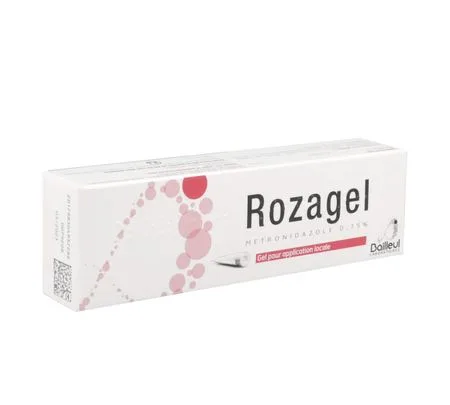
ROZAGEL, gel for topical use
Composition
For 100 g :
Metronidazole: 0,75 g
Excipients with known effect:
1 g of gel contains 30 mg of propylene glycol, 0,8 mg of methyl parahydroxybenzoate and 0,2 mg of propyl parahydroxybenzoate.
Propylene glycol, carbomer 940 (Carbopol 980), sodium edetate, methyl parahydroxybenzoate, propyl parahydroxybenzoate, sodium hydroxide, purified water.
Indications
Topical treatment of rosacea.
Official recommendations concerning the appropriate use of antibacterial agents should be taken into account.
Dosage and administration
Dosage
Apply the gel as a thin layer over the entire area to be treated, twice daily after washing.
The usual duration of treatment is 3 to 4 months.
Paediatric population
Not applicable.
Method of administration
Cutaneous use.
Contraindications
Hypersensitivity to the active substance or to any of the excipients listed in section Composition.
Warnings and precautions
Avoid contact with the eyes.
Discontinue treatment completely or temporarily in case of local intolerance.
The area treated with metronidazole must not be exposed to sunlight or ultraviolet radiation.
This medicine contains 30 mg of propylene glycol per g of gel and may cause skin irritation.
This medicine contains methyl parahydroxybenzoate and propyl parahydroxybenzoate and may cause allergic reactions (possibly delayed).
Fertility, pregnancy and breastfeeding
Pregnancy
Animal studies have not shown any teratogenic effect. In the absence of a teratogenic effect in animals, a malformative effect in humans is not expected. Indeed, to date, substances responsible for malformations in humans have been shown to be teratogenic in animals in well-conducted studies in two species.
In clinical practice, analysis of a large number of exposed pregnancies apparently revealed no particular malformative or fetotoxic effect of metronidazole. However, only epidemiological studies would make it possible to verify the absence of risk.
Consequently, metronidazole may be prescribed during pregnancy if needed.
Breast-feeding
The administration of ROZAGEL may be considered during breastfeeding.
Driving and using machines
ROZAGEL, gel for topical use has no or negligible effect on the ability to drive vehicles and use machines
Adverse effects
Secondary reactions attributable to metronidazole gel are minor and consist essentially of local irritation symptoms such as tingling, pruritus and burning sensations.
Due to the presence of propylene glycol, methyl and propyl parahydroxybenzoates, there is a risk of contact eczema; exceptionally, immediate reactions with urticaria and bronchospasm.
Reporting of suspected adverse reactions
Reporting suspected adverse reactions after authorisation of the medicinal product is important. It allows continued monitoring of the benefit/risk balance of the medicinal product. Healthcare professionals are asked to report any suspected adverse reactions via the national reporting system: National Agency for the Safety of Medicines and Health Products (ANSM) and the network of Regional Pharmacovigilance Centres - Website: www.signalement-sante.gouv.fr.
Pharmacodynamics
Pharmacotherapeutic class: antibiotics and chemotherapy for dermatological use, other chemotherapeutics, ATC code: D06BX01.
Metronidazole is an antiparasitic and antibacterial agent active against many pathogenic germs. Metronidazole is particularly effective against the inflammatory papulopustular component of the disease.
Its mechanism of action likely appears to involve an anti-inflammatory effect.
SPECTRUM OF ANTIMICROBIAL ACTIVITY
Critical concentrations separate susceptible strains from strains of intermediate susceptibility, and the latter from resistant ones:
S ≤ 4 mg/l and R > 4 mg/l
The prevalence of acquired resistance can vary according to geography and time for certain species. It is therefore useful to have information on local resistance prevalence, especially for the treatment of severe infections. These data can only provide guidance on the probabilities of the susceptibility of a bacterial strain to this antibiotic.
Where the variability of resistance prevalence in France is known for a bacterial species, it is indicated in the table below:
|
Categories |
Frequency of acquired resistance in France
|
|
SENSITIVE SPECIES
|
|
|
RESISTANT SPECIES
|
|
|
ANTIPARASITIC ACTIVITY
|
Note: this spectrum corresponds to that of the systemic forms of metronidazole. With the local pharmaceutical presentations, the concentrations obtained in situ are much higher than plasma concentrations. Some uncertainties remain regarding the kinetics of the concentrations in situ, the local physicochemical conditions that may alter the activity of the antibiotic, and the stability of the product in situ.
Pharmacokinetics
Bioavailability studies with ROZAGEL in patients with rosacea, treated with 7,5 mg of metronidazole applied locally to the face, show a maximum serum concentration of 66 ng/ml, approximately 100 times less than that reached by a single oral dose of 250 mg.
The systemic passage of metronidazole after local application of gel is variable depending on the subject. In most patients, serum concentrations were below the limits of detection (25 ng/ml); when they were measurable, they were of the order of 2%.
Preclinical safety
Earlier appearance of UV radiation-induced skin tumors was observed in nude mice treated with metronidazole by the intraperitoneal route.
Prescription, supply and reimbursement
| Marketing authorisation (AMM) |
|
| Price: |
|
Collection.
GIULIANI GROUP 264 RUE DU FAUBOURG SAINT-HONORÉ
75008 PARIS
Tel: 01 56 33 11 11 accueil@bailleul.com
https://bailleul.com/france/
Source: VIDAL · Updated on 11/11/2026. This information does not replace advice from a healthcare professional.