
Medicines
SmPC of 11/12/2025
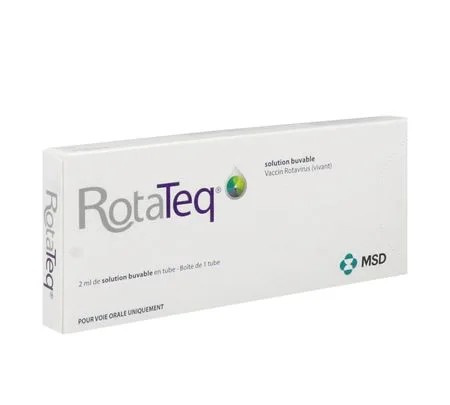
ROTATEQ oral solution, Rotavirus vaccine (live)
Forms and presentations
Oral solution (clear liquid, pale yellow, possibly with a pinkish tinge).
Flexible single-dose tube containing 2 ml, in protective sachet. Box of 1.
Composition
One dose (2 ml) contains :
Rotavirus type* G1: at least 2,2 x 10⁶ IU1, 2
Rotavirus type* G2: at least 2,8 x 10⁶ IU1, 2
Rotavirus type* G3: at least 2,2 x 10⁶ IU1, 2
Rotavirus type* G4: at least 2,0 x 10⁶ IU1, 2
Rotavirus type* P1A[8]: at least 2,3 x 10⁶ IU1, 2
* human-bovine reassortant rotavirus (live), produced on Vero cells
1 Infectious Units
2 Lower limit of the confidence interval (p = 0,95)
Excipients with known effect
This vaccine contains 1 080 milligrams of sucrose and 37,6 milligrams of sodium (see section Warnings and precautions).
Sucrose, sodium citrate, monosodium phosphate monohydrate, sodium hydroxide, polysorbate 80, culture medium (containing inorganic salts, amino acids and vitamins), purified water.
Indications
RotaTeq is indicated for the active immunisation of infants from the age of 6 weeks to 32 weeks for the prevention of gastroenteritis due to rotavirus infection (see sections Dosage and administration, Warnings and precautions and Pharmacodynamics).
RotaTeq must be used on the basis of official recommendations.
Dosage and administration
Dosage
From birth to 6 weeks
RotaTeq is not indicated in this age group
The safety and efficacy of RotaTeq in subjects younger than 6 weeks have not been evaluated.
From 6 to 32 weeks
The vaccination schedule consists of 3 doses.
The first dose may be administered from the age of 6 weeks and no later than the age of 12 weeks.
RotaTeq may be administered to premature infants, provided that the duration of pregnancy is at least 25 weeks. These infants must receive the first dose of RotaTeq at least 6 weeks after birth. See sections Warnings and precautions and Pharmacodynamics.
The interval between each dose must be at least 4 weeks.
It is preferable that the vaccination schedule in 3 doses be completed at the age of 20-22 weeks. If necessary, the third (last) dose may be given up to the age of 32 weeks (see section Pharmacodynamics). There are no data on the interchangeability of RotaTeq with another rotavirus vaccine. It is recommended that children who have received a first dose of RotaTeq continue to receive this same vaccine for subsequent doses.
If an incomplete dose has been swallowed with certainty or strong probability, (for example if the infant spits up or regurgitates the vaccine), a single replacement dose may be given during the same consultation, however this practice has not been studied in clinical trials. If the incident recurs, an additional dose must not be given.
It is not recommended to administer an additional dose after completing the vaccination schedule in 3 doses (see sections Warnings and precautions and Pharmacodynamics for available information on the duration of protection).
From 33 weeks to 18 years
RotaTeq is not indicated in this age group.
Method of administration
RotaTeq is for oral administration only.
RotaTeq MUST NEVER BE INJECTED.
RotaTeq may be administered without any special precaution with regard to food, liquids or breast milk.
See section Disposal and handling for administration instructions.
Contraindications
Hypersensitivity to the active substances or to any of the excipients listed in section Composition.
Hypersensitivity following a previous administration of rotavirus vaccine.
History of intussusception.
Infants with a congenital malformation of the gastrointestinal tract that may predispose to intussusception.
Infants with known or suspected immunodeficiency (see section Warnings and precautions and Adverse effects).
Administration of RotaTeq must be deferred in infants with severe acute febrile illness. A mild infection is not a contraindication to vaccination.
Administration of RotaTeq must be deferred in subjects with acute diarrhoea or vomiting.
Warnings and precautions
Traceability: in order to improve the traceability of biological medicinal products, the name and batch number of the administered product must be clearly recorded.
As with all vaccines, appropriate medical treatment must always be readily available in case of rare anaphylactic reactions occurring after administration of the vaccine (see section Adverse effects).
There are no safety or efficacy data from clinical trials on the administration of RotaTeq to immunodeficient infants, infants exposed in utero to immunosuppressive treatment, infants infected with HIV or infants who have received a blood transfusion or immunoglobulins in the 42 days preceding administration of RotaTeq. Asymptomatic HIV infection should not affect the tolerability or efficacy of RotaTeq. However, in the absence of sufficient data, administration of RotaTeq to infants with asymptomatic HIV infection is not recommended. Administration of RotaTeq to infants who have been exposed in utero to immunosuppressive treatment must be based on a thorough evaluation of the potential benefits and risks.
Cases of vaccine virus-associated gastroenteritis have been reported after marketing in infants with severe combined immunodeficiency (SCID, see section Contraindications).
In clinical studies, RotaTeq was shed in the stools of 8,9 % of vaccinated infants, almost exclusively in the week following the first dose and in a single infant (0.3 %) after the third dose.
The peak of shedding is observed within 7 days following administration of the dose. Transmission of vaccine viral strains to unvaccinated contact subjects has been observed after marketing. RotaTeq should be administered with caution in subjects in close contact with immunodeficient patients (subjects with a malignant condition or any type of immunosuppression, subjects receiving immunosuppressive therapy). In addition, caregivers of recently vaccinated children must carefully observe hygiene rules, particularly when in contact with stools.
In a clinical study, RotaTeq was administered to approximately 1 000 premature infants, born after a pregnancy of 25 to 36 weeks. The first dose was administered 6 weeks after birth. The tolerability and efficacy of RotaTeq were comparable between this subgroup of infants and the population of full-term infants. However, among these approximately 1 000 children, 19 were born after a pregnancy between 25 and 28 weeks, 55 were born after a pregnancy between 29 and 31 weeks, the other infants being born after a pregnancy between 32 and 36 weeks. See sections Dosage and administration and Pharmacodynamics.
Intussusception: as a precaution, healthcare professionals must monitor any symptom suggestive of intussusception (severe abdominal pain, persistent vomiting, bloody stools, abdominal distension and/or high fever), as data from certain observational studies indicate an increased risk of intussusception, mainly within 7 days following administration of rotavirus vaccination (see section Adverse effects). Parents or guardians must be advised to report such symptoms promptly to healthcare professionals.
For subjects with a predisposition to intestinal intussusceptions, see section Contraindications.
The tolerability and efficacy have not been studied in infants presenting with an evolving disease of the gastrointestinal system (including chronic diarrhoea) or growth retardation.
Administration of RotaTeq must be considered with caution in these infants when, according to the physician's opinion, not vaccinating entails a greater risk.
The level of protection conferred by RotaTeq is based on the administration of a vaccination schedule in 3 doses. As with other vaccines, vaccination with RotaTeq may not protect completely all subjects. RotaTeq does not protect against gastroenteritis due to pathogens other than rotavirus.
Clinical efficacy trials against rotavirus gastroenteritis have been conducted in Europe, the United States, Latin America and Asia. In these trials, G1P[8] was the most commonly circulating rotavirus genotype, while rotavirus genotypes G2P[4], G3P[8], G4P[8] and G9P[8] were less frequently identified. The extent of protection that RotaTeq may confer against other rotavirus genotypes and in other populations is not known.
The use of RotaTeq for post-exposure prophylaxis against rotavirus has not been studied.
The potential risk of apnoea with the need for respiratory monitoring for 48-72 hours must be carefully considered when administering the doses of primary vaccination in very premature infants (born at 28 weeks of gestation or less) and particularly in those with a history of respiratory immaturity. Due to the high benefit of vaccination in these infants, administration must not be suspended or postponed.
RotaTeq MUST NOT BE INJECTED UNDER ANY CIRCUMSTANCES.
Sucrose
RotaTeq contains sucrose. Patients with rare hereditary problems of fructose intolerance, glucose-galactose malabsorption or sucrase-isomaltase deficiency must not receive this vaccine. See section Composition.
Sodium
This vaccine contains 37,6 mg of sodium per dose, which is equivalent to 1,88 % of the maximum daily dietary sodium intake recommended by the WHO of 2 g of sodium per adult. See section Composition.
Interactions
Co-administration of RotaTeq with vaccines containing one or more of the following antigens at approximately 2, 4 and 6 months of age has demonstrated that the immune responses and safety profiles of the co-administered vaccines were not altered:
- Diphtheria-tetanus-acellular pertussis vaccine (DTaP)
- Conjugate vaccine Haemophilus influenzae type b (Hib)
- Inactivated poliomyelitis vaccine (IPV)
- Hepatitis B vaccine (HBV)
- Pneumococcal conjugate vaccine (PCV).
Co-administration of RotaTeq with the DTaP-IPV-HBV-Hib vaccine (Infanrix hexa) at approximately 2, 3 and 4 months of age has demonstrated that the immune responses and safety profiles of the co-administered vaccines were not altered compared to separate administrations.
Co-administration of RotaTeq with a group C meningococcal conjugate vaccine (MenCC, the vaccine studied was a tetanus toxoid conjugate vaccine) at 3 and 5 months of age (and mainly at the same time as the DTaP-IPV-Hib vaccine), followed by a third dose of RotaTeq at approximately 6 months of age, has demonstrated that the immune responses of RotaTeq and MenCC were not altered. The co-administration showed an acceptable safety profile.
Simultaneous administration of RotaTeq and oral poliomyelitis vaccine (OPV) did not modify the immune response against poliovirus antigens. Although simultaneous administration of the OPV vaccine slightly reduced the immune response to the rotavirus vaccine, there is currently no evidence demonstrating that clinical protection against severe rotavirus gastroenteritis would be altered. The immune response to RotaTeq was not altered when the OPV vaccine was administered two weeks after the RotaTeq vaccine.
Therefore, RotaTeq may be administered simultaneously with monovalent or combination infant vaccines containing one or more of the following antigens: DTaP, Hib, IPV or OPV, HBV, PCV and MenCC.
Fertility, pregnancy and breastfeeding
RotaTeq is intended only for infants. Thus, data on the use of the vaccine in pregnant or breastfeeding women are not available and fertility or reproduction studies in animals have not been conducted.
Adverse effects
a. Summary of the safety profile
Adverse events have been studied in a subgroup of infants (n = 6 130 receiving RotaTeq and 5 560 receiving placebo) from 3 placebo-controlled clinical studies. Adverse events occurring within 42 days after vaccination with RotaTeq, with or without concomitant administration of other paediatric vaccines, were evaluated. Overall, 47 % of infants receiving RotaTeq experienced an adverse reaction compared to 45,8 % of infants receiving placebo. The most commonly reported adverse reactions, which occurred more frequently with the vaccine than with placebo, were fever (20,9 %), diarrhoea (17,6 %) and vomiting (10,1 %).
Serious adverse reactions were evaluated in all participants in the 3 clinical studies (36 150 receiving RotaTeq and 35 536 receiving placebo) up to 42 days after each dose. Their overall frequency was 0,1 % for infants receiving RotaTeq and 0,2 % for infants receiving placebo.
b. Tabulated summary of adverse reactions
The most frequently reported adverse reactions in the vaccinated group are listed below, by system organ class and frequency. Based on data from 3 clinical trials in which 6 130 infants received RotaTeq and 5 560 received placebo, the adverse reactions listed below occurred in infants who received RotaTeq with an increase in incidence between 0,2 % and 2,5 % compared to infants who received placebo.
Frequencies are reported as:
Very common (≥ 1/10), common (≥ 1/100, < 1/10), uncommon (≥ 1/1 000, < 1/100), rare (≥ 1/10 000, < 1/1 000), very rare (< 1/10 000), frequency not known (cannot be estimated from the available data)
|
Adverse effects following administration of RotaTeq in clinical trials and reported after marketing (in italics) |
||
|
System organ class |
Frequency |
Event/adverse effect |
|
Infections and infestations |
Common |
Upper respiratory tract infection |
|
Uncommon |
Rhinopharyngitis, otitis media |
|
|
Immune system disorders |
Indeterminate |
Anaphylactic reaction‡ |
|
Respiratory, thoracic and mediastinal disorders |
Rare |
Bronchospasm |
|
Gastrointestinal disorders |
Very common |
Diarrhoea, vomiting |
|
Uncommon |
Rectal bleeding†, upper abdominal pain |
|
|
Very rare |
Intussusceptionα* |
|
|
Indeterminate |
Gastroenteritis‡ § |
|
|
Skin and subcutaneous tissue disorders |
Uncommon |
Rash |
|
Rare |
Urticaria† |
|
|
Indeterminate |
Quincke's oedema‡ |
|
|
General disorders and administration site conditions |
Very common |
Fever |
|
Indeterminate |
Irritability‡ |
|
† This adverse effect was identified during post-marketing surveillance
The frequency category was estimated from the data of the clinical trials.
α The frequency category was estimated from data from an observational study.
* See section Warnings and precautions.
‡ Adverse events observed after marketing (their frequency cannot be estimated based on the available data).
§ Gastroenteritis, associated with elimination in the stools of the vaccine virus, have been reported.
c. Description of selected adverse effects
5 cases of Kawasaki disease were reported among 36 150 infants who received the vaccine (< 0,1 %) and 1 cases among 35 536 infants who received the placebo (< 0.1 %) giving a relative risk (RR) of 4,9 [CI 95 %, 0,6-239,1] (not statistically significant).
No increased risk of Kawasaki disease was observed in infants who received RotaTeq in a large observational post-marketing safety surveillance study (see section Pharmacodynamics).
Intussusception
Data from observational studies conducted in several countries indicate that rotavirus vaccines lead to an increase in the risk of intussusception, up to 6 additional cases per 100 000 infants in the 7 days following vaccination. There are limited data regarding a smaller increase in risk after the second dose. The baseline incidence of intussusception in infants under 1 year varied in these countries from 25 to 101 per 100 000 infants per year. It has not been determined whether rotavirus vaccines modify the overall incidence of intussusception over longer follow-up periods (see section Warnings and precautions).
d. Other special populations
Apnea in very premature infants (born at 28 weeks of gestation or less) (see section Warnings and precautions).
Gastroenteritis associated with elimination in the stools of the vaccine virus in infants with severe combined immunodeficiency (SCID) have been reported after marketing.
Reporting of suspected adverse reactions
The reporting of suspected adverse reactions after authorization of the medicinal product is important. It allows continuous monitoring of the benefit/risk balance of the medicinal product. Healthcare professionals report any suspected adverse reaction via the national reporting system: Agence nationale de sécurité du médicament et des produits de santé (ANSM) and network of Regional Pharmacovigilance Centres - Website: https://signalement.social-sante.gouv.fr.
Overdose
Cases of administration of RotaTeq doses higher than those recommended have been reported. In general, the safety profile reported in these overdose cases was comparable to that observed after administration of the usual doses of RotaTeq.
Pharmacodynamics
Pharmacotherapeutic group: Vaccines, Viral Vaccine
ATC code: J07BH02
Efficacy
In clinical studies, efficacy was demonstrated against gastroenteritis due to rotaviruses of genotype G1P[8], G2P[4], G3P[8], G4P[8] and G9P[8].
The efficacy of RotaTeq was evaluated in two different ways in a placebo-controlled clinical study “Rotavirus Efficacy and Safety Trial (REST)”.
- In a group of 5 673 vaccinated infants (2 834 in the vaccine group) efficacy was measured as a reduction in the incidence of rotavirus (RV) gastroenteritis due to the genotypes included in the vaccine (G1-G4) and occurring at least 14 days after the third dose of vaccine, throughout the first epidemic season following vaccination.
- In a group of 68 038 vaccinated infants (34 035 in the vaccine group) protective efficacy was measured as a reduction in the rate of hospitalizations and emergency department admissions for RV gastroenteritis from 14 days after the third dose.
The results of these analyses are presented in the following table.
|
Reduction in the incidence of RV gastroenteritis throughout an epidemic season following vaccination
|
||||||
|
Efficacy all severities combined by rotavirus genotypes |
||||||
|
Severe disease*
|
Any severity
|
G1 |
G2 |
G3 |
G4 |
G9 |
|
98,0 %
|
74,0 %
|
74,9 %
|
63,4 %
|
82,7 %
|
48,1 %
|
65,4 %
|
* Severity defined by a score > 16/24 using a scale, clinically validated, based on the intensity and duration of symptoms (fever, vomiting, diarrhea and changes in behavior)
† Statistically significant
|
Reduction in hospitalizations/emergency department admissions for RV gastroenteritis up to 2 years after vaccination
|
|||||
|
G1-G4 |
G1 |
G2 |
G3 |
G4 |
G9 |
|
94,5 %
|
95,1 %
|
87,6 %
|
93,4 %
|
89,1 %
|
100 %
|
† Statistically significant
The reduction in the incidence of RV gastroenteritis due to G1-G4 during the second rotavirus season after vaccination was 88.0 % [CI 95 %, 49,4-98,7] for severe disease and 62,6 % [CI 95 % 44,3 ; 75,4] for disease of any severity.
The observed efficacy against rotaviruses G2P[4], G3P[8], G4P[8] and G9P[8] is based on a smaller number of cases than for G1. The observed efficacy against G2P[4] is more likely attributable to the G2 component of the vaccine.
In a combined post-hoc analysis of the REST study and another phase III study, the efficacy of the vaccine in preventing RV gastroenteritis of types G1, G2, G3 and G4 (all severities combined) was 61,5 % [CI 95 % : 14,2 ; 84,2] in infants who, at the time of the third dose, were aged more than 26 weeks (> 26) to 32 weeks inclusive (≤ 32).
An extension of the REST study was conducted in Finland. This “Finnish Extension Study (FES)” included a subgroup of 20 736 infants who had been previously enrolled in REST. These infants were followed up to 3 years following vaccination in FES.
In the REST study, 403 hospitalizations or emergency department visits (20 in the vaccine group and 383 in the placebo group) associated with rotavirus gastroenteritis of type G1-G4 and G9 in the per-protocol population were reported. The additional data from FES made it possible to increase this number by 136 additional hospitalizations or emergency department visits, of which 9 in the vaccine group and 127 in the placebo group. Overall, 31 % and 25 % of the hospitalizations or emergency department visits in the respective groups came from FES.
In the combined data from REST and FES, the reduction up to 3 years following vaccination in the rate of hospitalizations and emergency department admissions for RV gastroenteritis was 94,4 % [CI 95 % : 91,6 ; 96,2] for genotypes G1-G4, 95,5 % [CI 95 % : 92,8 ; 97,2] for genotype G1, 81,9 % [CI 95 % : 16,1 ; 98,0] for genotype G2, 89,0 % [CI 95 % : 53,3 ; 98,7] for genotype G3, 83,4 % [CI 95 % : 51,2 ; 95,8] for genotype G4, and 94,2 % [CI 95 % : 62,2 ; 99,9] for genotype G9. In the third year, there were no hospitalizations or emergency department visits due to RV gastroenteritis in the vaccine group (n = 3 112) and one case (non-typeable) in the placebo group (n = 3 126).
The 3-dose vaccination schedule for RotaTeq must be administered in full (see section Dosage and administration) to acquire the level and duration of protection against rotavirus gastroenteritis that were observed in the clinical studies. Nevertheless, post hoc analyses indicate that RotaTeq provides some level of reduction in the number of cases of rotavirus gastroenteritis with severity requiring hospitalization or emergency department admission before having received all 3 doses (approximately 14 days after administration of the first dose and beyond).
Efficacy in premature infants
In REST, RotaTeq was administered to approximately 1 000 infants, born after a pregnancy of 25 to 36 weeks. Efficacy was comparable between this subgroup of infants and the population of term-born infants.
Post-marketing observational safety surveillance study
In a large prospective post-marketing observational study in the United States, the risks of Kawasaki disease were analyzed in 85 150 infants who received one or more doses of RotaTeq (17 433 person-years of follow-up).
During the follow-up period of 0 to 30 days after vaccination, there was no statistically significant difference in the rate of Kawasaki disease compared to the expected rates in the absence of vaccination. In addition, there was no statistically significant increase in this adverse event during the follow-up period of 0 to 30 days compared to a control group of infants who received DTaP, but not RotaTeq (n = 62 617, 12 339 person-years of follow-up). There was one confirmed case identified in infants vaccinated with RotaTeq and one confirmed case in those in the DTaP-vaccinated control group (relative risk = 0,7 ; 95 % CI : 0,01-55,56). No particular safety concerns were identified in the analyses of overall safety.
Real-world effectiveness data
Post-marketing studies demonstrating real-world effectiveness in the prevention of RV gastroenteritis
|
Study methodology
|
Study population |
Endpoints |
Real-world effectiveness
|
RV seasons |
|
|
Database analysis
|
33 140 vaccinated
|
Hospitalizations and emergency department admissions for RV gastroenteritis |
100 % [87-100] |
2007-2008 |
|
|
Outpatient consultations for RV gastroenteritis |
96 % [76-100] |
||||
|
Hospitalizations and emergency department admissions related to gastroenteritis of any cause |
59 % [47-68] |
||||
|
Cohort study
|
1 895 vaccinated with 3 doses
|
Hospitalizations for RV gastroenteritis |
98 % [83-100] |
2007-2008
|
|
|
Study
|
402 cases
|
Hospitalizations and emergency department admissions for RV gastroenteritis |
80 % [74-84] |
2011-2012
|
|
|
Strain-specific |
|||||
|
- G1P[8] |
89 % [55-97] |
||||
|
- G2P[4] |
87 % [65-95] |
||||
|
- G3P[8] |
80 % [64-89] |
||||
|
- G12P[8] |
78 % [71-84] |
||||
|
Age-specific |
|||||
|
- 1e year of life |
91 % [78-96] |
||||
|
- 2e year of life |
82 % [69-89] |
||||
|
- 3e year of life |
88 % [78-93] |
||||
|
- 4e year of life |
76 % [51-88] |
||||
|
- 5e year of life |
60 % [16-81] |
||||
|
- 6e-7e year of life |
69 % [43-84] |
||||
* Controls: RV-negative acute gastroenteritis
Immunogenicity
The immunological mechanism by which RotaTeq protects against rotavirus gastroenteritis is not completely understood. No immunological correlate of protection has yet been identified for rotavirus vaccines. In phase III studies, between 92,5 % and 100 % of infants showed a significant increase in serum anti-rotavirus IgA, after administration of 3 doses of RotaTeq. The vaccine induces an immune response against the 5 human rotavirus proteins expressed on the reassortants (G1, G2, G3, G4 and P[8]) (with appearance of neutralizing serum antibodies).
Preclinical safety
An oral toxicity study at single dose and repeated dose in the mouse did not reveal any particular risk for humans. The dose administered to the mouse was approximately 2,79 x 10⁸ infectious units per kg (approximately 14 times the dose planned for the infant).
INCOMPATIBILITIES
In the absence of compatibility studies, this vaccine must not be mixed with other medicinal products.
Special storage precautions
Store and transport refrigerated (between 2 °C and 8 °C).
Keep the single-dose tube in the outer packaging protected from light.
SPECIAL PRECAUTIONS FOR DISPOSAL AND HANDLING
The vaccine must be administered orally without being mixed with other vaccines or solutions. Do not dilute.
|
To administer the vaccine: |
|||
|
Open the protective sachet and remove the single-dose tube. |
|||
|
Make the liquid descend from the neck of the tube by holding the tube vertically and tapping on the cap. |
|||
|
Open the single-dose tube in 2 simple movements:
|
|||
|
2. Turn the cap counterclockwise to remove it. |
|||
|
Place the tip in the mouth against the inside of the infant's cheek. Administer the dose by gently pressing the tube until it is completely empty. (A residual drop may remain in the neck.) |
|||
|
Dispose of the empty tube and the cap in biological containers provided for this purpose according to local recommendations. |
|||
Any unused medicinal product or waste must be disposed of in accordance with current regulations.
Prescription, supply and reimbursement
| MA |
|
| Price: |
|
Reimbursed by social security at 65 % and Collect. in the indication « active immunisation of infants from the age of 6 weeks to 32 weeks for the prevention of gastroenteritis due to rotavirus infection, according to the current recommendations of the HAS dated 23 June 2022 ».
MSD France
10-12, cours Michelet. 92800 Puteaux
Medical Information, Pharmacovigilance, Quality Complaints, Quality of Promotional Information:
Tel: 01 80 46 40 40
Websites:
https://www.msdconnect.fr/information-medicale
https://www.msd-france.com
Source: VIDAL · Updated on 10/11/2026. This information does not replace advice from a healthcare professional.