Medicines
Update of 06/02/2023
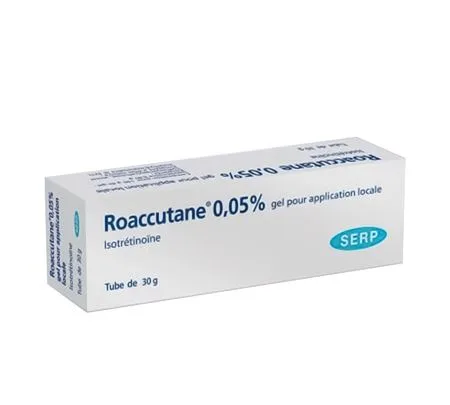
*ROACCUTANE® gel
isotretinoin
Forms and presentations
Gel for topical application at 0,050 % : Tube of 30 g.Composition
| for 100 g | |
| Isotretinoin
|
0,05 g |
Excipient with known effect: ethanol (alcohol).
Indications
- Juvenile polymorphic acne.
- Acne with predominantly retentional features: comedonal or microcystic.
Dosage and administration
DosageApply the product in a thin layer with the fingers, once or twice a day, to the skin areas to be treated, about a quarter of an hour after washing.
Doses will be adjusted according to each patient's sensitivity.
The first signs of clinical improvement generally appear as early as the end of the first month of treatment. Treatment should be continued for an average of 3 months.
Method of administration:
Cutaneous use.
Wash hands thoroughly immediately after application.
Contraindications
- Hypersensitivity to the active substance or to any of the excipients listed in section Composition.
- Pregnancy (see Fertility/Pregnancy/Breastfeeding).
- Women planning a pregnancy.
Warnings and precautions
Avoid contact with the eyes, mouth, nostrils and mucous membranes. In case of accidental contact, it is recommended to wash thoroughly with water.
Avoid using any perfumed or alcohol-containing product that could cause additional irritation.
Particular caution is required when treating concurrently with other topical preparations, especially those with a desquamating effect. If, before treatment with Roaccutane, the patient has already been treated with keratolytic or exfoliating preparations, it is recommended to wait until skin irritation phenomena have resolved.
Exposure to sunlight and ultraviolet lamps causes additional irritation. Therefore, avoid exposure during treatment with Roaccutane as far as possible. Treatment may, however, be continued if exposure is reduced to a minimum (protection by wearing a hat and using a sunscreen cream) and the frequency of applications is adjusted.
In case of exceptional sun exposure (for example, a day at the sea), do not apply Roaccutane the day before, on the day itself, or the day after.
If prior exposure has caused burns, wait for complete recovery before starting treatment with Roaccutane.
Given the absence of systemic passage, the precautions for use specific to retinoids administered systemically may be lifted during treatment with Roaccutane gel.
Interactions
Drug interactionsAs the transcutaneous absorption of isotretinoin can be considered nil, interaction with medicines administered systemically is therefore unlikely.
Fertility, pregnancy and breastfeeding
Retinoids administered orally are associated with congenital abnormalities. When used in accordance with the prescribing information, topical retinoids are generally considered to result in low systemic exposure due to minimal dermal absorption.
However, individual factors (for example: skin lesion, excessive use) may contribute to increasing systemic exposure.
Pregnancy:Roaccutane 0,05 %, gel for topical application is contraindicated (see Contraindications) in pregnant women or women planning a pregnancy.
If used in a pregnant patient, or if a patient treated with this medicine becomes pregnant, treatment must be discontinued.
Breastfeeding:
Taking this medicine is not recommended during breastfeeding.
Adverse effects
Local side effects may appear during the first weeks of treatment, in the form of irritative phenomena characterised by slightly stinging dry erythema of the application areas, particularly perioral and neck.
These phenomena generally remain moderate and subside with spacing out of applications.
Reporting of suspected adverse reactions:Reporting suspected adverse reactions after authorisation of the medicinal product is important. It allows continuous monitoring of the benefit/risk balance of the medicinal product. Healthcare professionals should report any suspected adverse reaction via the national reporting system: National Agency for the Safety of Medicines and Health Products (ANSM) and the network of Regional Pharmacovigilance Centres. Website: https://signalement.social-sante.gouv.fr.
Overdose
Excessive use will only cause an unpleasant skin reaction, but will not improve the result of the treatment.
Pharmacodynamics
Pharmacotherapeutic class: Dermatology - anti-acne preparations for topical use, ATC code: D010AD04.
- Mechanism of action:
- Isotretinoin is a synthetic isomer of all-trans-retinoic acid (tretinoin).
- The mechanism of action of Roaccutane gel has not been elucidated in detail.
Pharmacokinetics
No measurable concentration of isotretinoin, tretinoin or their 4-oxo metabolites has been detected in humans after repeated application of a supratherapeutic dose of Roaccutane.
Thus the transcutaneous absorption of isotretinoin can be considered nil.
Storage conditions
- Shelf life
- 3 years.
Close the tube tightly after use.
HANDLING/DISPOSAL INSTRUCTIONS
No special requirements.
Prescription, supply and reimbursement
LIST I| Marketing authorisation (AMM) | 3400933471705 (1992, SmPC rev 29.11.2022). |
| Not reimbursed by Social Security. |
SERP
Le Triton, 5, rue du Gabian. MC 98000 Monaco
Tel: 00 377 97 77 87 05. Fax: 00 377 92 16 78 27
Source: VIDAL · Updated on 11/11/2026. This information does not replace advice from a healthcare professional.