
Medicines
Update of 02/01/2026
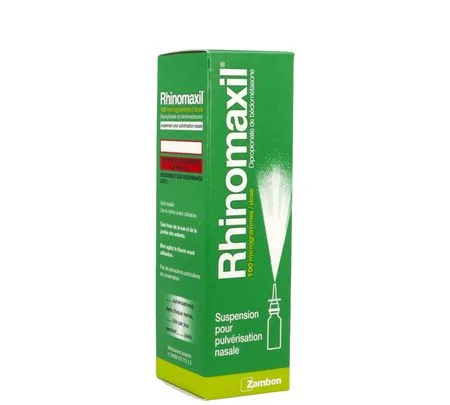
RHINOMAXIL®
beclometasone
Forms and presentations
Nasal spray suspension at 100 µg/dose: Spray bottle of 120 doses, with metering pump and nasal tip.Composition
| per dose | |
| Beclomethasone dipropionate
|
100 µg |
Excipient with known effect: benzalkonium chloride.
Indications
- Perennial or seasonal allergic rhinitis.
- Chronic eosinophilic inflammatory rhinitis.
Dosage and administration
Nasal use.
1 spray delivers 100 µg of beclomethasone dipropionate.
Dosage- Adults:
- The daily dose is on average 400 µg per day, i.e. 1 spray in each nostril 2 times per day.
- The dosage will be adapted to the clinical condition of the patient and should usually not exceed 1 mg per day (i.e. 5 sprays in each nostril per day).
- In chronic forms, efforts should be made to gradually lower the doses to 200 µg per day, i.e. 1 spray in each nostril 1 times per day.
- Children over 3 years:
- The daily dose is on average 200 to 400 µg per day (6 to 13 µg/kg/day), i.e. 1 spray in each nostril 1 to 2 times per day.
- The dosage will be adapted to the clinical condition of the patient and should usually not exceed 600 µg in children under 12 years (i.e. 3 sprays in each nostril per day).
- In allergic rhinitis, the initiation and duration of treatment depend on allergen exposure.
- Treatment will be continued while efforts are made to gradually lower the doses as soon as symptoms improve.
Method of administration:
Shake the bottle vigorously before use.
Remove the cap and press 1 or 2 times into the air to activate.
Administer as follows:- Clean the nose thoroughly.
- Remove the protective cap.
- Remove the ring.
- Press the sprayer several times until a fine mist is obtained.
- Insert the nasal applicator into one nostril and close the other by pressing with a finger. Inhale while pressing on the base of the nasal applicator. This delivers a precise dose of active ingredient. Proceed in the same way with the other nostril.
- After use, put the ring back on the bottle, along with the cap.
When using the medicine for the first time, or after a few days without having used it, remove the cap and press the sprayer several times until a fine mist is obtained.
If no mist comes out, do not try to unblock the sprayer opening with a pin or any other sharp object; instead, remove the tip by pulling it upwards and clean it by soaking it in hot water for a few minutes. Then rinse it under the tap and let it dry before reassembling it.
Contraindications
- Hypersensitivity to the active substance or to any of the excipients listed in section Composition.
- Haemostasis disorders, in particular epistaxis.
- Oral, oropharyngeal, nasal and ocular herpes virus infection.
Warnings and precautions
In children, in the case of prolonged treatment, vigilance is required regarding the risk of impact on growth.
The risk of systemic effects, adrenocortical suppression and impact on growth is increased when corticosteroid therapy by the inhaled route, or even more so by the systemic route, is administered concomitantly.
Systemic effects may occur during long-term treatment with high doses of nasal corticosteroids. The risk of systemic impact nevertheless remains lower than with oral corticosteroids and may vary depending on individual susceptibility and on the composition of the corticosteroid product used. Possible systemic effects are: Cushing's syndrome or Cushingoid symptoms, skin thinning, subcutaneous haematomas, adrenal insufficiency, growth retardation in children and adolescents, decreased bone density, cataract and glaucoma and, more rarely, psychological and behavioural disorders including psychomotor hyperactivity, sleep disorders, anxiety, depression or aggressiveness (particularly in children).
Visual disturbances may occur during systemic or local corticosteroid therapy. In case of blurred vision or the appearance of any other visual symptom during corticosteroid therapy, an ophthalmological examination is required to look for, in particular, cataract, glaucoma, or a rarer lesion such as central serous chorioretinopathy, described with the administration of systemic or local corticosteroids.
Concomitant administration of nasal corticosteroids in patients on long-term oral corticosteroid therapy does not remove the precautions necessary when reducing oral corticosteroid doses. These will be reduced very gradually and withdrawal must be carried out under careful medical supervision (watching for the appearance of signs of acute or subacute renal insufficiency), continuing beyond the discontinuation of systemic corticosteroid therapy.
Local nasal administration of corticosteroids is not recommended in patients who have recently had ulceration of the nasal septum, or who have undergone surgery or trauma to the nose, until healing is complete.
This medicine contains 35,00 µg of benzalkonium chloride per dose. Benzalkonium chloride may cause irritation or oedema of the nasal mucosa, particularly in the case of long-term use.
The patency of the nasal passages must be ensured for optimal diffusion of the product. Inform the patient and advise them to dry them by blowing their nose before instillation.
In case of major nasal obstruction, a detailed examination of the ENT area should be performed.
In cases of pulmonary tuberculosis or pulmonary fungal infection, the institution of close monitoring and appropriate treatment is required.
In the case of prolonged treatment, repeated examinations of the nasal mucosa are recommended (as an indication, approximately 2 months after starting treatment and then every 6 months) in order to assess any impact of corticosteroid therapy on the nasal mucosa. If atrophy of the nasal mucosa is observed, a reduction in topical corticosteroid doses should be considered.
Inform the patient that this is a regular treatment, and that a period of several days of treatment may be necessary before effects on rhinitis symptoms are observed.
Athletes should be made aware that this specialty contains an active substance that may induce a positive reaction in tests carried out during anti-doping controls.
Interactions
The metabolism of beclometasone is less dependent on CYP3A than that of certain other corticosteroids, and interactions are generally unlikely; nevertheless, in case of concomitant use of potent CYP3A inhibitors (e.g. ritonavir, cobicistat), the possibility of systemic effects cannot be excluded and it is therefore advised to be cautious and to apply adequate monitoring when these agents are used.
Fertility, pregnancy and breastfeeding
Pregnancy:In animals, experimentation has demonstrated a teratogenic effect, variable depending on the species.
In humans, epidemiological studies have detected no teratogenic risk associated with oral corticosteroid use during the first trimester.
In chronic diseases requiring treatment throughout pregnancy, a slight intrauterine growth retardation is possible. Neonatal adrenal insufficiency has been exceptionally observed after high-dose corticosteroid therapy.
A period of clinical (weight, diuresis) and biological (blood glucose) monitoring of the newborn may be justified.
Consequently, this medicine may be prescribed during pregnancy if needed.
Breastfeeding:
The passage of beclomethasone into milk has not been studied. Nevertheless, other corticosteroids are excreted in milk.
Available data appear to show good tolerance in children; however, the biological or clinical impact of long-term maternal treatment has not been assessed to date.
Consequently, breastfeeding is possible during short-term treatment. During chronic treatment, as a precaution, breastfeeding should be avoided.
Adverse effects
- Local effects:
- Possibility of epistaxis, nasal irritation, dryness of the nasal mucosa.
- Hypersensitivity reactions have been reported (pruritus, skin rash, facial oedema).
- Cases of nasal and pharyngeal infections with Candida albicans have been described during treatment with topical corticosteroids. In this case, it is preferable to discontinue nasal corticosteroid therapy and consider initiating appropriate treatment.
- Rare cases of septal perforation as well as ocular hypertension have been reported with nasal corticosteroids.
- Due to the presence of benzalkonium chloride, risk of irritation or oedema of the nasal mucosa (see Warnings and Precautions for Use).
- Systemic effects:
-
- With long-term administration of beclomethasone, a systemic effect, and in particular on growth in children, cannot be excluded (see Warnings and Precautions for Use). This risk is increased in cases of concomitant administration of corticosteroid therapy by inhalation or, a fortiori, by the systemic route. The risk of latent corticotropic insufficiency after prolonged administration should be considered in cases of intercurrent infection, trauma or surgical intervention.
- Very rare frequency: cataract and glaucoma.
- Frequency not determined: blurred vision (see Warnings and Precautions for Use), headache.
- With long-term administration of beclomethasone, a systemic effect, and in particular on growth in children, cannot be excluded (see Warnings and Precautions for Use). This risk is increased in cases of concomitant administration of corticosteroid therapy by inhalation or, a fortiori, by the systemic route. The risk of latent corticotropic insufficiency after prolonged administration should be considered in cases of intercurrent infection, trauma or surgical intervention.
Reporting suspected adverse reactions after authorisation of the medicinal product is important. It allows continuous monitoring of the benefit/risk balance of the medicinal product. Healthcare professionals should report any suspected adverse reaction via the national reporting system: National Agency for the Safety of Medicines and Health Products (ANSM) and the network of Regional Pharmacovigilance Centres. Website: https://signalement.social-sante.gouv.fr.
Overdose
Long-term overdose could lead to hypothalamic-pituitary-adrenal suppression and, if prolonged, clinical signs of hypercorticism. These symptoms will disappear after discontinuation of treatment, which must be gradual.
Pharmacodynamics
Pharmacotherapeutic class: Glucocorticoid for nasal use (R: respiratory system).
Beclomethasone dipropionate administered nasally exerts an anti-inflammatory activity on the nasal mucosa.
Pharmacokinetics
Beclomethasone dipropionate, partly absorbed through the nasal mucosa and partly swallowed, is metabolised in the liver to beclomethasone monopropionate and beclomethasone alcohol, then excreted as inactive metabolites in bile and urine.
Storage conditions
- Shelf life
- 3 years.
No special precautions for storage.
HANDLING/DISPOSAL INSTRUCTIONS
See Posology and Method of Administration.
Prescription, supply and reimbursement
LIST I| Marketing authorisation (AMM) | 3400937071253 (2006, SmPC rev 20.09.2022). |
| Price: | 5,61 euros (1 bottle). |
| Social Security reimbursement at 30%. Collect. | |
ZAMBON FRANCE
13, rue René-Jacques
92138 Issy-les-Moulineaux cdx
Tel: 01 58 04 41 41. Fax: 01 58 04 41 00
www.zambon.fr
Source: VIDAL · Updated on 11/11/2026. This information does not replace advice from a healthcare professional.