Medicines
SmPC of the 24/08/2023
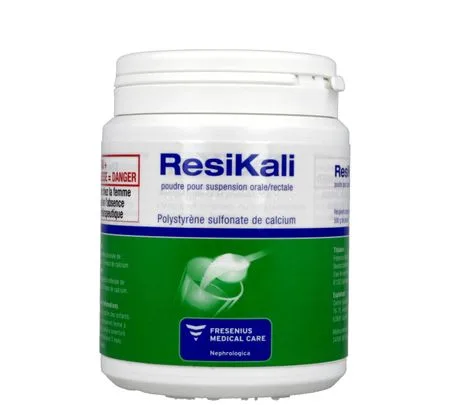
RESIKALI, powder for oral/rectal suspension
Forms and presentations
Powder for oral/rectal suspension.
Fine powder, cream to light brown in colour.
Composition
1 g of powder contains:
759-949 mg of calcium polystyrene sulfonate, corresponding to 1,8 mmol of calcium.
Excipient with known effect: 50,74-240,74 mg of sucrose.
20 g of powder contains:
15,18-18,98 g of calcium polystyrene sulfonate, corresponding to 36 mmol of calcium.
Excipient with known effect: 1,01-4,81 g of sucrose
Sucrose, citric acid.
Indications
Treatment of hyperkalaemia in patients with chronic or acute renal failure, including patients undergoing dialysis.
Dosage and administration
Administration by oral route or as a rectal enema.
The recommended dosages are given as a guide. They must be determined according to regular clinical and biological monitoring.
The duration of treatment with RESIKALI, which is a calcium-based cation exchanger, depends on the results of daily examinations of the serum potassium concentration. If this concentration falls to 5 mmol/l, treatment must be stopped. When it exceeds 5 mmol/l, treatment must be resumed.
Oral use
In adults, including the elderly:
20 grams (1 measuring spoon) of powder 1 to 3 times a day, mixed with 150 ml of liquid.
In children, including infants:
0,5 to 1,0 g/kg of body weight per day in several doses, mixed with 150 ml of liquid. This preparation must be divided into at least 3 doses spread over 24 hours.
RESIKALI must not be administered orally to newborns.
RESIKALI must be taken at least 3 hours before or after the administration of other oral medicinal products (see section Interactions).
RESIKALI must be taken with the main meals.
For liquids suitable for diluting RESIKALI before oral administration, see section Disposal and handling.
Rectal route (enema)
In adults, including the elderly:
After a rectal enema, 40 g (2 measuring spoons) are suspended in 150 ml of 5% glucose solution, then administered 1 to 3 times a day. At the start of treatment, administration by rectal or oral route may promote a rapid decrease in the serum potassium concentration.
Retention time: 6 hours.
Paediatric population :
When oral administration is not possible, a dose at least equivalent to an oral dose may be administered rectally: 0.5 to 1.0 g/kg body mass per day suspended in 150 ml of 5% glucose. This preparation must be divided into at least three doses spread over 24 hours. After the rectal enema, the colon must be irrigated to ensure adequate elimination of the resin.
However, particular attention is required when this product is administered rectally to children or newborns. Indeed, excessive dosing or inadequate dilution may lead to agglomeration of the resin. Therefore, when this product is administered to children born prematurely or to newborns of low body weight, particular attention is required due to a risk of gastrointestinal haemorrhage or colonic necrosis (see section Warnings and precautions).
Contraindications
The use of RESIKALI is contraindicated in patients presenting with:
- hypokalaemia (serum potassium < 5 mmol/l);
- a condition associated with hypercalcaemia (for example, hyperthyroidism, multiple myeloma, sarcoidosis and metastatic carcinoma);
- hypersensitivity to the active substance or to any of the excipients listed in section Composition ;
- an obstructive bowel disease;
- reduced bowel motility;
- concomitant administration of sorbitol (see section Interactions) ;
- a risk of colonic necrosis.
Newborns:
RESIKALI must not be administered orally to newborns and is also contraindicated, regardless of the route of administration, in newborns with reduced bowel motility (for example post-operative or induced by another treatment).
Warnings and precautions
RESIKALI, a calcium-based cation exchanger, is not sufficiently effective in cases of severe potassium intoxication (levels above 6,5 mmol/l and/or ECG changes). In these situations, emergency measures (administration of sodium bicarbonate, insulin infusion in glucose solution) or dialysis should be considered.
The possibility of severe potassium depletion should be considered; adequate clinical and biological monitoring is therefore necessary during treatment, particularly in patients treated with digitalis glycosides. Administration of the resin must be discontinued when the serum potassium level is below 5 mmol/l.
Calcium intake during this treatment may lead to a significant increase in serum calcium, particularly if the patient follows a calcium-rich diet or if they take other calcium-containing preparations, such as phosphate binders or vitamin D analogues. Therefore, it is recommended to monitor serum calcium concentrations constantly.
To achieve its objectives, therapy using the cation exchange resin RESIKALI must be reinforced by other measures such as restriction of potassium intake, monitoring for the onset of acidosis and a high-calorie diet.
Like other polystyrene sulfonate resins, RESIKALI is not entirely selective for potassium; its use may present a risk of hypomagnesaemia. Therefore, serum magnesium levels should be monitored during treatment with RESIKALI.
In case of constipation with clinical impact, treatment with RESIKALI must be discontinued.
20 g of RESIKALI contains 4,81 g of sucrose, corresponding approximately to 0,41 of carbohydrates, which must be taken into account in diabetic patients.
RESIKALI must be taken at least 3 hours before or after the administration of other oral medicinal products. This time interval must be increased to 6 hours for patients with gastroparesis or other conditions causing delayed gastric emptying of food from the stomach into the small intestine (see section Interactions).
Due to a risk of colonic necrosis, sorbitol must not be used as a laxative in conjunction with RESIKALI administration, whether orally or rectally. (see section Contraindications).
Gastrointestinal stricture, intestinal ischaemia and its complications (necrosis and perforation), some with a fatal outcome, have been reported in patients treated with polystyrene sulfonate alone or in combination with sorbitol.
Patients should be advised to consult a doctor promptly if severe abdominal pain, nausea and vomiting, abdominal distension and rectal bleeding develop recently.
The lesions observed in gastrointestinal disorders induced by polystyrene sulfonate may be similar to those observed in inflammatory bowel diseases, ischaemic colitis, infectious colitis and microscopic colitis.
Particular attention is required during oral administration in order to avoid aspiration into the respiratory tract. RESIKALI should, if possible, be administered to the patient in a sitting position.
Patients with fructose intolerance, glucose-galactose malabsorption syndrome or sucrase/isomaltase deficiency (rare hereditary diseases) must not take this medicine.
Paediatric populationue
In newborns, calcium polystyrene sulfonate must not be given orally (see section Contraindications). In children and newborns, particular attention is required during rectal administration. Indeed, excessive dosage or inadequate dilution may lead to agglomeration of the resin. Particular attention is required in premature infants or newborns of low body weight, due to the risk of gastrointestinal haemorrhage and colonic necrosis.
Interactions
Concomitant use is contraindicated with:
- Sorbitol, orally or rectally: the use of sorbitol during treatment with RESIKALI may cause colonic necrosis. Concomitant administration of sorbitol and calcium polystyrene sulfonate is therefore contraindicated (see section Contraindications).
When administered orally, RESIKALI may bind to other orally administered medicinal products. Binding of RESIKALI to other orally administered medicinal products could reduce their gastrointestinal absorption and efficacy (see list below). Co-administration of RESIKALI with other orally taken medicinal products should be avoided. Administer RESIKALI at least 3 hours before or 3 hours after the administration of other orally administered medicinal products. For patients with gastroparesis, an interval of 6 hours should be considered.
To be used with caution with:
- Cation-releasing agents: they may reduce the efficacy of calcium polystyrene sulfonate in binding potassium.
- Cation-releasing antacids and non-absorbable laxatives: systemic alkalosis has been reported with concomitant administration of cation-exchange resin and antacids or laxatives such as magnesium hydroxide, aluminium hydroxide or calcium carbonate. A certain interval should be observed between administration of these medicinal products and taking RESIKALI (see sections Dosage and administration and Warnings and precautions).
- Aluminium hydroxide: intestinal obstruction due to aluminium hydroxide concretions has been reported when aluminium hydroxide was combined with a resin (sodium form).
- Digitalis medicinal products: the toxic effects of digitalis on the heart, in particular ventricular arrhythmias and atrioventricular nodal dissociation, may be increased if hypokalaemia and/or hypercalcaemia develops (see section Warnings and precautions).
- Lithium: possible decrease in lithium absorption.
- L-thyroxine: possible decrease in L-thyroxine absorption.
- Medicinal products that interact with calcium (calcium release by the resin):
- Ciprofloxacin: possible decrease in the bioavailability of ciprofloxacin
- Tetracyclines: possible decrease in tetracycline absorption
- Thiazide diuretics or loop diuretics: concomitant use of RESIKALI and thiazide diuretics or loop diuretics may increase the risk of hypokalaemia.
- Anticholinergics: they may reduce gastric motility and thereby increase the risk of gastrointestinal adverse effects of RESIKALI.
Fertility, pregnancy and breastfeeding
Pregnancy
There are no data or limited data on the use of calcium polystyrene sulfonate in pregnant women. Animal studies are insufficient to conclude on reproductive toxicity (see section Preclinical safety). The potential risk in humans is not known. RESIKALI should not be used during pregnancy unless the clinical situation of the woman requires treatment with calcium polystyrene sulfonate.
Breast-feeding
There are insufficient data on the excretion of calcium polystyrene sulfonate/metabolites in human milk. RESIKALI should not be used during breastfeeding unless absolutely necessary.
Fertility
Data are not available.
Driving and using machines
RESIKALI has no or negligible influence on the ability to drive and use machines.
Adverse effects
Adverse reactions are classified by frequency as follows:
Very common: (> 1/10)
Common: (> 1/100, < 1/10)
Uncommon: (> 1/1 000, < 1/100)
Rare: (> 1/10 000, < 1/1 000)
Very rare: (< 1/10 000)
Frequency not known: (cannot be estimated from the available data).
|
Metabolism and nutrition disorders: |
|
|
Common: |
hypercalcaemia, hypokalaemia, hypomagnesaemia. |
|
Respiratory, thoracic and mediastinal disorders: |
|
|
Very rare: |
acute bronchitis and/or bronchopneumonia associated with inhalation of calcium polystyrene sulfonate. |
|
Gastrointestinal disorders: |
|
|
Common: |
nausea, vomiting. |
|
Uncommon: |
constipation, diarrhoea, intestinal obstruction, gastric ulcers, necrosis of the colon and even perforations (sometimes fatal), anorexia. |
|
Rare: |
in severe cases, obstructive ileus due to intestinal agglutination of the resin, faecal impaction following rectal administration in children, gastrointestinal concretions following oral administration in newborns.
|
|
Frequency not known: |
gastrointestinal ischaemia, ischaemic colitis, severe abdominal/rectal pain, rectal bleeding, haematemesis. |
With oral administration, patients may have difficulty swallowing the fairly large volume of dissolved powder. The extent of this difficulty depends on individual predisposition, the disease, the mode of administration and the duration of treatment.
Reporting of suspected adverse reactions
Reporting suspected adverse reactions after authorisation of the medicinal product is important. It allows continued monitoring of the benefit/risk balance of the medicinal product. Healthcare professionals should report any suspected adverse reactions via the national reporting system: Agence nationale de sécurité du médicament et des produits de santé (ANSM) and the network of Regional Centres of Pharmacovigilance - Website: https://signalement.social-sante.gouv.fr/.
Overdose
Biochemical disturbances following overdose may lead to clinical signs symptomatic of hypokalaemia, including ECG abnormalities, deterioration of cardiac function, irritability, confusion, attention disorders, muscle weakness, hyporeflexia and possible paralysis. Changes on the electrocardiogram may indicate hypokalaemia or hypercalcaemia; cardiac arrhythmia may occur.
Other symptoms of overdose may include constipation, obstructive ileus and retention of sodium and water. Appropriate measures to correct serum electrolyte levels should be taken and the resin should be removed from the digestive tract by use of appropriate laxatives or enemas.
Pharmacodynamics
Pharmacotherapeutic class: Medicinal products for the treatment of hyperkalaemia and hyperphosphataemia, ATC code: V03AE01.
Mechanism of action
RESIKALI is a cation-exchange resin that releases calcium in the intestines and binds potassium. This process reduces the absorption of potassium ions and their bioavailability.
Pharmacokinetics
Absorption/distribution/elimination
The calcium bound to the resin is exchanged for potassium present in the intestines. According to several publications, 1 g of exchange resin can bind 0.7 mmol of potassium in vivo.
Polystyrene resins are insoluble and not absorbable. They pass through the intestinal tract and are excreted almost entirely in the faeces. Thus, the potassium bound to the cation-exchange resin is excreted with the resin. The calcium released from the resin is partially absorbed. The electrolyte is then subject to the physiological routes of absorption, distribution and elimination.
The capacity of RESIKALI to exchange potassium depends largely on pH, as other cations such as ammonium and magnesium, as well as lipids and proteins, also have a strong affinity for the exchange resin as they pass through the intestines.
Preclinical safety
No preclinical studies on RESIKALI are available.
Toxicity studies with single oral, intraperitoneal or subcutaneous doses of calcium polystyrene sulfonate did not reveal a risk of acute toxicity. No preclinical studies with calcium polystyrene sulfonate are available.
SPECIAL PRECAUTIONS FOR DISPOSAL AND OTHER HANDLING
Suitable liquids for dissolving RESIKALI before oral administration are water, tea and non-alcoholic drinks.
RESIKALI must not be taken with fruit juices that contain a high dose of potassium.
The appropriate liquids for dissolving RESIKALI before administration by the rectal route are glucose solutions at 5 %.
Prescription, supply and reimbursement
| Marketing authorisation (AMM) |
|
| Price: |
|
100-101 TERRASSE BOIELDIEU TOUR FRANKLIN LA DEFENSE 8
92042 PARIS-LA-DÉFENSE CEDEX
Tel: 01 41 06 58 90 Tel (Green number): 0 800 400 160
contact_Fr@viforpharma.com
https://www.cslvifor.fr/
Source: VIDAL · Updated on 11/11/2026. This information does not replace advice from a healthcare professional.