
Medicines
SmPC of 13/01/2025
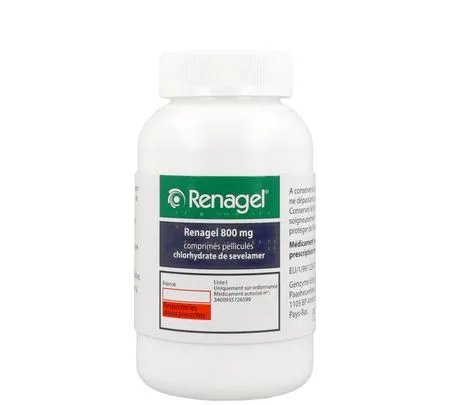
RENAGEL 800 mg film-coated tablets
Forms and presentations
Film-coated tablet (whitish, oval, with the mention "RG800" engraved on one side).
Bottle of 180, with a child-resistant safety cap.
Composition
Each tablet contains 800 mg of sevelamer hydrochloride.
Tablet core: anhydrous colloidal silica, stearic acid.
Film coating: hypromellose (E464), diacetylated monoglycerides.
Indications
Renagel is indicated for the control of hyperphosphataemia in adults on haemodialysis or peritoneal dialysis.
Renagel must be used as part of a multiple therapeutic approach, which may include calcium supplements, vitamin 1,25 - dihydroxy D3 or an analogue, to prevent the development of renal osteodystrophy.
Dosage and administration
Dosage
Initial dose
The recommended initial dose of sevelamer hydrochloride is 2,4 g, or 4,8 g per day depending on clinical needs and serum phosphate levels. Renagel must be taken three times a day with meals.
|
Serum phosphate level in patients not treated with phosphate binders |
Initial dosage of Renagel 800 mg tablets |
|
1,76-2,42 mmol/L (5,5-7,5 mg/dL) |
1 tablet 3 times a day |
|
> 2,42 mmol/L (> 7,5 mg/dL) |
2 tablets 3 times a day |
In patients previously on phosphate binders, the initial dose of Renagel should correspond gram for gram to the binder dose, with subsequent monitoring of serum phosphate levels until the optimal daily dose is reached.
Dose escalation and maintenance dosage
The serum phosphate concentration must be monitored regularly and the dose of sevelamer hydrochloride increased in steps of 0.8 g three times a day (2.4 g/day) in order to reduce this level to 1,76 mmol/L (5,5 mg/dL) or less. Serum phosphate should be measured every two to three weeks until the serum phosphate level stabilises, and regularly thereafter.
The dosage range may vary between 1 and 5 tablets of 800 mg per meal. The actual average daily dose used during the chronic phase of a one-year clinical study was 7 grams of sevelamer.
Paediatric population
The safety and efficacy of this product in children under 18 years of age have not been established.
Renal impairment
The tolerability and efficacy of this product have not been established in patients with pre-dialysis chronic kidney disease.
Method of administration
Oral use
Patients should take Renagel during meals and follow the prescribed diet. The tablets must be swallowed whole without being crushed, chewed or cut into pieces before administration.
Contraindications
- Hypersensitivity to sevelamer or to any of the excipients listed in section Composition.
- Hypophosphataemia
- Intestinal obstruction.
Warnings and precautions
The efficacy and tolerability of Renagel have not been studied in patients suffering from:
- swallowing disorders
- uncontrolled inflammatory bowel disease
- gastrointestinal transit disorders, including untreated or severe gastroparesis, diverticulosis, retention of gastric contents and abnormal or irregular transit
- patients with a history of major gastrointestinal surgery
Therefore, Renagel should be administered with caution in patients with these conditions.
Intestinal obstruction and ileus/subileus
In very rare cases, intestinal obstruction and ileus/subileus have been observed in patients during treatment with sevelamer hydrochloride. Constipation may be a precursor symptom. Constipated patients should be closely monitored during treatment with sevelamer hydrochloride. This treatment should be reassessed in the patient if severe constipation or severe gastrointestinal symptoms occur.
Fat-soluble vitamins
Depending on dietary intake and the nature of end-stage renal failure, dialysed patients may develop hypovitaminosis A, D, E and K. It cannot be excluded that Renagel binds fat-soluble vitamins present in the diet. Therefore, in patients not receiving vitamin supplements, monitoring of vitamin A, D and E concentrations, and assessment of vitamin K concentration by measuring prothrombin time should be considered, and vitamin supplementation should be administered if necessary. Particular monitoring of vitamin and folic acid concentrations is recommended in patients on peritoneal dialysis, as vitamin A, D, E and K concentrations were not measured in these patients in the clinical study.
Folate deficiency
The currently available data do not allow the possibility of folate deficiency during prolonged treatment with Renagel to be excluded.
Hypocalcaemia/hypercalcaemia
Patients with renal failure may develop hypocalcaemia or hypercalcaemia. Renagel does not contain calcium. Serum calcium should be monitored as part of the routine management of a dialysed patient. Calcium supplementation should be administered in case of hypocalcaemia.
Metabolic acidosis
Chronic renal failure is a predisposing factor for metabolic acidosis. Worsening of acidosis has been reported when sevelamer was substituted for other phosphate binders in several studies, with bicarbonate levels observed in patients on sevelamer lower than those observed in patients on calcium-based binders. Increased monitoring of serum bicarbonate levels is therefore recommended.
Peritonitis
Dialysed patients are at risk of infections inherent to the dialysis method used. Peritonitis is a known complication occurring in patients on peritoneal dialysis (PD). In a clinical study with Renagel, several cases of peritonitis were reported. Therefore, PD patients should be closely monitored to ensure compliance with aseptic conditions and early recognition of all signs and symptoms associated with peritonitis as well as its prompt management.
Swallowing difficulties and risk of choking:
Difficulties in swallowing Renagel tablets have been reported in rare cases. For the most part, these were patients with associated comorbidities, including swallowing disorders or oesophageal abnormalities. Particular attention should be paid when Renagel is prescribed to patients with swallowing disorders.
Hypothyroidism
In patients with hypothyroidism treated with levothyroxine and receiving sevelamer hydrochloride, closer monitoring is recommended (see section Interactions).
Long-term chronic treatment
In the absence of data on chronic use of sevelamer beyond 1 year, potential absorption and accumulation of sevelamer during prolonged chronic treatment cannot be entirely excluded (see section Pharmacokinetics).
Hyperparathyroidism
Renagel alone is not indicated for the control of hyperparathyroidism. In patients with secondary hyperparathyroidism, Renagel should be used as part of an overall therapeutic management, which may include calcium supplements, vitamin 1,25 - dihydroxy D3 or an analogue, to reduce intact parathyroid hormone (iPTH) concentrations.
Chloraemia
Chloraemia may increase during treatment with Renagel insofar as chloride may be exchanged with phosphorus in the intestinal lumen. Although no clinically significant increase in chloraemia was observed during clinical studies, chloraemia should be monitored as is the case during normal follow-up of a dialysis patient. One gram of Renagel contains approximately 180 mg (5,1 mEq) of chloride.
Gastrointestinal inflammatory disorders
Cases of severe inflammatory disorders affecting different parts of the gastrointestinal tract (including serious complications such as haemorrhage, perforation, ulceration, necrosis, colitis and colonic mass/mass at the caecum) associated with the presence of sevelamer crystals have been reported (see section Adverse effects). Inflammatory disorders may resolve upon discontinuation of sevelamer. Treatment with sevelamer hydrochloride should be reassessed in patients presenting with severe gastrointestinal symptoms.
Interactions
Dialysis
No interaction study has been performed in dialysis patients.
Ciprofloxacin
In interaction studies in healthy volunteers, sevelamer hydrochloride decreased the bioavailability of ciprofloxacin by approximately 50% when administered with Renagel. Therefore, Renagel should not be administered at the same time as ciprofloxacin.
Antiarrhythmics and anticonvulsants
Patients receiving antiarrhythmic medicinal products to treat arrhythmia or anticonvulsant medicinal products to treat epileptic disorders were excluded from clinical trials. Sevelamer hydrochloride should only be prescribed with caution in patients who are also taking these medicinal products.
Levothyroxine
Since marketing, very rare cases of increased thyrotropin (TSH) concentrations have been reported in patients treated concomitantly with levothyroxine and sevelamer hydrochloride. Therefore, closer monitoring of TSH concentrations is recommended in patients receiving both medicinal products.
Ciclosporin, mycophenolate mofetil and tacrolimus in transplant patients
A decrease in ciclosporin, mycophenolate mofetil and tacrolimus levels has been reported in transplant patients when co-administered with sevelamer hydrochloride, but this is without clinical consequence (e.g. graft rejection). The possibility of a drug interaction therefore cannot be excluded, and close monitoring of blood concentrations of mycophenolate mofetil, ciclosporin and tacrolimus should be considered during co-administration and after its discontinuation.
Digoxin, warfarin, enalapril, metoprolol
Renagel showed no effect on the bioavailability of digoxin, warfarin, enalapril or metoprolol in interaction studies in healthy volunteers.
Proton pump inhibitors
Since marketing, very rare cases of increased phosphate concentrations have been reported in patients treated concomitantly with proton pump inhibitors and sevelamer hydrochloride.
Bioavailability
Renagel is not absorbed and may influence the bioavailability of other medicinal products. When a medicinal product is administered and a reduction in its bioavailability could have a non-negligible clinical impact on its tolerability or efficacy, that medicinal product should be administered at least one hour before or three hours after Renagel, or the physician should consider monitoring blood levels.
Fertility, pregnancy and breastfeeding
Pregnancy
The safety of sevelamer hydrochloride has not been established in pregnant women. In animal studies, no embryo-foetal toxicity was found with Renagel. However, during pregnancy Renagel should only be administered if clearly necessary and after careful assessment of the risk/benefit ratio for both the mother and the foetus (see Preclinical safety).
Breast-feeding
The safety of sevelamer hydrochloride has not been established in breast-feeding women. Renagel should only be administered to a breast-feeding woman if clearly necessary and after careful assessment of the risk/benefit ratio for both the mother and the infant (see Preclinical safety).
Fertility
No data are available regarding the effect of sevelamer on fertility in men.
Animal studies have shown that sevelamer had no effect on the fertility of male and female rats exposed to doses equivalent in humans to twice the maximum dose of 13 g/day used in clinical trials, based on a comparison of body surface areas.
Driving and using machines
Sevelamer has negligible or no effect on the ability to drive and use machines.
Adverse effects
Summary of the safety profile
The most frequently observed adverse reactions (≥ 5% of patients) all belonged to the system organ class "Gastrointestinal disorders".
Table listing undesirable effects
Parallel-group studies were conducted involving 244 hemodialysis patients treated for a period of up to 54 weeks and 97 peritoneal dialysis patients treated for a treatment period of 12 weeks.
Adverse reactions from these studies (299 patients), uncontrolled clinical trials (384 patients), and those reported spontaneously after marketing are classified in the table below by frequency. The frequency classification of adverse events is as follows: very common (≥ 1/10), common (≥ 1/100, < 1/10), uncommon (≥ 1/1 000, < 1/100), rare (≥ 1/10 000, < 1/1 000), very rare (< 1/10 000), not known (cannot be estimated from the available data).
|
System organ class |
Very common |
Common |
Uncommon |
Very rare |
Frequency not known |
|
Immune system disorders |
Hypersensitivity* |
||||
|
Metabolism and nutrition disorders |
Acidosis, increased chloride levels |
||||
|
Gastrointestinal disorders |
Nausea, vomiting |
Diarrhea, dyspepsia, flatulence, upper abdominal pain, constipation |
Abdominal pain, intestinal obstruction, ileus/subileus, diverticulitis, intestinal perforation1, gastrointestinal hemorrhage*1, intestinal ulceration*1, gastrointestinal necrosis*1, colitis*1, intestinal mass*1 |
||
|
Skin and subcutaneous tissue disorders |
Pruritus, skin rash |
||||
|
Investigations |
Crystal deposition in the intestine*1 |
* after marketing
1 See the warning on gastrointestinal inflammatory disorders in section Warnings and precautions
Reporting of suspected adverse reactions
Reporting suspected adverse reactions after authorisation of the medicinal product is important. It allows continued monitoring of the benefit/risk balance of the medicinal product. Healthcare professionals are asked to report any suspected adverse reactions via the national reporting system: National Agency for the Safety of Medicines and Health Products (ANSM) and the network of Regional Pharmacovigilance Centres - Website: https://signalement.social-sante.gouv.fr.
Overdose
Renagel was administered to healthy volunteers at doses of up to 14 grams, equivalent to seventeen tablets of 800 mg per day for eight days without adverse effects.
Pharmacodynamics
Pharmacotherapeutic class: Treatment of hyperphosphataemia. ATC code: V03AE02.
Renagel contains sevelamer, a phosphate chelator, a non-absorbed poly(allylamine) hydrochloride polymer, free of metal and calcium. It contains several amines separated by a carbon ion of the polymeric structure. These amines are partially ionised in the intestine and interact with phosphate molecules through ionic and hydrogen bonds. Thanks to the chelation of phosphate in the gastrointestinal tract, sevelamer reduces the serum phosphate concentration.
In clinical trials, sevelamer has been shown to be effective in reducing serum phosphorus in patients on haemodialysis or peritoneal dialysis.
Sevelamer reduces the incidence of hypercalcaemic episodes compared with patients using only calcium-based phosphate chelators, probably because the product itself contains no calcium. The effects on phosphate and calcium were shown to be maintained throughout a study with one year of follow-up.
Sevelamer binds bile acids in vitro and in vivo in animal models. Binding of bile acids by ion-exchange resins is a well-known method for lowering cholesterolaemia. In clinical trials, the mean level of total cholesterol and LDL cholesterol decreased by 15 to 31%. This effect is observed after 2 weeks and is maintained with long-term treatment. Triglycerides, HDL cholesterol and albumin did not change.
In clinical studies in haemodialysis patients, sevelamer alone had no consistent and clinically significant effect on the serum concentration of intact parathyroid hormone (iPTH). However, in the 12-week study including peritoneal dialysis patients, similar reductions in iPTH comparable to those in patients receiving calcium acetate were observed. In patients with secondary hyperparathyroidism, Renagel should be used as part of a multiple therapeutic approach, which may include calcium supplements, vitamin 1,25-dihydroxy D or an analogue, to reduce iPTH concentrations.3 or an analogue, to reduce iPTH concentrations.
In a one-year clinical trial, Renagel had no adverse effect on bone remodelling or bone mineralisation compared with calcium carbonate.
Pharmacokinetics
Renagel is not absorbed in the gastrointestinal tract, according to the results of a single-dose pharmacokinetic study in healthy volunteers. No pharmacokinetic study has been carried out in renally impaired patients (see section Warnings and precautions).
Preclinical safety
In preclinical studies in rats and dogs, Renagel at a dose representing 10 times the maximum human doses reduced the absorption of the fat-soluble vitamins D, E and K, and folic acid.
In a study in rats, following administration of a dose of sevelamer 15 to 30 times higher than the prescribed dose in humans, an increase in serum copper was detected. This was not confirmed in a study in dogs, nor in clinical trials.
Currently, no formal data concerning carcinogenic potential are available. However, studies in vitro and in vivo have indicated that Renagel does not have genotoxic potential. Furthermore, the medicine is not absorbed in the gastrointestinal tract.
Reproduction studies showed no sign that sevelamer induced embryolethal, foetotoxic or teratogenic effects at the doses studied (up to 1 g/kg/day in rabbits and up to 4,5 g/kg/day in rats). Skeletal ossification deficits were observed at several sites in foetuses of female rats receiving sevelamer at 8 to 20 times the maximum human dose of 200 mg/kg. At these high doses, the effects may result from depletion of vitamin D and/or vitamin K.
Special storage precautions
Store at a temperature not exceeding +25 °C.
Keep the bottle tightly closed to protect it from moisture.
SPECIAL PRECAUTIONS FOR DISPOSAL AND OTHER HANDLING
Any unused medicinal product or waste material should be disposed of in accordance with local requirements.
Prescription, supply and reimbursement
| Marketing authorisation (AMM) |
|
| Price: |
|
Sanofi Winthrop Industrie
82, av Raspail. 94250 Gentilly
Medical information, Pharmacovigilance, Quality complaints, Quality of information and Medical visit ethics:
Medical Information website:
https://www.sanofimedicalinformation.com/s/?language=fr&CN=FR
Source: VIDAL · Updated on 11/11/2026. This information does not replace advice from a healthcare professional.