
Medicines
SmPC of 14/11/2024
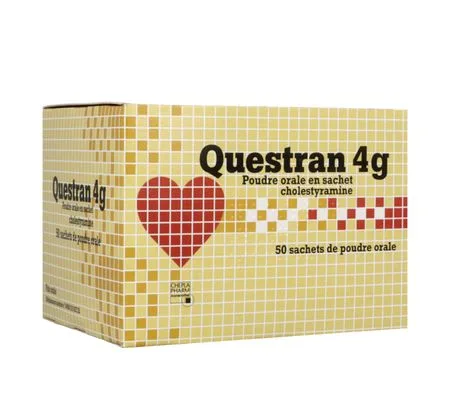
QUESTRAN 4 g, oral powder in sachet
Composition
For one sachet:
Cholestyramine expressed as anhydrous product: 4,000 g
Excipients with known effect : aspartame (E 951), propylene glycol (E 1520).
Xanthan gum, propylene glycol alginate, anhydrous citric acid, orange flavouring*, aspartame, anhydrous colloidal silica.
* Composition of orange flavouring : water, dextrimaltose, concentrated orange essence, 1-dodecanol, 1-octanol, triacetin, ethyl butyrate, linalyl acetate, ethyl acetate, allyl hexanoate, alpha-ionome, concentrated mandarin essence, methyl acetate, ethyl propionate, ethyl isobutyrate, tocopherol, acetic acid.
Indications
- Essential hypercholesterolaemia (Frederickson type II classification) including xanthomatosis,
- when an appropriate and consistently followed diet has proven insufficient,
- when cholesterolaemia remains high after diet and/or when associated risk factors exist.
Continuation of the diet is always essential.
Primary prevention: In a controlled multicentre study conducted over a period of 7 years in male subjects suffering from type II hypercholesterolaemia (cholesterol above 2,65 g/l) and free of clinical signs of coronary disease, a reduction in coronary events, fatal or non-fatal, was observed compared with placebo, without reduction in total mortality.
- Pruritus of incomplete intra- and extra-hepatic cholestasis.
Dosage and administration
Dosage
On average: 1 sachet 3 times a day. Administration should preferably be at mealtime. However, this may be modified to avoid any interference with the absorption of other therapies (see section Warnings and precautions)
In certain cases, this dose may be exceeded if the tolerability of the treatment is satisfactory. If the dose must be increased, this should be done gradually with periodic determination of lipid/lipoprotein levels.
Doses of more than 24 g of cholestyramine per day may interfere with normal fat absorption.
In association with diet, this treatment is a symptomatic treatment which must be very prolonged. Its effect on cholesterolaemia must be monitored frequently during the first months and periodically thereafter.
A tendency towards a decrease in cholesterolaemia should appear within the first month of treatment. Triglyceridaemia should be assessed periodically to detect any significant change.
Method of administration
The product must not be taken in pure form (dry form).
Pour the powder onto the surface of water in half a glass of water; optionally into fruit juice (notably orange juice) or milk. Leave to stand for 1 to 2 minutes, then stir to obtain a homogeneous suspension.
May also be prepared each evening for the following day and stored in the refrigerator.
Contraindications
This medicine must never be prescribed in the following cases:
- hepatic insufficiency and in particular complete obstruction of the biliary tract,
- hypersensitivity to any of the components,
- in cases of phenylketonuria, due to the presence of aspartame.
QUESTRAN contains aspartame, a source of phenylalanine which may cause harmful effects in people suffering from phenylketonuria.
This medicine is generally not recommended in the following cases:
- in combination with bile acids (see section Interactions),
- in cases of chronic constipation (see section Adverse effects).
Warnings and precautions
Before initiating treatment with QUESTRAN, other conditions that may increase cholesterolemia (such as hypothyroidism, diabetes mellitus, nephrotic syndromes, dysproteinemias, obstructive biliary tract disorders) should be investigated and treated.
In addition, before starting treatment with Questran, an attempt should be made to control serum cholesterol levels through the institution of an appropriate diet, weight reduction and treatment of any underlying disorder that could be the cause of hypercholesterolemia. Serum cholesterol levels should be determined frequently during the first months of treatment and periodically thereafter. A therapeutic response is generally observed within 4 weeks. Treatment must be continued to maintain cholesterol reduction. Serum triglyceride levels should be measured periodically to detect whether significant changes have occurred.
If there is no satisfactory response to treatment within four weeks, a change of treatment should be considered.
Special warnings
|
In children, as long-term safety has not been demonstrated and the specific effects on the development of a growing organism are not known, use should only be considered in cases of severe lipid disorders that are responsive to treatment. |
To minimize gastrointestinal adverse effects, it is preferable to start treatment in children with one sachet per day, then gradually increase the dose every 5 or 7 days until the desired result is obtained.
Precautions for use
- For elderly patients, it is recommended to start treatment with low doses.
- QUESTRAN should be used with caution in patients with exudative or bloody diarrhea, as it may increase the tendency to bleeding due to hypoprothrombinemia (vitamin K deficiency) induced by chronic use.
- Cholestyramine may produce or worsen pre-existing constipation or related conditions, such as hemorrhoids. In patients with constipation, the dose of cholestyramine should be reduced, as it may lead to a fecaloma. In patients with clinically symptomatic coronary artery disease, where straining at stool must be avoided, the dose of QUESTRAN must be adjusted to avoid constipation.
- By its mode of action, cholestyramine interferes with normal fat absorption (for doses greater than 24 g/day).
Absorption of fat-soluble vitamins (A, D, K, E) may be affected with prolonged treatment at high doses; vitamin supplementation should be considered in certain cases.
Chronic use of cholestyramine may be associated with an increased tendency to bleeding due to thrombopenia associated with vitamin A and K deficiency, usually rapidly corrected by parenteral administration of vitamin K. Relapses may be prevented by oral administration of vitamin K. - Reductions in folate levels have exceptionally been reported during long-term administration. Additional intake of folic acid is justified in this case.
- Cholestyramine being a chloride anion exchange resin, prolonged use at high doses may produce hyperchloremic acidosis. This is particularly true in young and small patients for whom the relative dose may be higher, as well as in patients suffering from renal insufficiency.
- QUESTRAN contains aspartame, a source of phenylalanine which may cause harmful effects in people suffering from phenylketonuria.
This medicine contains aspartame (E 951) and propylene glycol (E 1520).
This medicine contains 30 mg of aspartame per sachet. Aspartame contains a source of phenylalanine. May be harmful for people with phenylketonuria (PKU), a rare genetic disease characterized by the accumulation of phenylalanine that cannot be properly eliminated.
There are no clinical or non-clinical data concerning the use of aspartame in children under 12 weeks of age
This medicine contains 32,5 mg of propylene glycol per sachet. Intake of propylene glycol at doses above 1 mg/kg/day in newborns and 50 mg/kg/day in children under 5 years should be avoided. Concomitant use of other substrates of the enzyme alcohol dehydrogenase such as ethanol may induce serious side effects. For propylene glycol at doses above 50 mg/kg/day, medical monitoring is necessary in patients with renal or hepatic insufficiency.
Interactions
QUESTRAN delays or reduces the absorption of concomitantly taken treatments:
Table 1 - List of examples of drug interactions with cholestyramine
The table provided below may not be complete.
|
Class of medicines |
Medicine(s) |
|
Antiarrhythmics |
Amiodarone |
|
Anticonvulsants |
Valproate |
|
Antiepileptics |
Phenobarbital |
|
Anti-infectives |
Benzylpenicillin, Tetracycline |
|
Antimetabolites |
Methotrexate |
|
Bile acids |
Ursodeoxycholic acid |
|
Hypocholesterolemic drugs |
Bezafibrate, Ezetimibe |
|
Combined hormonal contraceptives |
Ethinylestradiol |
|
Coumarins |
Phenprocoumon, warfarin |
|
Digitalis glycosides |
Digitoxin, digoxin |
|
Immunosuppressants |
Leflunomide, mycophenolate |
|
Loop diuretics |
Furosemide |
|
Nicotinic acid derivatives |
Nicotinic acid |
|
Non-steroidal anti-inflammatory drugs |
Diclofenac, meloxicam, piroxicam, sulindac, tenoxicam |
|
Estrogen modulators |
Raloxifene |
|
Statins |
Fluvastatin, pravastatin |
|
Thiazide diuretics |
Hydrochlorothiazide |
|
Thyroid hormones |
Levothyroxine, liothyronine, thyroid extract |
|
Action to be taken: |
|
Take other therapies at a distance from cholestyramine (for example 1 to 2 hours before or 4 hours after). |
Fertility, pregnancy and breastfeeding
Pregnancy
Studies conducted in animals have not shown any teratogenic effect.
In clinical use, no malformative or foetotoxic effect has appeared to date. However, monitoring of pregnancies exposed to cholestyramine is insufficient to rule out any risk.
Indications for prescribing cholestyramine during pregnancy are exceptional and reserved for severe cases: women at very high vascular risk, intense pruritus linked to severe intrahepatic cholestasis of pregnancy.
Due to possible interference with the absorption of fat-soluble vitamins and folic acid, take cholestyramine at a distance from any supplementation.
Breast-feeding
If it proves essential, treatment must be initiated with caution in breastfeeding women, due to the possible impaired absorption of fat-soluble vitamins and folic acid.
Fertility
No data are available on the effect of cholestyramine on male fertility.
Adverse effects
The most frequent adverse effect is mild, transient constipation, well controlled by usual treatments, sometimes requiring dose reduction or even temporary discontinuation of treatment in certain patients. High doses and age (over 60 years) are predisposing factors (see section Contraindications). QUESTRAN may cause constipation, worsen it if it pre-existed, or worsen associated conditions such as haemorrhoids. In these patients, the dose of QUESTRAN should be reduced as it may cause faecal impaction.
In constipated patients presenting symptoms of coronary heart disease, straining during bowel movements should be avoided and the dose of QUESTRAN will be adjusted to avoid constipation.
Less frequent adverse effects:
- abdominal pain, eructation, dysphagia, hiccups, bloating, diarrhoea, flatulence, epigastric burning, nausea, vomiting, anorexia, steatorrhoea, taste alteration, tendency to bleeding due to hypoprothrombinaemia (vitamin K deficiency), vitamin A deficiency (cases of night blindness have been reported in rare cases) and vitamin D deficiency, hyperchloraemic acidosis in children, and osteoporosis.
- Carcinogenesis and mutagenesis: it has been suggested that cholestyramine could act as a promoter of colon cancer in rats when associated with an inducer.
The clinical significance of this observation in humans is not known. In the controlled primary prevention study (see section Indications), the overall incidence of cancers was identical in both groups. However, the frequency of cancers of the digestive tract was slightly higher in the "cholestyramine" group. The small number of cases did not allow a statistically significant difference to be demonstrated.
Calcified deposits have occasionally been observed in the bile ducts, as well as porcelain gallbladder, including in patients who had taken cholestyramine. However, this could be related to liver disease and not attributable to the product.
One patient had biliary colic on each of the three occasions he took cholestyramine.
An "earthy" mass in the transverse colon was identified by radiography in a patient suffering from a complex abdominal symptom.
Other adverse effects have been observed in patients taking QUESTRAN:
- gastrointestinal: gastrointestinal, rectal, haemorrhoidal bleeding, black stools, rectal pain,
- hypersensitivity reactions: rash, irritation of the skin, tongue, perianal region, urticaria, asthma, breathlessness, wheezing,
- muscle and joint pain,
- headache, dizziness, fatigue, drowsiness, paraesthesia,
- pancreatitis, diverticulitis, weight change (loss or gain), dental caries.
Reporting of suspected adverse reactions
Reporting suspected adverse reactions after authorisation of the medicinal product is important. It allows continued monitoring of the benefit/risk balance of the medicinal product. Healthcare professionals are asked to report any suspected adverse reactions via the national reporting system: National Agency for the Safety of Medicines and Health Products (ANSM) and the network of Regional Pharmacovigilance Centres - Website: https://signalement.social-sante.gouv.fr/.
Overdose
A case of overdose with QUESTRAN has been reported in a patient who took 1 times 1/2 the recommended maximum daily dose for several weeks. No manifestations were observed.
However, an overdose risks exposing patients to the onset or worsening of constipation, particularly in elderly subjects, with a risk of intestinal obstruction.
Overdose also exposes patients to the risk of hypovitaminosis (A, D, K, E) and a reduction in folate levels.
Prolonged use at high doses may exceptionally cause hyperchloremic acidosis in children or in patients with renal insufficiency (see section Warnings and precautions).
Symptomatic treatment should be put in place.
Pharmacodynamics
Pharmacotherapeutic class: HYPOCHOLESTEROLEMIC AGENT (B: blood, haematopoietic organs), ATC code: C10AC01
Cholestyramine is a synthetic basic ion-exchange resin with a high affinity for bile acids. It binds bile acids in the form of an insoluble complex, thereby inhibiting their enterohepatic cycle and increasing their faecal elimination.
Although hepatic synthesis of cholesterol is increased under the action of cholestyramine, cholesterol is rapidly eliminated in the form of bile acids and cholesterolaemia is lowered in the majority of patients.
Pharmacokinetics
Cholestyramine is not absorbed. In the intestinal tract, it exchanges chloride ions for bile acids, which it binds. Furthermore, the resin remains unchanged.
SPECIAL PRECAUTIONS FOR DISPOSAL AND OTHER HANDLING
The powder should be placed on the surface of the water in half a glass of water. Leave to stand for 1 to 2 minutes, then stir to obtain a uniform suspension. The container must be sufficiently large, given the swelling power of the powder.
Prescription, supply and reimbursement
| Marketing authorisation (AMM) |
|
| Price: |
|
CHEPLAPHARM France
68, rue Marjolin. 92300 Levallois-Perret
Tel: 08 09 54 20 23
https://www.cheplapharm.fr
Source: VIDAL · Updated on 11/11/2026. This information does not replace advice from a healthcare professional.