
Medicines
SmPC of 05/05/2025
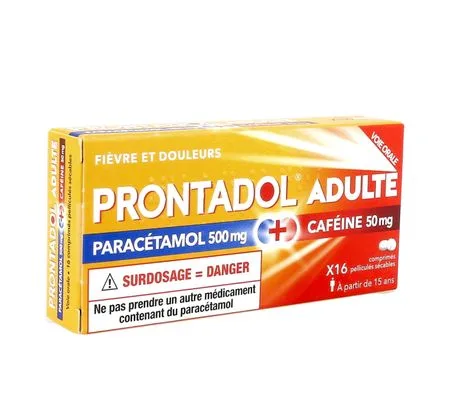
PRONTADOL ADULTS 500 mg/50 mg, tablet
Composition
For one tablet:
Paracetamol: 500.0 mg
Caffeine: 50.0 mg
Microcrystalline cellulose, povidone, croscarmellose sodium, magnesium stearate
Indications
PRONTADOL ADULTS is indicated in adults and children over 15 years for the symptomatic treatment of mild to moderate pain and/or febrile conditions.
Dosage and administration
Dosage
Adults and children > 50 kg
RESERVED FOR ADULTS AND CHILDREN OVER 50 kg (from 15 years) due to the presence of caffeine.
The usual dosage is 1 to 2 tablets at 500 mg, to be repeated if needed after a minimum of 4 hours.
It is generally not necessary to exceed 3 grams of paracetamol per day, i.e. 6 tablets.
However, in case of more intense pain, the maximum dosage may be increased up to 4 grams per day, i.e. 8 tablets per day.
Always respect an interval of 4 hours between doses.
Maximum recommended doses: see section Warnings and precautions.
Method of administration
Oral use.
Swallow the tablet without chewing it with a large glass of water.
Frequency of administration
Regular intake helps avoid fluctuations in pain and/or fever.
In adults, they must be spaced at least 4 hours apart.
Due to the presence of caffeine, avoid any intake at the end of the day.
Renal impairment
In cases of severe renal insufficiency (creatinine clearance less than 10 ml/min), the interval between two doses should be increased and will be at least 8 hours. The paracetamol dose should not exceed 3 g per day, i.e. 6 tablets.
The lowest effective daily dose should be considered, without exceeding 60 mg/kg/day (not exceeding 3 g/day) in the following situations:
- adults under 50 kg,
- mild to moderate hepatocellular insufficiency,
- chronic alcoholism,
- chronic malnutrition,
- dehydration.
Duration of treatment
The duration of treatment is limited to 3 days in case of fever and 5 days in case of pain.
Contraindications
- Hypersensitivity to the active substances or to any of the excipients listed in section Composition.
- Hepatocellular insufficiency.
- Child under 15 years (related to caffeine).
Warnings and precautions
Special warnings
To avoid a risk of overdose:
- check the absence of paracetamol in the composition of other medicines;
- respect the recommended maximum doses.
Maximum recommended doses:
- in adults and children over 50 kg (from 15 years), THE TOTAL DOSE OF PARACETAMOL MUST NOT EXCEED 4 GRAMS PER DAY (see section Overdose).
Precautions for use
Athletes' attention is drawn to the fact that this specialty contains an active ingredient, caffeine, which may cause a positive reaction in tests carried out during anti-doping controls.
Due to the presence of caffeine, this medicine may cause insomnia; it must not be taken late in the day.
Paracetamol should be used with caution in cases of:
- weight < 50 kg,
- mild to moderate hepatocellular insufficiency,
- severe renal impairment (creatinine clearance ≤ 30 ml/min (see sections Dosage and administration and Pharmacokinetics)),
- chronic alcoholism,
- chronic malnutrition (low hepatic glutathione reserves),
- dehydration (see section Dosage and administration).
If acute viral hepatitis is diagnosed, treatment should be stopped.
Cases of high anion gap metabolic acidosis (HAGMA) due to pyroglutamic acidosis have been reported in patients with serious illness such as severe renal insufficiency and sepsis, or in patients suffering from malnutrition or other sources of glutathione deficiency (for example, chronic alcoholism) who were treated with paracetamol at a therapeutic dose for a prolonged period or with a combination of paracetamol and flucloxacillin. In case of suspected HAGMA due to pyroglutamic acidosis, it is recommended to stop paracetamol immediately and carry out close monitoring. Measurement of urinary 5-oxoproline may be useful to identify pyroglutamic acidosis as the underlying cause of HAGMA in patients with multiple risk factors.
Interactions
RELATED TO PARACETAMOL
Associations requiring precautions for use
+ Oral anticoagulants
Risk of increased effect of the oral anticoagulant and of bleeding risk in case of paracetamol intake at maximum doses (4 g/day) for at least 4 days. More frequent monitoring of INR. Possible adjustment of the oral anticoagulant dosage during paracetamol treatment and after its discontinuation.
+ Flucloxacillin
Precautions must be taken when paracetamol is used at the same time as flucloxacillin, as concomitant intake has been associated with high anion gap metabolic acidosis due to pyroglutamic acidosis, particularly in patients with risk factors (see section Warnings and precautions).
Interactions with paraclinical tests
Taking paracetamol may distort the measurement of blood uric acid by the phosphotungstic acid method and the measurement of blood glucose by the glucose oxidase-peroxidase method.
RELATED TO CAFFEINE
Combinations not recommended
+ Enoxacin
Increase in plasma caffeine concentrations, which may lead to excitation and hallucinations due to decreased hepatic metabolism.
Associations requiring precautions for use
+ Stiripentol
Possible increase in plasma caffeine concentrations, with risk of overdose, due to inhibition of its hepatic metabolism.
Clinical monitoring and possible adjustment of the caffeine dose.
+ Dipyridamole (by injection) : reduction of the vasodilator effect of dipyridamole.
Discontinue caffeine-based treatment at least 5 days before myocardial imaging with dipyridamole and avoid consuming coffee, tea or cola in the 24 hours preceding the test.
Associations to be taken into account
+ Ciprofloxacin, norfloxacin, mexiletine
Increase in plasma caffeine concentrations due to decreased hepatic metabolism.
Fertility, pregnancy and breastfeeding
Pregnancy
DATA RELATED TO PARACETAMOL
Studies conducted in animals have not demonstrated any teratogenic or fetotoxic effect of paracetamol.
A large amount of data on pregnant women shows the absence of any malformation or any fetal/neonatal toxicity.
Epidemiological studies on the neurodevelopment of children exposed to paracetamol in utero produce inconclusive results. If clinically necessary, paracetamol may be used during pregnancy; however, it should be used at the lowest effective dose, for the shortest possible duration and at the lowest possible frequency.
CAFFEINE-RELATED DATA
Epidemiological studies do not show an increased risk of malformation due to caffeine. Late in pregnancy, at high doses, caffeine may cause fetal or neonatal cardiac arrhythmia.
Consequently, the use of caffeine should be considered during pregnancy only if necessary.
Breast-feeding
Caffeine passes into breast milk and the maximum concentration is observed 1 to 2 hours after intake. The half-life of caffeine is considerably increased in breastfed newborns, by a factor of approximately 15.
Repeated and high doses of caffeine may cause agitation and irritability in the breastfed infant.
The maximum dose of caffeine that is unlikely to have an effect on the child is approximately 100 to 200 mg per day (i.e., one to two cups of coffee).
Consequently:
- if taking this medicine appears essential, this dose should not be exceeded, dietary intake included, while spacing out doses as much as possible;
- the medicine should be taken immediately after breastfeeding.
Adverse effects
Undesirable effects are classified by system organ class. Their frequencies are defined as follows:
- Very common (≥ 1/10);
- Frequent (≥ 1/100 to < 1/10);
- Uncommon (≥ 1/1 000 to < 1/100);
- Rare (≥ 1/10 000 to < 1/1 000);
- Very rare (< 1/10 000);
- Frequency not determinable (cannot be estimated from the available data).
RELATED TO PARACETAMOL
Immune system disorders
- A few rare cases of hypersensitivity reactions of the anaphylactic shock type, Quincke's edema, erythema, urticaria, and skin rash have been reported.
Skin and subcutaneous tissue disorders
- Very rare cases of severe skin reactions have been reported.
The occurrence of these adverse effects requires permanent discontinuation of this medicine and of related medicines.
Blood and lymphatic system disorders
- Very exceptional cases of thrombocytopenia, leukopenia and neutropenia have been reported.
Metabolism and nutrition disorders
- Metabolic acidosis with high anion gap, with 'undetermined' frequency.
Cases of high anion gap metabolic acidosis due to pyroglutamic acidosis have been observed in patients with risk factors taking paracetamol (see section Warnings and precautions). Pyroglutamic acidosis may occur in these patients due to low glutathione levels.
RELATED TO CAFFEINE
Possibility of excitation, insomnia and palpitations.
Reporting of suspected adverse reactions
Reporting suspected adverse reactions after authorisation of the medicinal product is important. It allows continued monitoring of the benefit/risk balance of the medicinal product. Healthcare professionals are asked to report any suspected adverse reactions via the national reporting system: National Agency for the Safety of Medicines and Health Products (ANSM) and the network of Regional Pharmacovigilance Centres - Website: https://signalement.social-sante.gouv.fr/.
Overdose
The risk of serious poisoning may be particularly high in elderly subjects, in young children, in patients with hepatic impairment, in cases of chronic alcoholism, in patients suffering from chronic malnutrition. In these cases, the poisoning may be fatal.
Symptoms
Nausea, vomiting, anorexia, pallor, abdominal pain generally appear within the 24 first hours.
An overdose, from 10 g of paracetamol in a single dose in adults and 150 mg/kg of body weight in a single dose in children, causes hepatic cytolysis that may lead to complete and irreversible necrosis resulting in hepatocellular failure, metabolic acidosis, encephalopathy that may progress to coma and death.
Simultaneously, an increase in hepatic transaminases, lactate dehydrogenase, and bilirubin, and a decrease in the prothrombin level are observed, which may appear 12 to 48 hours after ingestion.
Emergency management
- Immediate transfer to a hospital setting.
- Rapid evacuation of the ingested product by gastric lavage.
- Before starting treatment, draw one tube of blood to perform a plasma paracetamol assay.
- Treatment of overdose classically includes administration of the antidote N-acetylcysteine as early as possible by I.V. route or oral route if possible before the tenth hour.
- Symptomatic treatment.
Pharmacodynamics
Pharmacotherapeutic class: PERIPHERAL ANALGESIC/ANTIPYRETIC (N. Central nervous system), ATC code: N02BE51
PARACETAMOL: analgesic and antipyretic.
CAFFEINE: central stimulant.
Pharmacokinetics
RELATED TO PARACETAMOL
Absorption
Oral absorption of paracetamol is complete and rapid. Maximum plasma concentrations are reached 30 to 60 minutes after ingestion.
Distribution
Paracetamol is rapidly distributed in all tissues. Concentrations are comparable in blood, saliva and plasma. Binding to plasma proteins is low.
Biotransformation
Paracetamol is metabolised mainly in the liver. The 2 major metabolic pathways are glucuronidation and sulfoconjugation. The latter pathway is rapidly saturable at doses above therapeutic doses. A minor pathway, catalysed by cytochrome P 450, leads to the formation of a reactive intermediate which, under normal conditions of use, is rapidly detoxified by reduced glutathione and eliminated in the urine after conjugation with cysteine and mercapturic acid. In contrast, in massive overdoses, the amount of this toxic metabolite is increased.
Elimination
Elimination is mainly urinary. 90% of the ingested dose is eliminated by the kidney within 24 hours, mainly in glucuronide-conjugated form (60 to 80%) and sulfate-conjugated form (20 to 30%). Less than 5% is eliminated in unchanged form.
The elimination half-life is approximately 2 hours.
Pathophysiological variations
- Renal impairment: in cases of severe renal impairment (creatinine clearance below 10 ml/min), elimination of paracetamol and its metabolites is delayed.
- Elderly subjects: conjugation capacity is not modified.
RELATED TO CAFFEINE
Caffeine is rapidly and completely absorbed. Maximum plasma concentrations are generally reached between a few minutes and 60 minutes after ingestion. It is metabolised by the liver. Its elimination is urinary.
Preclinical safety
No conventional study based on currently accepted standards for assessing reproductive and developmental toxicity is available.
SPECIAL PRECAUTIONS FOR DISPOSAL AND OTHER HANDLING
Any unused medicinal product or waste material should be disposed of in accordance with local requirements.
Prescription, supply and reimbursement
| Marketing authorisation (AMM) |
|
MAYOLY PHARMA FRANCE
3, Renault Square. 92500 Rueil-Malmaison
Medical information:
Tel: 01 58 33 51 16
Source: VIDAL · Updated on 11/11/2026. This information does not replace advice from a healthcare professional.