
Medicines
SmPC of 07/05/2018
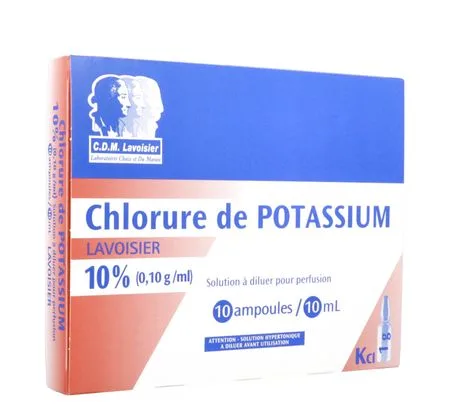
LAVOISIER POTASSIUM CHLORIDE 10 % (0,10 g/ml), solution to be diluted for infusion
Forms and presentations
Solution to be diluted for infusion.
Osmolarity of the solution: 2680 mOsm/l
Composition
Potassium chloride ............................................................................................................... 0,10 g
For 1 ml
Chloride: 1340 mmol/l or 1,34 mmol/mll
Potassium: 1340 mmol/l or 1,34 mmol/mll
One ampoule of 10 ml contains 1,0 g of potassium chloride.
One ampoule of 20 ml contains 2,0 g of potassium chloride.
Water for injections.
Indications
- Treatment of hypokalaemia and correction of potassium depletion in severe disorders or when enteral intake is impossible or insufficient.
NB: Intravenous administration of potassium salt causes a rapid potassium gradient that may lead to hyperkalaemia and cardiac arrest (see section Dosage and administration).
Dosage and administration
|
SLOW INTRAVENOUS ADMINISTRATION ONLY AFTER DILUTION, BY INFUSION |
Dosage
Usual dosage in adults:
Usual daily intake is in the order of 0,8 to 2 mmol of potassium ion per kilogram of body weight. 1 g of potassium chloride corresponds to 13,4 mmol or 524 mg of potassium.
Paediatric population
The safety and efficacy of potassium chloride have not been fully established in children. Nevertheless, when administration of potassium chloride is necessary, it is recommended to give it intravenously after dilution in an infusion solution. The maximum daily potassium intake is 3 mmol of potassium per kg of body weight per day, or 40 mmol/m² of body surface area per day.
Method of administration
Slow administration after dilution in an infusion solution, strictly by intravenous route, by infusion.
No direct intravenous injection.
Administration of KCl must be carried out under clinical and biological monitoring with, if necessary, cardiovascular monitoring.
For gradual correction of hypokalaemia in adults, compensation or parenteral hydration, dilute until a maximum concentration of 4 g/l of potassium chloride is obtained (i.e. 50 mmol of potassium per litre) and infuse slowly over a period of 12 or 24 hours. The peripheral intravenous infusion rate must be controlled using a volumetric pump or a manual flow regulator to avoid an infusion that is too rapid. In adults, a rate of 10 mmol/h is usually considered safe. As a general rule, this rate must not exceed 15 mmol/h.
When rapid correction of hypokalaemia in adults is essential, the concentration of the solution after dilution and the infusion rate must be adjusted case by case, under increased monitoring and in an intensive care unit. In this context, the use of an electric syringe may be considered if necessary.
Contraindications
Administration of this medicinal product is contraindicated in cases of hyperkalaemia or any situation that may lead to hyperkalaemia (severe renal insufficiency, acute adrenal insufficiency, decompensated metabolic acidosis).
Warnings and precautions
HYPERTONIC SOLUTION TO BE DILUTED BEFORE USE.
WARNING, RAPID ADMINISTRATION OF KCl MAY CAUSE CARDIAC ARREST.
Special warnings
- Hyperkalemia occurring during administration of potassium chloride warrants discontinuation of the treatment;
- In case of oliguric-anuric renal failure, administration of KCl carries a particularly significant risk of hyperkalemia.
- During treatment of diabetic ketoacidosis, administration of potassium chloride may prove necessary in combination with insulin to compensate for the potassium deficit generated by ketotic decompensation and unmasked by insulin therapy.
Precautions for use
- Parenteral administration of potassium salts must be monitored by repeated verification of the plasma electrolyte panel and, if necessary, cardiovascular monitoring;
- Verify compatibility before carrying out mixtures with other solutions;
- Taking this medicine is not recommended in combination with potassium-sparing diuretics, angiotensin-converting enzyme inhibitors, angiotensin II receptor antagonists, ciclosporin and tacrolimus (see section Interactions).
Method of administration
- Administration after dilution by infusion, strictly by intravenous route;
- Slow administration (in adults, less than 15 mmol/hour);
- The concentration of the solution to be administered must not exceed 4 g/L of potassium chloride (i.e. 50 mmol/L of potassium).
Interactions
+ Hyperkalemic agents:
Certain medicines or therapeutic classes may favour the occurrence of hyperkalemia: potassium salts, hyperkalemic diuretics, angiotensin-converting enzyme inhibitors, angiotensin II antagonists, non-steroidal anti-inflammatory drugs, heparins (low molecular weight or unfractionated), immunosuppressants such as ciclosporin or tacrolimus, trimethoprim.
The combination of these medicinal products increases the risk of hyperkalaemia. This risk is particularly important with potassium-sparing diuretics, especially when they are combined with each other or with potassium salts, whereas the combination of an ACE inhibitor and an NSAID, for example, carries a lower risk provided the recommended precautions are implemented.
To know the specific risks and levels of constraint for hyperkalemic drugs, refer to the interactions specific to each substance.
However, certain substances, such as trimethoprim, do not have specific interactions with regard to this risk. Nevertheless, they may act as contributing factors when combined with other medicines already mentioned in this section.
Combinations not recommended
+ Potassium-sparing diuretics (alone or in combination) such as:
amiloride, spironolactone, triamterene, potassium canrenoate, eplerenone; Risk of potentially lethal hyperkalemia, particularly in patients with renal insufficiency (additive hyperkalemic effects).
+ Angiotensin-converting enzyme inhibitors (ACEI) and angiotensin receptor antagonists II:
Additive hyperkalemic effects with risk of potentially lethal hyperkalemia. Avoid this combination unless there is prior hypokalemia.
+ Ciclosporin, tacrolimus:
Potentially lethal hyperkalemia, particularly in patients with renal insufficiency (additive hyperkalemic effects). Avoid this combination unless there is prior hypokalemia.
Fertility, pregnancy and breastfeeding
Pregnancy
Clinically, no malformative or foetotoxic effect has appeared to date. However, follow-up of pregnancies exposed to intravenous potassium administration is insufficient to exclude any risk.
Consequently, this solution will be administered during pregnancy only if necessary.
Breast-feeding
In the absence of data on possible passage into breast milk, it is preferable to avoid breastfeeding during treatment.
Adverse effects
General disorders and administration site conditions
Not known (frequency cannot be estimated from the available data)
- Pain at the injection site,
- Necrosis in case of extravasation,
- Phlebitis at the infusion site (particularly in case of excessively high concentration).
Reporting of suspected adverse reactions
Reporting suspected adverse reactions after authorisation of the medicinal product is important. It allows continued monitoring of the benefit/risk balance of the medicinal product. Healthcare professionals are asked to report any suspected adverse reaction via the national reporting system: National Agency for the Safety of Medicines and Health Products (ANSM) and the network of Regional Centres of Pharmacovigilance - Website: www.ansm.sante.fr.
Overdose
Symptoms:
An overdose may have tragic consequences, possibly giving rise to the following symptoms:
- paralysis, paresthesias in the limbs, areflexia, apathy, weakness and heaviness of the legs, muscle weakness progressing to paralysis and respiratory arrest,
- hypotension and death from cardiac arrest, generally preceded by electrical disturbances of the heart appearing on the electrocardiogram as tall, peaked T waves, accompanied by absence of P waves, then widening of the QRS complex, ventricular tachycardia and ventricular fibrillation.
A resuscitation specialist must be urgently consulted for advice.
Emergency management:
Hyperkalemia occurring during administration of KCl warrants discontinuation of the treatment.
In case of threatening hyperkalemia giving rise to clinical or electrical signs, the infusion must be stopped and calcium chloride must be administered immediately, followed by an infusion of bicarbonate serum, or a solution comprising concentrated glucose serum and insulin. In the absence of clinical signs, oral or rectal administration of Kayexalate may be considered. In the presence of renal insufficiency, extrarenal purification should be considered.
Pharmacodynamics
Pharmacotherapeutic class: Potassium supplementation
- potassium ion : potassium supplementation
Biologically, a kalemia below 3,6 mmol/l indicates a potassium deficiency. This deficiency may be of origin:
- digestive: diarrhea, vomiting; stimulant laxatives
- endocrine: primary hyperaldosteronism (requires etiological treatment).
- renal: through increased urinary excretion in case of congenital tubular disease or during treatment with saluretics, corticosteroids or amphotericin B (IV), through excessive consumption of alkalis or licorice derivatives.
Potassium deficiency, when symptomatic, results in muscle fatigability, pseudoparalysis, cramps and ECG changes: repolarization disturbances and ventricular hyperexcitability.
- chloride ion
Correction of metabolic alkalosis often associated with hypokalemia.
Pharmacokinetics
Elimination
Excretion, mainly urinary, is decreased in cases of renal insufficiency with possibility of hyperkalemia.
Preclinical safety
No particular data, potassium chloride being a physiological component of plasma.
INCOMPATIBILITIES
In the absence of compatibility studies, this medicinal product must not be mixed with other medicinal products.
Shelf life
Glass and polypropylene ampoule: 3 years.
Shelf life after opening: the product must be used immediately.
Special storage precautions
This medicinal product does not require any special storage precautions before opening.
Prescription, supply and reimbursement
| Marketing authorisation (AMM) |
|
Hospital model(s) (100Amp/10ml, 100AmpPP/10ml, 50AmpPP/20ml).
Collection.
7 RUE PASQUIER
75008 PARIS
Tel: 01 55 37 83 83 commercial@lavoisier.com
https://www.lavoisier.com/fr/
Source: VIDAL · Updated on 11/11/2026. This information does not replace advice from a healthcare professional.