
Medicines
SmPC of 15/05/2025
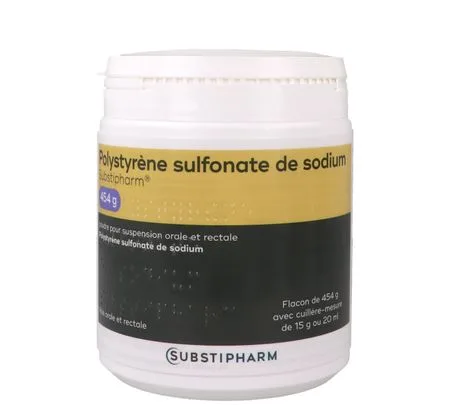
SODIUM POLYSTYRENE SULFONATE SUBSTIPHARM 454 g, powder for oral and rectal suspension
Composition
Sodium polystyrene sulfonate.................................................................................................... 453,70036 g
For a bottle of 454 g.
Excipient with known effect: This medicine contains 1,7 g of sodium per measuring spoon.
Vanillin, saccharin.
Dosage and administration
Dosage
The amount of sodium polystyrene sulfonate to be administered is directly related to the blood potassium level; it must therefore be adjusted for each patient.
For information only :
In adults.
Oral use :
A dose of 15 g, i.e. 1 measuring spoon, one to four times a day by the oral route, is commonly prescribed. Sodium polystyrene sulfonate is administered after being suspended in a little still, low-mineral water. Do not suspend in a carbonated drink or soda.
The powder does not dissolve completely in water, which explains the persistence of small particles in the mixture.
Any addition of vanilla sugar or syrup should be left to each patient's discretion. Suspension in fruit juice should be avoided due to its high potassium content.
SODIUM POLYSTYRENE SULFONATE SUBSTIPHARM must be administered at least 2 hours before or 2 hours after other medicines administered by the oral route.
Rectal route :
Sodium polystyrene sulfonate may be administered by enema by suspending it in 100 mL of 10% glucose solution at body temperature or as a mixture in equal parts of water and a 2% methylcellulose suspension.
The liquid containing the suspended sodium polystyrene sulfonate will be gently stirred during administration to keep it in suspension. The enema will be retained for 4 to 10 hours if possible and followed by an evacuant enema.
This procedure may be repeated twice a day if necessary.
NB: since ion exchange takes place mainly in the colon, it may be necessary, at the start of treatment, to begin by administering the product as an enema while also administering it orally. The fall in kalaemia will thus be achieved more rapidly and will be maintained by oral administration.
When treatment needs to be continued for a prolonged period, monitoring by blood potassium assays will allow the effective dose to be adjusted.
In children.
The quantity must be adjusted on the principle that 1 g of resin eliminates 1 mmol (1 mEq) of potassium. The usual initial oral dose in children is 1 g/kg body weight/day in several doses, which may then be reduced to a maintenance treatment of 0,5 g/kg body weight per day.
Sodium polystyrene sulfonate may be administered to children rectally at the same dose as if it had been given orally and according to the same procedures as in adults.
In newborns.
Sodium polystyrene sulfonate must be administered only by the rectal route. The minimum effective dose is between 0,5 g/kg and 1 g/kg of body weight/day.
Contraindications
This medicine must never be used in the following cases:
• serum potassium below 5 mmol/l,
• history of hypersensitivity to polystyrene sulfonate resins,
• obstructive intestinal pathology (oral route),
• administration by oral route in the newborn,
• administration (by oral and rectal route) to the newborn presenting with decreased intestinal motility (post-operative or drug-induced),
• in combination with sorbitol (oral and rectal route) for a dose of sorbitol per intake greater than or equal to 2,5 g in children and greater than or equal to 5 g in adults – (see sections Interactions).
Warnings and precautions
Warnings
Due to the risk of severe gastrointestinal disorders (such as intestinal obstruction, ischaemia, necrosis or perforation), the use of polystyrene sulfonate is not recommended in patients with impaired gastrointestinal motility (including immediately after surgery or drug-induced). For patients with obstructive intestinal pathology and newborns, refer to the section Contraindications.
Interaction with other orally administered medicines :
POLYSTYRENE SULFONATE DE SODIUM SUBSTIPHARM may bind to orally administered medicines, which may reduce their gastrointestinal absorption and potentially their efficacy when taken concurrently. POLYSTYRENE SULFONATE DE SODIUM SUBSTIPHARM should be administered at least 2 hours before or 2 hours after other orally administered medicines, if possible.
Precautions for use
Electrolyte disturbances :
Biological monitoring of the patient must continue throughout the treatment. Frequent determinations of electrolytes, and in particular of blood potassium, are essential. Care should be taken to avoid an excessive decrease in kalaemia: potassium will be maintained at approximately 5 mmol/L (5 mEq/L). Treatment must be stopped as soon as the kalaemia value is below 5 mEq/L.
Blood levels of calcium and magnesium should be checked periodically. During the exchange, for each potassium ion captured by the resin, one sodium ion is released into the blood, i.e. 1 gram of resin releases approximately 1 mmol (1 mEq) of sodium.
Gastrointestinal ischaemia and stenosis
Gastrointestinal stenosis, intestinal ischaemia and its complications (necrosis and perforation), some of them fatal, have been reported in patients treated with sodium polystyrene sulfonate alone or in combination with sorbitol. Concomitant administration of sorbitol with sodium polystyrene sulfonate is not recommended (see section Interactions).
Patients should be advised to consult a doctor promptly if severe abdominal pain, nausea and vomiting, abdominal distension and rectal bleeding develop recently.
The lesions observed in gastrointestinal injuries induced by sodium polystyrene sulfonate may resemble those observed in inflammatory bowel diseases, ischaemic colitis, infectious colitis and microscopic colitis.
Other risks :
In case of constipation with clinical impact, stop treatment until normal motility returns. Magnesium-based laxatives require precautions for use.
The patient must maintain a correct position during ingestion of the resin in order to avoid inhalation that could lead to broncho-pulmonary complications.
Children and newborns :
Possibility of impaction of the resin administered by rectal route in case of excessive dosing or incorrect dilution.
Risk of gastrointestinal haemorrhage or colonic necrosis or sodium overload in premature infants and low-birth-weight newborns.
Patients at risk of hydrosodium overload :
This medicine contains approximately 1,7 g of sodium per measuring spoon, which is equivalent to 85 % of the maximum recommended daily dietary intake of 2 g of sodium for adults set by the WHO.
The maximum daily dose of this medicine is equivalent to 340 % of the maximum recommended daily dietary sodium intake for adults set by the WHO.
In children, the maximum intake recommended by the WHO should be adjusted downwards according to energy requirements by age.
POLYSTYRENE SULFONATE DE SODIUM SUBSTIPHARM 454 g, powder for oral and rectal suspension is considered to have a high sodium content. This is particularly important to consider in patients on a low-sodium diet. In these patients, increased clinical and biological monitoring is required.
Interactions
Contraindicated combination
+ Sorbitol (oral and rectal routes) for a dose of sorbitol per intake greater than or equal to 2,5 g in children and greater than or equal to 5 g in adults
Risk of colonic necrosis, possibly fatal (see section Contraindications).
Combination not recommended
+ Sorbitol (oral and rectal route) for a dose of sorbitol per intake less than 2,5 g in children and less than 5 g in adults
Gastrointestinal stenosis, intestinal ischaemia and its complications (necrosis and perforation), some of which have been fatal, have been reported in patients treated with polystyrene sulfonate alone or in combination with sorbitol. Concomitant administration of sorbitol with polystyrene sulfonate is not recommended (see section Warnings and precautions).
Associations requiring precautions for use
+ Medicinal products administered orally
Taking the chelating resin may reduce intestinal absorption and, potentially, the efficacy of other medicines taken at the same time.
In general, the resin should be taken at a distance from other medicines, respecting an interval of more than 2 hours, if possible.
+ Thyroid hormones : Reduction of digestive absorption of thyroid hormones.
Take thyroid hormones at a distance from SUBSTIPHARM SODIUM POLYSTYRENE SULFONATE (more than 2 hours, if possible).
Fertility, pregnancy and breastfeeding
No data are available on the use of the resin during pregnancy or breastfeeding. However, since sodium polystyrene sulfonate is not absorbed or resorbed, this medicine may be prescribed during pregnancy or breastfeeding, if necessary.
Adverse effects
Metabolism and nutrition disorders
• Hypokalaemia, hypocalcaemia, fluid and sodium retention, hypomagnesaemia.
Gastrointestinal disorders
• Constipation.
• Minor digestive disorders after oral administration (gastric irritation, nausea, vomiting, anorexia, sometimes diarrhoea).
• Faecaloma after rectal administration, particularly in children.
• Gastrointestinal concretions (bezoars) after oral administration.
• Gastrointestinal stenosis and intestinal obstruction (particularly in the case of intercurrent pathology or inadequate dilution of the resin).
• Gastrointestinal ischaemia, ischaemic colitis, gastrointestinal ulceration, gastrointestinal necrosis which may lead to intestinal perforation, sometimes with a fatal outcome.
Respiratory, thoracic and mediastinal disorders
• Acute bronchitis and/or bronchopneumonia after inhalation of sodium polystyrene sulfonate particles.
Reporting of suspected adverse effects.
Reporting suspected adverse reactions after authorisation of the medicinal product is important. It allows continued monitoring of the benefit/risk balance of the medicinal product. Healthcare professionals are asked to report any suspected adverse reactions via the national reporting system: National Agency for the Safety of Medicines and Health Products (ANSM) and the network of Regional Pharmacovigilance Centres - Website: https://signalement.social-sante.gouv.fr.
Pharmacodynamics
Pharmacotherapeutic class: MEDICINES FOR HYPERKALAEMIA AND HYPERPHOSPHATAEMIA - ATC code: V03AE
Sodium polystyrene sulfonate is a cation exchange resin.
Its affinity for the potassium ion (K+) is much greater than its affinity for the sodium ion.
Therefore, on contact with the colon, it releases its sodium ions to bind potassium ions, which are thus eliminated in the faeces. The efficacy of the action depends on the contact time as much as on the concentration of potassium ions.
Pharmacokinetics
Sodium polystyrene sulfonate is not absorbed. Digestive fluids have no effect on this specialty.
It is during its passage through the colon that most of the exchange of sodium ions for potassium ions takes place, the resin otherwise remaining unchanged. The resin is ultimately eliminated in the feces.
Prescription, supply and reimbursement
| Marketing authorisation (AMM) |
|
| Price: |
|
- Indication(s) appearing in the marketing authorisation at the date of publication of this decree
Collection.
24 RUE ERLANGER
75016 PARIS
Tel: 01 43 18 13 00 contact@substipharm.com
https://www.substipharm.com/legal-mention/
Source: VIDAL · Updated on 11/11/2026. This information does not replace advice from a healthcare professional.