
Medicines
SPC of 18/08/2022
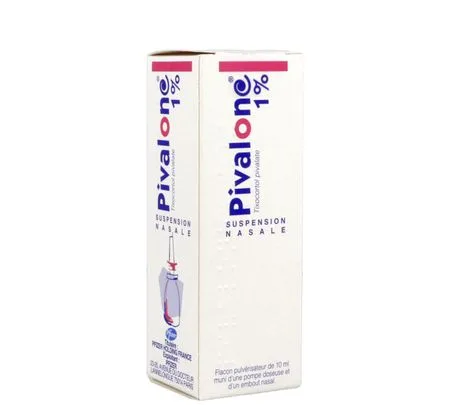
PIVALONE 1 percent, nasal suspension
Composition
Tixocortol pivalate ......................................................................................................................................1,000 g
For 100 g of nasal suspension.
Excipient with known effect: benzyl alcohol.
PIVALONE 1 PERCENT contains 50 mg of benzyl alcohol per 10 ml bottle of nasal suspension, equivalent to 5 mg/ml of benzyl alcohol.
Cetylpyridinium chloride, benzyl alcohol (E 1519), sodium chloride, monosodium phosphate dihydrate, officinal sodium hydroxide solution, purified water.
Indications
Inflammatory and allergic manifestations of the rhinopharynx: allergic rhinitis, seasonal rhinitis, acute and chronic congestive rhinitis, vasomotor rhinitis.
Dosage and administration
1 to 2 sprays into each nostril 2 to 4 times a day. Shake before each use.
Contraindications
Hypersensitivity to the active substance or to any of the excipients listed in section Composition.
Epistaxis.
PIVALONE 1 PERCENT must not be used in the presence of a localised viral infection involving the nasal mucosa, such as Herpes simplex.
PIVALONE 1 PERCENT must not be used in the presence of a local fungal infection, such as candidiasis.
Due to the inhibitory effect of corticosteroids on wound healing, patients who have undergone surgery or recent nasal trauma must not use PIVALONE 1 PERCENT until healing is complete.
Warnings and precautions
Special warnings
Systemic effects may occur with long-term treatment with high doses of intranasal corticosteroids. The risk of systemic effects remains however lower than with oral corticosteroids and may vary depending on individual susceptibility and the composition of the corticosteroid product used. Possible systemic effects are Cushing's syndrome or Cushingoid symptoms, skin thinning, subcutaneous haematomas, adrenal insufficiency, growth retardation in children and adolescents, decreased bone mineral density, cataract and glaucoma and, more rarely, psychological and behavioural disorders including psychomotor hyperactivity, sleep disorders, anxiety, depression or aggression (particularly in children).
Events of epidural lipomatosis, central serous chorioretinopathy and pheochromocytoma crisis have been associated with systemic corticosteroid administration. Long-term inhaled or topical corticosteroid administration could be associated with these potential systemic effects.
Visual disorders
Visual disturbances may occur with systemic or local corticosteroid therapy. In case of blurred vision or onset of any other visual symptom during corticosteroid therapy, an ophthalmological examination is required to look for, in particular, cataract, glaucoma, or a rarer lesion such as central serous chorioretinopathy, described with systemic or local corticosteroid administration.
Excipient
PIVALONE 1 PERCENT contains benzyl alcohol (see section 2). Each spray delivers 0,45 mg of benzyl alcohol per nostril, and up to a total of 7,2 mg of benzyl alcohol per day based on a maximum daily administration (see section Dosage and administration). Benzyl alcohol may cause mild local irritation and may also cause hypersensitivity.
Precautions for use
To be used after blowing or careful cleaning of the nose.
In case of a general manifestation of a bacterial infection, systemic antibiotic therapy should be considered.
Fertility, pregnancy and breastfeeding
An oral toxicity study on fertility and development conducted in rats showed no effect on fertility, nor any teratogenic effect of tixocortol, although a study in rabbits showed a teratogenic effect (see section Preclinical safety).
As no reproduction studies have been performed with tixocortol, this medicine should only be used during pregnancy and breast-feeding after a thorough evaluation of the benefit-risk ratio for the mother and for the foetus or child.
Driving and using machines
This medicine should not affect the ability to drive vehicles and use machines.
Adverse effects
Adverse effects are listed below by System Organ Class (SOC) (MedDRA dictionary) and by frequency category according to the standard convention. They are presented in decreasing order of seriousness within each frequency group.'Organs (SOC) (MedDRA dictionary) and by frequency category according to the standard convention. They are presented in decreasing order of seriousness within each frequency group.
|
System Organ Classes MedDRA |
Very common ≥ 1/10 |
Frequent ≥ 1/100 to < 1/10 |
Uncommon ≥ 1/1 000 to < 1/100 |
Rare ≥ 1/10 000 to < 1/1000 |
Very Rare <1/10 000 |
Not known (frequency cannot be estimated from the available data) |
|
Eye disorders |
|
|
|
|
Cataract Glaucoma |
Blurred vision (see section Warnings and precautions) |
|
Immune system disorders |
|
|
|
|
|
Hypersensitivity∗ |
|
Respiratory, thoracic and mediastinal disorders |
|
|
|
|
|
Nasal dryness∗ Rhinalgia† Epistaxis |
|
Skin and subcutaneous tissue disorders |
|
|
|
|
|
Angioedema* |
|
General disorders and administration site conditions |
|
|
|
|
|
Facial oedema* |
|
∗ These reactions regress when treatment is stopped. † May appear at the start of treatment. |
|
|||||
Reporting of suspected adverse reactions
Reporting suspected adverse reactions after authorisation of the medicinal product is important. It allows continued monitoring of the benefit/risk balance of the medicinal product. Healthcare professionals are asked to report any suspected adverse reaction via the national reporting system: National Agency for the Safety of Medicines and Health Products (ANSM) and the network of Regional Centres of Pharmacovigilance - Website: www.signalement-sante.gouv.fr
Pharmacodynamics
Pharmacotherapeutic class: Topical corticosteroid: anti-allergic, anti-inflammatory, ATC code: R01AD07.
Tixocortol pivalate has the local efficacy of reference corticosteroids, but in humans it has no significant corticosteroid activity at a distance from the site of application.
Administration to humans of 130 times the daily therapeutic dose does not produce any systemic glucocorticoid effect.
The PIVALONE 1 PERCENT nasal suspension respects nasal drainage by the ciliary beating of the pituitary mucosa.
Pharmacokinetics
Studies conducted in animals and humans have shown extremely rapid metabolism of tixocortol pivalate, explaining the absence of significant systemic corticosteroid effects in humans.
Tixocortol pivalate is well absorbed orally; however, even after oral administration of a very high dose (2 g), only inactive metabolites lacking glucocorticoid action are found in the general circulation. This is due to extremely rapid degradation of tixocortol pivalate, mainly hepatic.
Preclinical safety
General toxicity studies in rats and primates did not identify any particular risk.
In an oral toxicity study on fertility and development in rats, there was no effect on fertility.
Prenatal developmental toxicity studies showed a slight increase in post-implantation losses and a decrease in fetal weight, and tixocortol was not teratogenic. There were no adverse effects on postnatal development.
In an embryo-fetal development study, tixocortol pivalate was administered daily by oral gavage to female rabbits at known stages of gestation, at doses up to 360 mg/kg/day from day 6 of gestation to day 18.
At doses ≥ 120 mg/kg/day, at which maternal toxicity was observed, there was a reduction in fetal weights and increased incidence of major malformations (hydrocephalus, cleft palate and skeletal malformations). An increase in post-implantation losses, a decrease in litter size and skeletal abnormalities were also observed at 360 mg/kg/day. Based on mg/kg, the doses administered in this study far exceeded the doses of this product administered to humans by the topical route.
Tixocortol did not produce a clastogenic effect on human lymphocytes, and a negative response was obtained in the in vivo micronucleus test in mice. Tixocortol showed no carcinogenic potential in oral gavage studies over 2 years at doses up to 250 mg/kg/day in rats and up to 100 mg/kg/day in mice.
Prescription, supply and reimbursement
| Marketing authorisation (AMM) |
|
| Price: |
|
Collection.
23-25 DOCTOR LANNELONGUE AVENUE
75668 PARIS CEDEX 14
Tel: 01 58 07 30 00 Toll-free tel: 07 88 77 30 29
https://www.pfizer.fr/
Source: VIDAL · Updated on 11/11/2026. This information does not replace advice from a healthcare professional.