
Medicines
Update of 06/08/2025
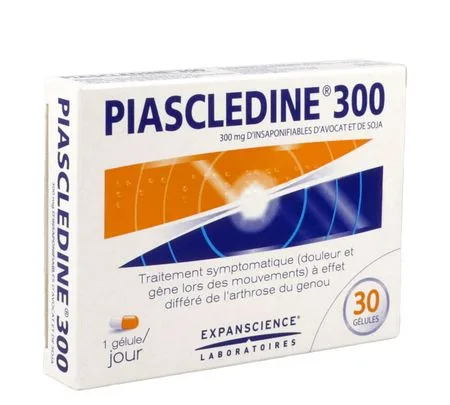
PIASCLÉDINE® 300
avocado and soybean unsaponifiables
Forms and presentations
Capsule of 300 mg (orange and beige-grey): Boxes of 15, of 30, of 60 and of 90, under blister packs.Composition
| p capsule | |
| Avocado oil unsaponifiable*
|
100 mg |
| Soybean oil unsaponifiable*
|
200 mg |
Excipients: anhydrous colloidal silica, butylhydroxytoluene. Capsule shell: gelatin, polysorbate 80, titanium dioxide, erythrosine, yellow iron oxide. Calibration: No. 1.
Indications
Piasclédine is indicated as a delayed-effect symptomatic treatment of knee osteoarthritis.Piasclédine is indicated in adults.
Dosage and administration
DosageAdult patients:
One capsule per day.
The duration of treatment will be adjusted according to clinical results, bearing in mind that the effect is delayed by approximately 2 months and that it may persist after treatment is stopped.
Paediatric population:
In the absence of data on efficacy and safety of use in children under 18 years of age, the use of Piasclédine is not recommended in this population.
Hepatic impairment:
No data are available in patients with severe hepatic impairment; therefore, no recommendation can be made.
Elderly patients:
No dose adjustment is necessary in elderly patients. In clinical studies conducted with Piasclédine, the mean age of the population was over 60 years and a significant proportion of patients were over 65 years old.
Method of administration:
Oral use.
The capsule must be swallowed whole, without being chewed, with a large glass of water, in the middle of a meal.
Contraindications
Hypersensitivity to the active substance or to any of the excipients listed in section Composition.Warnings and precautions
During the post-marketing period, adverse reactions such as hepatic cytolysis, cholestasis, jaundice and elevations of transaminases have been reported infrequently. Particular attention should therefore be paid to patients with a medical history of, or suffering from, hepatic or biliary disorders, or presenting a disease likely to increase the risk of cholelithiasis or liver damage. Treatment with Piasclédine must be stopped in case of biological signs or clinical symptoms of hepatic or biliary damage.
Hypersensitivity reactions, as well as skin rashes, urticaria and dermatitis, have been reported infrequently during the clinical development of the product. Patients must be informed of signs and/or symptoms suggestive of an allergic reaction and must stop treatment and consult their doctor at the first appearance of a skin reaction or signs of hypersensitivity (see Undesirable effects).
A few cases of thrombocytopenia have been reported with Piasclédine, one of them during clinical development. Treatment with Piasclédine must be stopped if symptoms suggestive of coagulation disorders occur (for example, petechiae, purpura).
Interactions
Piasclédine must be used with caution in patients receiving concomitant anticoagulant treatment (see Warnings and Precautions for Use).
Fertility, pregnancy and breastfeeding
Pregnancy:Animal data have shown reproductive toxicity at systemic exposure levels far above the human therapeutic doses (see Preclinical safety).
In clinical practice, there is currently no sufficiently relevant data to assess a possible malformative or fetotoxic effect of Piasclédine 300 mg when this medicine is administered during pregnancy.
Consequently, use of this medicine is not recommended during pregnancy and in women of childbearing potential not using contraception.
Breastfeeding:
In the absence of data on the excretion of Piasclédine 300 mg or its metabolites in human milk, a risk to newborns/infants cannot be excluded.
This medicine should not be used during breastfeeding.
Fertility:Animal data have shown, at high doses, early pre-implantation and post-implantation losses (see Preclinical safety).
In humans, the relevance of these data is not known.
Driving and using machines
Piasclédine has no or negligible influence on the ability to drive and use machines.Adverse effects
Summary of the safety profile:
The most frequently reported adverse reactions during treatment with Piasclédine are gastrointestinal in nature and occurred in approximately 3 % of patients. Diarrhoea, abdominal pain, dyspepsia, abdominal distension and nausea may occur in 0,4 to 1,1 % of patients. These non-serious adverse reactions were of mild or moderate intensity.
Table of undesirable effects:
The adverse reactions reported in clinical trials and placebo/active-comparator-controlled trials, including 1310 patients treated with Piasclédine, of whom 1174 patients treated with Piasclédine 300 mg once daily, and/or the adverse reactions reported since marketing, are listed in the table below.
Summary table of adverse reactions by system organ class, frequency [very common (≥ 1/10); common (≥ 1/100 to < 1/10); uncommon (≥ 1/1000 to < 1/100); rare (≥ 1/10 000 to < 1/1000); very rare (< 1/10 000)].
For each frequency category, serious adverse reactions are presented first:
| System organ class | Frequency | Adverse effects |
| Blood and lymphatic system disorders | Rare | Thrombocytopenia |
| Immune system disorders | Uncommon | Hypersensitivity* |
| Nervous system disorders | Uncommon | Headache |
| Gastrointestinal disorders | Common | Diarrhoea |
| Uncommon | Dyspepsia; dysgeusia(a) ; nausea; abdominal pain; discoloration of stools** | |
| Rare | Enteritis; vomiting; eructation; dry mouth | |
| Hepatobiliary disorders**(b) | Uncommon | Hepatic cytolysis; cholestasis; jaundice; increase in transaminases, alkaline phosphatase, bilirubin and gamma-glutamyl transpeptidase |
| Skin and subcutaneous tissue disorders | Rare | Toxic skin rash* ; eczema* |
| Renal and urinary disorders | Uncommon | Chromaturia** |
| Rare | Nephrolithiasis | |
| Disorders of the reproductive system and breast(b) | Uncommon | Breast pain; breast swelling; metrorrhagia |
| General disorders and administration site conditions | Uncommon | States of asthenia |
| Investigations | Rare | Increase in blood pressure*** |
(b) These adverse effects have been reported after marketing. As these effects were not reported during clinical trials including 1310 patients exposed to Piasclédine, they are estimated to be uncommon.
Description of certain adverse effects:
* Taking Piasclédine may in some cases cause hypersensitivity, such as systemic allergic reactions, i.e. sudden onset of a condition with skin involvement (pruritus, urticaria, erythema, rash), mucosal involvement or both, cough, persistent gastrointestinal symptoms or a decrease in blood pressure and/or associated symptoms. see Warnings and Precautions for Use.** Signs of liver disorders, such as abdominal pain associated with nausea, discoloration of the stools, chromaturia and/or jaundice, may occur during treatment with Piasclédine. see Warnings and Precautions for Use.
*** Signs and symptoms suggestive of an increase in blood pressure (namely headaches, hearing disorders, vasomotor flushes) may occur with Piasclédine treatment.
Reporting of suspected adverse reactions:
Reporting suspected adverse reactions after authorisation of the medicinal product is important. It allows continuous monitoring of the benefit/risk balance of the medicinal product. Healthcare professionals should report any suspected adverse reaction via the national reporting system: National Agency for the Safety of Medicines and Health Products (ANSM) and the network of Regional Pharmacovigilance Centres. Website: https://signalement.social-sante.gouv.fr.
Overdose
In clinical trials, administration of doses up to 900 mg/day for several months was associated with dose-dependent gastrointestinal disorders.
Overdoses may induce or exacerbate gastrointestinal disorders and/or liver disorders.
Pharmacodynamics
Pharmacotherapeutic class: Other anti-inflammatory and antirheumatic agents, non-steroidal, ATC code: M01AX26.
Pharmacodynamic effects:
For trophic use.
Clinical efficacy and safety:
The effects of Piasclédine 300 mg in osteoarthritis have been evaluated in clinical studies and have shown positive results on the occurrence of symptoms. The results of five randomised controlled studies (three versus placebo and two versus active comparators) are presented below.
In a multicentre, randomised, double-blind, placebo-controlled clinical study in 86 patients with knee osteoarthritis, NSAID consumption was significantly reduced by 70% compared with 33% for placebo (p < 0,01) after 3 months. Pain at rest and functional discomfort were also significantly improved with Piasclédine 300 mg compared with placebo.
In another multicentre, randomised, double-blind, placebo-controlled clinical study, in the subgroup of 101 patients with knee osteoarthritis, the primary endpoint was resumption of NSAIDs after discontinuation. The number of patients who resumed an NSAID after 3 months of treatment was 54,2% with Piasclédine 300 mg, compared with 73% with placebo (p = 0,05). A significant reduction in functional discomfort was observed, whereas the reduction in pain at rest was not significant.
In a multicentre, randomised, double-blind clinical study over 6 months versus placebo, Piasclédine 300 mg did not significantly improve the primary endpoint (Lequesne index, p = 0,07) or pain at rest in the subgroup of patients with knee osteoarthritis (N = 55), possibly due to the small number of patients, but significantly reduced NSAID consumption.
Two non-inferiority studies compared Piasclédine 300 mg with chondroitin sulfate 400 mg three times daily for 6 months and diacerein 50 mg twice daily for 3 months in 184 and 64 patients respectively. These studies showed the non-inferiority of Piasclédine 300 mg versus both comparators on the total WOMAC score and on NSAID consumption, which were the primary endpoints of each study respectively. No difference was observed between these comparators and Piasclédine 300 mg on the secondary endpoints (Lequesne index and pain at rest).
Furthermore, Piasclédine 300 mg has a slow action, delayed by approximately 2 months, and its effect may persist after treatment discontinuation.
Pharmacokinetics
Piasclédine is an extract composed of a multitude of entities derived from soybean and avocado, for which no validated analytical method is available. Therefore, no pharmacokinetic study has been conducted.
Preclinical safety
The general toxicological properties of Piasclédine have been studied in different animal species, including rodents, rabbits and dogs, under single-dose and repeated-dose conditions.
Single-dose toxicity studies showed low toxicity of Piasclédine, with no LD50 being able to be calculated due to the absence of mortality at doses up to 8000 mg/kg in mice.
In repeated-dose toxicity studies (6 months) in rats and dogs, the general tolerance of Piasclédine was satisfactory; however, the liver and thyroid were considered target organs.
- Liver:
- In long-term treatments (6 months) in dogs with doses of 30, 125 and 500 mg/kg/day, minor liver disorders were observed at the lowest dose, while anatomical lesions and microscopic abnormalities were detected at the highest dose. Similar results were observed in rats, but of lesser extent and only at the high dose of 750 mg/kg/day.
- Piasclédine 300 mg is not an enzyme inducer in rats.
- Thyroid:
- In a toxicity study in rats (28 days), at autopsy, thyroid weight was higher in animals treated at the high dose of 750 mg/kg/day compared with control animals.
- Histopathology revealed minor abnormalities (hypertrophy of epithelial cells) in males.
- In a repeated-dose study of 26 weeks in rats, Piasclédine 300 mg induced reversible thyroid follicular hypertrophy at the high dose of 750 mg/kg/day.
- Reproductive toxicology:
- A fertility study in rats demonstrated that Piasclédine 300 mg at high dose (750 mg/kg/day) could very slightly decrease uterine implantation and early embryo survival. No effect was reported in male rats.
- No teratogenic or embryotoxic effect was demonstrated up to doses of 200 mg/kg/day in rats and 150 mg/kg/day in rabbits (corresponding to 7 times and 10 times the recommended dose in humans). An increase in post-implantation losses, minimal skeletal changes (rat), and changes in the abdominal wall (rabbit) were reported at maternotoxic doses of 750 mg/kg/day in rats and 500 mg/kg/day in rabbits (corresponding to 24 and 32 times the recommended dose in humans).
- No effect on the peri- and postnatal development of the F1 generation was demonstrated in a dedicated study conducted in rats.
- Studies carried out with Piasclédine showed no mutagenic or genotoxic effect.
Storage conditions
Shelf life 3 years.
No special precautions for storage.
HANDLING/DISPOSAL INSTRUCTIONS
No special requirements.
Any unused medicinal product or waste material should be disposed of in accordance with local requirements.
Prescription, supply and reimbursement
| Marketing authorisation (AMM) | 3400932149544 (1977/92, SmPC rev 10.11.2020) 15 gel. |
| 3400935941350 (2002, SmPC rev 10.11.2020) 30 gel. | |
| 3400930072929 (2016, SmPC rev 10.11.2020) 60 gel. | |
| 3400930072936 (2016, SmPC rev 10.11.2020) 90 gel. |
| Not reimbursed by Social Security and not approved for Collectivités. |
Laboratoires Expanscience SAS
1, place des Saisons. 92048 Paris-La-Défense cdx
Tel: 01 43 34 60 00. Fax: 01 43 34 61 00
www.expanscience.com
Source: VIDAL · Updated on 11/11/2026. This information does not replace advice from a healthcare professional.