
Medicines
Update of 03/12/2025
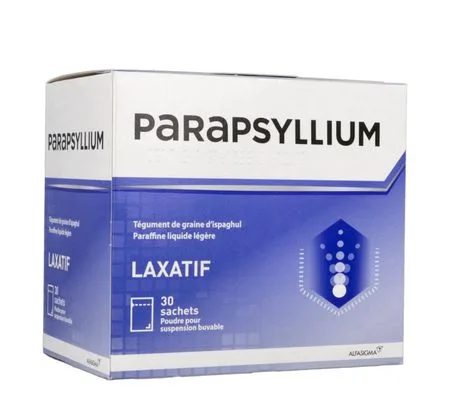
PARAPSYLLIUM®
psyllium, liquid paraffin
Forms and presentations
Powder for oral suspension: Sachets, boxes of 10 and 30.Composition
| per sachet | |
| Ispaghul (seed coat of)(1)
|
3,333 g |
| Light liquid paraffin(2)
|
2,867 g |
| (1) Ispaghul seed coat powder (Psyllium husk), obtained from seeds of " Plantago ovata " Forssk. | |
| (2) Introduced in microencapsulated form. | |
Paraffin microencapsulation excipients: gelatin, silicon dioxide, sorbic acid.
Excipient with known effect: sorbitol (E420).
* Composition of mango flavouring: maltodextrin; triacetin; 1 (3-hexenyl)-ol; caryophyllene; hexanol-1; partially deterpenated lemon oil; α-pinene; dimethyl-2,5-dihydrofuranolone; hexanoic acid; hexyl caproate.
** Composition of apricot flavouring: maltodextrin; acetic acid; triacetin; isobutyric acid; gamma-decalactone; ethyl citrate; propionic acid; ethyl malonate; ethyl acetate; hexanoic acid; ethyl formate; linalyl formate; butanol-1; delta-undecalactone; linalool; ethyl acetoacetate; gamma-dodecalactone.
Indications
Symptomatic treatment of constipation.Dosage and administration
DosageThe dosage is one sachet in a large glass of water, before or after dinner.
- Paediatric population:
- Use in children under 6 years is not recommended (see Warnings and Precautions for Use).
Method of administration:
Oral use.
Dissolve the powder in a large glass of water. Stir and drink the preparation immediately.
Parapsyllium must be taken at least ½ hour to 1 hour before or after taking other medicines, and never immediately before bedtime.
Onset of action at the start of treatment: 12 to 24 hours.
When preparing the oral suspension, it is important to avoid inhaling the powder in order to minimise any risk of sensitisation to the psyllium seed husk powder.
- Duration of treatment:
- If symptoms persist beyond 3 days of treatment, a doctor or pharmacist must be consulted (see Warnings and Precautions for Use).
Contraindications
- Hypersensitivity to psyllium or to any of the excipients listed in section Composition (see Warnings and Precautions for Use).
- Occlusive or subocclusive syndrome, abdominal pain syndromes of undetermined cause, faecaloma.
- Hereditary fructose intolerance.
- Patients suffering from stenosing disorders of the gastrointestinal tract, oesophageal and cardiac disease, latent or declared intestinal obstruction (ileus) or paralysis of the intestine or megacolon.
- Patients presenting with a sudden change in bowel function persisting for more than 2 weeks.
- Rectal bleeding of undetermined cause or absence of defaecation after use of another laxative.
- Patients with difficulty swallowing or throat disorders.
Warnings and precautions
Warnings:
Prolonged use is not recommended.
Drug treatment of constipation is only an adjunct to dietary and lifestyle measures:- enrichment of the diet with vegetable fibers and beverages;
- Advice on physical activity and rehabilitation of evacuation.
This medicine contains sorbitol. Its use is not recommended in diabetic patients and those with fructose intolerance. In diabetic patients, take into account the presence of sorbitol (3,284 g/sachet).
Due to the sorbitol content, do not use in case of obstruction of the bile ducts.
Due to the presence of liquid paraffin, prolonged use may reduce the absorption of fat-soluble vitamins (A, D, E and K).
Caution in cases of megacolon due to impaired colonic motility and in bed-bound subjects (risk of faecaloma).
Treatment of elderly or debilitated patients requires medical supervision. In elderly persons, ensure that fluid intake is sufficient.
In order to reduce the risk of gastrointestinal obstruction (ileus), psyllium may be used with medicines known to inhibit intestinal peristalsis (e.g. opioids) only under medical supervision.
A sufficient quantity of liquid must always be taken (for example 30 ml of water per gram of psyllium).
When Parapsyllium is taken with an insufficient amount of liquid, it may cause obstruction of the throat or oesophagus and lead to respiratory shock. Associated symptoms may include chest pain, vomiting or difficulty swallowing or breathing.
Psyllium-based products must not be used in case of obstruction of the digestive tract, abdominal pain syndromes, nausea or vomiting without medical advice, as these symptoms may be a sign of latent or declared intestinal obstruction (ileus).
If abdominal pain occurs, or if stools are irregular, use of Parapsyllium should be discontinued and the advice of a doctor sought.
- Warning related to hypersensitivity risks:
- In people who may have prolonged contact with psyllium husk (e.g., healthcare professionals, nursing assistants), allergic reactions may occur following inhalation of the powder, this being more frequent in sensitive (allergic) individuals. This may sometimes lead to hypersensitivity reactions, possibly severe (see Warnings and Precautions for Use).
- It is recommended to assess at-risk individuals and, where justified, to perform specific hypersensitivity tests.
- In the event of a hypersensitivity reaction, any exposure to the product must be stopped immediately (see Contraindications)
- Paediatric population:
- In children, the prescription of laxatives should be exceptional: it must take into account the risk of interfering with the normal functioning of the defecation reflex.
- Parapsyllium is not recommended in children under 6 years of age because only insufficient efficacy data are available.
Interactions
Enteral absorption of concomitantly administered medicines such as minerals (e.g., lithium), vitamins (B12), cardiac glycosides, coumarin derivatives and carbamazepine may be delayed. For this reason, Parapsyllium must not be taken within ½ hour before or after taking any other medicine.
Diabetic patients should only take Parapsyllium under medical supervision, as it may be necessary to adjust antidiabetic treatment.
Parapsyllium should only be used concomitantly with thyroid hormones under medical supervision, as it may be necessary to adjust the thyroid hormone dose.
Fertility, pregnancy and breastfeeding
In clinical practice, no particular malformative or fetotoxic effect has appeared to date with Parapsyllium. However, follow-up of pregnancies exposed to psyllium is insufficient (fewer than 300 pregnancy follow-ups) to exclude any risk.
Animal reproductive toxicity studies are insufficient (see Preclinical safety).
Consequently, use of this medicine during pregnancy and breastfeeding should only be considered if necessary and if dietary change has been ineffective.
Bulk-forming laxatives must be used before any other laxative.
There is no evidence of an effect on fertility in rats following oral administration (see Preclinical safety).
Adverse effects
Possibility of flatulence and abdominal bloating at the start of treatment.
Cases of bezoars with oesophageal obstruction, most often requiring endoscopy, have been reported in elderly people, some of whom had impaired oesophageal motility (particularly when the product is swallowed with an insufficient amount of water). The frequency is not known.
Intestinal obstruction and faecaloma may also occur when Parapsyllium is swallowed with an insufficient amount of water. The frequency is not known.
Due to the potentially allergenic nature of psyllium, patients must be informed of possible hypersensitivity reactions, such as rhinitis, conjunctivitis, bronchospasm and, in some cases, anaphylactic shock. The frequency is not known.
Skin symptoms such as exanthema and/or pruritus have also been reported. Particular attention must be paid to individuals handling psyllium in powder form for prolonged periods.
Reporting of suspected adverse reactions:Reporting suspected adverse reactions after authorisation of the medicinal product is important. It allows continuous monitoring of the benefit/risk balance of the medicinal product. Healthcare professionals should report any suspected adverse reaction via the national reporting system: National Agency for the Safety of Medicines and Health Products (ANSM) and the network of Regional Pharmacovigilance Centres. Website: https://signalement.social-sante.gouv.fr.
Pharmacodynamics
Pharmacotherapeutic class: Bulk-forming laxative/lubricant laxative, ATC code: A06AC51.
- Mechanism of action:
- The seed coat of psyllium exerts a mechanical laxative action through a bulk-forming effect. It increases faecal mass and modifies its consistency by forming a hydrophilic colloidal gel. Taken with a sufficient amount of liquid (at least 30 ml per gram of plant), psyllium causes an increase in stool volume due to its highly swelling properties and a stimulus triggering defecation; at the same time, the mass of mucilage forms a lubricating layer that facilitates intestinal transit.
- The seed coat of the psyllium seed is contained in the epidermis and adjacent layers of the dried mature separated seeds of Plantago ovata Forssk. Psyllium is particularly rich in dietary fibre and mucilage. The mucilage content is higher than that of other Plantago species. Psyllium can absorb up to 40 times its own weight in water. Psyllium, composed of 85 % water-soluble fibre, is partially fermented (72 % non-fermentable residues in vitro) and acts by hydration in the intestine. The pharmacological effects of psyllium on intestinal motility and transit speed are thought to be due to mechanical stimulation of the intestinal wall by an increase in the volume of intestinal contents through the action of water, and a decrease in stool viscosity.
- Paraffin oil facilitates expulsion of the stool.
Onset of action at the start of treatment: 12 to 24 hours. The maximum effect is sometimes reached after 2 to 3 days of treatment.
In patients with moderate hypercholesterolaemia, a reduction in LDL cholesterol of approximately 7 % was observed. Studies on the effect of psyllium seed powder on the incidence of cardiovascular events and total mortality are not available.
Pharmacokinetics
The psyllium seed husk and paraffin oil do not pass through the intestinal barrier.
Sorbitol is degraded by sorbitol dehydrogenase into fructose and then, through a delayed process, into glucose.
The partially soluble psyllium seed husk absorbs water and swells to form a mucilage. Polysaccharides, such as those contained in certain dietary fibres, are hydrolysed into monosaccharides before intestinal absorption.
The xylose residues of the main chain and side chains are linked by ß-glucosidic bonds, which cannot be broken by human digestive enzymes.
Less than 10 % of the mucilage is hydrolysed in the stomach, with formation of free arabinose. The intestinal absorption of arabinose is approximately 85 % to 93 %.
To varying degrees, dietary fibres are fermented by bacteria in the colon, producing carbon dioxide, hydrogen, methane, water and short-chain fatty acids, which are absorbed and pass into the hepatic circulation. In humans, such fibres reach the large intestine in highly polymerised form, which is fermented up to a certain limit, resulting in an increase in faecal concentration and excretion of short-chain fatty acids.
Preclinical safety
In 3 studies of 28 days and 13 weeks, rats were fed psyllium seed powder at high doses representing up to 10 % of their diet over periods of up to 13 weeks: 3,876 to 11,809 mg/kg/day (3 to 16 times the human dose for a 60 kg man). The observed effects were a decrease in serum proteins, albumin, globulin, iron-binding capacity, calcium, potassium and cholesterol, and an increase in AST and ALT levels.
The absence of an increase in urinary proteins and of any difference in growth in rats fed psyllium seed powder could demonstrate the absence of an undesirable effect on protein metabolism. Since absorption of psyllium is very low, histopathology was limited to the gastrointestinal tract, liver, kidneys and macroscopic lesions, with no treatment-related effect demonstrated.
In a reproduction study, embryo-foetal, pre- and postnatal development (multigenerational study), psyllium seed powder (0, 1, 2,5 or 5 % of the diet) was administered continuously over two generations of rats. For reproduction, foetal development and teratogenesis, the maximum dose with no observable adverse effect was 5 % of the diet, while for growth and development of their offspring, the maximum dose with no observable adverse effect was 1 % of the diet based on the reduction in their body weight.
The embryo-foetal development study in rabbits (administration of psyllium seed powder at 0, 2,5, 5 or 10 % of the diet) must be considered preliminary. No conclusion can be drawn from it.
No genotoxicity or carcinogenicity studies have been performed.
Storage conditions
- Shelf life
- 3 years
This medicine must be stored protected from moisture.
HANDLING/DISPOSAL INSTRUCTIONS
No special requirements.
Prescription, supply and reimbursement
| Marketing authorisation (AMM) | 3400934055942 (1996, SmPC rev 11.01.2024) 10 sachet. |
| 3400934916885 (1998, SmPC rev 11.01.2024) 30 sachet. |
| Not reimbursed by Social Security. |
ALFASIGMA FRANCE
Bords de Seine 1
3, esplanade du Foncet, 92130 Issy-les-Moulineaux
Tel: 01 45 21 02 69. Fax: 01 41 90 69 76
E-mail: info.fr@alfasigma.com
www.alfasigma.fr
Source: VIDAL · Updated on 11/11/2026. This information does not replace advice from a healthcare professional.