
Medicines
SmPC of the 14/01/2025
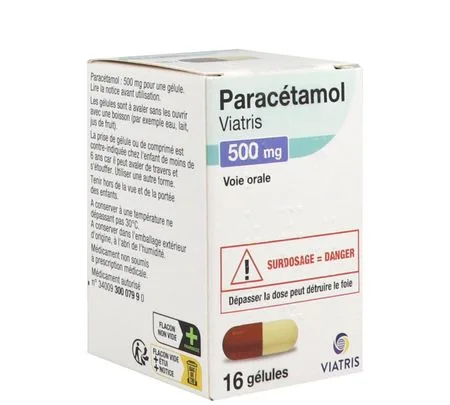
PARACETAMOL VIATRIS 500 mg, capsule
Composition
Paracetamol.................................................................................................................................................500 mg
For one capsule.
Magnesium stearate.
Composition of the capsule shell : gelatin, titanium dioxide, red iron oxide, yellow iron oxide.
Indications
Symptomatic treatment of mild to moderate pain and fever.
Adults and children from 27 kg (approximately 8 years).
Dosage and administration
Dosage
Use the lowest effective dose for the shortest possible duration. Use the dose of 1 000 mg for pain and/or fever not relieved by a dose of 500 mg of paracetamol.
Recommended dosage: approximately 60 mg/kg/day to be divided into several doses, without exceeding the maximum doses indicated in the table below. In children, the dosage should be adjusted according to weight.
The approximate ages according to weight are given for information only.
|
Weight (approximate age) |
Maximum dose per administration |
Interval of administration |
Maximum daily dose |
|
Child 27 kg – 40 kg (approximately 8 to 12 years) |
500 mg (1 capsule) |
at least 6 hours |
2 000 mg per day
|
|
Child 41 kg – 49 kg (approximately 13 to 15 years) |
500 mg (1 capsule) |
at least 4 hours |
3 000 mg per day
|
|
Adults and children from 50 kg (approximately 15 years) |
500 mg to 1 000 mg
|
at least 4 hours |
3 000 mg per day
|
Warning: Take into account all medicines containing paracetamol to avoid overdose, including those obtained without a prescription.
Only on medical advice and in the absence of concomitant risk factors, the dosage may be increased up to 4 000 mg (4 g) per day, i.e. 8 capsules per day, in patients weighing at least 50 kg (from approximately 15 years of age).
Special populations
The maximum daily dose must not exceed 60 mg/kg/day nor exceed 3 000 mg per day (3 g/day) in the following situations:
• Adults under 50 kg,
• In case of low reserves or hepatic glutathione deficiency (e.g., chronic malnutrition, fasting, recent weight loss, anorexia, cachexia),
• Dehydration.
Hepatic insufficiency (mild to moderate), chronic alcoholism and Gilbert's syndrome (familial non-haemolytic jaundice)
It is recommended to reduce the dose and increase the minimum interval between two doses. The daily dose of paracetamol must not exceed 2 000 mg/day (2 g/day).
Renal impairment
In cases of renal impairment and unless medically advised, it is recommended to reduce the maximum daily dose and increase the minimum interval between 2 doses as shown in the table below.
Adults:
|
Creatinine clearance |
Administration interval |
Maximum daily dose |
|
10-50 ml/min |
at least 6 hours |
3 000 mg/day (3 g/day) |
|
< 10 ml/min |
at least 8 hours |
2 000 mg/day (2 g/day) |
Elderly
Clinical experience indicates that the recommended dosage is generally adequate in adults. However, concomitant risk factors, some of which occur more frequently in elderly subjects and which require dose adjustment, should be taken into account.
Method of administration
Oral use.
The capsules are to be swallowed whole with a glass of water.
Duration of treatment
Frequent or prolonged use without medical supervision is not recommended.
If symptoms persist beyond 5 days in the case of pain or 3 days in the case of fever, if symptoms worsen or if new symptoms appear, the treatment should be re-evaluated.
Contraindications
Hypersensitivity to paracetamol or to any of the excipients listed in section Composition.
Severe hepatic insufficiency.
Warnings and precautions
Patients must be informed that they must not take other medicines containing paracetamol. Taking several doses at one administration can seriously damage the liver; if this occurs, the patient must immediately call a doctor.
In a child treated with 60 mg/kg/day of paracetamol, combining another antipyretic is justified only in case of ineffectiveness.
In case of acute viral hepatitis, treatment should be stopped.
Precautions for use
Paracetamol must be administered with caution in the following situations (see section Dosage and administration) :
• Adult weighing less than 50 kg
• Mild to moderate hepatic insufficiency
• Chronic alcoholism and recent withdrawal
• Renal insufficiency
• Gilbert's syndrome
• Concomitant treatment with medicinal products affecting hepatic function (e.g., potentially hepatotoxic medicinal products or enzyme-inducing medicinal products of cytochrome P450 such as phenobarbital, phenytoin, carbamazepine, topiramate, rifampicin)
• Deficiency in Glucose-6-Phosphate Dehydrogenase (G6PD) (which may lead to haemolytic anaemia)
• Dehydration
• In cases of low reserves or hepatic glutathione deficiency (e.g. chronic malnutrition, fasting, recent weight loss, anorexia, cachexia)
• Elderly people
Consumption of alcoholic beverages during treatment is not recommended.
With long-term use, high doses, or incorrect use of analgesics in patients with chronic headaches, headaches may appear or worsen; they must not be treated with higher doses of this medicine. In such cases, use of analgesics should be discontinued on medical advice.
Cases of high anion gap metabolic acidosis (HAGMA) due to pyroglutamic acidosis have been reported in patients with serious illness such as severe renal failure and sepsis, or in patients suffering from malnutrition or other sources of glutathione deficiency (for example, chronic alcoholism) who have been treated with paracetamol at a therapeutic dose for a prolonged period, or with a combination of paracetamol and flucloxacillin. In case of suspected HAGMA due to pyroglutamic acidosis, it is recommended to immediately discontinue paracetamol and carry out close monitoring. Measurement of urinary 5‑oxoproline may be useful to identify pyroglutamic acidosis as the underlying cause of HAGMA in patients presenting with multiple risk factors.
Interactions
Associations requiring precautions for use
+ Vitamin K antagonists
Risk of increased effect of vitamin K antagonists and of bleeding risk in case of paracetamol intake at maximum doses (4 g/day) for at least 4 days.
More frequent INR monitoring. Possible adjustment of the vitamin K antagonist dose during paracetamol treatment and after its discontinuation.
+ Flucloxacillin
Precautions must be taken when paracetamol is used at the same time as flucloxacillin, as concomitant intake has been associated with high anion gap metabolic acidosis due to pyroglutamic acidosis, particularly in patients with risk factors (see section Warnings and precautions).
Interactions with paraclinical tests
Paracetamol intake may distort blood glucose measurement by the glucose oxidase‑peroxidase method in cases of abnormally high concentrations.
Taking paracetamol may distort the measurement of blood uric acid by the phosphotungstic acid method.
Fertility, pregnancy and breastfeeding
Pregnancy
Studies carried out in animals have not demonstrated a teratogenic or foetotoxic effect of paracetamol.
A large amount of data concerning pregnant women demonstrates the absence of any malformation or any fetal/neonatal toxicity. Epidemiological studies on the neurodevelopment of children exposed to paracetamol in utero produce inconclusive results. If clinically necessary, paracetamol may be used during pregnancy; however, it should be used at the lowest effective dose, for the shortest possible duration and at the lowest possible frequency.
Breast-feeding
After administration, paracetamol is excreted in small quantities in breast milk. At therapeutic doses, administration of this medicine is possible during breastfeeding.
Fertility
Due to the potential mechanism of action on cyclo-oxygenases and prostaglandin synthesis, paracetamol could impair fertility in women, through an effect on ovulation that is reversible upon discontinuation of treatment.
Effects on male fertility have been observed in an animal study. The relevance of these effects in humans is not known.
Driving and using machines
Paracetamol has no or negligible effect on the ability to drive vehicles and use machines.
Adverse effects
Undesirable effects are classified by system organ class. Their frequencies are defined as follows:
• Very common (≥ 1/10)
• Common (≥ 1/100 to < 1/10)
• Uncommon (≥ 1/1 000 to < 1/100)
• Rare (≥ 1/10 000 to < 1/1 000)
• Very rare (< 1/10 000)
• Frequency not known (cannot be estimated from the available data)
Blood and lymphatic system disorders
• Very rare: thrombocytopenia, leukopenia and neutropenia.
Immune system disorders
• Rare: hypersensitivity reactions.
• Frequency not known: anaphylactic reaction (including hypotension), anaphylactic shock, angioedema (Quincke's edema).
Their occurrence requires immediate and permanent discontinuation of this medicine and related medicines.
Respiratory, thoracic and mediastinal disorders
• Frequency not known: bronchospasm (cases of bronchospasm have been identified with paracetamol, mainly in asthmatic patients sensitive to aspirin or other non-steroidal anti-inflammatory drugs).
Metabolism and nutrition disorders
• Frequency not known: metabolic acidosis with high anion gap.
Description of selected adverse reactions
High anion gap metabolic acidosis
Cases of high anion gap metabolic acidosis due to pyroglutamic acidosis have been observed in patients with risk factors taking paracetamol (see section Warnings and precautions). Pyroglutamic acidosis may occur in these patients due to low glutathione levels.
Gastrointestinal disorders
• Frequency undetermined: diarrhoea, abdominal pain.
Hepatobiliary disorders
• Frequency undetermined: increased liver enzymes.
Skin and subcutaneous tissue disorders‑cutaneous
• Rare: erythema, urticaria, skin rash. If these occur, this medicine and related medicines must be stopped immediately and permanently.
• Rare: purpura. If this effect occurs, this medicine must be stopped immediately. The medicine may be reintroduced only on medical advice.
• Very rare: severe skin reactions. Their occurrence requires immediate and permanent discontinuation of this medicine and of related medicines.
• Frequency not known: fixed pigmented erythema.
Reporting of suspected adverse reactions
Reporting suspected adverse reactions after authorisation of the medicinal product is important. It allows continued monitoring of the benefit/risk balance of the medicinal product. Healthcare professionals are asked to report any suspected adverse reactions via the national reporting system: National Agency for the Safety of Medicines and Health Products (ANSM) and the network of Regional Pharmacovigilance Centres - Website: https://signalement.social-sante.gouv.fr/.
Overdose
The risk of serious poisoning (therapeutic overdose or accidental poisoning) may be particularly high in elderly subjects, in young children, in patients with liver impairment, in cases of chronic alcoholism, in patients suffering from chronic malnutrition (see section Dosage and administration), fasting, recent weight loss, familial cholemia (Gilbert's syndrome), as well as patients receiving enzyme-inducing medicines. In these cases, poisoning may be fatal.
Symptoms
Nausea, vomiting, anorexia, pallor, malaise, sweating, abdominal pain generally appear within 24 first hours.
An overdose may cause hepatic cytolysis that may lead to hepatocellular failure which may require liver transplantation, gastrointestinal bleeding, metabolic acidosis, encephalopathy which may progress to coma and death.
Cases of disseminated intravascular coagulation have been observed in the context of paracetamol overdose.
Simultaneously, an increase in hepatic transaminases, lactate dehydrogenase and bilirubin, and a decrease in prothrombin level are observed, which may appear 12 to 48 hours after ingestion. Clinical symptoms of hepatic involvement are generally observed after 1 to 2 days, and reach a maximum after 3 to 4 days.
Overdose may also cause acute pancreatitis, hyperamylasemia, acute renal failure and pancytopenia.
Emergency management
• Discontinue treatment.
• Immediate transfer to a hospital setting for emergency medical care, despite the absence of significant early symptoms.
• Rapid evacuation of the ingested product, by aspiration and gastric lavage, preferably within 4 hours following ingestion.
• Blood sample to perform the initial plasma paracetamol assay. The plasma paracetamol concentration must be measured at least 4 hours after ingestion (an assay performed earlier is not reliable).
• Treatment of overdose conventionally includes administration of the antidote N-acetylcysteine as early as possible, intravenously or orally if possible. before the tenth hour. Although less effective, a protective effect of the antidote may be obtained up to 48 hours post-ingestion. In this case the antidote must be administered for longer.
• Symptomatic treatment.
• Liver tests must be performed at the start of treatment and repeated every 24 hours. In most cases, hepatic transaminases return to normal within 1 to 2 weeks with full restoration of liver function. However, in very severe cases, liver transplantation may be necessary.
• Further measures will depend on the severity, nature and course of the clinical symptoms of paracetamol poisoning and should follow standard intensive care protocols.
Pharmacodynamics
Pharmacotherapeutic class: OTHER ANALGESICS AND ANTIPYRETICS-ANILIDES, ATC code: N02BE01.
Paracetamol has a central and peripheral mechanism of action.
Pharmacokinetics
Absorption
Oral absorption of paracetamol is complete and rapid. Maximum plasma concentrations are reached 30 to 60 minutes after ingestion.
Distribution
Paracetamol is rapidly distributed in all tissues. Concentrations are comparable in blood, saliva and plasma. Binding to plasma proteins is low.
Biotransformation
Paracetamol is metabolised essentially in the liver. The 2 major metabolic pathways are glucuronidation and sulfoconjugation. The latter pathway is rapidly saturable at doses above therapeutic doses. A minor pathway, catalysed by cytochrome P450, is the formation of a reactive intermediate (N-acetyl benzoquinone imine), which, under normal conditions of use, is rapidly detoxified by reduced glutathione and eliminated in the urine after conjugation with cysteine and mercapturic acid. In contrast, during massive overdoses, the quantity of this toxic metabolite is increased.
Elimination
Elimination is mainly urinary. 90 % of the ingested dose is eliminated by the kidney in 24 hours, mainly in glucuronide conjugated form (60 to 80 %) and sulfate conjugated form (20 to 30 %).
Less than 5% is eliminated unchanged.
The elimination half-life is approximately 2 hours.
Pathophysiological variations
Renal impairment : in cases of renal impairment (see section Dosage and administration), the elimination of paracetamol and its metabolites is delayed.
Hepatic impairment : paracetamol metabolism is altered in patients with chronic hepatic impairment, as shown by increased plasma concentrations of paracetamol and a longer elimination half-life (see section Dosage and administration).
Elderly subject : the conjugation capacity is not modified (see section Dosage and administration).
Preclinical safety
No conventional study based on currently accepted standards for assessing reproductive and developmental toxicity is available.
Special storage precautions
To be stored at a temperature not exceeding 30°C.
To be stored in the original outer packaging, protected from moisture.
Prescription, supply and reimbursement
| Marketing authorisation (AMM) |
|
| Price: |
|
Reimbursed by Social Security at 65% (Fl/16) in the indications:
- Indication(s) appearing in the marketing authorisation (AMM) at the date of publication of this order (Fl/16)
Hospital model(s) (Fl/100).
Collection.
1 RUE DE TURIN
69007 LYON
Tel: 04 37 25 75 00 https://www.viatris.fr/
Source: VIDAL · Updated on 11/11/2026. This information does not replace advice from a healthcare professional.