
Medicines
SmPC of 12/06/2026
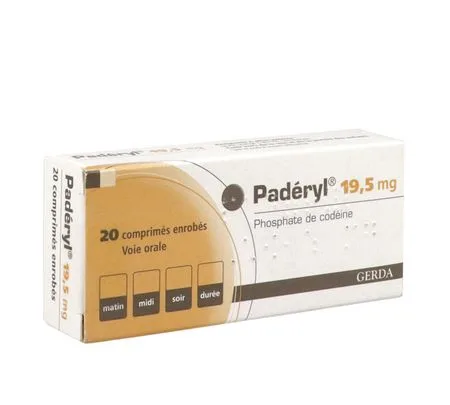
PADERYL 19,5 mg, coated tablet
Composition
Codeine phosphate hemihydrate...................................................................................................19,500 mg
Corresponding quantity in codeine....................................................................................................15,22 mg
For one film-coated tablet.
Excipients with known effect: orange yellow S (E110), sucrose.
Microcrystalline cellulose (Avicel PH102), magnesium stearate.
Coating: bleached dewaxed shellac, white Sépifilm SC (hypromellose, sucrose, titanium dioxide), orange yellow S (E110), sucrose, white beeswax.
Dosage and administration
Dosage
RESERVED FOR ADULTS.
1 tablet contains 15 mg of codeine.
Symptomatic treatment should be short (a few days) and limited to the times when the cough occurs.
Doses should be spaced at least 6 hours apart.
In the absence of any other medicinal intake providing codeine or any other central antitussive, the maximum daily dose of codeine not to be exceeded in adults is 120 mg.
The usual dosage is:
• in adults : 1 to 2 tablets, to be repeated if necessary after 6 hours, without exceeding 8 tablets per day.
• in elderly subjects or in cases of hepatic insufficiency : The initial dose will be halved compared with the dose recommended in adults, and may be increased if necessary depending on tolerance and needs.
Method of administration
Oral use.
Contraindications
• Hypersensitivity to the active substance or to any of the excipients listed in section Composition,
• In combination with sodium oxybate (see section Interactions),
• Respiratory insufficiency,
• Cough in asthmatics,
• Breast-feeding (see section Fertility, pregnancy and breastfeeding),
• Patients known to be ultrarapid metabolisers of CYP2D6 substrates.
In general, codeine is contraindicated in children under 12 years of age, due to an increased risk of serious adverse effects that may threaten the prognosis vital (section Warnings and precautions). In addition, the use of codeine is not recommended in children aged 12 to 18 years whose respiratory function is impaired (see section Warnings and precautions).
Warnings and precautions
Special warnings
Prolonged treatment with high doses of codeine may lead to a state of dependence.
Productive coughs, which are a fundamental element of bronchopulmonary defence, should be respected. It is illogical to combine an expectorant or mucolytic with an antitussive.
Before prescribing an antitussive treatment, the causes of the cough that require specific treatment should be investigated.
If the cough does not respond to an antitussive administered at the usual dose, the dose should not be increased; instead, the clinical situation should be reassessed. This medicine contains sucrose. Its use is contraindicated in patients with fructose intolerance, glucose-galactose malabsorption syndrome or sucrase/isomaltase deficiency (rare hereditary diseases).
This medicine contains an azo colouring agent: orange yellow S (E110) and may cause allergic reactions.
Combination of this medicine is not recommended with mixed agonist-antagonist opioids, with partial opioid antagonists, with alcoholic beverages or other medicines containing alcohol (see section Interactions).
Hepatobiliary disorders
Codeine may cause acute abdominal pain of biliary or pancreatic type, most often associated with biological abnormalities, suggestive of a spasm of the sphincter of Oddi (see section Adverse effects). Caution is required in patients who have undergone cholecystectomy, or who have biliary tract disorders or pancreatitis.
Tolerance and opioid use-associated disorders (abuse and dependence)
Tolerance, physical and psychological dependence and opioid use-associated disorders may develop with repeated administration of opioids such as PADERYL 19,5 mg, coated tablet. Repeated use of PADERYL 19,5 mg, coated tablet may lead to opioid use-associated disorders. Increasing the dose and prolonging opioid treatment may increase the risk of developing an opioid use-associated disorder. Intentional abuse or misuse of PADERYL 19,5 mg, coated tablet may lead to overdose and/or death of the patient. The risk of developing an opioid use-associated disorder is increased in patients with a personal or family history (parents, brothers or sisters) of substance use disorders (including those related to alcohol abuse), in smokers, or in patients with a personal history of mental disorders (for example major depression, anxiety, personality disorders..).
Patients must be informed of the risks and signs of opioid use disorders as presented in the leaflet. If these signs appear, they must contact their doctor.
If a patient presents with signs and symptoms of opioid use-associated disorders and/or excessive medication use, a review of the opioids and psychoactive medicines (such as benzodiazepines) taken concurrently by the patient, as well as a consultation with an addiction specialist, may be necessary.
Metabolism by CYP2D6
Codeine is metabolised to morphine, its active metabolite, by the cytochrome CYP2D6 in the liver. In case of deficiency or total absence of this enzyme, the expected therapeutic effect will not be obtained. It is estimated that up to 7% of the Caucasian population may have this deficiency. However, if the patient is a major or ultrarapid metaboliser, the risk of occurrence of side effects related to opioid toxicity is increased, even at the usually prescribed doses. In these patients, the metabolism of codeine to morphine is faster, resulting in higher serum morphine levels.
Symptoms of opiate toxic effects include: mental confusion, drowsiness, polypnoea (shallow breathing), miosis, nausea, vomiting, constipation and loss of appetite. In severe cases, circulatory and respiratory failure may occur, which may threaten the prognosis vital, with a fatal outcome reported in very rare cases.
Estimates of the prevalence of ultrarapid metabolisers in different populations are summarised below:
|
Population |
% prevalence |
|
African/Ethiopian |
29% |
|
Afro-American |
3,4% to 6,5% |
|
Asian |
1,2% to 2% |
|
Caucasian |
3,6% to 6,5% |
|
Greek |
6,0% |
|
Hungarian |
1,9% |
|
Northern European |
1% to 2% |
Children whose respiratory function is impaired
The use of codeine is not recommended in children whose respiratory function is impaired, including in cases of neuromuscular deficiency, severe cardiac or respiratory disorders, infections of the upper airways or lungs, polytrauma or major surgical interventions. These factors may aggravate symptoms related to morphine toxicity.
Sleep-related breathing disorders
Opioids can cause sleep-related breathing disorders, including central sleep apnoea and sleep-related hypoxaemia. Opioid use increases the risk of central sleep apnoea in a dose-dependent manner. In patients with central sleep apnoea, a reduction in the total opioid dose should be considered.
Hyperalgesia
Like other opioids, codeine may induce hyperalgesia. In this case, the dose should be reduced and the treatment reviewed.
Precautions for use
Caution is required in cases of intracranial hypertension, which could be increased by codeine intake.
Interactions
Sedative medicinal products
It must be taken into account that many medicines or substances can add up their central nervous system depressant effects and contribute to decreased alertness. These include morphine derivatives (analgesics, antitussives and substitution treatments), neuroleptics, barbiturates, benzodiazepines, anxiolytics other than benzodiazepines (for example, meprobamate), hypnotics, sedative antidepressants (amitriptyline, doxepin, mianserin, mirtazapine, trimipramine), sedative H1 antihistamines, centrally acting antihypertensives, baclofen and thalidomide.
Contraindicated combinations (see section Contraindications)
+ Sodium oxybate
Increased risk of respiratory depression, which may be fatal in case of overdose.
Contraindicated combinations (see section Warnings and precautions)
+ Alcohol (beverage or excipient)
Alcohol increases the sedative effect of central antitussives. Impaired alertness may make driving vehicles and using machines dangerous.
Avoid taking alcoholic beverages and medicines containing alcohol.
+ Agonist-antagonist opioids (buprenorphine, nalbuphine)
Reduction of the analgesic or antitussive effect of the opioid, by competitive receptor blockade, with risk of onset of a withdrawal syndrome.
+ Partial opioid antagonists (nalmefene, naltrexone)
Risk of reduction of analgesic effect.
Associations to be taken into account
+ Other morphine-like opioid agonist analgesics (alfentanil, dihydrocodeine, fentanyl, hydromorphone, morphine, oxycodone, pethidine, remifentanil, sufentanil, tapentadol, tramadol)
Increased risk of respiratory depression, which may be fatal in the event of overdose.
+ Other sedative medicines
Increased central depression. Impaired alertness may make driving vehicles and using machines dangerous.
+ Morphine-like antitussives (dextromethorphan, noscapine, pholcodine)
Increased risk of respiratory depression, which may be fatal in the event of overdose.
+ Other true morphinic antitussive: ethylmorphine
Increased risk of respiratory depression, which may be fatal in the event of overdose.
+ Barbiturates
Increased risk of respiratory depression, which may be fatal in the event of overdose.
+ Benzodiazepines and related drugs
Increased risk of respiratory depression, which may be fatal in the event of overdose.
+ Methadone
Increased risk of respiratory depression, which may be fatal in case of overdose
+ Gabapentinoids
Concomitant use of PADERYL 19,5 mg, coated tablet, with gabapentinoids (gabapentin and pregabalin) may result in respiratory depression, hypotension, profound sedation, coma or death.
Fertility, pregnancy and breastfeeding
Pregnancy
Studies conducted in animals have demonstrated a teratogenic effect of codeine.
In clinical practice, the results of epidemiological studies conducted on small numbers of women appear to rule out a specific malformative effect of codeine.
Near the end of pregnancy, high doses, even with short-term treatment, may cause respiratory depression in the newborn.
During the last three months of pregnancy, chronic intake of codeine by the mother, whatever the dose, may cause withdrawal syndrome in the newborn.
Consequently, the use of codeine during pregnancy should only be considered if necessary and on an occasional basis.
Breast-feeding
PADERYL is contraindicated during breastfeeding (see section Contraindications).
Codeine passes into breast milk; a few cases of hypotonia and respiratory pauses have been described in infants after ingestion by mothers of codeine at supra-therapeutic doses.
At usual therapeutic doses, codeine and its active metabolite pass very weakly into breast milk, which a priori, does not expose the breastfed infant to the risk of adverse effects. However, if the breastfeeding woman is an ultra-rapid metaboliser of CYP2D6 substrates, higher levels of the active metabolite, morphine, may be present in breast milk, which may, in very rare cases, lead to opioid effects that may be fatal for the breastfed infant.
Driving and using machines
Attention is drawn, in particular for drivers of vehicles and users of machinery, to the risks of drowsiness associated with the use of this medicine.
Adverse effects
At therapeutic doses, the adverse effects of codeine are comparable to those of other opiates, but they are rarer and milder.
• Possible constipation, drowsiness, dizziness, nausea, vomiting.
• Rarely: bronchospasm, allergic skin reactions, respiratory depression (see section Contraindications).
• Acute abdominal pain syndrome of biliary or pancreatic type, suggestive of a spasm of the sphincter of Oddi, occurring particularly in cholecystectomized subjects (see section Warnings and precautions).
• Pancreatitis.
At supra-therapeutic doses : there is a risk of dependence and withdrawal syndrome on abrupt cessation, which may be observed in the user and in the newborn of a mother intoxicated with codeine (see section Fertility, pregnancy and breastfeeding).
• Psychiatric disorders (frequency not known): Abuse. Prolonged use carries a risk of drug dependence (see section Warnings and precautions).
Drug dependence
Repeated use of PADERYL 19,5 mg, coated tablet may lead to dependence, even at therapeutic doses. The risk of dependence may vary depending on individual risk factors, the dose and the duration of opioid treatment (see section Warnings and precautions).
Reporting of suspected adverse reactions
Reporting suspected adverse reactions after authorisation of the medicinal product is important. It allows continued monitoring of the benefit/risk balance of the medicinal product. Healthcare professionals are asked to report any suspected adverse reaction via the national reporting system: National Agency for the Safety of Medicines and Health Products (ANSM) and the network of Regional Centres of Pharmacovigilance - Website: https://signalement.social-sante.gouv.fr/.
Overdose
Signs in adults
• acute depression of the respiratory centres (cyanosis, bradypnoea),
• drowsiness, rash, vomiting,
• pruritus,
• ataxia,
• pulmonary edema.
Signs in children (toxic threshold: 2 mg/kg as a single dose):
• bradypnoea, respiratory pauses,
• miosis,
• convulsions,
• flushing and facial oedema,
• urticarial rash, collapse,
• urinary retention.
Treatment
• respiratory assistance,
• naloxone in case of massive overdose.
Pharmacodynamics
Pharmacotherapeutic class: OPIATE ANTITUSSIVE, ATC code: R. respiratory system.
Codeine : opium alkaloid, centrally acting antitussive, having a depressant effect on the respiratory centers.
Pharmacokinetics
Codeine by oral route:
• The time to reach peak plasma concentration is of the order of one hour.
• Hepatic metabolism.
• Approximately 10 % of codeine is demethylated and converted to morphine in the body.
• Plasma half-life of the order of 3 hours (in adults).
• Crosses the placenta and diffuses into breast milk.
Prescription, supply and reimbursement
Prescription duration limited to 84 day(s).
Prescription on a secure prescription form (meeting the specifications set by the order of 31 March 1999).
| Marketing authorisation (AMM) |
|
| Price: |
|
24 RUE ERLANGER
75016 PARIS
Tel: 01 43 18 13 00 contact@substipharm.com
https://www.substipharm.com/legal-mention/
Source: VIDAL · Updated on 11/11/2026. This information does not replace advice from a healthcare professional.