Medicines
SmPC of 04/08/2026
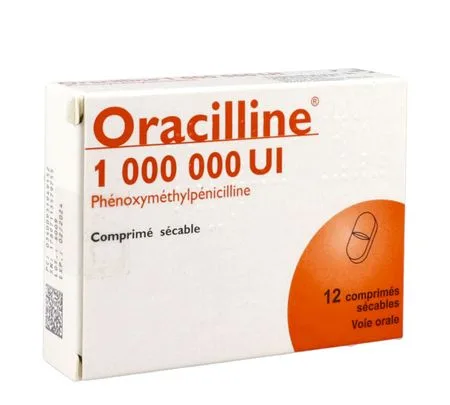
ORACILLINE 1 000 000 IU, scored tablet
Composition
For a scored tablet:
Phenoxymethylpenicillin: 1 000 000 IU
Silica, magnesium stearate, microcrystalline cellulose, sodium carboxymethyl starch, stearic acid.
Indications
ORACILLINE 1 000 000 IU, scored tablet is indicated in adults and children for the curative and preventive treatment of the following infections (see section Pharmacodynamics).
As curative treatment:
• tonsillitis documented to be due to beta-haemolytic streptococcus group A,
• Mild skin infections due to susceptible germs.
As prophylaxis:
• Prophylaxis of recurrences of acute rheumatic fever (ARF),
• Prophylaxis of recurrent erysipelas,
• Prophylaxis of contacts in the household of a scarlet fever case,
• Prophylaxis of pneumococcal infections in splenectomised patients, patients with major sickle cell disease and other patients with functional asplenia.
Official recommendations concerning the appropriate use of antibacterial agents should be taken into account.
Dosage and administration
Dosage
This tablet form is reserved for adults and for children over 6 years (see section Warnings and precautions).
Other presentations of phenoxymethylpenicillin are more suitable for children under 6 years.
As curative treatment:
The daily dose must be divided into 2 to 3 doses for tonsillitis, or into 3 or 4 doses for the other indications.
• In adults: 2 000 000 IU to 4 000 000 IU/day.
• In infants and children up to 40 kg: 50 000 to 100 000 IU/kg/day.
Duration of treatment
The duration of treatment for tonsillitis is 10 days. To prevent late complications (acute rheumatic fever), treatment of infections due to beta-haemolytic streptococcus must be 10 days.
As prophylaxis:
The daily dose must be divided into two doses.
Paediatric population
• Up to 10 kg: 100 000 IU/kg/day.
• From 10 kg to 40 kg: 50 000 IU/kg/day without exceeding 2 000 000 IU/day.
Prophylaxis should be started as soon as the diagnosis is made for sickle cell disease.
It is to be continued for at least until the age of 5 years for sickle cell patients and for at least during the 5 years following the procedure for splenectomised patients.
Adult: 2 000 000 IU/day.
Prophylaxis is to be continued for at least 2 years after splenectomy.
Method of administration
Oral use.
The tablets are to be swallowed with a glass of water.
The medicine may be taken independently of meals.
Contraindications
This medicine must never be used:
• in patients with hypersensitivity to phenoxymethylpenicillin, to other antibiotics of the beta-lactam family (penicillins and cephalosporins: take into account the risk of cross-allergy with antibiotics of the cephalosporin group), or to any of the other components of this medicine (see section Composition).
Warnings and precautions
Paediatric population
Taking tablets is contraindicated in children under 6 years of age, as it may cause choking. Other presentations of phenoxymethylpenicillin that are more suitable for children under 6 years of age are available.
Hypersensitivity
The occurrence of any allergic reaction requires discontinuation of treatment and the initiation of appropriate treatment.
Severe and sometimes fatal hypersensitivity reactions (anaphylaxis) have exceptionally been observed in patients treated with beta-lactams. Hypersensitivity reactions, including Quincke's oedema and anaphylactic shock, may occur with phenoxymethylpenicillin intake (see section Adverse effects) and may be life-threatening.
Administration of penicillin therefore requires prior questioning. In the presence of a history of typical allergy to these products, the contraindication is absolute.
Allergy to penicillins is cross-reactive with allergy to cephalosporins in 5 to 10% of cases. This leads to penicillins being avoided when the subject is a known allergic person to cephalosporins.
The occurrence, at the start of treatment, of a generalised febrile erythema associated with pustules should raise suspicion of acute generalised exanthematous pustulosis (see section Adverse effects), this requires discontinuation of treatment and contraindicates any further administration.
Encephalopathy
Beta-lactams expose patients to the risk of encephalopathy (confusion, disturbances of consciousness, epilepsy or abnormal movements) and, particularly, in cases of overdose and renal insufficiency.
Gastrointestinal system
Pseudomembranous colitis due to Clostridium difficile has been reported with antibiotics, including phenoxymethylpenicillin. This diagnosis should be considered in patients with persistent and/or severe diarrhoea during or after antibiotic treatment (including several weeks after treatment).
In this situation, appropriate therapeutic measures must be initiated immediately. Discontinuation of antibiotic treatment should be considered. Medicines that inhibit peristalsis are contraindicated in this situation (see section Adverse effects).
Sickle cell patients, splenectomised patients, asplenic patients
In case of fever greater than or equal to 38.5°C in a sickle cell patient, a splenectomised patient or a functionally asplenic patient, immediate medical advice is recommended in order to urgently initiate treatment.
Combination not recommended
This medicine is not recommended in combination with methotrexate (see section Interactions).
Interactions
Combinations not recommended
+ Methotrexate
Increased effects and haematological toxicity of methotrexate: inhibition of renal tubular secretion of methotrexate by penicillins.
Particular problems with INR imbalance:
Numerous cases of increased activity of oral anticoagulants have been reported in patients receiving antibiotics. Marked infectious or inflammatory conditions, age and general condition of the patient appear to be risk factors. In these circumstances, it appears difficult to distinguish between the infectious disease and its treatment in the occurrence of INR imbalance. However, certain classes of antibiotics are more often implicated: these include fluoroquinolones, macrolides, cyclines, cotrimoxazole and certain cephalosporins.
Fertility, pregnancy and breastfeeding
Pregnancy
Studies in rabbits have not shown any teratogenic effect.
In clinical practice, the results of epidemiological studies appear to rule out any specific malformative or foetotoxic effect of penicillin V.
Consequently, penicillin V, under normal conditions of use, may be prescribed during pregnancy.
Breast-feeding
The passage of penicillin into breast milk is low and the quantities ingested are far below therapeutic doses. Consequently, breastfeeding is possible when this antibiotic is taken.
However, interrupt breastfeeding (or the medicinal product) if diarrhoea, candidiasis or skin rash occurs in the infant.
Driving and using machines
This medicine may have a significant influence on the ability to drive vehicles and use machines, in particular due to the possible occurrence of encephalopathy (see sections Warnings and precautions, Adverse effects, Overdose).
Adverse effects
Immune system disorders: fever, urticaria, eosinophilia, Quincke's oedema, exceptionally anaphylactic shock (see sections Contraindications and Warnings and precautions).
Skin and subcutaneous tissue disorders: pruritus, skin rash including erythematous and maculopapular eruptions, rash, Stevens-Johnson syndrome, drug hypersensitivity with eosinophilia and systemic symptoms (DRESS syndrome), Lyell's syndrome, acute generalised exanthematous pustulosis (see section Warnings and precautions). These manifestations are generally reversible on discontinuation of treatment.
Gastrointestinal disorders: nausea, vomiting, diarrhoea, pseudomembranous colitis due to Clostridium difficile (see section Warnings and precautions), black hairy tongue with prolonged treatment.
Blood and lymphatic system disorders : anaemia (generally haemolytic), thrombocytopenia, leukopenia (mainly neutropenia), agranulocytosis, coagulation disorders.
Nervous system disorders : beta-lactams expose patients to the risk of encephalopathy (confusion, impaired consciousness, epilepsy or abnormal movements), particularly in cases of overdose and renal insufficiency (see section Warnings and precautions).
Reporting of suspected adverse reactions
Reporting suspected adverse reactions after authorisation of the medicinal product is important. It allows continued monitoring of the benefit/risk balance of the medicinal product. Healthcare professionals are asked to report any suspected adverse reaction via the national reporting system: National Agency for the Safety of Medicines and Health Products (ANSM) and the network of Regional Centres of Pharmacovigilance - Website: https://signalement.social-sante.gouv.fr
Overdose
Phenoxymethylpenicillin has low toxicity. Cases of intoxication are rare and benign.
Treatment: There is no antidote to penicillin. If adverse effects associated with an overdose occur, treatment remains symptomatic.
Beta-lactams expose patients to the risk of encephalopathy (confusion, disturbances of consciousness, epilepsy or abnormal movements) and, particularly, in cases of overdose and renal insufficiency.
Pharmacodynamics
Pharmacotherapeutic class: Beta-lactamase-sensitive penicillins, ATC code: J01CE02.
Phenoxymethylpenicillin (penicillin V) is a bactericidal antibiotic of the beta-lactam family, of the natural penicillin group, of the phenoxypenicillin type.
Critical concentrations
The critical concentrations or breakpoints of minimum inhibitory concentrations (MIC) by which the susceptibility of the bacterial strain is interpreted are established by the European Committee on Antimicrobial Susceptibility Testing (EUCAST) for phenoxymethylpenicillin and are as follows: https://www.ema.europa.eu/documents/other/minimum-inhibitory-concentration-mic-breakpoints_en.xlsx
Pharmacokinetics
Absorption
In adults, the oral bioavailability of penicillin V is on the order of 55 to 60 %. It is decreased by food intake. In children, taking penicillin V with a bottle of milk decreases the Cmax value. However, the influence of meals does not justify any recommendation regarding the timing of taking the medicinal product.
In adults, the plasma peak is early, as it occurs between the 30th and the 60th minute.
At an equal dosage, plasma concentrations appear lower in children (7 months – 10 years) than in adults. For example, in children aged 1 to 8 months, for a dose of 8 mg/kg (12 500 IU/kg), the plasma peak after administration on an empty stomach is 1 to 2 mg/L.
Distribution
In animals, penicillin V is satisfactorily distributed in the lungs. In humans, this distribution is satisfactory in tonsillar tissue. Penetration into the cerebrospinal fluid remains low, and concentrations there do not exceed 1/10 of the maximum serum concentrations.
The percentage of binding to plasma proteins is on the order of 65 to 80 %.
Elimination
Penicillin V undergoes both metabolism leading to the corresponding penicilloic acid and renal elimination combining glomerular filtration and tubular secretion.
The fraction eliminated in the urine over 12 hours is between 25 and 50 % of the total administered dose.
The total plasma clearance is on the order of 500 to 600 mL/min, and the apparent elimination half-life is between 0.6 and 1.0 hour.
Preclinical safety
The main effect observed in repeated-dose toxicology studies in rats and mice with phenoxymethylpenicillin is gastrointestinal toxicity.
Although phenoxymethylpenicillin in the form of its potassium salt proved genotoxic in various in vitro tests (TK gene mutation test in mammalian cells, chromosomal aberration test, sister chromatid exchange test in mammalian cells), the active substance did not show carcinogenicity in mice and rats.
Phenoxymethylpenicillin did not show teratogenicity in rabbits.
Prescription, supply and reimbursement
| Marketing authorisation (AMM) |
|
| Price: |
|
VIA F.LLI CERVI, 8
27010 VALLE SALIMBENE (PAVIA)
Tel: 00 39 0382 422 008 amministrazione@teofarma.it
https://www.teofarmasrl.it/
Source: VIDAL · Updated on 11/11/2026. This information does not replace advice from a healthcare professional.