
Medicines
SmPC of 01/10/2025
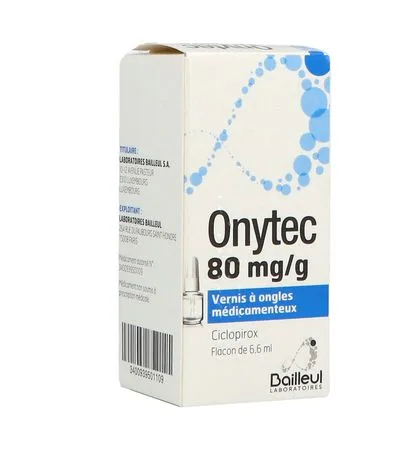
ONYTEC 80 mg/g, medicated nail varnish
Forms and presentations
Medicated nail lacquer (clear, colourless to slightly yellowish solution).
Bottle of 6,6 ml fitted with an application brush. Box of 1.
Composition
One gram of medicated nail lacquer contains 80 mg of ciclopirox.
Excipients with known effect:
One gram of medicated nail lacquer solution contains 10 mg of cetostearyl alcohol and 730 mg of ethanol.
Ethyl acetate, ethanol at 96 %, cetostearyl alcohol, hydroxypropyl chitosan, purified water.
Indications
Mild to moderate onychomycoses caused by dermatophytes and/or other fungi sensitive to ciclopirox, without involvement of the nail matrix.
Dosage and administration
Dosage
Paediatric population
The safety and efficacy of ONYTEC 80 mg/g, medicated nail varnish in children and adolescents under 18 years of age have not yet been established. No data are available.
Method of administration
Cutaneous use.
Topical use on the nails of the fingers and toes and on the immediately adjacent skin (periungual area, hyponychium).
Unless otherwise stated, ONYTEC 80 mg/g, medicated nail varnish is applied as a thin layer, once a day, to the affected nail(s), after washing and drying the nails. The medicated nail varnish must be applied to the entire nail plate, to the surrounding skin over 5 mm and, if possible, under the free edge of the nail. ONYTEC 80 mg/g, medicated nail varnish takes about thirty seconds to dry. Treated nails must not be washed for at least six hours, so it is recommended to apply it in the evening, before going to bed. After this period, usual hygiene practices may be resumed.
It is not necessary to remove ONYTEC 80 mg/g, medicated nail varnish with a solvent or an abrasive (i.e. a nail file); simply cleaning the nails thoroughly with water is sufficient. Sometimes, due to insufficient washing of the nails, a white layer may appear on the surface of the nails after a few days of treatment. Thorough washing with a neutral soap and, if necessary, with a nail brush or sponge will help remove it. If the varnish is accidentally removed by washing, ONYTEC 80 mg/g, medicated nail varnish may be applied again.
It is recommended to regularly remove the free edge of the nail and any onycholytic material using nail clippers.
Treatment must be continued until complete clinical and mycological cure and until a healthy nail has regrown. Complete cure of the fingernails is normally achieved in about 6 months, whereas 9 to 12 months are required for the toenails.
A control fungal culture should be performed 4 weeks after the end of treatment in order to avoid any disturbance of culture results by possible residues of the active substance.
As this is a topical treatment, no dose adjustment is necessary in special patient populations.
If the condition is refractory to treatment with ONYTEC 80 mg/g, medicated nail varnish and/or if there is extensive involvement of one or more fingernails and toenails, additional oral treatment should be considered.
Contraindications
Hypersensitivity to the active substance or to any of the excipients listed in section Composition.
Children and adolescents under 18 years of age, due to the lack of experience in this age group.
Warnings and precautions
The duration of the disease, the extent of the infection (involvement of the nail plate) and the thickness of the nail may affect treatment outcomes.
Patients with a history of diabetes, immune disorders, peripheral vascular disease, damaged, painful or severely deteriorated nails, skin diseases such as psoriasis or any other chronic skin condition, oedema, or respiratory disorders (yellow nail syndrome) should consult a doctor before starting treatment.
In case of sensitisation, treatment must be discontinued and appropriate measures taken.
As with any topical treatment of onychomycosis, where several nails are involved (more than 3), or where more than half of the nail plate is affected, or if the nail matrix is involved, and in cases of predisposing factors such as diabetes and immune disorders, the addition of systemic treatment should be considered.
The risk that the healthcare professional removes the non-adherent nail or that the patient tears it off while washing must be seriously considered in patients with a history of insulin-dependent diabetes or diabetic neuropathy.
Avoid contact with the eyes and mucous membranes.
ONYTEC 80 mg/g, medicated nail lacquer is for external use only.
Do not apply nail lacquer or other cosmetic nail products to treated nails.
ONYTEC 80 mg/g, medicated nail lacquer contains cetostearyl alcohol, which may cause local skin reactions, such as irritant contact dermatitis.
This medicine contains 730 mg of alcohol (ethanol) per gram of solution. This may cause a burning sensation on damaged skin.
This product is flammable. Keep away from heat sources or naked flames.
Interactions
No interaction has been reported between ciclopirox and other medicinal products. No other form of interaction has been described.
Fertility, pregnancy and breastfeeding
Pregnancy
There are no data on exposure of pregnant women to ciclopirox. Studies in animals have not revealed any direct or indirect harmful effect on gestation, embryonic development, fetal development and/or delivery. However, there are no relevant data on possible long-term effects on postnatal development (see section Preclinical safety). Treatment with ONYTEC 80 mg/g, medicated nail lacquer should only be initiated where absolutely necessary, after the physician has carefully weighed the potential benefits and risks.
Breast-feeding
It is not known whether ciclopirox passes into breast milk. Treatment with ONYTEC 80 mg/g, medicated nail lacquer may only be initiated where absolutely necessary, after the physician has carefully weighed the potential benefits and risks.
Fertility
No fertility studies have been conducted in humans. A reduction in the fertility index was observed in rats following oral administration. These animal data have minimal clinical relevance due to the low systemic exposure to ciclopirox following treatment with ONYTEC 80 mg/g, medicated nail lacquer.
Driving and using machines
ONYTEC 80 mg/g, medicated nail lacquer has no or negligible effect on the ability to drive and use machines.
Adverse effects
The frequencies of occurrence of adverse reactions are as follows:
Very common (≥ 1/10), common (≥ 1/100, < 1/10), uncommon (≥ 1/1 000, < 1/100), rare (≥ 1/10 000, < 1/1 000), very rare (< 1/10 000), frequency not known (cannot be estimated from the available data).
No systemic adverse reactions are expected. The signs and symptoms reported at the application site have been mild and transient.
General disorders and administration site conditions:
Very rare: erythema, scaling, burning and pruritus at the application site.
Frequency not known:
Skin rash, eczema and allergic contact dermatitis, even beyond the application site.
(Transient) nail discolouration (this reaction may also be due to onychomycosis itself).
Reporting of suspected adverse reactions
Reporting suspected adverse reactions after authorisation of the medicinal product is important. It allows continued monitoring of the benefit/risk balance of the medicinal product. Healthcare professionals are asked to report any suspected adverse reactions via the national reporting system: National Agency for the Safety of Medicines and Health Products (ANSM) and the network of Regional Pharmacovigilance Centres - Website: https://signalement.social-sante.gouv.fr
Pharmacodynamics
Pharmacotherapeutic class: Other antifungals for topical use, ATC code: D01AE14.
ONYTEC 80 mg/g, medicated nail lacquer is a formulation based on patented technology (ONY-TEC®) for delivering active substances to the nails. It is a hydro-alcoholic solution of hydroxypropyl chitosan with the following properties: good water solubility, high plasticity, affinity for keratin, wound-healing activity and high compatibility with human tissues.
ONYTEC 80 mg/g, medicated nail lacquer exerts a topical antifungal action. The active substance is ciclopirox (a pyridone derivative). In vitro, ciclopirox has been shown to be fungicidal and fungistatic, and to possess sporicidal activity. Ciclopirox is active against a broad spectrum of dermatophytes, yeasts, moulds and other fungi. For most dermatophytes (Trichophyton species, Microsporum species, Epidermophyton species) and yeasts (Candida albicans, other Candida species), the MIC is in the range of 0,9 to 3,9 μg/ml.
No cases of resistance to ciclopirox have been reported over more than twenty years.
|
Dermatophytes |
Trichophyton rubrum
|
|
Yeasts |
Candida albicans
|
|
Moulds |
Scopulariopsis brevicaulis
|
Once applied to the surface of the nail, ONYTEC 80 mg/g, medicated nail lacquer forms an invisible film, permeable to moisture and air, which adheres to the keratin structure of the nail and thus allows easy and rapid delivery of the active substance to the substrate.
ONYTEC 80 mg/g, medicated nail lacquer was evaluated in a long-term clinical study conducted in 467 patients with onychomycosis. It was a three-arm study, controlled versus placebo (excipients of ONYTEC) and versus a commercially available ciclopirox nail lacquer formulation at 8 %. All treatments were applied daily for 48 weeks to the infected nails. Patients were then followed for a further period of 12 weeks. As required by the different characteristics of the formulations, the reference ciclopirox nail lacquer was removed once a week using solvents and a nail file, whereas ONYTEC and the placebo (both water-soluble) were simply removed by washing.
Efficacy data were available for 454 patients (ITT population) and confirmed for 433 patients (PP population). ONYTEC showed better efficacy than the placebo and than the reference ciclopirox. A better effect was demonstrated for the "cure" rate, the primary endpoint (namely, patients whose mycological examination was negative and whose nail was cured with 100 % of any lesion resolved), and for the "responder" rate, a secondary endpoint (patients whose mycological examination was negative and whose nail was cured with ≥ 90 % of its lesions resolved).
At weeks 48 and 52, the percentages of completely cured patients and the percentages of responder patients in the ONYTEC group were consistently higher than in the reference ciclopirox group.
At week 60, that is 12 weeks after the end of treatment, the percentages of completely cured patients and of responders in the ONYTEC group had further increased compared with the reference group, being higher by 119 % for the cure rate (statistically significant, p < 0,05) and higher by 66 % for the responder rate (statistically significant, p < 0,05).
ONYTEC 80 mg/g, medicated nail lacquer induced a continuous increase in both efficacy endpoints over weeks 48, 52 and 60, unlike the reference product.
Tolerance at the application site was regularly monitored throughout the treatment period. Reported signs and symptoms were recorded in a minority of patients in all treatment groups. Overall, signs or symptoms were more frequent with the reference ciclopirox formulation (8,6 % of signs and 16 % of symptoms) than with ONYTEC (2,8 % of signs and 7,8 % of symptoms). In the placebo group, 7,2 % of signs and 12,4 % of symptoms were recorded. The most frequently recorded sign was erythema. It was observed by the investigator in 2,8 % of patients in the ONYTEC group and in 8,6 % of patients in the reference group. Erythema was also reported in 2,1 % of patients in the reference group. The most frequent symptom was burning. It was reported in 2,8 % of patients in the ONYTEC group and in 10,7 % of patients in the reference group.
No fungal resistance to ciclopirox has been described to date.
A second, randomised, long-term clinical study was conducted in 137 patients with onychomycosis. It was a randomised, two-arm study lasting 48 weeks, comparing ONYTEC nail lacquer applied daily with amorolfine 5 % in a commercially available acrylate-based nail lacquer, applied twice weekly.
All efficacy variables (study endpoints) were assessed on the nail of the big toe.
The study met its primary objective, namely that ONYTEC nail lacquer, after 12 weeks of treatment, was non-inferior to amorolfine 5 % in terms of culture negativity: culture negativity of 78,3 % for ONYTEC nail lacquer versus 64,7 % for amorolfine 5 % nail lacquer, a difference of 13,6 % between treatments (confidence interval of 95 % [-1,4 ; 28,5]).
At week 48, the percentages of patients with a complete cure rate, a treatment success/response rate and mycological cure in the ONYTEC group were systematically higher than in the reference group:
|
Parameters measured |
ONYTEC
|
Amorolfine 5 % nail lacquer |
Difference
|
95 % confidence interval for the difference |
|
Complete cure rate* |
35,0 % |
11,7 % |
23,3** |
8,8 ; 37,9 |
|
Treatment success rate# |
58,3 % |
26,7 % |
31,7** |
14,9 ; 48,4 |
|
Mycological cure $ |
100 % |
81,7 % |
18,3** |
8,5 ; 28,1 |
* Negative result observed by KOH microscopy and fungal culture, and healthy big toenail at 100 %, as measured by the blinded evaluator
# Negativization observed by KOH microscopy and fungal culture, and reduction of the affected nail area to ≤ 10 % of the total, as measured by the blinded evaluator
$ Negative result observed by KOH microscopy and fungal culture
** p < 0,001
No drug-related systemic adverse effects were recorded in this clinical study.
ONYTEC 80 mg/g, medicated nail lacquer was well tolerated, in terms of local and general adverse effects. Signs of irritation were detected in only 2,06 % of patients in the ONYTEC group, in the skin surrounding the treated nails.
Pharmacokinetics
Based on ONY-TEC® technology, ONYTEC 80 mg/g, medicated nail lacquer has demonstrated good penetration properties into keratin. After application of the medicated nail lacquer to keratinized tissues, the active substance is immediately released and penetrates the nail. By reaching a fungicidal concentration at the site of infection, the active substance binds irreversibly to the fungal cell wall, thereby resulting in inhibition of the fixation of elements essential for cell synthesis, as well as of the respiratory chain.
A very small quantity of ciclopirox passes into the systemic circulation (< 2 % of the applied dose) and the blood concentrations measured in a long-term study were 0,904 ng/ml (n = 163) and 1,144 ng/ml (n = 149) respectively after 6 and 12 months of treatment. This shows that the drug exerts its activity particularly locally and that the risk of any possible interference with the normal functions of the body is negligible.
Preclinical safety
Non-clinical data from conventional safety pharmacology, repeated-dose toxicology, genotoxicity, carcinogenesis, and reproduction and developmental function studies did not reveal any particular risk for humans at daily oral doses up to 10 mg of ciclopirox/kg. No embryo-fetal or teratogenic toxicity was noted in reproduction function studies in rats and rabbits. At the oral dose of 5 mg/kg, a decrease in the fertility index of rats was observed. There is no evidence of peri- or postnatal toxicity; however, possible long-term effects on offspring have not been studied. ONYTEC 80 mg/g, medicated nail lacquer did not cause irritation in local tolerance studies in rabbits and guinea pigs.
The chitosan derivative contained in the formulation is free of tropomyosin and did not show allergenic potential in patients with shellfish allergy.
Special storage precautions
Store the bottle in the outer packaging, protected from light.
Keep the bottle carefully closed to prevent evaporation of the contents.
Do not refrigerate.
At temperatures below 15 °C, the medicated nail lacquer may gel. Slight flocculation or the formation of a clear precipitate may also occur, which may disappear by bringing the product back to room temperature (25 °C) by rubbing the bottle between the hands until the solution is clear again (about one minute). This has no effect on the quality or performance of the product.
For storage conditions of the medicine after first opening, see section Shelf life.
The bottle must be closed when not in use. This product is flammable. Keep away from heat and naked flame.
SPECIAL PRECAUTIONS FOR DISPOSAL AND OTHER HANDLING
Any unused medicinal product or waste material should be disposed of in accordance with local requirements.
Prescription, supply and reimbursement
| Marketing authorisation (AMM) |
|
| Price: |
|
ALMIRALL SAS
3-5, bd Galliéni. 92130 Issy-les-Moulineaux
Tel: 01 46 46 19 20. Fax: 01 46 46 19 66
E-mail: pharmacovigilance.fr@almirall.com
Source: VIDAL · Updated on 11/11/2026. This information does not replace advice from a healthcare professional.