
Medicines
SPC of 19/01/2026
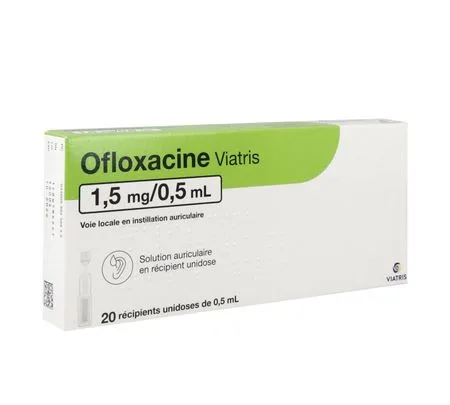
OFLOXACIN VIATRIS 1,5 mg/0,5 mL, auricular solution in single-dose container
Composition
Ofloxacin......................................................................................................................................................1,5 mg
For one single-dose container.
Sodium chloride, hydrochloric acid and sodium hydroxide, purified water.
Indications
Local treatment of purulent otorrhea:
• via transtympanic ventilation tube;
• in mastoid cavity;
• in chronic non-osteitic otitis media with an intact (open) tympanic membrane.
Note: no study has been conducted in otitis externa.
Official recommendations concerning the appropriate use of antibacterial agents should be taken into account.
Dosage and administration
Dosage
Instil the entire contents of the single-dose container (i.e., approximately 10 drops) into the ear canal of the affected ear every morning, and repeat the procedure in the evening.
The duration of treatment is usually 7 days.
If symptoms persist after 10 days, the patient should be reassessed to re-evaluate the condition and treatment.
Method of administration
Topical use.
Auricular instillation.
For INTRAAURICULAR use ONLY.
Use a single-dose container for each ear if both ears are affected.
• Detach a single-dose container from the strip.
• Warm the single-dose container at the time of use by holding it in the palm of the hand for a few minutes.
• Open this single-dose container by twisting the cap.
• Turn the single-dose container over to bring its contents toward the tip.
• With head tilted, instil the entire contents of the single-dose container into the ear canal of the affected ear, pulling the auricle repeatedly.
• Keep the head tilted to the side for approximately 5 minutes to facilitate penetration of the drops into the external ear canal.
• Repeat, if necessary, in the other ear, using another single-dose container.
• Discard the single-dose container immediately after use.
Contraindications
This medicine must never be used in cases of hypersensitivity to ofloxacin or to other quinolones.
Warnings and precautions
Hypersensitivity
The administration of local antibiotics contributes to the occurrence of sensitisation to these active substances, with the possible occurrence of systemic reactions.
Discontinue treatment at the first signs of onset of a skin rash or any other sign of local or general hypersensitivity.
Tendinitis and tendon rupture
Tendinitis and tendon ruptures can occur with systemic treatment with a fluoroquinolone such as ofloxacin, particularly in elderly subjects and in those treated concurrently with corticosteroids. Therefore, OFLOXACINE VIATRIS 1,5 mg/0,5 mL, ear solution in single-dose container must be discontinued at the first signs of tendon inflammation.
Precautions for use
DO NOT INJECT, DO NOT SWALLOW, DO NOT PUT IN THE EYE, DO NOT INHALE.
DO NOT USE ANYWHERE OTHER THAN IN THE EAR.
At the time of use, avoid contact of the tip with the ear or fingers, in order to limit the risk of contamination.
This solution is presented in a single-use container.
The single-dose container must be discarded immediately after use and must not be kept for reuse: since this product contains no preservative, there is a risk of rapid bacterial contamination.
Interactions
The data available to date do not suggest the existence of clinically significant interactions.
Fertility, pregnancy and breastfeeding
Pregnancy
Systemic exposure to ofloxacin appears negligible after administration of OFLOXACINE VIATRIS, ear solution. However, given the risk of joint damage described in children treated with systemic quinolones, as a precaution, it is preferable to avoid using OFLOXACINE VIATRIS, ear solution during pregnancy.
Breast-feeding
No effect on breastfed newborns / infants is expected, given that systemic exposure to OFLOXACINE VIATRIS, ear solution in breastfeeding women is negligible. However, as a precaution, this medicine should be avoided in breastfeeding women.
Driving and using machines
No influence on the ability to drive vehicles or use machines is expected, due to the route of administration and the low dose administered.
Adverse effects
Frequencies are determined as follows: very common (≥ 1/10); common (≥ 1/100, < 1/10); uncommon (≥ 1/1 000, < 1/100); rare (≥ 1/10 000, < 1/1 000); very rare (< 1/10 000); and not known (cannot be estimated from the available data).
Ear and labyrinth disorders
Rare: earache.
Immune system disorders
Rare: hypersensitivity reactions
Musculoskeletal and connective tissue disorders 1
Not known: tendon disorders
1 Tendon ruptures at the shoulder, hand and Achilles tendon, requiring surgical intervention or resulting in prolonged disability, have been reported in patients treated with systemic fluoroquinolones. Studies and experience since the marketing of systemic fluoroquinolones indicate that the risk of these ruptures may be increased in patients treated with corticosteroids (particularly the elderly) and where tendons are subject to high tension (including the Achilles tendon). To date, clinical data and post-marketing data have not shown a link between auricular administration of ofloxacin and these adverse effects affecting musculoskeletal and connective tissues.
Reporting of suspected adverse reactions
Reporting suspected adverse reactions after authorisation of the medicinal product is important. It allows continued monitoring of the benefit/risk balance of the medicinal product. Healthcare professionals are asked to report any suspected adverse reactions via the national reporting system: National Agency for the Safety of Medicines and Health Products (ANSM) and the network of Regional Pharmacovigilance Centres - Website: https://signalement.social-sante.gouv.fr/.
Pharmacodynamics
Pharmacotherapeutic class: Otological medicines, Anti-infectives, ATC code: S02AA.
Ofloxacin is a synthetic antibiotic belonging to the quinolone family, of the fluoroquinolone group. Its activity is strongly bactericidal through inhibition of bacterial DNA gyrase, preventing the synthesis of bacterial chromosomal DNA.
Antibacterial activity spectrum
For topical forms, there are no interpretive criteria for susceptibility testing.
The prevalence of acquired resistance can vary according to geography and time for certain species. It is therefore useful to have information on local resistance prevalence, especially for the treatment of severe infections. These data can only provide guidance on the probabilities of the susceptibility of a bacterial strain to this antibiotic.
Where the variability of resistance prevalence in France is known for a bacterial species, it is indicated in the table below:
|
Categories |
Frequency of acquired resistance in France (> 10 %) (extreme values) |
|
SUSCEPTIBLE SPECIES |
|
|
Gram-positive aerobes |
|
|
Bacillus anthracis*** |
|
|
Staphylococcus methicillin-S * |
|
|
Gram-negative aerobes |
|
|
Acinetobacter (essentially Acinetobacter baumannii) |
50 - 75 % |
|
Branhamella catarrhalis |
|
|
Bordetella pertussis |
|
|
Campylobacter |
|
|
Citrobacter freundii |
15 - 25 % |
|
Enterobacter cloacae |
15 - 25 % |
|
Escherichia coli |
0 - 10 % |
|
Haemophilus influenzae |
|
|
Klebsiella oxytoca |
0 - 11 % |
|
Klebsiella pneumoniae |
0 - 25 % |
|
Legionella |
|
|
Morganella morganii |
|
|
Neisseria |
|
|
Pasteurella |
|
|
Proteus mirabilis |
0 - 10 % |
|
Proteus vulgaris |
|
|
Providencia |
45 - 70 % |
|
Pseudomonas aeruginosa * |
45 - 85 % |
|
Salmonella |
|
|
Serratia |
40 - 45 % |
|
Shigella |
|
|
Vibrio |
|
|
Yersinia |
|
|
Anaerobes |
|
|
Mobiluncus |
|
|
Propionibacterium acnes |
|
|
Other |
|
|
Mycoplasma hominis |
|
|
MODERATELY SUSCEPTIBLE SPECIES |
|
|
(in vitro of intermediate susceptibility) |
|
|
Gram-positive aerobes |
|
|
Corynebacteria |
|
|
Streptococcus |
|
|
Streptococcus pneumoniae |
|
|
Other |
|
|
Chlamydiae |
|
|
Mycoplasma pneumoniae |
|
|
Ureaplasma urealyticum |
|
|
RESISTANT SPECIES |
|
|
Gram-positive aerobes |
|
|
Enterococci |
|
|
Listeria monocytogenes |
|
|
Nocardia asteroides |
|
|
Methicillin-resistant Staphylococcus** |
|
|
Anaerobes |
|
|
except for Mobiluncus and Propionibacterium acnes |
|
* Clinical efficacy demonstrated for susceptible strains in the approved clinical indications.
** The frequency of methicillin resistance is approximately 30 to 50 % of all staphylococci and is found mainly in hospital settings.
*** Bacillus anthracis : no animal study of experimental infection in anthrax disease has been performed.
Atypical mycobacteria:
Ofloxacin has in vitro moderate activity on certain species of mycobacteria: Mycobacterium tuberculosis, Mycobacterium fortuitum, lesser on Mycobacterium kansasii and even less so on Mycobacterium avium.
Note: this spectrum corresponds to that of the systemic forms of ofloxacin. With the local pharmaceutical presentations, the concentrations obtained in situ are much higher than plasma concentrations. Some uncertainties remain regarding the kinetics of the concentrations in situ, the local physicochemical conditions that may alter the activity of the antibiotic, and the stability of the product in situ.
Pharmacokinetics
In adults, serum concentrations of ofloxacin 30 minutes after a single instillation of 10 drops of solution dosed at 0,3 % (i.e. 1,5 mg of ofloxacin) are less than or equal to 0,002 µg/mL and after repeated administrations (10 drops every 12 hours for 7 days) between 0,002 and 0,012 µg/mL.
In children, serum concentrations of ofloxacin after a single instillation are less than or equal to 0,013 µg/mL.
The systemic passage of this presentation of ofloxacin is negligible; good diffusion at high concentrations at the site of infection is observed.
Special storage precautions
Store protected from light.
After use, the single-dose container must be discarded. Do not use a single-dose container that has already been opened.
SPECIAL PRECAUTIONS FOR DISPOSAL AND OTHER HANDLING
Detach a single-dose container from the strip.
Warm the single-dose container at the time of use by holding it in the palm of the hand for a few minutes.
Open this single-dose container by twisting it at the cap.
Invert the single-dose container so that its contents move down toward the tip, and instil the entire contents of the single-dose container into the ear canal of the affected ear.
After administration, keep the head tilted to the side for a few more minutes.
Prescription, supply and reimbursement
| Marketing authorisation (AMM) |
|
| Price: |
|
- Indication(s) appearing in the marketing authorisation at the date of publication of this decree
Collection.
1 RUE DE TURIN
69007 LYON
Tel: 04 37 25 75 00 https://www.viatris.fr/
Source: VIDAL · Updated on 11/11/2026. This information does not replace advice from a healthcare professional.