
Medicines
Update of 30/05/2024
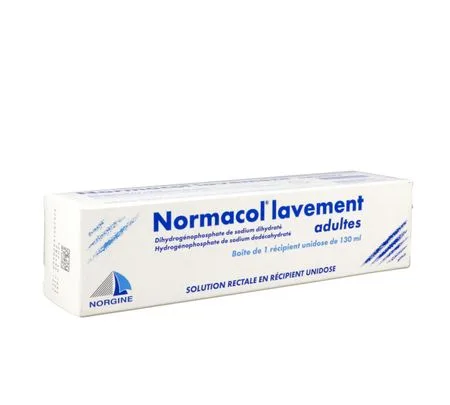
NORMACOL® ENEMA
sodium dihydrogen phosphate and disodium hydrogen phosphate
Forms and presentations
Adult rectal solution: Single-dose container of 130 ml with cannula.Child rectal solution: Single-dose container of 60 ml with cannula.
Composition
| per single dose | ||
| of 130 ml | of 60 ml | |
| Sodium dihydrogen phosphate dihydrate
|
23,66 g | 10,92 g |
| Disodium hydrogen phosphate dodecahydrate
|
10,4 g | 4,8 g |
Excipients with known effect: sodium methyl parahydroxybenzoate (E219), sorbic acid.
Indications
This medicine is indicated, for Normacol Enema Adults from 15 years of age, and for Normacol Enema Children in children from 3 years of age, for:- Preparation for radiological and endoscopic examinations of the rectosigmoid.
- Symptomatic treatment of low constipation, notably due to rectal dyschezia.
Dosage and administration
Dosage- Preparation for endoscopic or radiological examinations:
- 1 enema the evening before and 1 on the day of the examination.
- Constipation:
- 1 enema five to twenty minutes before the chosen time for evacuation.
- Paediatric population:
- Normacol Enema Adults must not be used in children under 15 years (see Contraindications).
Method of administration:
The patient must lie on the left side with both knees bent in front of them, arms at rest. Remove the protective cap covering the lubricated cannula. Gently insert the cannula into the anal orifice. With regular pressure, press the bottle until the liquid is expelled. Stop administration immediately if resistance occurs. Do not force insertion as this may cause local injuries.
Normacol Enema is a solution for rectal use: do not swallow.
Contraindications
Normacol Enema must not be used with other laxatives containing sodium phosphate.Do not use in the following cases:
- Hypersensitivity to the active substances or to any of the excipients listed in section Composition.
- Toxic colitis or toxic megacolon.
- Patients presenting with or likely to present with intestinal obstruction.
- Megacolon (congenital or acquired).
- Fluid and electrolyte disorders with sodium retention.
- Severe renal insufficiency.
- Children under 15 years (Normacol Enema Adults).
- Children under 3 years (Normacol Enema Children).
Warnings and precautions
Warnings:
- Prolonged or repeated use is not recommended, including in the treatment of chronic constipation.
- This medicine contains sodium methyl parahydroxybenzoate (E219) and may cause allergic reactions (possibly delayed).
- This medicine contains sorbic acid or one of its salts and may cause local skin reactions (for example: eczema).
- Normacol Enema Adults and Children:
- It is preferable not to use this medicine in cases of hemorrhoidal flare-ups, anal fissures, or hemorrhagic proctocolitis.
- The product must be used with caution in elderly or frail patients, in patients with mild to moderate chronic renal insufficiency or heart failure, or on a strict sodium-restricted diet, as there is a risk of hyperphosphatemia, hypocalcemia, hypernatremic dehydration and acidosis.
- Children with anorectal malformations (following surgery for neonatal imperforation, atresia) must be particularly monitored.
- Patients should be encouraged to maintain adequate hydration during treatment.
-
Drug treatment of constipation is only an adjunct to dietary and lifestyle measures:
- enrichment of the diet with vegetable fibers and beverages;
- Advice on physical activity and rehabilitation of evacuation.
- enrichment of the diet with vegetable fibers and beverages;
- Normacol Enema Adults:
- The product must be used with caution according to the instructions described in Dosage and administration. Personnel administering the enema must be warned to stop administration immediately if resistance occurs, as forced insertion may cause local injuries and, very rarely, rectal perforations.
- Normacol Enema Children:
-
Due to the occurrence of serious, possibly fatal, fluid and electrolyte disturbances in case of overdose:
- prolonged or repeated use is strictly not recommended;
- it is imperative not to exceed the prescribed doses.
- prolonged or repeated use is strictly not recommended;
Interactions
- Other hypokalaemic agents: increased risk of hypokalaemia. Monitoring of kaliaemia with correction if necessary.
- Digitalis: hypokalaemia favouring the toxic effects of digitalis. Correct any hypokalaemia beforehand and carry out clinical, electrolyte and electrocardiographic monitoring.
- Medicinal products likely to cause torsades de pointes: increased risk of ventricular rhythm disorders, in particular torsades de pointes. Correct any hypokalaemia before administering the product and carry out clinical, electrolyte and electrocardiographic monitoring.
Fertility, pregnancy and breastfeeding
Pregnancy:Treatment of constipation in pregnancy should only use rectal laxatives on a very occasional basis. As a precaution, it is preferable not to use phosphate enemas. Indeed, animal data are absent, but the human data currently available are reassuring.
Adverse effects
The following convention was used for the classification of undesirable effects: very common (≥ 1/10), common (≥ 1/100, < 1/10), uncommon (≥ 1/1 000, < 1/100), rare (≥ 1/10 000, < 1/1 000), very rare (< 1/10 000), frequency not known (cannot be estimated from the available data).
Very rare:- Disorders of fluid and electrolyte balance including hyperphosphataemia, hypocalcaemia, acidosis and hypernatraemic dehydration, manifesting as convulsions. These almost always occurred in cases of overdose, in young children or in patients with an anorectal malformation or Hirschsprung's disease, or in patients with renal insufficiency.
- Immune system disorders: allergic reactions including anaphylactic reactions; dyspnoea, oedema, urticaria, rash and erythema.
- Disorders of fluid and electrolyte balance: hypokalaemia.
When administered rectally, sodium phosphate solutions may cause local irritation. Very exceptionally, necrosis of the rectum has been observed.
Reporting of suspected adverse reactions:Reporting suspected adverse reactions after authorisation of the medicinal product is important. It allows continuous monitoring of the benefit/risk balance of the medicinal product. Healthcare professionals should report any suspected adverse reaction via the national reporting system: National Agency for the Safety of Medicines and Health Products (ANSM) and the network of Regional Pharmacovigilance Centres. Website: https://signalement.social-sante.gouv.fr.
Overdose
Management of overdose accidents requires care in a specialised setting, elimination of phosphates, general supportive measures, correction of acidosis and of serum electrolyte concentrations, in particular that of calcium.
Pharmacodynamics
Pharmacotherapeutic class: laxatives, ATC code: A06AG20.
Hypertonic solution. Evacuation is generally obtained within five minutes following administration of the enema.
Pharmacokinetics
The components of Normacol Enema are not absorbed.
Storage conditions
- Shelf life
- 3 years.
No special precautions for storage.
HANDLING/DISPOSAL INSTRUCTIONS
Normacol Enema is a solution for rectal use: do not swallow.
Remove the cannula protector. Insert the cannula into the anus and gently squeeze the container.
Prescription, supply and reimbursement
| Marketing authorisation (AMM) | 3400931307372 (1969/95, SmPC rev 23.04.2024) adult. |
| 3400931307433 (1969/95, SmPC rev 23.04.2024) child. |
| Price: | 1,55 euros (130 ml). |
| 1,31 euros (60 ml). | |
| Reimbursed by Social Security at 65 %. Collective. | |
NORGINE SAS
23, rue François-Jacob. 92500 Rueil-Malmaison
Tel: 01 41 39 94 00
Source: VIDAL · Updated on 11/11/2026. This information does not replace advice from a healthcare professional.