
Medicines
Update of 03/08/2026
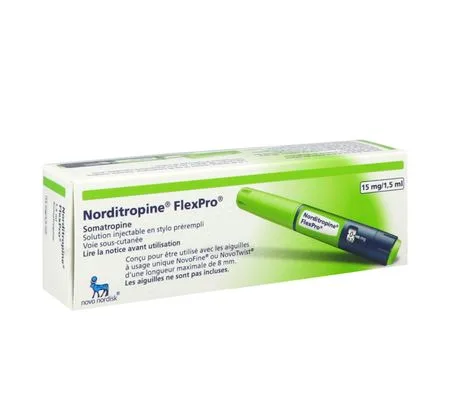
NORDITROPINE® FlexPro
somatropin
Forms and presentations
SC injectable solution at 5 mg/1,5 ml, at 10 mg/1,5 ml and at 15 mg/1,5 ml (colourless and clear): 1,5 ml cartridge, sealed in a prefilled disposable multidose injector pen, unit box.Composition
| per pen | ||
| Solution at 5 mg/1,5 ml:
|
||
| somatropin*
|
5 mg (15 IU) | |
| Solution at 10 mg/1,5 ml:
|
||
| somatropin*
|
10 mg (30 IU) | |
| Solution at 15 mg/1,5 ml:
|
||
| somatropin*
|
15 mg (45 IU) | |
1 ml of solution contains 3,3 mg of somatropin (inj sol at 5 mg/1,5 ml), 6,7 mg of somatropin (inj sol at 10 mg/1,5 ml) or 10 mg of somatropin (inj sol at 15 mg/1,5 ml).
1 mg of somatropin corresponds to 3 IU (international units) of somatropin.
* Obtained by recombinant DNA technology on Escherichia coli.Indications
- Growth retardation related to somatotropic deficiency.
- Growth retardation in girls with gonadal dysgenesis (Turner syndrome).
- Growth retardation in prepubertal children due to chronic renal failure.
- Growth retardation (current height < -2,5 SD and adjusted parental height < -1 SD) in children born small for gestational age (SGA) with birth weight and/or height below -2 SD, who have not caught up their growth retardation (growth velocity < 0 SD during the last year) at the age of 4 years or more.
- Growth retardation related to Noonan syndrome.
- Somatotropic deficiency acquired in childhood:
- Once their growth is complete, growth hormone secretory capacity shall be re-evaluated in patients with somatotropic deficiency acquired in childhood. No test is required in patients with more than three pituitary hormone deficiencies, in patients with severe somatotropic deficiency due to a defined genetic cause, due to hypothalamo-pituitary structural abnormalities, due to central nervous system tumours or due to high-dose intracranial irradiation, or in patients with somatotropic deficiency secondary to a pathology or hypothalamo-pituitary involvement, if the IGF-1 (Insulin-like Growth Factor 1) assay is < -2 SD at least four weeks after discontinuation of growth hormone treatment.
- In all other patients, an IGF-1 assay and a dynamic growth hormone stimulation test are required.
- Acquired growth hormone deficiency in adulthood:
- Significant growth hormone deficiency in the context of a known hypothalamo-pituitary pathology, intracranial irradiation or traumatic brain injury. The growth hormone deficiency must be associated with another deficient axis, other than prolactin. The growth hormone deficiency must be demonstrated during a dynamic test after adequate hormone replacement of any other hormonal deficiency.
- In adults, insulin-induced hypoglycaemia is the dynamic test of choice. When insulin-induced hypoglycaemia is contraindicated, alternative dynamic tests must be used. The arginine-GHRH combination is recommended. The arginine or glucagon test may also be considered; however, the diagnostic value of these tests is less well established than that of the insulin-induced hypoglycaemia test.
Dosage and administration
Norditropine must be prescribed only by physicians specialised in these therapeutic indications.
DosageThe dosage must be adapted to each patient and must always be adjusted according to the clinical and biological results of the treatment.
- Paediatric population:
-
- Growth retardation related to growth hormone deficiency:
0,025 to 0,035 mg/kg/day or 0,7 to 1 mg/m2/day.
If the growth hormone deficiency persists once growth is complete, treatment with growth hormone must be continued until complete somatic development of the adult, including lean mass and bone mineral accretion (for dosage adjustment, see Growth hormone deficiency in adults). - Turner syndrome:
0,045 to 0,067 mg/kg/day or 1,3 to 2,0 mg/m2/day. - Chronic renal failure:
0,050 mg/kg/day or 1,4 mg/m2/day (see Warnings and Precautions for use). - Growth retardation in children born small for gestational age:
0,035 mg/kg/day or 1,0 mg/m2/day.
A dose of 0,035 mg/kg/day is usually recommended until final height is reached (see Pharmacodynamics). Treatment must be stopped after the first year of treatment if the growth rate is less than +1 SD.
Treatment must be stopped if the growth rate is < 2 cm/year and, if confirmation is necessary, either bone age > 14 years (for girls), or > 16 years (for boys), corresponding to epiphyseal fusion. - Noonan syndrome:
0,066 mg/kg/day is the recommended dose, however in some cases the dose of 0,033 mg/kg/day may be sufficient* (see Pharmacodynamics).
Treatment must be discontinued at the time of epiphyseal closure (see Warnings and Precautions for use).
* HAS recommends in particular to initiate treatment at the lowest dose, i.e. 0,033 mg/kg/day. The dosage will be adapted to each patient and may be adjusted every 6 months according to the clinical response (growth rate and height) and tolerance to treatment, by monitoring IGF-1 levels (source: Therapeutic information sheet, order of 11 March 2021, published in the OJ of 19 March 2021).
- Growth retardation related to growth hormone deficiency:
- Adult population:
-
- Growth hormone deficiency in adults:
The dosage must be adapted according to the needs of each patient.
In patients with growth hormone deficiency acquired in childhood, the recommended dose for reinstating treatment is 0,2 to 0,5 mg/day. The dose must then be adapted according to IGF-1 concentrations.
In patients with growth hormone deficiency acquired in adulthood, it is recommended to start treatment at a low dose: 0,1 to 0,3 mg/day. It is recommended to increase the dosage gradually at monthly intervals based on clinical results and side effects. Determination of the serum IGF-1 level may guide dosage adjustment. Women may require higher doses than men, with men showing increasing sensitivity to IGF-1 over time. This means there is a risk that women, particularly those receiving oral estrogen treatment, will be undertreated while men are overtreated.
The required doses decrease with age. The maintenance dosage varies considerably from one patient to another, but rarely exceeds 1,0 mg/day.
- Growth hormone deficiency in adults:
Mode of administration:
In general, it is recommended to administer the medicine by subcutaneous route every evening.
It is necessary to vary the injection site to prevent the occurrence of lipoatrophies.
Contraindications
- Hypersensitivity to the active substance or to any of the excipients mentioned in the section Composition.
- Somatropin must not be used if there is any evidence in favor of tumor activity. Intracranial tumors must be inactive and any antitumor treatment must be completed before starting treatment with growth hormone. Treatment must be interrupted in the event of any evidence indicating tumor growth.
- Somatropin must not be used to improve statural growth in children whose epiphyses are fused.
- Patients presenting with an acute critical condition suffering from complications secondary to open-heart surgery, abdominal surgery, accidental polytrauma, acute respiratory failure or a similar situation must not be treated with somatropin (see Warnings and Precautions for use).
- In children with chronic renal insufficiency, treatment with Norditropine FlexPro must be suspended in the event of renal transplantation.
Warnings and precautions
Traceability : In order to improve the traceability of biological medicines, the name and batch number of the administered product must be clearly recorded.
Children treated with somatropin must be monitored regularly by a physician specialized in growth. Treatment with somatropin must always be initiated by a physician specialized and experienced in the diagnosis and treatment of growth hormone deficiency. This also applies to the monitoring of cases of Turner syndrome, chronic renal insufficiency, growth retardation in children born small for gestational age and Noonan syndrome. Data on final adult height after treatment with Norditropine are limited in children with Noonan syndrome and are not available for children with chronic renal insufficiency.
The recommended maximum daily dose must not be exceeded (cf Posology and Method of administration).
Stimulation of statural growth in children can only occur before fusion of the epiphyses.
- Treatment of growth hormone deficiency in patients with Prader-Willi syndrome:
- Cases of sudden death have been reported after initiation of treatment with somatropin in patients with Prader-Willi syndrome who presented with one or more of the following risk factors: severe obesity, history of upper airway obstruction or sleep apnea, or unspecified respiratory infection.
- Growth retardation in children born small for gestational age:
- In children born small for gestational age, other medical reasons or treatments that could explain growth retardation must be excluded before starting treatment.
- Experience regarding initiation of treatment near the onset of puberty in children born small for gestational age is limited. Therefore, it is not recommended to initiate treatment near the onset of puberty.
- Experience in patients with Silver-Russell syndrome is limited.
- Turner syndrome:
- It is recommended to monitor the growth of the hands and feet in female patients with Turner syndrome treated with somatropin. If an increase in the growth of the hands and feet is observed, a dose reduction toward the lower limit of the dose range must be considered.
- Girls with Turner syndrome generally have an increased risk of developing otitis media, which is why an otological examination is recommended at least once a year.
- Chronic renal failure:
- The dosage in children with chronic renal insufficiency is individual and must be adapted according to the individual response to treatment (cf Posology and Method of administration). The growth retardation related to renal insufficiency must be clearly established before treatment with somatropin by monitoring growth under optimal conservative treatment of renal insufficiency for one year. Treatment of renal insufficiency must be maintained and, if necessary, combined with dialysis during the duration of treatment with somatropin.
- Patients with chronic renal insufficiency usually develop a progressive deterioration of renal function related to the natural evolution of the disease. As a precaution, during treatment with somatropin, renal function must be monitored to detect excessive deterioration or an increase in glomerular filtration (which could imply hyperfiltration).
- Scoliosis:
- Scoliosis is known to be more frequent in certain groups of patients treated with somatropin such as those with Turner syndrome and Noonan syndrome. In addition, in all children, scoliosis is likely to progress during rapid growth. It has not been demonstrated that somatropin increases the incidence or severity of scoliosis. Signs of scoliosis must be monitored during treatment.
- Glycemia and insulinemia:
- In children with Turner syndrome and in children born small for gestational age, it is recommended to measure fasting insulinemia and glycemia before starting treatment and then annually. In patients with an increased risk of diabetes (for example: family history of diabetes, obesity, severe insulin resistance, Acanthosis nigricans), an oral glucose tolerance test must be performed. If clinical diabetes appears, somatropin must not be administered.
- As somatropin has an influence on carbohydrate metabolism, patients must be monitored in order to detect possible glucose intolerance.
- IGF-1:
- In children with Turner syndrome and in children born small for gestational age, it is recommended to measure the IGF-1 level before initiating treatment and subsequently to measure it twice per year. If, on repeated measurements, the IGF-1 levels are above + 2 SD compared to the norms for age and pubertal stage, the dose shall be decreased in order to obtain an IGF-1 level within the normal limits.
- A part of the height gain in children born small for gestational age treated with somatropin could disappear if treatment is stopped before final height is reached.
- Slipped capital femoral epiphysis and osteonecrosis:
- In patients with endocrine disorders, including growth hormone deficiency, slipped capital femoral epiphysis may occur more frequently than in the general population. Slipped capital femoral epiphysis may occur during treatment with growth hormone during childhood. Cases of osteonecrosis of the femoral head (including Legg-Calvé-Perthes disease) have been reported in patients treated with somatropin. Children with persistent hip/knee pain and/or presenting with limping during treatment with somatropin must be examined clinically.
- Growth hormone deficiency in adults:
- Growth hormone deficiency in adults is a chronic disease that must be treated as such. However, in growth hormone deficiency in adults, data in patients aged over 60 years and in patients treated for more than 5 years are still limited.
- Pancreatitis:
- Although rare, pancreatitis must be considered in patients treated with somatropin who develop abdominal pain, particularly in children.
- Tumours:
- There is no evidence in favour of an increased risk of new primary cancers in children or adults treated with somatropin.
- In patients in complete remission from benign or malignant tumour disease, treatment with somatropin has not been associated with an increase in the recurrence rate.
- A slight overall increase in secondary tumours has been observed in patients treated with growth hormone who had cancer during childhood, with intracranial tumours being the most frequent. The main risk factor for a secondary tumour appears to be prior treatment with radiotherapy.
- Patients who have had complete remission of a malignant tumour disease shall be monitored closely after initiation of their treatment with somatropin in order to detect a possible recurrence of the tumour process.
- Leukaemias:
- Some cases of leukaemias have been reported in a small number of patients with growth hormone deficiency, some of whom had been treated with somatropin. However, no increase in the incidence of leukaemias has been demonstrated in subjects receiving somatropin and without predisposing factors.
- Benign intracranial hypertension:
- In the event of severe or repeated headaches, visual disturbances, nausea and/or vomiting, it is recommended to perform fundoscopy to look for papilloedema. In the event of confirmed papilloedema, a diagnosis of benign intracranial hypertension shall be considered and treatment with somatropin shall be interrupted if necessary.
- At the present time, there are not sufficient data to guide the therapeutic decision in patients with resolved intracranial hypertension. If treatment with somatropin is restarted, close monitoring to look for the appearance of signs of intracranial hypertension is necessary.
- In the event of growth hormone deficiency secondary to an intracranial lesion, patients shall be examined frequently in order to detect a possible progression or recurrence of an underlying malignant process.
- Thyroid function:
- Somatropin increases the extrathyroidal conversion of T4 to T3 and may thus reveal incipient hypothyroidism. This is why monitoring of thyroid function shall be performed in all patients. In patients with hypopituitarism, standard replacement therapy must be closely followed during administration of treatment with somatropin.
- In patients with progressive pituitary disease, hypothyroidism may develop.
- Patients with Turner syndrome have an increased risk of developing primary hypothyroidism related to anti-thyroid antibodies. Knowing that hypothyroidism interferes with the response to treatment with somatropin, patients shall have their thyroid function checked regularly and shall receive thyroid hormones as replacement therapy if necessary.
- Insulin sensitivity:
- As somatropin may decrease insulin sensitivity, glucose intolerance shall be looked for in treated patients (see Interactions). In diabetic patients, an adjustment of the insulin dose may be necessary after initiation of treatment with somatropin. Patients with diabetes or glucose intolerance shall be closely monitored during treatment with somatropin.
- Antibodies:
- As with all products containing somatropin, a small percentage of patients may develop anti-somatropin antibodies. The binding potential of these antibodies is low and there is no effect on growth. Testing for anti-somatropin antibodies shall be performed in all patients not responding to treatment.
- Acute adrenal insufficiency:
- Initiation of treatment with somatropin may lead to inhibition of 11ßHSD-1 and reduce serum cortisol concentrations. In patients treated with somatropin, previously undiagnosed central (secondary) adrenal insufficiency may be discovered and replacement treatment with glucocorticoid may be necessary. In addition, patients treated with glucocorticoid for previously diagnosed adrenal insufficiency may require an increase in their maintenance doses or their doses in case of stress, after the start of treatment with somatropin (see Interactions).
- Use with oral estrogen treatment:
- If a woman treated with somatropin starts oral estrogen treatment, it may be necessary to increase the somatropin dose to maintain serum IGF-1 levels within the normal range for age. Conversely, if a woman on somatropin discontinues oral estrogen treatment, the somatropin dose may need to be reduced to avoid excess growth hormone and/or adverse effects (see Interactions).
- Experience from clinical trials:
- Two placebo-controlled clinical trials conducted in patients hospitalized in intensive care units have demonstrated an increase in mortality in patients with an acute critical condition due to complications secondary to open-heart surgery or abdominal surgery, accidental polytrauma or acute respiratory failure, and who were treated with high doses of somatropin (5,3 to 8 mg/day). The safety of continuing somatropin treatment in patients receiving replacement doses in approved indications and who develop an acute critical condition has not been established. Therefore, the potential benefit of continuing somatropin treatment in patients in an acute critical condition must be weighed against this potential risk.
- A randomized, open-label clinical trial conducted in patients with Turner syndrome (dose of 0,045 to 0,090 mg/kg/day) showed a dose-dependent trend in risk of otitis externa and otitis media. The increase in ear infections did not lead to an increase in ear operations/tympanostomy tube insertions compared with the lowest-dose group in the trial.
Norditropine contains less than 1 mmol of sodium (23 mg) per 1,5 ml, that is to say essentially 'without sodium'.
Interactions
Concomitant treatment with glucocorticoids inhibits the growth-stimulating effect of Norditropine. Glucocorticoid replacement therapy in patients with ACTH deficiency must be adjusted with caution to avoid any inhibitory effect on growth.
Growth hormone decreases the conversion of cortisone to cortisol and may reveal undiagnosed central adrenal insufficiency or render low doses of glucocorticoids ineffective (see Warnings and Precautions for use).
In women on oral estrogen replacement therapy, a higher dose of growth hormone may be necessary to achieve the treatment goal (see Warnings and Precautions for use).
According to the results of an interaction study conducted in adults with growth hormone deficiency, administration of somatropin may increase the clearance of compounds known to be metabolized by cytochrome P450 isoenzymes. In particular, the clearance of compounds metabolized by cytochrome P450 3A4 (for example: sex steroid hormones, corticosteroids, anticonvulsants and ciclosporin) may be increased, leading to a decrease in plasma levels of these compounds. The clinical consequence is unknown.
The effect of somatropin on final height may also be influenced by concomitant treatment with other hormones, such as gonadotropins, anabolic steroids, estrogens and thyroid hormones.
In patients treated with insulin, an adjustment of the insulin dose may be necessary after initiation of somatropin treatment (see Warnings and Precautions for use).
- Paediatric population:
- Interaction studies have only been conducted in adults.
Fertility, pregnancy and breastfeeding
Pregnancy:Animal studies are insufficient to assess the effect on pregnancy, embryonic and fetal development, parturition or postnatal development. There are no clinical data in pregnant women.
Therefore, products containing somatropin are not recommended during pregnancy and in women of childbearing potential not using a contraceptive method.
Breast-feeding:
No clinical study has been conducted with products containing somatropin in breast-feeding women. It is not known whether somatropin is excreted in human breast milk. Consequently, particular caution must be exercised when medicines containing somatropin are administered to breast-feeding women.
Fertility:Fertility studies have not been conducted with Norditropine.
Driving and using machines
Norditropine FlexPro has no or negligible effect on the ability to drive and use machines.Adverse effects
Growth hormone deficiency is characterized by a deficit in extracellular volume. When treatment with somatropin is initiated, this deficit is corrected. Fluid retention with peripheral edema may occur, particularly in adults. Carpal tunnel syndrome is uncommon, but may occur in adults. These symptoms are normally transient, are dose-dependent and may require a temporary dose reduction.
Moderate arthralgia, myalgia and paresthesia may also occur but generally these symptoms are self-limiting.
Side effects in children are uncommon or rare.
According to clinical trial experience:
| System organ classes | Very common
(≥ 1/10) |
Common
(≥ 1/100, < 1/10) |
Uncommon
(≥ 1/1 000, < 1/100) |
Rare
(≥ 1/10 000, < 1/1 000) |
| Metabolism and nutrition disorders | In adults, type 2 diabetes | |||
| Nervous system disorders | In adults, headache and paresthesia | In adults, carpal tunnel syndrome.
In children, headache |
||
| Skin and subcutaneous tissue disorders | In adults, pruritus | In children, rash | ||
| Musculoskeletal and systemic disorders | In adults, arthralgia, joint stiffness and myalgia | In adults, muscle stiffness | In children, arthralgia and myalgia | |
| Reproductive system and breast disorders | In adults and children, gynecomastia | |||
| General disorders and administration site conditions | In adults, peripheral edema (see above) | In adults and children, injection site pain. In children, injection site reaction | In children, peripheral edema |
In children with Turner syndrome, an increase in the growth of the hands and feet has been reported during treatment with somatropin.
In female patients with Turner syndrome treated with high doses of Norditropine, a randomized, open-label clinical trial reported a trend toward an increased incidence of otitis media. However, the increase in ear infections did not lead to an increase in ear operations/tympanostomy tube insertions compared to the group with the lowest dose in the trial.
- Post-marketing experience:
- In addition to the adverse effects mentioned above, those presented below have been spontaneously reported and are generally considered potentially related to treatment with Norditropine. The frequency of these adverse effects cannot be estimated based on the available data:
-
- Benign and malignant tumors (including cysts and polyps): some cases of leukemia have been reported in a small number of patients with growth hormone deficiency (see Warnings and Precautions for use).
- Immune system disorders: hypersensitivity (cf Contraindications). Formation of antibodies directed against somatropin. The titer of these antibodies and their binding capacity were very low and had no impact on growth after administration of Norditropine.
- Endocrine disorders: hypothyroidism. Decrease in serum thyroxine levels (see Warnings and Precautions for use).
- Metabolism and nutrition disorders: hyperglycemia (see Warnings and Precautions for use).
- Nervous system disorders: benign intracranial hypertension (see Warnings and Precautions for use).
- Musculoskeletal and systemic disorders: osteonecrosis of the femoral head and Legg-Calvé-Perthes disease (paediatric population) (see Warnings and Precautions for use). Legg-Calvé-Perthes disease would occur more frequently in patients of short stature.
- Investigations: increased blood alkaline phosphatase.
- Benign and malignant tumors (including cysts and polyps): some cases of leukemia have been reported in a small number of patients with growth hormone deficiency (see Warnings and Precautions for use).
Reporting suspected adverse reactions after authorisation of the medicinal product is important. It allows continuous monitoring of the benefit/risk balance of the medicinal product. Healthcare professionals should report any suspected adverse reaction via the national reporting system: National Agency for the Safety of Medicines and Health Products (ANSM) and the network of Regional Pharmacovigilance Centres. Website: https://signalement.social-sante.gouv.fr.
Overdose
An acute overdose may initially cause hypoglycaemia, followed by hyperglycaemia. Hypoglycaemia was demonstrated by blood testing, but without clinical signs. A long-term overdose could lead to signs and symptoms corresponding to the known effects of an excess of human growth hormone.
Pharmacodynamics
Pharmacotherapeutic class: Somatropin and somatropin agonists (ATC code: H01AC01).
- Mechanism of action:
- Norditropin FlexPro contains somatropin, human growth hormone produced by recombinant DNA technology. It is an anabolic peptide of 191 amino acids stabilised by two disulphide bridges, and its molecular mass is approximately 22 000 daltons.
- The main effects of somatropin are the stimulation of bone and somatic growth as well as a significant metabolic effect.
- Pharmacodynamic effects:
- Treatment of growth hormone deficiency leads to normalisation of body composition with an increase in lean mass and a decrease in fat mass.
- The actions of somatropin are exerted mostly via IGF-1 (Insulin-like Growth Factor 1), which is produced in all tissues of the body, but essentially by the liver. IGF-1 binds for more than 90% to binding proteins (IGFBP), the main one being IGFBP-3.
- This hormone has a lipolytic effect and prevents protein loss, particularly during stress.
- Somatropin also promotes bone turnover, evidenced by an increase in plasma levels of bone biochemical markers. In adults, bone mass decreases slightly during the first months of treatment due to greater bone resorption; however, bone mass increases during long-term treatment.
- Clinical efficacy and safety:
- In clinical trials in children born small for gestational age, doses of 0,033 and 0,067 mg/kg/day were used until final height was reached. For 56 patients treated continuously who reached (or nearly reached) their final height, the mean change in height since the start of treatment was + 1,90 SD (0,033 mg/kg/day) and + 2,19 SD (0,067 mg/kg/day). Literature data suggest catch-up growth of 0,5 SD in untreated children born small for gestational age without early spontaneous catch-up growth. Long-term safety data are still limited.
- A growth-promoting effect was observed after 104 weeks (primary endpoint) and 208 weeks of treatment with a daily dose of Norditropin of 0,033 mg/kg/day and 0,066 mg/kg/day in 51 children of short stature associated with Noonan syndrome aged between 3 and < 11 years.
- A statistically significant increase in mean height SDS from baseline to week 104 (primary endpoint) was observed at the dose of 0,033 mg/kg/day (0,84 SD) and at the dose of 0,066 mg/kg/day (1,47 SD). A mean difference of 0,63 SD [95% CI: 0,38; 0,88] was observed between groups at week 104; the difference was greater after week 208 with a mean difference of 0,99 SD [95% CI: 0,62; 1,36] (figure 1).
-
Figure 1: Height SDS - from baseline to week 208
- Mean growth velocity and growth velocity SDS increased considerably from baseline during the first year of treatment, with a greater increase at the dose of 0,066 mg/kg/day compared with the dose of 0,033 mg/kg/day. Mean growth velocity SDS was maintained above 0 in both groups after two years of treatment and also after four years of treatment in the group receiving 0,066 mg/kg/day. Growth velocity SDS was higher with 0,066 mg/kg/day compared with 0,033 mg/kg/day throughout the study (figure 2).
-
Figure 2: Growth velocity SDS - from baseline to week 208
- Final height data were collected in 24 paediatric patients (18 included in a two-year, prospective, open-label, randomised, parallel-group study and six patients who followed the protocol without randomisation). After the initial two-year prospective study, Norditropin was continued until final height. At the end of treatment, the majority of patients (16 of 24) reached a final height within the normal national reference range (> 2 SD).
Pharmacokinetics
After intravenous infusion of Norditropin (33 ng/kg/min for 3 hours) in nine patients with growth hormone deficiency, the results were: serum half-life of 21,1 ± 1,7 min, metabolic clearance of 2,33 ± 0,58 ml/kg/min and volume of distribution of 67,6 ± 14,6 ml/kg.
Subcutaneous injection of 2,5 mg/m2 of Norditropin SimpleXx (Norditropin SimpleXx is the cartridge containing the solution for injection of Norditropin FlexPro) in 31 healthy subjects (endogenous somatropin being inhibited by continuous somatostatin infusion) gave the following results: maximum growth hormone concentration (42 to 46 ng/ml) after approximately 4 hours. Thereafter, growth hormone levels declined with a half-life of approximately 2,6 hours.
Furthermore, it was demonstrated after subcutaneous injection in healthy subjects that the different concentrations of Norditropin SimpleXx were bioequivalent to each other and to Norditropin for reconstitution.
Preclinical safety
The general pharmacological effects on the central nervous system (CNS), cardiovascular and respiratory systems after administration of Norditropine SimpleXx with and without forced degradation were studied in mice and rats; renal function was also evaluated. The effect of the degraded product is not different from that of Norditropine SimpleXx and Norditropine. All three preparations showed the expected dose-dependent decrease in urine volume and in sodium and chloride retention.
In rats, similar pharmacokinetics between Norditropine SimpleXx and Norditropine were demonstrated. It was also shown that degraded Norditropine SimpleXx is bioequivalent to Norditropine SimpleXx.
No toxicity or alteration of muscle tissues was revealed in the single-dose and repeated-dose toxicity studies and the local tolerance studies with Norditropine SimpleXx and the degradation product.
The toxicity of poloxamer 188 was tested in mice, rats, rabbits and dogs, and no particular toxicity was detected.
Poloxamer 188 was rapidly absorbed at the injection site, with no significant retention of the dose at the injection site. Poloxamer 188 was excreted mainly via the urinary route.
Norditropine SimpleXx corresponds to the cartridge containing the injectable solution in Norditropine FlexPro.
INCOMPATIBILITIES
In the absence of compatibility studies, this medicinal product must not be mixed with other medicinal products.
Storage conditions
Shelf life before opening: 2 years.
Before use: Store in a refrigerator (between 2 °C and 8 °C) in the outer carton, in order to protect it from light. Do not freeze. Do not store next to the cooling elements.
After first opening and during use: Store for a maximum of 4 weeks in a refrigerator (between 2 °C and 8 °C). Alternatively the medicinal product may be stored for a maximum of 3 weeks at a temperature not exceeding 25 °C.
During use, it is necessary to always replace the cap on the Norditropine FlexPro pre-filled pen after each injection. Always use a new needle for each injection.
The needle must not remain attached to the pre-filled pen when it is not in use.
HANDLING/DISPOSAL INSTRUCTIONS
Norditropine FlexPro is a pre-filled pen designed to be used with NovoFine or NovoTwist single-use needles with a maximum length of 8 mm.
The system delivers a maximum of:- 2,0 mg of somatropin per dose, in increments of 0,025 mg of somatropin (solution at 5 mg/1,5 ml),
- 4,0 mg of somatropin per dose, in increments of 0,050 mg of somatropin (solution at 10 mg/1,5 ml),
- 8,0 mg of somatropin per dose, in increments of 0,1 mg of somatropin (solution at 15 mg/1,5 ml).
To ensure correct dosing and avoid injecting air, check the flow of growth hormone before the first injection. Do not use Norditropine FlexPro if no drop of growth hormone appears at the tip of the needle. The dose is selected by turning the dose selector until the desired dose appears in the dose indicator window.
If an incorrect dose is selected, the dose can be corrected by turning the dose selector in the opposite direction. To inject the dose, press the dose button.
Norditropine FlexPro must never be shaken vigorously.
Norditropine FlexPro must not be used if the injectable growth hormone solution is cloudy or coloured. To check this, turn the pen upside down once or twice.
Any unused medicinal product or waste material should be disposed of in accordance with local requirements.
Prescription, supply and reimbursement
LIST I| Initial annual hospital prescription reserved for specialists in paediatrics or endocrinology and metabolic diseases, practising in specialised paediatric or endocrinology and metabolic disease departments. | |
| Marketing authorisation (AMM) | 3400930179543 (2019, SmPC rev 10.06.2026) Norditropine FlexPro 5 mg/1,5 ml. |
| 3400930179567 (2019, SmPC rev 01.07.2026) Norditropine FlexPro 10 mg/1,5 ml. | |
| 3400930179581 (2019, SmPC rev 10.06.2026) Norditropine FlexPro 15 mg/1,5 mL. | |
| Price: | 115,89 euros (Norditropine FlexPro 5 mg/1,5 mL). |
| 230,47 euros (Norditropine FlexPro 10 mg/1,5 mL). | |
| 344,80 euros (Norditropine FlexPro 15 mg/1,5 mL). | |
|
Exception medicine. Social Security reimbursement at 100 %. Collect. Noonan syndrome: Social Security reimbursement at 100 % and Collect for children with Noonan syndrome with growth retardation defined by a current height < - 2 SDS. |
|
NOVO NORDISK
12, cours Michelet. 92800 Puteaux
Medical and pharmaceutical information:
Tel:
or 01 41 97 65 00 (free service and calls)
Fax:
E-mail: infomed@novonordisk.com
http://www.novonordisk.fr
Source: VIDAL · Updated on 10/11/2026. This information does not replace advice from a healthcare professional.