Medicines
Update of 20/01/2026
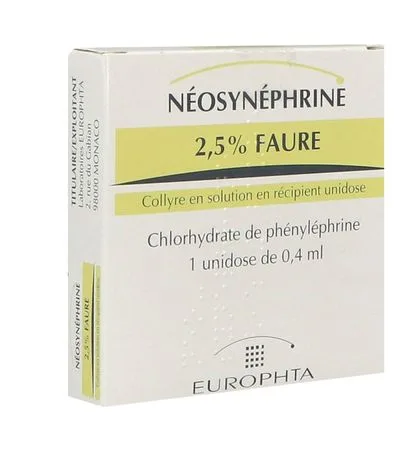
NEOSYNEPHRINE FAURE 2,5 %
phenylephrine
Forms and presentations
Eye drops in solution at 2,5 % (clear; colourless to yellow): Single-dose containers of 0,4 ml, packaged in sachets, boxes of 1 and of 20.Composition
| per single dose | |
| Phenylephrine (INN) hydrochloride
|
10 mg |
Indications
These eye drops are indicated to obtain:- a diagnostic mydriasis,
- a therapeutic mydriasis,
- a preoperative mydriasis.
Dosage and administration
Dosage1 drop of eye drops (approximately 20 µl) contains on average 0,50 mg of active substance (phenylephrine hydrochloride).
The single-dose container of 0,4 ml contains on average 20 drops of eye drops, which corresponds to 10 mg of phenylephrine (20 x 0,50 mg).
Phenylephrine is generally used if necessary with an atropine-type eye drop, most often tropicamide, to obtain optimal dilation.
- Adults:
- 1 instillation into the eye, to be repeated if necessary after 15 minutes (or even 20 minutes), without exceeding 3 instillations.
- In elderly subjects, particular caution is necessary (see Warnings and Precautions for Use).
- Paediatric population:
-
- Premature infant, newborn (0 to 27 days) and infant (28 days to 2 years):
- 1 instillation limited to 1 single drop into the eye, without repetition (see Warnings and Precautions for Use). In premature infants weighing ≤ 1500 g, available data are limited.
-
- Child (2 to 12 years):
- 1 instillation into the eye. It is generally not necessary to repeat the application.
-
- Adolescent (12 to 18 years):
- If necessary, the instillation will be repeated after 15 minutes (or even 20 minutes). The maximum dose must not exceed 2 instillations (see Warnings and Precautions for Use).
Method of administration:
As with all eye drops, carry out the following operations, in order:
- Wash hands thoroughly.
- Avoid touching the eye or eyelids with the tip of the single-dose container.
- To instil these eye drops, look upwards and gently pull the lower eyelid downwards.
- With the eye closed, carefully wipe away the excess, particularly from the cheek.
- Compress the inner corner of the eye for 1 minute after each instillation.
- If concomitant treatment with another eye drop is used, space the instillations by 15 minutes.
- Discard the single-dose container after use.
In order to avoid systemic effects induced by the passage of phenylephrine into the general circulation via the lacrimo-nasal routes, through the skin and by oral ingestion, it is recommended to compress the inner corner of the eye for 1 minute after each instillation in order to occlude the lacrimal points. It is also advisable to close the eyelid and wipe away the excess eye drops running down the cheek in order to avoid any risk of ingestion, especially in children (see also Warnings and precautions).
Contraindications
- Hypersensitivity to the active substance or to any of the excipients listed in section Composition.
- In newborns and infants with cardiovascular and cerebrovascular comorbidities.
- In certain elderly subjects with severe arteriosclerotic, cardiac or cerebrovascular comorbidities.
- Risk of angle-closure glaucoma.
- In combination with non-selective MAO inhibitors.
- In combination with other indirect sympathomimetics.
- In combination with alpha sympathomimetics (oral and/or nasal routes).
- During the first trimester of pregnancy and in cases of breastfeeding.
- In combination with selective MAO-A inhibitors.
- In combination with linezolid.
- In combination with dopaminergic and vasoconstrictor ergot alkaloids.
Warnings and precautions
Do not leave within the reach of children, as there is a risk of acute poisoning through accidental ingestion.
- As with any eye drops, there is passage of phenylephrine into the general circulation.
- In order to avoid systemic effects induced by the passage of phenylephrine into the general circulation via the lacrimo-nasal routes, through the skin and by oral ingestion, the following measures should be taken:
- wipe away the excess eye drops running down the cheek in order to avoid any risk of ingestion, especially in children (see Posology and Method of administration) ;
- close the eye and at the same time compress the inner corner of the eye for 1 minute after each instillation in order to occlude the lacrimal points.
- wipe away the excess eye drops running down the cheek in order to avoid any risk of ingestion, especially in children (see Posology and Method of administration) ;
- The risk of toxicity is higher in children and elderly subjects.
- Phenylephrine eye drops should be administered with caution in patients at risk, particularly cardiovascular risk: arterial hypertension, coronary insufficiency, hyperthyroidism, rhythm disorders.
- In order to avoid overdose, repeated instillations should be avoided and the maximum recommended doses within a given time interval should not be exceeded (see Posology and Method of administration). Observe the recommended interval between instillations.
- In all children, the maximum recommended dosages within a given time interval must not be exceeded (respect the recommended spacing between instillations).
- Neonatology:
- NEOSYNEPHRINE 2,5 % FAURE, eye drops in solution in single-dose container, must be administered with caution in newborns and infants who were formerly premature (use within the framework of monitoring retinopathy of prematurity) due to hemodynamic effects related to powerful vasoconstriction. These effects may clinically manifest as malaise, respiratory pauses, arterial hypertension, profound bradycardia and desaturation. The newborn or former premature infant should therefore be closely monitored by cardiorespiratory monitoring and blood pressure checks for at least 30 minutes following instillation.
-
In addition:
- Limit administration to 1 single drop of eye drops per eye at each instillation (do not double the administration unless the first drop has absolutely not reached the eye).
- Wipe the skin thoroughly, especially in premature infants, to avoid cutaneous absorption and/or ingestion.
- Carefully assess and take into account the additional risks related to any comorbidity (in particular cardiovascular and cerebrovascular conditions and CNS disorders).
- Limit administration to 1 single drop of eye drops per eye at each instillation (do not double the administration unless the first drop has absolutely not reached the eye).
- In case of general anesthesia, possible associations, particularly with halogenated volatile anesthetics, must be taken into account. It is important that the anesthetist be informed of the administration of phenylephrine eye drops before or during the ophthalmologic procedure.
- Dark irides dilate less easily than light irides. In case of dark irides, particular attention must be paid to the risk of overdosage. In case of insufficient dilation, if instillation must be repeated to obtain sufficient mydriasis, wait at least 30 minutes before repeating the instillation.
- Do not inject: the eye drops must not be administered by peri- or intraocular injection.
- Phenylephrine may trigger an acute glaucoma attack by mechanical obstruction of the aqueous humor outflow pathways in subjects with a narrow iridocorneal angle.
- In case of hypersensitivity to phenylephrine, discontinue treatment.
- If the recommended doses (repeated instillations) are not respected, a rebound effect may occur.
- Due to the presence of phenylephrine, wearing soft hydrophilic contact lenses is not recommended during treatment.
- Athletes are advised that this eye drop contains an active substance (phenylephrine) that may induce a positive reaction in tests performed during anti-doping controls.
Interactions
Although administered locally, this medicine may cause systemic effects that should be taken into account.
Contraindicated combinations
+ non-selective MAOs
Paroxysmal hypertension, hyperpyrexia which may be fatal. Due to the duration of action of the MAOI, this interaction remains possible 15 days after discontinuation of the MAOI.
+ Other indirect sympathomimetics
Risk of vasoconstriction and/or hypertensive crises.
+ Alpha sympathomimetics (oral and/or nasal routes)
Risk of vasoconstriction and/or hypertensive surges.
Combinations not recommended
+ Dopaminergic ergot of rye alkaloids
Risk of vasoconstriction and/or hypertensive surges.
+ Vasoconstrictor ergot alkaloids of rye
Risk of vasoconstriction and/or hypertensive surges.
+ Selective MAO-A inhibitors
Risk of vasoconstriction and/or hypertensive surges.
+ Linezolid
Risk of vasoconstriction and/or hypertensive surges.
Associations requiring precautions for use
+ Halogenated volatile anaesthetics
Intraoperative hypertensive surge.
It is important that the anesthetist be informed of the administration of phenylephrine eye drops before or during the ophthalmologic procedure.
Fertility, pregnancy and breastfeeding
Pregnancy:There are no reliable data on teratogenesis in animals. Clinically, there are no specific data on ocular administration in pregnant women. In general, the results of epidemiological studies do not make it possible to establish, on large numbers, that there is a malformative effect of phenylephrine after exposure (all routes combined) to 1er trimester of pregnancy.
However, given its potent vasoconstrictive properties, the use of phenylephrine by ocular route should only be considered if necessary during pregnancy. If administered, it is recommended to follow the rules previously mentioned for instillation.
Breastfeeding:
There is no data concerning the passage of phenylephrine into breast milk. However, given the possible cardiovascular and neurological effects of vasoconstrictors, breastfeeding is not recommended in case of ocular treatment with phenylephrine.
Driving and using machines
Instillation of this medicine causes troublesome mydriasis lasting a few hours. Consequently, after instillation, driving vehicles and/or using machines is not recommended for the entire duration of the visual disturbances.Adverse effects
Table of adverse reactions
The table below lists the adverse effects of NEOSYNEPHRINE 2,5 % FAURE, eye drops in solution in single-dose container. The following frequencies were used as the basis for evaluating adverse effects: very common (≥ 1/10), common (≥ 1/100, < 1/10), uncommon (≥ 1/1 000 to < 1/100), rare (≥ 1/10 000 to < 1/1 000), very rare (< 1/10 000), frequency not known (cannot be estimated from the available data).
| Classification by medical discipline (System Organ Class, MedDRA) | Frequency not known |
| Nervous system disorders | Tremor, headache |
| Eye disorders | Troublesome mydriasis, photophobia |
| Risk of acute angle-closure glaucoma | |
| Possibility of eye irritation or transient eye stinging | |
| Possibility of allergic reactions: eyelid oedema, blepharitis, allergic conjunctivitis, superficial punctate keratitis | |
| Cardiac disorders | Tachycardia |
| Acute coronary syndrome, myocardial infarction, cardiac rhythm disorders | |
| In premature and newborn infants: Bradycardia | |
| Vascular disorders | Pallor |
| Severe hypertension | |
| In premature infants: Periorbital pallor | |
| In premature and newborn infants: Arterial hypertension | |
| Respiratory, thoracic and mediastinal disorders | Pulmonary oedema |
| In premature and newborn infants: Neonatal apnea, neonatal oxygen desaturation | |
| Skin and subcutaneous tissue disorders | Contact eczema |
| General disorders and administration site conditions | In premature and newborn infants: Possibility of collapse |
| Investigations | Increase in blood pressure |
Description of selected adverse reactions
Phenylephrine eye drops pass into the general circulation and may cause systemic effects that must be taken into account (see Posology and Method of administrationWarnings and precautions) :
- Elevated blood pressure, tachycardia.
- Tremor, pallor, headache.
- Risk of major accidents such as:
- Severe hypertension.
- Pulmonary oedema, acute coronary syndrome, myocardial infarction, cardiac rhythm disorders.
- Severe hypertension.
Paediatric population
In premature infants and newborns, the haemodynamic effects linked to potent vasoconstriction may clinically manifest as collapse, neonatal apnea, arterial hypertension, profound bradycardia and neonatal oxygen desaturation. The vasoconstrictor effect may lead to mesenteric distress and potentiate the effect on the digestive tract of an atropine eye drop that is often co-administered.
Great caution in administration is essential in this population of premature newborns. The newborn or former premature infant should therefore be closely monitored, by cardiorespiratory monitoring and blood pressure checks for at least 30 minutes following instillation.
Reporting of suspected adverse reactions:Reporting suspected adverse reactions after authorisation of the medicinal product is important. It allows continuous monitoring of the benefit/risk balance of the medicinal product. Healthcare professionals should report any suspected adverse reaction via the national reporting system: National Agency for the Safety of Medicines and Health Products (ANSM) and the network of Regional Pharmacovigilance Centres. Website: https://signalement.social-sante.gouv.fr.
Overdose
2 situations are possible:- either through overdose during administration of the eye drops (particularly during repeated instillations),
- or due to accidental ingestion of a multidose bottle of eye drops, particularly by a child.
- severe hypertension;
- Acute pulmonary oedema.
- Acute coronary syndrome, myocardial infarction.
- Ventricular rhythm disorders.
- Cerebrovascular accident.
- Convulsion.
- Coma.
The onset is generally rapid; treatment is symptomatic.
Management must be carried out in a specialist setting.
Pharmacodynamics
Pharmacotherapeutic class: Mydriatic, alpha sympathomimetic (ATC code: S01FB01 ; S: sensory organs).
Phenylephrine is a potent mydriatic, resistant to opening of the anterior chamber, but with limited duration of action and without notable cycloplegic effect.
Phenylephrine has the properties and adverse effects of alpha sympathomimetics 1. It causes:- active mydriasis (within 15 to 60 minutes), which is the therapeutic effect sought in ophthalmology; the duration of the mydriasis obtained is a few hours (5 to 7 hours on average);
- vasoconstriction responsible for arterial hypertension and a decrease in cardiac output.
Pharmacokinetics
There are no relevant published data concerning the ocular bioavailability of phenylephrine.
It is extremely difficult to know what quantity of active ingredient reaches the eye. Only a small proportion of the volume of a drop reaches the anterior chamber of the eye for a local action. The remainder is rapidly drained through the nasolacrimal duct; this drainage promotes systemic passage, which is the cause of potentially serious adverse effects. It can be estimated that 90 % of the quantity of active ingredient that reaches the eye will pass into the general circulation.
Phenylephrine administered locally by the ocular route can pass into the general circulation by three routes: through the conjunctival vessels, through the anterior segment of the eye, and through the nasal and oropharyngeal mucosae. Phenylephrine then passes directly into the bloodstream without undergoing first-pass hepatic metabolism.
In newborns, passage of phenylephrine into the general circulation following local administration is considered to be greater due to a lower tear volume, a smaller plasma volume and a still immature metabolic system.
Ocular penetration depends on the state of the cornea. When the epithelium is altered, the barrier function of the cornea and local metabolic activity are reduced, which may generate greater absorption.
Caution is therefore advised when using the 2,5 % eye drops in premature infants, newborns, infants, elderly people and patients suffering from diabetes, arterial hypertension, hyperthyroidism, generalised arteriosclerosis or other cardiovascular diseases, for whom blood pressure must be carefully monitored.
Preclinical safety
In the ocular tolerance study in adult and young rabbits, phenylephrine at 2,5 % in ophthalmic solution, instilled 2 times at 1 hour intervals, did not induce any local effect or clinical sign.
In a study in rats, administration of phenylephrine alone caused a decrease in uterine blood flow (86,8 % reduction) at a dose of 12,5 mg/kg (s.c.) but did not induce visceral and skeletal malformations up to 15 mg/kg (s.c.). However, in the same study, co-administration of phenylephrine and acetazolamide resulted in potentiation of the teratogenic effects (ectrodactyly) of acetazolamide.
Storage conditions
- Shelf life
- 2 years.
Single-use container. Discard immediately after use.
Store single-dose containers in the outer packaging, protected from light. Do not freeze.
HANDLING/DISPOSAL INSTRUCTIONS
No special requirements for disposal.
Any unused medicinal product or waste material should be disposed of in accordance with local requirements.
Prescription, supply and reimbursement
| Marketing authorisation (AMM) | 3400927909283 (2014, SmPC rev 21.11.2025) 1 single dose. |
| 3400927893162 (2014, SmPC rev 21.11.2025) 20 single doses. |
| Not reimbursed by Social Security. | |
| Box of 20 single doses: Collect. |
EUROPHTA Laboratories
2, rue du Gabian. MC 98000 Monaco
Tel: 00 377 97 77 72 72. Fax: 00 377 97 77 72 70
Source: VIDAL · Updated on 11/11/2026. This information does not replace advice from a healthcare professional.