
Medicines
Update of 12/10/2026
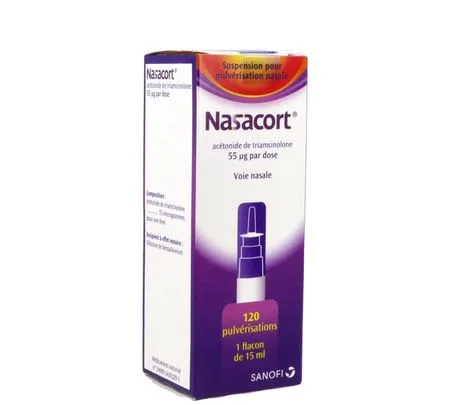
NASACORT®
triamcinolone acetonide
Forms and presentations
Nasal spray suspension at 55 µg/dose: Spray bottle of 15 ml (120 sprays), with metering pump and nasal tip.Composition
| p spray | |
| Triamcinolone acetonide
|
55 µg |
1 spray of 100 mg delivers 1 dose of 55 µg of triamcinolone acetonide.
Excipient with known effect: benzalkonium chloride (15 µg per dose) (see Warnings and Precautions for Use).
Indications
Nasacort is indicated for the treatment of symptoms of seasonal and perennial allergic rhinitis in adults and children aged 2 years and older.Dosage and administration
Dosage- Adults:
-
- The recommended initial dose is 220 micrograms per day, i.e. 2 sprays in each nostril 1 times daily in the morning. Once symptom improvement is achieved, patients may be maintained at a dose of 110 micrograms per day (1 spray in each nostril 1 times daily).
- The recommended initial dose is 220 micrograms per day, i.e. 2 sprays in each nostril 1 times daily in the morning. Once symptom improvement is achieved, patients may be maintained at a dose of 110 micrograms per day (1 spray in each nostril 1 times daily).
- Paediatric population:
-
- Children aged 12 years and older:
-
- The recommended initial dose is 220 micrograms per day, i.e. 2 sprays in each nostril 1 times daily in the morning. Once symptom improvement is achieved, patients may be maintained at a dose of 110 micrograms per day (1 spray in each nostril 1 times daily).
- The recommended initial dose is 220 micrograms per day, i.e. 2 sprays in each nostril 1 times daily in the morning. Once symptom improvement is achieved, patients may be maintained at a dose of 110 micrograms per day (1 spray in each nostril 1 times daily).
-
- Children aged 6 to 12 years:
-
- The recommended dose is 110 micrograms per day, i.e. one spray in each nostril 1 time daily in the morning. In patients with more severe symptoms, a dose of 220 micrograms per day may be used. However, once symptom improvement is achieved, patients should be maintained at the lowest effective dose (see InteractionsPharmacodynamics).
- The recommended dose is 110 micrograms per day, i.e. one spray in each nostril 1 time daily in the morning. In patients with more severe symptoms, a dose of 220 micrograms per day may be used. However, once symptom improvement is achieved, patients should be maintained at the lowest effective dose (see InteractionsPharmacodynamics).
-
- Children aged 2 to 5 years:
-
- The maximum recommended dose is 110 micrograms per day, administered as 1 spray in each nostril 1 times daily in the morning (see Warnings and Precautions for UsePharmacodynamics).
- The maximum recommended dose is 110 micrograms per day, administered as 1 spray in each nostril 1 times daily in the morning (see Warnings and Precautions for UsePharmacodynamics).
- The initiation and duration of treatment depend on allergen exposure.
- In children under 12 years, continuous treatment for more than 3 months is not recommended.
Method of administration:
Nasal use.
- Shake the bottle gently before use.
- During first use, the pump must be primed with 5 sprays. When not in use, it remains correctly primed for approximately 2 weeks. Beyond that, it can be re-primed with 1 single spray.
Contraindications
- Hypersensitivity to triamcinolone or to any of the excipients mentioned in section Composition.
- Haemostasis disorders, in particular epistaxis.
- Oro-buccal-nasal and ophthalmic infection by herpes simplex virus.
- Child under 2 years of age, in the absence of clinical data.
Warnings and precautions
Warnings:
Paediatric population:
Nasacort must not be used in children under 2 years of age (see Contraindications).
The risk of systemic effects, adrenal suppression and impact on child growth is increased in case of concomitant administration of inhaled or a fortiori systemic corticosteroid therapy.
A slowing of growth has been reported in children receiving nasal corticosteroid therapy including Nasacort at therapeutic doses in long-term studies (1 year of treatment). See Pharmacodynamics.
Regular monitoring of children's height is recommended in children receiving nasal corticosteroid therapy. The effect of treatment should be monitored in order to reduce the nasal corticosteroid dose, if possible, to the lowest dose at which effective symptom control is achieved. The long-term effects of growth slowing associated with nasal corticosteroids, including the impact on final adult height, are not known. Furthermore, it is strongly recommended to refer the patient to a paediatrician, in particular for children under 6 years of age.
Visual disturbances: Visual disturbances may occur during systemic or local corticosteroid therapy. In case of blurred vision or the appearance of any other visual symptom during corticosteroid therapy, an ophthalmological examination is required to look for, in particular, cataract, glaucoma, or a rarer lesion such as central serous chorioretinopathy, described with the administration of systemic or local corticosteroids. Close monitoring is therefore justified in patients with visual disturbances or a history of elevated intraocular pressure, glaucoma and/or cataract.
Systemic effects may occur, in particular during long-term treatment with high doses of nasal corticosteroids. The risk of systemic repercussions nevertheless remains lower than with oral corticosteroids and may vary according to individual susceptibility and the composition of the corticosteroid product used (may vary according to the potency, dosage and pharmacokinetic properties (lipophilicity, volume of distribution and elimination half-life) of the steroid). Possible systemic effects are Cushing's syndrome or Cushingoid symptoms, skin thinning, subcutaneous haematomas, adrenal insufficiency, growth retardation in children and adolescents, decreased bone density, cataract and glaucoma and, more rarely, psychological and behavioural disorders including psychomotor hyperactivity, sleep disorders, anxiety, depression or aggressiveness (particularly in children). Concomitant administration of nasal corticosteroids in patients on long-term oral corticosteroid therapy does not exempt from the necessary precautions when reducing oral corticosteroid doses. These will be decreased very gradually and withdrawal must be carried out under careful medical supervision (watching for signs of acute or subacute adrenal insufficiency), continuing beyond the cessation of systemic corticosteroid therapy.
Local intranasal administration of corticosteroids is not recommended in patients who have recently had an ulceration of the nasal septum, or who have undergone surgery or trauma to the nose, until healing is complete.
Risks associated with abrupt discontinuation of corticosteroids after prolonged use may include exacerbation or recurrence of the underlying disease, adrenocortical insufficiency or steroid withdrawal syndrome. However, these effects are extremely rare for nasal corticosteroids, and much less likely to occur with nasal corticosteroids than with oral corticosteroids.
Benzalkonium chloride:
This medicine contains 15 micrograms of benzalkonium chloride per dose.
Due to the presence of benzalkonium chloride, this medicine may cause oedema of the nasal mucosa, particularly in cases of long-term use, and respiratory discomfort.
Precautions for useNasal patency should be ensured to allow optimal distribution of the product. Advise the patient to dry the nasal passages by blowing the nose before instillation.
In case of major nasal obstruction, a detailed examination of the ENT area should be performed.
In case of prolonged treatment, repeated examinations of the nasal mucosa are recommended in order to assess any effect of corticosteroid therapy on the nasal mucosa. If atrophy of the nasal mucosa is observed, a reduction in local corticosteroid doses should be considered.
In cases of pulmonary tuberculosis or pulmonary fungal infection, the institution of close monitoring and appropriate treatment is required.
Advise the patient that this is a regular treatment and that several days of treatment may be needed before effects on rhinitis symptoms are observed.
Athletes should be made aware that this product contains an active substance that may induce a positive reaction in tests carried out during anti-doping controls.
Interactions
Combinations not recommended:
+ CYP3A inhibitors:
Concomitant administration of CYP3A inhibitors, including products containing cobicistat, is expected to increase the risk of systemic side effects. The combination should be avoided, unless the benefits outweigh the increased risk of systemic side effects of corticosteroids; in this case, patients should be monitored for possible systemic side effects of corticosteroids.
Fertility, pregnancy and breastfeeding
Pregnancy:In animals, experimentation has demonstrated a teratogenic effect, which varies according to species.
In humans, epidemiological studies have detected no teratogenic risk associated with oral corticosteroid use during the first trimester.
During chronic diseases requiring treatment throughout pregnancy, a slight intrauterine growth retardation is possible. Neonatal adrenal insufficiency has been exceptionally observed after high-dose corticosteroid therapy.
A period of clinical (weight, diuresis) and biological (blood glucose) monitoring of the newborn may be justified.
Consequently, this medicine may be prescribed during pregnancy if needed.
Breastfeeding:
The passage of triamcinolone acetonide into milk has not been studied. Nevertheless, other corticosteroids are excreted into milk.
Available data appear to show good tolerance in children; however, the biological or clinical impact of long-term maternal treatment has not been evaluated to date.
Consequently, breastfeeding is possible during short-term treatment. During chronic treatment, as a precaution, breastfeeding should be avoided.
Adverse effects
The classification of adverse events according to their frequency is as follows: very common (≥ 1/10), common (≥ 1/100 and < 1/10), uncommon (≥ 1/1000 and < 1/100), rare (≥ 1/10 000 and < 1/1000), very rare (< 1/10 000), frequency not known (cannot be estimated from the available data).
| System organ classes | |
| Frequency | Adverse effects |
| Immune system disorders | |
| Frequency not known | Hypersensitivity including pruritus or rash |
| Endocrine disorders | |
| Frequency not known | Steroid withdrawal syndrome (see Warnings and Precautions for Use) |
| Nervous system disorders | |
| Common | Headache |
| Frequency not known | Dysgeusia, parosmia |
| Eye disorders | |
| Very rare | Cataract, glaucoma |
| Frequency not known | Blurred vision (see Warnings and Precautions for Use), increased intraocular pressure*, chorioretinopathy |
| Respiratory, thoracic and mediastinal disorders | |
| Common | Epistaxis, cough |
| Frequency not known | Nasal burning or irritation sensation, dryness of nasal and oropharyngeal mucous membranes, pharyngeal irritation, nasal congestion, sneezing, dyspnoea, nasal septum perforation*, atrophy of the nasal mucosa* |
| Infections and infestations | |
| Common | Rhinitis, pharyngitis, flu-like syndrome |
| Frequency not known | Nasal and oropharyngeal candidiasis |
| Gastrointestinal disorders | |
| Common | Dyspepsia, dental abnormalities |
| Frequency not known | Nausea |
| Psychiatric disorders | |
| Frequency not known | Insomnia |
| General disorders and abnormalities at the site of administration | |
| Frequency not known | Fatigue |
| Investigations | |
| Frequency not known | Decreased blood cortisol level |
- Candida albicans infections:
- Cases of nasal and pharyngeal Candida albicans infections have been described during treatment. In such cases, intranasal corticosteroid therapy should be discontinued and appropriate treatment considered.
- Systemic effects:
- The risk of systemic effects related to intranasal triamcinolone acetonide is not excluded. This risk is increased in cases of concomitant administration of inhaled or a fortiori systemic corticosteroid therapy. The clinical impact, particularly in the long term, is not clearly established. The risk of latent corticotropic insufficiency after prolonged administration should be considered in cases of intercurrent infection, trauma or surgical intervention.
- Paediatric population:
- A growth delay has been reported in children and adolescents receiving intranasal corticosteroid therapy (see Warnings and Precautions for Use).
Reporting suspected adverse reactions after authorisation of the medicinal product is important. It allows continuous monitoring of the benefit/risk balance of the medicinal product. Healthcare professionals should report any suspected adverse reaction via the national reporting system: National Agency for the Safety of Medicines and Health Products (ANSM) and the network of Regional Pharmacovigilance Centres. Website: https://signalement.social-sante.gouv.fr.
Overdose
It could cause hypothalamic-pituitary-adrenal suppression and, if prolonged, clinical signs of hypercorticism. These symptoms will disappear after discontinuation of treatment, which should be gradual.
Pharmacodynamics
Pharmacotherapeutic class: Topical glucocorticoid, ATC code: R01AD11 (R: respiratory system).
Triamcinolone acetonide is a glucocorticoid. It exerts a local anti-inflammatory activity. It is a more potent derivative than triamcinolone, its activity being approximately 8 times greater than that of prednisone.
In clinical studies conducted in adults and children aged 6 years and over, at intranasal doses up to 440 micrograms/day, and in children aged 2 to 5 years at intranasal doses of 110 micrograms/day, no suppression of the hypothalamic-pituitary-adrenal (HPA) axis was observed.
Pharmacokinetics
After intranasal administration of a dose of 220 micrograms of triamcinolone acetonide, the mean peak plasma concentration is approximately 0,5 ng/ml (between 0,1 and 1 ng/ml) and occurs 1 h 30 after administration.
The mean plasma concentration of the product is less than 0,06 ng/ml at 12e hour, and below the detection threshold of the assay method at 24e hour. The half-life is 3 to 3,3 hours.
Paediatric population:
After administration of multiple intranasal doses of Nasacort, the systemic exposure observed in paediatric patients aged 6 to 12 years was similar to that observed in adult patients.
Intranasal administration of Nasacort at doses of 110 micrograms/day in paediatric patients aged 2 to 5 years showed systemic exposure similar to that obtained in adult patients at doses of 220 micrograms/day.
The apparent clearance and volume of distribution in paediatric patients aged 2 to 5 years were approximately half of those obtained in adults.
Preclinical safety
In preclinical studies, only effects characteristic of glucocorticoids were observed.
No mutagenic effect was noted in the tests in vitro (reverse mutation test in Salmonella and forward mutation test in Chinese hamster ovary cells).
Studies in rodents did not show any carcinogenic effect related to administration of triamcinolone acetonide. Like other corticosteroids, triamcinolone acetonide is teratogenic in animals and induces (in rats and rabbits) cleft palate and/or internal hydrocephalus and skeletal abnormalities at the level of the spinal column. Other teratogenic effects such as central nervous system abnormalities and craniofacial malformations were observed in monkeys. Triamcinolone acetonide induces an increase in foetal resorptions, stillbirth and a decrease in the weight of newborns and in survival rate in rodents without change in the pregnancy rate.
Storage conditions
- Shelf life
- 2 years.
No special storage conditions.
HANDLING/DISPOSAL INSTRUCTIONS
Shake the bottle gently before use.
At first use, the pump must be primed with 5 sprays. When not in use, it remains correctly primed for approximately 2 weeks.
Beyond that, it can be re-primed with 1 single spray.
Any unused medicinal product or waste material should be disposed of in accordance with local requirements.
Prescription, supply and reimbursement
LIST I| Marketing authorisation (AMM) | 3400934292293 (1997, SmPC rev 12.09.2022). |
| Price: | 7,47 euros (bottle of 15 ml). |
| Social Security reimbursement at 30%. Collect. | |
OPELLA HEALTHCARE France SAS
157, av Charles-de-Gaulle. 92200 Neuilly-sur-Seine
Medical information, Pharmacovigilance, Quality complaints, Quality of information and Medical visit ethics:
https://www.opella.com/our-countries/fr-fr
Source: VIDAL · Updated on 11/11/2026. This information does not replace advice from a healthcare professional.