
Medicines
Update of the 04/09/2025
MYDRIATICUM® single-dose units
tropicamide
Forms and presentations
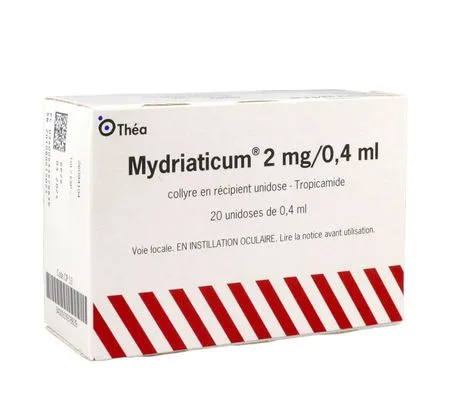
Eye drops at 0,5 % (2 mg/0,4 mL): Single-dose containers of 0,4 mL, in thermoformed blister packs, boxes of 1 and 20.Hospital model: Box of 100.
Composition
| per single dose | |
| Tropicamide (INN)
|
2 mg |
Indications
To obtain mydriasis:- for diagnostic purposes: to allow fundus examinations;
- for therapeutic purposes: in particular, preoperatively and before photocoagulation.
Dosage and administration
Dosage1 drop of eye drops contains 150 µg of active ingredient (tropicamide).
- Examination of the fundus of the eye: instil 1 or 2 drops 15 minutes approximately before the examination.
- Skiascopic examination under cycloplegia: instil 4 to 6 drops, at a rate of one drop every 5 minutes; it is generally advised to begin instillations 45 minutes approximately before the examination and to continue them for approximately 30 minutes.
- Preoperative dilation for cataract, photocoagulation: instil 1 or 2 drops of eye drops within 15 minutes preceding the procedure.
Method of administration:
As with all eye drops, carry out the following operations, in order:
- Wash hands thoroughly.
- Avoid touching the eye or eyelids with the tip of the single-dose container.
- For the box of 1 single-dose containers, remove the single dose from its plastic holder before use.
- To instil these eye drops, look upwards and gently pull the lower eyelid downwards.
- With the eye closed, carefully wipe away the excess, particularly from the cheek.
- To avoid ingestion, especially in children, see Warnings and Precautions for Use.
- In order to avoid systemic effects induced by the passage of tropicamide into the general circulation via the lacrimal ducts and by oral ingestion, it is recommended, especially in children and the elderly, to press the inner corner of the eye for 1 minute after each instillation and to wipe off the excess on the cheek.
- Discard the single-dose container after use. Do not reuse an opened single-dose container for a subsequent administration.
- If concomitant treatment with another eye drop is used, space the instillations by 15 minutes.
Contraindications
- Hypersensitivity to the active substance (tropicamide), to atropine or its derivatives, or to any of the excipients mentioned in section Composition.
- In patients at risk of angle-closure glaucoma.
Warnings and precautions
- Do not leave within the reach of children, as there is a risk of acute poisoning through accidental ingestion.
- With the eye drops, tropicamide passes into the general circulation.
- The risk of toxicity is higher in children and elderly subjects.
- In order to avoid systemic effects induced by the passage of tropicamide into the general circulation via the lacrimal ducts and by oral ingestion, it is recommended, especially in children and elderly subjects, to press the inner corner of the eye for 1 minute after each instillation and wipe off the excess on the cheek (see Posology and Method of administration).
- In order to avoid overdose, repeated instillations should be avoided and the maximum recommended doses within a given time interval should not be exceeded (see Posology and Method of administration).
- Tropicamide may trigger an acute glaucoma attack by mechanical obstruction of the aqueous humour outflow pathways in subjects with a narrow iridocorneal angle.
- Open-angle glaucoma: tropicamide eye drops may be used in chronic glaucoma after verifying that the angle is indeed open.
- Tropicamide eye drops should be administered with caution in patients presenting with symptoms of central nervous system involvement, as this medicine may cause central nervous system disorders, especially in young children.
- Tropicamide should be used with caution in cases of prostatic adenoma.
Interactions
Drug interactionsAlthough administered locally, this medicine may cause systemic effects that should be taken into account.
To be taken into account:
- Other atropinic medicines (imipramine-type antidepressants, most H1 atropinic antihistamines, anticholinergic antiparkinsonian agents, atropinic antispasmodics, disopyramide, phenothiazine neuroleptics as well as clozapine): addition of atropinic undesirable effects such as urinary retention, constipation, dry mouth, etc.
Fertility, pregnancy and breastfeeding
There is no reliable data on teratogenicity in animals.
In clinical practice, no particular malformative or foetotoxic effect has appeared to date. However, follow-up of pregnancies exposed to tropicamide is insufficient to exclude any risk.
Consequently, use of tropicamide during pregnancy should only be considered if necessary.
Driving and using machines
Instillation of tropicamide eye drops causes uncomfortable mydriasis for a few hours. Consequently, after instillation, driving vehicles and/or using machines is not advised for the entire duration of visual disturbances.Adverse effects
Undesirable effects are classified according to the following frequency categories: Very common (≥ 1/10); common (≥ 1/100, < 1/10); uncommon (≥ 1/1 000, < 1/100); rare (≥ 1/10 000, < 1/1 000); very rare (< 1/10 000); frequency not known (cannot be estimated from the available data).
| System organ class | Frequency not known |
| Psychiatric disorders | Agitation*
Confusional state* Hallucination* |
| Nervous system disorders | Convulsion*
Somnolence* |
| Eye disorders | Acute angle-closure glaucoma**
Mydriasis Accommodation disorder Eye irritation Ocular pain Ocular allergy |
| Cardiac disorders | Tachycardia* |
| Gastrointestinal disorders | Necrotising enterocolitis*
Abdominal distension* Ileus* Intestinal obstruction* Constipation* Dry mouth* |
| Skin and subcutaneous tissue disorders | Erythema* |
| General disorders and administration site conditions | Fever* |
The adverse effects are mainly neurological and psychiatric:
- In particular: agitation, hyperexcitability or sudden drowsiness, confusion.
- More rarely, at therapeutic dosages: convulsions and hallucinations.
- Children and the elderly have variable responses to atropinic eye drops.
- Flushing of the face, tachycardia, dry mouth.
- Fever in children, rarely severe except in cases of overdose.
- Gastrointestinal disorders:
- constipation, particularly in elderly subjects;
- in premature newborns: necrotising enterocolitis, abdominal distension, ileus, obstruction.
- constipation, particularly in elderly subjects;
** Mydriaticum must not be used in patients at risk of angle-closure glaucoma (see Contraindications).
Reporting of suspected adverse reactions:
Reporting suspected adverse reactions after authorisation of the medicinal product is important. It allows continuous monitoring of the benefit/risk balance of the medicinal product. Healthcare professionals should report any suspected adverse reaction via the national reporting system: National Agency for the Safety of Medicines and Health Products (ANSM) and the network of Regional Pharmacovigilance Centres. Website: https://signalement.social-sante.gouv.fr.
Overdose
Two situations are possible:- either through overdose during administration of the eye drops (particularly during repeated instillations);
- or due to accidental ingestion of a multidose bottle of eye drops, particularly by a child.
The signs "redness of the face, dry mouth and mydriasis" help with diagnosis. Severity is linked to disturbances of thermoregulation and to neurological and psychiatric toxicity: convulsions, delirium or even coma.
Management is symptomatic in a specialised setting.
Pharmacodynamics
Pharmacotherapeutic class: Anticholinergic mydriatics and cycloplegics (ATC code: S01FA06).
Tropicamide, a synthetic parasympatholytic, is similar to atropine in its structure and its action.
Mydriasis appears 10 minutes after instillation of one drop of eye drops, reaches its maximum after 15 minutes, and lasts for about 1 hour and a half. It then gradually decreases. The pupil returns to its initial diameter after 5 to 8 hours.
Temporary paralysis of accommodation is established within 20 to 40 minutes following 4 to 6 instillations of one drop of tropicamide 0,5 % at 5 minute intervals.
The most favourable time to determine refraction is therefore around the 30e minute after the last instillation, accommodation returning to normal within 4 to 5 hours.
Storage conditions
Shelf life before opening: 3 years.
Store at a temperature below 25 °C.
Store the single-dose containers in the sachet, protected from light.
After first opening of the sachet: use the single-dose containers within a maximum period of one month.
After opening a single-dose container: use the single-dose container immediately and discard it after use.
HANDLING/DISPOSAL INSTRUCTIONS
For the box of 1 single-dose container, remove the single dose from its plastic holder.
Take the blister out of its protective envelope and detach one single dose.
To open the single dose, make a complete rotation of the upper part.
Invert the single dose and instil by applying gentle pressure.
Prescription, supply and reimbursement
LIST I| Marketing authorisation (AMM) | 3400934326165 (1997, SmPC rev 24.06.2025) 1 single-dose. |
| 3400933978839 (1995, SmPC rev 24.06.2025) 20 single-doses. | |
| 3400933979089 (1995, SmPC rev 24.06.2025) 100 single-doses. |
| Price: | 1,23 euros (1 single-dose). |
| 6,14 euros (20 single-doses). | |
| Social security reimbursement at 65 %. | |
| Collect (20 and 100 single-doses). | |
THÉA PHARMA
37, rue Georges-Besse
63100 Clermont-Ferrand
http://www.theapharma.fr
Source: VIDAL · Updated on 11/11/2026. This information does not replace advice from a healthcare professional.