Medicines
SmPC of 02/07/2024
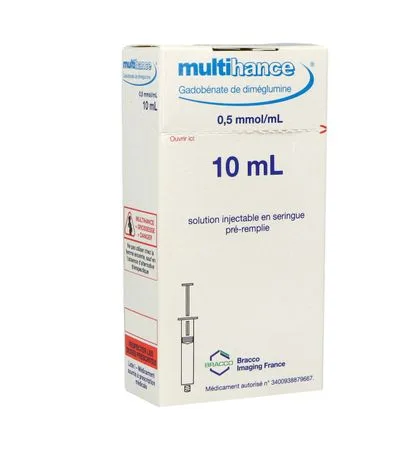
MULTIHANCE 0,5 mmol/mL, solution for injection in prefilled syringe
Forms and presentations
Injectable solution in prefilled syringe.
Clear, colourless to pale yellow aqueous solution.
Osmolality at 37° C: 1,97 Osmol/kg
Viscosity at 37° C: 5,3 mPa.s.
pH: 6,9-7,3
Composition
1 mL of solution contains: gadobenic acid 334 mg (0,5 M) as the dimeglumine salt. [529 mg of gadobenate dimeglumine = 334 mg of gadobenic acid + 195 mg of dimeglumine].
10 mL of solution contains: gadobenic acid 3340 mg (5 mmol) as the dimeglumine salt. [5290 mg of gadobenate dimeglumine = 3340 mg of gadobenic acid + 1950 mg of dimeglumine].
15 mL of solution contains: gadobenic acid 5010 mg (7,5 mmol) as the dimeglumine salt. [7935 mg of gadobenate dimeglumine = 5010 mg of gadobenic acid + 2925 mg of dimeglumine].
20 mL of solution contains: gadobenic acid 6680 mg (10 mmol) as the dimeglumine salt. [10580 mg of gadobenate dimeglumine = 6680 mg of gadobenic acid + 3900 mg of dimeglumine].
Water for injections.
Indications
This medicinal product is for diagnostic use only.
MULTIHANCE is a paramagnetic contrast agent used in magnetic resonance imaging (MRI) of the liver in adults and children (aged over 2 years).
MULTIHANCE should only be used when the diagnosis is necessary and cannot be obtained by magnetic resonance imaging (MRI) without contrast enhancement, and when late-phase imaging is required.
Dosage and administration
Dosage
The recommended dose of gadobenate dimeglumine in adult patients and children is 0,05 mmol/kg of body weight, i.e. 0,1 mL/kg of the 0,5 mol/L solution. The lowest dose providing sufficient contrast enhancement for diagnostic purposes should be used. The dose must be calculated based on the patient's body weight and must not exceed the recommended dose per kilogram of body weight detailed in this section.
If necessary, the injection may be repeated in subjects with normal renal function.
Method of administration
MULTIHANCE must be used immediately after opening and must not be diluted. Any remaining residue must be discarded and must not be used for other MRI examinations.
To use the syringe, the threaded end of the plunger rod must be screwed into the plunger clockwise, then pushed in a few millimetres to eliminate any friction between the plunger and the syringe barrel.
While keeping the syringe upright (cannula cap facing up), aseptically remove the cannula cap from the syringe tip and attach either a sterile disposable needle or a 5/6 tubing compatible with Luer fittings by applying a rotating push.
With the syringe still vertical, press the plunger to expel air until liquid beads at the needle tip or the tubing is completely filled.
The injection must be performed following the usual aspiration procedure.
To reduce the risk of extravasation of MULTIHANCE into the surrounding soft tissues, it is advised to ensure correct positioning of the needle or cannula in the vein.
The product must be administered intravenously either as a bolus or as a slow injection (10 mL/min), see the post-contrast image acquisition table.
The injection must be followed by a flush of sodium chloride at 9 mg/mL (0,9%).
Post-contrast imaging acquisition :
|
Liver |
Dynamic imaging: |
Immediately after bolus injection |
|
Delayed imaging: |
Between 40 and 120 minutes after injection depending on individual imaging requirements. |
Special populations
Renal impairment
Administration of MULTIHANCE should be avoided in patients with severe renal impairment (GFR < 30 mL/min/1,73 m²) and in the perioperative period of liver transplantation, unless the diagnostic information is essential and cannot be obtained by MRI without contrast enhancement (see the paragraph ''Renal impairment'' under section Warnings and precautions).
If administration of MULTIHANCE cannot be avoided, the dose should not exceed 0,05 mmol/kg body weight. Due to the lack of information on repeated administrations, MULTIHANCE injections should not be repeated, unless the interval between injections is at least 7 days.
Hepatic impairment
No dose adjustment is necessary in patients with hepatic impairment, as this has little effect on the pharmacokinetics of MULTIHANCE.
Elderly subjects (from 65 years)
No dose adjustment is necessary. Use with caution in elderly subjects (see section Warnings and precautions).
Children
No dose adjustment is necessary.
The use of MULTIHANCE is not recommended in children under 2 years of age.
Contraindications
MULTIHANCE is contraindicated in:
• patients with hypersensitivity to the active substance or to any of the excipients listed in section Composition.
• patients with a history of allergy or adverse reaction related to other gadolinium chelates.
Warnings and precautions
The use of diagnostic contrast agents should be restricted to facilities whose staff are trained in emergency management and where cardiopulmonary resuscitation equipment is readily available.
Patients must be kept under close surveillance for 15 minutes following injection, since the majority of serious reactions occur during this period. The patient should remain in a medical setting for the hour following injection.
The usual magnetic resonance imaging safety procedures must be applied when using MULTIHANCE, in particular excluding any patient carrying ferromagnetic material (for example pacemakers or vascular clips).
Caution is recommended in patients with cardiovascular disease.
The probability of convulsions during the examination may be higher in patients suffering from epilepsy or brain lesions. Caution is required when examining these patients (for example: patient monitoring), and equipment and medicines necessary for the rapid treatment of possible convulsions must be available.
Gadobenic acid must not be administered intrathecally. Serious reactions, potentially life-threatening and in some cases fatal, mainly neurological reactions (e.g., coma, encephalopathy, convulsions), have been reported following intrathecal administration.
After administration of gadobenate dimeglumine, gadolinium may be retained in the brain and in other body tissues (bone, liver, kidneys, skin tissue) and may cause a dose-dependent increase in T1-weighted signal intensity in the brain, particularly in the dentate nucleus, globus pallidus and thalamus. The clinical consequences are unknown. The possible diagnostic benefits of using gadobenate dimeglumine in patients who will require repeated examinations should be weighed against the potential risk of gadolinium deposition in the brain and other tissues.
Hypersensitivity reaction
As with other gadolinium chelates, the possibility of a reaction, including serious, fatal or life-threatening anaphylactic and anaphylactoid reactions involving one or more body systems, essentially the respiratory, cardiovascular and/or cutaneous-mucosal systems, must always be considered, particularly in patients with a history of asthma or other allergic diseases.
Before administering MULTIHANCE, please ensure that trained personnel and medicines are available to treat hypersensitivity reactions.
Negligible amounts of benzyl alcohol (<0,2%) may be released by gadobenate dimeglumine during storage. Nevertheless, MULTIHANCE must not be administered to patients with a history of allergy to benzyl alcohol.
As with other gadolinium chelates, a period of 7 hours should be observed before any further contrast-enhanced MRI to allow elimination of MULTIHANCE from the body.
Take care to avoid local extravasation during intravenous administration of MULTIHANCE. If extravasation occurs, assess and treat as necessary for local reactions (see section Adverse effects).
Renal impairment :
Before administration of MULTIHANCE, laboratory tests to detect impaired renal function are recommended in all patients.
Cases of nephrogenic systemic fibrosis (NSF) have been reported after injection of certain gadolinium-containing contrast agents in patients with acute or chronic severe renal insufficiency (creatinine clearance < 30 mL/min/1,73m²). Patients scheduled for liver transplantation are particularly at risk, as the incidence of acute renal failure is high in this group. Since cases of NSF may occur with MULTIHANCE, administration of this product should be avoided in patients with severe renal insufficiency and in patients in the pre- or post-operative period of liver transplantation, unless the diagnosis cannot be obtained by other means than MRI with gadolinium injection.
Performing haemodialysis shortly after administration of MULTIHANCE could facilitate elimination of this product from the body. It has not been established that initiating haemodialysis can prevent or treat NSF in patients who are not on haemodialysis.
Elderly patients :
As renal elimination of gadobenate dimeglumine may be impaired in elderly subjects, it is particularly important to look for renal dysfunction in subjects aged 65 years and older.
Interactions
During the clinical development of MULTIHANCE, no specific interaction study was conducted. However, no interaction between MULTIHANCE and other medicinal products was reported during clinical trials.
Fertility, pregnancy and breastfeeding
Pregnancy
Data on the use of gadolinium-containing contrast agents, including gadobenic acid, in pregnant women are limited. Gadolinium can cross the placental barrier. It is not known whether exposure to gadolinium is associated with adverse effects for the foetus.
Animal studies have shown reproductive toxicity at high repeated doses (see section Preclinical safety. MULTIHANCE should not be used during pregnancy unless the patient's clinical condition requires administration of gadobenate dimeglumine.
Breast-feeding
Gadolinium-containing contrast agents are excreted in breast milk in very small quantities (see section Preclinical safety. At clinical doses, no effect is expected in the breast-fed infant due to the small amount excreted in milk and the low intestinal absorption. The physician and the breast-feeding mother should decide whether to continue or discontinue breast-feeding during the 24 hours following administration of MULTIHANCE.
Fertility
Not applicable.
Driving and using machines
MULTIHANCE has no or negligible influence on the ability to drive and use machines.
Adverse effects
The following adverse reactions have been observed during the clinical development of MULTIHANCE.
|
System organ class |
Clinical trials |
Post-marketing surveillance |
||
|
Common (≥ 1/100 - < 1/10) |
Uncommon (≥1/1 000 - < 1/100) |
Rare (≥ 1/10 000 - <1/1 000) |
Not known** |
|
|
Immune system disorders |
|
|
Anaphylactic/anaphylactoid reaction Hypersensitivity reaction |
Anaphylactic shock |
|
Neurological manifestations |
Headache |
Paresthesias Dizziness sensations Dysgeusia |
Convulsions Syncope Hypoesthesia Tremors Parosmia |
Loss of consciousness |
|
Eye disorders |
|
|
Visual impairment |
Conjunctivitis |
|
Cardiac disorders |
|
1st degree atrioventricular block Tachycardia |
Myocardial ischemia, Bradycardia |
Cardiac arrest, Kounis syndrome*** Cyanosis |
|
Vascular disorders |
|
Arterial hypertension Hypotension Flushing |
|
|
|
Respiratory, thoracic and mediastinal disorders |
|
|
Pulmonary oedema Dyspnoea Laryngospasm Wheezing Rhinitis Cough |
Respiratory insufficiency Laryngeal oedema Hypoxia Bronchospasm
|
|
Gastrointestinal disorders |
Nausea |
Diarrhoea Vomiting Dry mouth
|
Hypersialorrhoea Abdominal pain |
Oedema of the mouth |
|
Skin and subcutaneous manifestations |
|
Urticaria Skin rash including erythematous, macular and maculopapular rash Pruritus
|
Facial oedema Hyperhidrosis |
Angioedema |
|
Muscular, osteoarticular and connective tissue manifestations |
|
|
Myalgia |
|
|
Renal disorders and urinary manifestations |
|
Proteinuria |
|
|
|
General and injection site manifestations |
|
Fever Sensation of heat Injection site reaction: Pain at the injection site Inflammation Burning Warmth Cold Discomfort Erythema Paresthesia and pruritus |
Chest pain Asthenia Malaise Chills |
Swelling at the injection site, vesicles at the injection site |
|
Abnormalities in paraclinical examinations |
|
Abnormalities of the electrocardiogram* Increased blood bilirubin Increase in serum levels of transaminases, gamma glutamyl transferase and creatinine |
Decrease in blood albumin Increase in alkaline phosphatases Increase in blood iron Increase in lactate dehydrogenase |
|
*Electrocardiogram abnormalities include prolongation of the QT interval, shortening of the QT interval, inversion of the T wave, prolongation of the PR interval, prolonged QRS complex.
**Since the reactions were not observed during clinical trials conducted on 4956 patients, the best estimate is that their relative frequency is rare (≥ 1 / 10.000 to <1/1000).
The most appropriate MedDRA term (version 16.1) is used to describe a reaction and its related symptoms and conditions.
*** Acute coronary syndrome occurring in the context of allergy.
Laboratory abnormalities were mainly observed in patients with known hepatic insufficiency or underlying metabolic disease.
In most cases, the events were non-serious, transient and resolved spontaneously without sequelae. No correlation could be established with age, sex or the dose administered.
As with other gadolinium chelates, cases of anaphylactic / anaphylactoid / hypersensitivity reactions have been reported. These reactions occur with varying degrees of severity, which may extend to anaphylactic shock and death, and involve one or more body systems, mainly the respiratory, cardiovascular, and/or cutaneous and mucous membrane systems.
In patients with a history of convulsions, brain tumours or metastases, or other brain disorders, convulsions have been reported after administration of MULTIHANCE (see section Warnings and precautions).
Injection site reactions, consequent to extravasation of the contrast agent, locally causing pain or a burning sensation, or even swelling, skin detachment, or in rare cases severe local swelling, necrosis have also been reported.
Local thrombophlebitis has also been reported in rare cases (see section Warnings and precautions).
Isolated cases of nephrogenic systemic fibrosis (NSF) have been reported with MULTIHANCE, in patients who also received other gadolinium-based contrast agents (see section Warnings and precautions).
Paediatric population
|
System organ class |
Adverse effects |
|
|
Clinical trials |
||
|
Common (> 1/100 - < 1/10) |
Uncommon (> 1/1 000 - < 1/100) |
|
|
Neurological manifestations |
|
Dizziness sensations |
|
Eye disorders |
|
Eye pain Eyelid edema |
|
Vascular disorders |
|
Flushing |
|
Gastrointestinal disorders |
Vomiting |
Abdominal pain |
|
Skin and subcutaneous manifestations |
|
Skin rash Hyperhidrosis |
|
General and injection site manifestations |
|
Chest pain Pain at the injection site Fever |
The adverse reactions reported in paediatric patients treated with MULTIHANCE during clinical trials and presented in the tables above were not serious. The adverse reactions identified during post-marketing surveillance indicate that the safety profile of MULTIHANCE is similar in children and adults.
Reporting of suspected adverse reactions
Reporting suspected adverse reactions after authorisation of the medicinal product is important. It allows continued monitoring of the benefit/risk balance of the medicinal product. Healthcare professionals are asked to report any suspected adverse reaction via the national reporting system: National Agency for the Safety of Medicines and Health Products (ANSM) and the network of Regional Centres of Pharmacovigilance - Website: https://signalement.social-sante.gouv.fr/.
Overdose
No cases of overdose have been observed. Consequently, the signs and symptoms of overdose have not been identified. Doses up to 0,4 mmol/kg have been administered to healthy volunteers without any serious adverse events being observed. However, the use of doses higher than the recommended doses is not advised. In case of overdose, close medical monitoring and symptomatic treatment should be implemented.
MULTIHANCE can be eliminated from the body by haemodialysis. However, it has not been demonstrated that haemodialysis is appropriate for the prevention of nephrogenic systemic fibrosis (NSF).
Pharmacodynamics
Paramagnetic contrast agent ATC code V08CA08
Mechanism of action and pharmacodynamic effects
The gadolinium chelate, gadobenate dimeglumine, shortens the longitudinal relaxation time (T1) and the transverse relaxation time (T2) of tissue water protons.
The relaxivities of gadobenate dimeglumine in aqueous solution are r1=4,39 and r2=5,56 mM-1.s-1 at 20 MHz.
When passing from an aqueous solution to a solution containing serum proteins, the relaxivity of gadobenate dimeglumine increases considerably: in human plasma, r1 and r2 reach values equal to 9,7 and 12,5 mM respectively-1.s-1.
Clinical efficacy and safety
In liver imaging, MULTIHANCE allows the detection of lesions not visualised during the non-contrast MRI examination, in patients with or suspected of having primary or secondary hepatic carcinoma. The nature of the lesions visualised after contrast enhancement with MULTIHANCE has not been verified by anatomopathological examination. Moreover, when evaluating patient management, the demonstration of lesions after administration of the product did not always lead to a change in management.
MULTIHANCE causes a significant and sustained increase in signal intensity on T1-weighted images in normal liver parenchyma. The increase in signal intensity persists at high levels for at least two hours after administration of doses of 0,05 or 0,10 mmol/kg.
The contrast between focal liver lesions and normal parenchyma is observed almost immediately after bolus injection (within 2 - 3 minutes) on dynamic T1-weighted images. Subsequently, the contrast tends to decrease at later times, due to the increase in non-specific lesion intensity.
It is nevertheless considered that the progressive disappearance of MULTIHANCE from lesions, together with the persistence of high signal intensity in normal liver parenchyma, allows better visualisation of lesions and a lower detection threshold for lesion localisation, during the period between 40 and 120 minutes after administration of MULTIHANCE.
Data from the pivotal phase II and III studies in patients with liver cancer show that, compared with other imaging modalities (e.g. intraoperative ultrasonography, computed tomographic angioportography (CTAP) or computed tomography after intra-arterial administration of iodinated contrast), MRI images obtained with MULTIHANCE had a mean sensitivity of 95% and a mean specificity of 80% for the detection of liver cancer or metastases in patients suspected of having them.
Pharmacokinetics
Human pharmacokinetics have been described using a biexponential decay model.
The apparent distribution and elimination half-lives are between 0,085 and 0,117 hour, and between 1,17 and 1,68 hours, respectively. The total apparent volume of distribution, between 0,170 and 0,248 L/kg of body mass, indicates that the compound distributes into plasma and the extracellular space.
The gadobenate ion is rapidly eliminated from plasma and excreted mainly in urine and, to a lesser extent, in bile.
The total plasma clearance, between 0,098 and 0,133 L/h.kg of body weight, and the renal clearance, between 0,082 and 0,104 L/h.kg of body mass, indicate that the compound is mainly eliminated by glomerular filtration. Plasma concentration and area under the curve (AUC) values show a statistically significant linear relationship with the administered dose. 78-94% of the injected dose of gadobenate ion is excreted unchanged in urine within 24 hours following intravenous administration. 2 to 4% of the dose is eliminated in faeces.
Disruption of the blood-brain barrier or abnormal vascularisation allows penetration of the gadobenate ion into the lesion.
The pharmacokinetic analysis covered systemic concentration-time data of the product in 80 subjects (40 healthy adult volunteers and 40 children) aged 2 to 47 years, after intravenous administration of gadobenate dimeglumine. The kinetics of gadolinium, up to the age of 2 years, can be described by a two-compartment model with standard allometric coefficients and a covariate effect of creatinine clearance (reflecting the glomerular filtration rate) on gadolinium clearance. The pharmacokinetic parameter values (reported per adult body weight) are consistent with previously reported values for MULTIHANCE and with the underlying physiology of distribution and elimination of MULTIHANCE considered: distribution into extracellular fluid (approximately 15 L in adults or 0,21 L/kg) and elimination by glomerular filtration (approximately 130 mL of plasma per minute in adults or 7,8 L/h and 0,11 L/h/kg). Clearance and volume of distribution progressively decrease in young subjects due to smaller body size. This effect can be largely accounted for by normalising the pharmacokinetic parameters to body weight.
On this basis, the MULTIHANCE dosage in children, according to body weight, results in systemic exposure (AUC) and maximum concentration (Cmax) similar to those reported for adults, and confirms that dose adjustment is not necessary in children in the proposed age range (2 years and older).
Gadobenate dimeglumine is a linear gadolinium-based contrast agent. Studies have shown that after exposure to gadolinium-based contrast agents, gadolinium is retained in the body. This includes retention in the brain and other tissues and organs. With linear gadolinium-based contrast agents, this may cause a dose-dependent increase in T1-weighted signal intensity in the brain, particularly in the dentate nucleus, globus pallidus and thalamus. The signal intensity increases and non-clinical data show that gadolinium is released from linear gadolinium-based contrast agents.
Preclinical safety
Non-clinical data reveal no particular risk for humans, based on conventional studies of safety pharmacology, repeated-dose toxicity, genotoxicity and carcinogenic potential. Indeed, the events observed in preclinical studies occurred at doses far exceeding those used in humans and therefore have low clinical significance.
Animal studies showed low local tolerance of MULTIHANCE, especially in cases of accidental extravasation, with severe local reactions of the necrosis and eschar type.
Local tolerance in case of accidental intra-arterial administration has not been studied; it is therefore particularly important to ensure that the needle or cannula is correctly positioned in the vein (see section Posology and method of administration).
Pregnancy and breastfeeding :
In studies in rats, no deleterious effect on embryonic or fetal development was observed after daily intravenous administration of gadobenate dimeglumine.
Furthermore, no adverse effect on physical and behavioural development was observed.
However, after repeated daily administration in rabbits, isolated cases of skeletal abnormalities as well as two cases of visceral malformations were reported.
INCOMPATIBILITIES
In the absence of compatibility studies, this medicinal product must not be mixed with other medicinal products.
Shelf life
3 years. From a microbiological point of view, the product must be used immediately after opening.
SPECIAL PRECAUTIONS FOR DISPOSAL AND OTHER HANDLING
For single use only.
Before use, inspect the product and ensure that the container and closure system are not damaged, that the solution is not coloured and that no particles are visible.
The detachable traceability label placed on the syringes must be affixed to the patient's file in order to allow precise monitoring of the administered gadolinium-based contrast agent. The administered dose must also be recorded. In the case of an electronic patient file, the product name, batch number and dose must be recorded therein.
Any unused medicinal product or waste material should be disposed of in accordance with local requirements.
Prescription, supply and reimbursement
| Marketing authorisation (AMM) |
|
Collection.
7 LÉONARD DE VINCI STREET
91300 MASSY
Tel: 01 60 79 82 76 www.bracco.com
Source: VIDAL · Updated on 11/11/2026. This information does not replace advice from a healthcare professional.