
Medicines
SmPC of the 25/04/2024
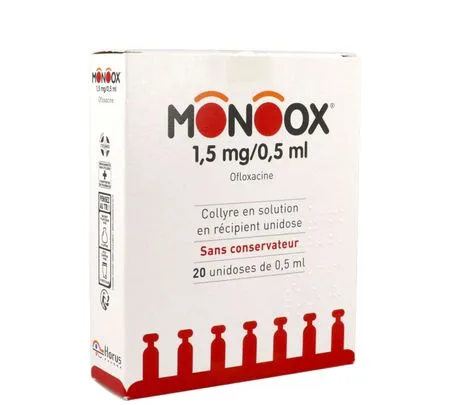
MONOOX 1,5 mg/0,5 ml, eye drops in solution in single-dose container
Forms and presentations
Eye drops in solution.
Single-dose container containing 0,5 ml of solution. Box of 20, under sachet of 5 in strip.
Composition
For a single-dose container of 0,5 ml:
Ofloxacin: 1,5 mg
Sodium chloride, hydrochloric acid (for pH adjustment), sodium hydroxide (for pH adjustment), water for injections.
Indications
Local antibacterial treatment of severe ocular infections (severe conjunctivitis, keratitis and corneal ulcers) due to germs sensitive to ofloxacin.
Official recommendations concerning the appropriate use of antibacterial agents should be taken into account.
Dosage and administration
Dosage
The usual dosage is 2 drops 4 times a day in the affected eye or eyes.
Treatment lasting more than 15 days should require a new ophthalmological consultation.
Method of administration
Ophthalmic use.
FOR OCULAR INSTILLATION.
The patient should be advised to wash hands thoroughly before and after instillation, and during instillation, not to touch the eye, eyelids or other surfaces with the tip of the single-dose container.
Systemic absorption may be reduced by nasolacrimal occlusion or by closing the eyelids for 2 minutes. This method may help to reduce systemic adverse effects and increase local efficacy.
The effectiveness of an eye drop may be disrupted by the simultaneous instillation of another eye drop. In case of concomitant treatment with a second eye drop, wait 15 minutes before its instillation. Ophthalmic ointments should be administered last.
Contraindications
This medicine MUST NEVER BE USED in cases of:
- hypersensitivity to ofloxacin or to another medicine of the quinolone family,
- hypersensitivity to any of the excipients of this eye drop,
- breastfeeding (see section Fertility, pregnancy and breastfeeding).
Warnings and precautions
The eye drops must not be injected or swallowed.
The eye drops must not be used for peri- or intra-ocular injection.
Data are insufficient to establish the efficacy and safety of ofloxacin eye drops at 0,3 % in the treatment of conjunctivitis in newborns.
In the absence of evaluation, the use of ofloxacin eye drops is not recommended in newborns with neonatal conjunctivitis due to Neisseria gonorrhoeae or due to Chlamydia trachomatis. These should receive appropriate treatment, such as systemic treatment of infections due to Neisseria gonorrhoeae or at Chlamydia trachomatis.
The use of this eye drop should take into account a risk of nasopharyngeal passage that may contribute to the emergence and spread of bacterial resistance. As with all antibiotic pharmaceutical forms, prolonged use may promote the emergence of resistant bacteria.
Hypersensitivity
Serious and sometimes fatal hypersensitivity reactions (anaphylactic shock), some occurring after the first dose, have been observed in patients treated with systemically administered quinolones. Some reactions were accompanied by cardiovascular collapse, loss of consciousness, tingling, pharyngeal or facial oedema, dyspnoea, urticaria and itching. Only a few patients had a known history of hypersensitivity reactions.
Therefore, treatment with this medicine must be discontinued at the first signs of skin rash or any other hypersensitivity reaction.
Eye disorders
Non-clinical and clinical publications have reported the occurrence of corneal perforation in patients with corneal ulcer or corneal abscess following local antibiotic treatment based on a fluoroquinolone. However, significant confounding factors have been identified in most of these cases, such as advanced age, the presence of multiple ulcers, associated ocular conditions (e.g. dry eye syndrome), systemic inflammatory diseases (e.g. rheumatoid arthritis), and concomitant use of topical ophthalmic corticosteroids or non-steroidal anti-inflammatory drugs. Therefore, caution is recommended regarding the risk of corneal perforation when treating patients with corneal ulcer or corneal abscess with a fluoroquinolone.
Prolongation of the QT interval
The use of fluoroquinolones, including MONOOX, should be undertaken with caution in patients with known risk factors for QT interval prolongation, such as:
- congenital long QT syndrome,
- concomitant treatment with medicinal products known to prolong the QT interval (e.g. class IA and III antiarrhythmics, tricyclic antidepressants, macrolides, antipsychotics),
- uncorrected electrolyte imbalance (e.g. hypokalaemia, hypomagnesaemia),
- cardiac disease (e.g. heart failure, myocardial infarction, bradycardia).
Elderly patients and women may be more sensitive to medicinal products that prolong the QT interval. Therefore, the use of fluoroquinolones including MONOOX should be undertaken with caution in these populations (see sections Interactions, Adverse effects and Overdose).
Tendinitis and tendon rupture
Inflammation and rupture of a tendon may occur with systemic treatment with a fluoroquinolone, including ofloxacin, particularly in elderly patients and in those concomitantly treated with corticosteroids. Therefore, caution is required and treatment with MONOOX must be discontinued at the first signs of tendon inflammation (see section Adverse effects).
Interactions
Medicinal products known to prolong the QT interval
MONOOX, like other medicinal products of the fluoroquinolone family, should be used with caution in patients receiving medicinal products known to prolong the QT interval (such as class IA and III antiarrhythmics, tricyclic antidepressants, macrolides and antipsychotics) (see section Warnings and precautions).
Fertility, pregnancy and breastfeeding
Pregnancy
Although animal studies have not shown a teratogenic effect, clinical data on the use of systemic ofloxacin are still insufficient.
Joint disorders have been described in children treated with quinolones; however, to date, no cases of arthropathy secondary to in utero exposure have been reported.
As a result, use of this medicine should only be considered during pregnancy if necessary.
Breast-feeding
Administration of this medicine requires breastfeeding to be contraindicated, due to the passage of fluoroquinolones into breast milk and the risk of joint effects in the breastfed newborn.
Adverse effects
Serious reactions after systemic use of ofloxacin are rare and most symptoms are reversible. As a small amount of ofloxacin is absorbed systemically after local administration, the adverse effects reported after systemic use may possibly occur.
The adverse effects reported after use of ofloxacin from clinical trial cases or after marketing are classified by system organ class and listed below as: very common (≥ 1/10); common (≥ 1/100, < 1/10); uncommon (≥ 1/1 000, < 1/100); rare (≥ 1/10 000, < 1/1 000); very rare (< 1/10 000) and frequency not known (cannot be estimated from the available data):
Immune system disorder
Frequency not known: hypersensitivity reaction
Eye disorders
Frequency not known: Local burning or stinging sensation.
Frequency not known: Periorbital oedema (including eyelid oedema)
Cardiac disorders
Frequency not known: Ventricular arrhythmia, torsades de pointes (reported particularly in patients with risk factors for QT interval prolongation), QT interval prolongation confirmed by ECG (see sections Warnings and precautions and Overdose).
Skin and subcutaneous tissue disorders
Frequency not known: Stevens-Johnson syndrome, toxic epidermal necrolysis
Musculoskeletal and connective tissue disorders
Frequency not known: Tendon disorders
Cases of rupture of the tendons of the shoulder, hand, Achilles tendon or other tendons requiring surgical repair or resulting in prolonged disability have been reported in patients receiving systemic fluoroquinolone therapy. Studies and post-marketing experience with systemically administered quinolones indicate that the risk of these ruptures may be increased in patients receiving corticosteroids, particularly in elderly patients and for tendons subjected to high stress, including the Achilles tendon (see section Warnings and precautions).
Reporting of suspected adverse reactions
Reporting suspected adverse reactions after authorisation of the medicinal product is important. It allows continued monitoring of the benefit/risk balance of the medicinal product. Healthcare professionals are asked to report any suspected adverse reactions via the national reporting system: National Agency for the Safety of Medicines and Health Products (ANSM) and the network of Regional Pharmacovigilance Centres - Website: https://signalement.social-sante.gouv.fr.
Overdose
In case of excessive local administration, wash abundantly with sterile physiological saline.
In case of overdose, symptomatic treatment must be initiated. ECG monitoring must be performed because of the possibility of QT interval prolongation.
Pharmacodynamics
Pharmacotherapeutic class: OPHTHALMOLOGICAL MEDICINES, OTHER ANTI-INFECTIVES, ATC code: S01AX11.
Ofloxacin is a synthetic antibiotic belonging to the quinolone family, of the fluoroquinolone group. Its activity is strongly bactericidal through inhibition of bacterial DNA gyrase, preventing the synthesis of bacterial chromosomal DNA.
ANTIBACTERIAL ACTIVITY SPECTRUM
Critical concentrations separate susceptible strains from strains of intermediate susceptibility, and the latter from resistant ones:
S ≤ 1 mg/l and R > 4 mg/l
The prevalence of acquired resistance can vary according to geography and time for certain species. It is therefore useful to have information on local resistance prevalence, especially for the treatment of severe infections. These data can only provide guidance on the probabilities of the susceptibility of a bacterial strain to this antibiotic.
Where the variability of resistance prevalence in France is known for a bacterial species, it is indicated in the table below:
|
Categories |
Frequency of acquired resistance in France (> 10 %) (extreme values) |
|
SUSCEPTIBLE SPECIES |
|
|
Gram-positive aerobes |
|
|
Bacillus anthracis* |
|
|
Staphylococcus methicillin-S |
|
|
Gram-negative aerobes |
|
|
Acinetobacter (mainly Acinetobacter baumannii) |
50-75 % |
|
Branhamella catarrhalis |
|
|
Bordetella pertussis |
|
|
Campylobacter |
|
|
Citrobacter freundii |
15-25 % |
|
Enterobacter cloacae |
15-25 % |
|
Escherichia coli |
0-10 % |
|
Haemophilus influenzae |
|
|
Klebsiella oxytoca |
0-11 % |
|
Klebsiella pneumoniae |
0-25 % |
|
Legionella |
|
|
Morganella morganii |
|
|
Neisseria |
|
|
Pasteurella |
|
|
Proteus mirabilis |
0-10 % |
|
Proteus vulgaris |
|
|
Providencia |
45-70 % |
|
Pseudomonas aeruginosa |
45-85 % |
|
Salmonella |
|
|
Serratia |
40-45 % |
|
Shigella |
|
|
Vibrio |
|
|
Yersinia |
|
|
Anaerobes |
|
|
Mobiluncus |
|
|
Propionibacterium acnes |
|
|
Other |
|
|
Mycoplasma hominis |
|
|
MODERATELY SUSCEPTIBLE SPECIES |
|
|
(in vitro of intermediate susceptibility) |
|
|
Gram-positive aerobes |
|
|
Corynebacteria |
|
|
Streptococcus |
|
|
Streptococcus pneumoniae |
|
|
Other |
|
|
Chlamydiae |
|
|
Mycoplasma pneumoniae |
|
|
Ureaplasma urealyticum |
|
|
RESISTANT SPECIES |
|
|
Gram-positive aerobes |
|
|
Enterococci |
|
|
Listeria monocytogenes |
|
|
Nocardia asteroides |
|
|
Methicillin-resistant Staphylococcus** |
|
|
Anaerobes |
|
|
With the exception of Mobiluncus and Propionibacterium acnes |
* The frequency of resistance to methicillin is approximately 30 to 50 % of all staphylococci and is found mainly in hospital settings.
** Bacillus anthracis : no animal study of experimental infection in anthrax disease has been performed.
Atypical mycobacteria : ofloxacin has in vitro moderate activity on certain species of mycobacteria: Mycobacterium tuberculosis, Mycobacterium fortuitum, lesser on Mycobacterium kansasii and even less so on Mycobacterium avium.
Remark : this spectrum corresponds to that of the systemic forms of ofloxacin. With the local pharmaceutical presentations, the concentrations obtained in situ are much higher than plasma concentrations. Some uncertainties remain regarding the kinetics of the concentrations in situ, the local physicochemical conditions that may alter the activity of the antibiotic, and the stability of the product in situ.
Pharmacokinetics
Studies carried out in animals show that one hour after the instillation of one drop of this eye drops, the concentrations of the product are greater than the MICs of the main germs encountered in ocular infections, in tears, the cornea and in the aqueous humour.
Studies carried out in humans have confirmed the favourable kinetics of ofloxacin in the aqueous humour and in tears.
Special storage precautions
Store in the original package, protected from light.
Stability after opening: after use, the single-dose container must be discarded.
Do not use a single-dose container that has already been opened.
Prescription, supply and reimbursement
| Marketing authorisation (AMM) |
|
| Price: |
|
Social security reimbursement at 65%. Collective.
HORUS PHARMA
22, Allée Camille-Muffat
INEDI 5. 06200 Nice
Tel: 04 93 19 54 03. Fax: 04 93 19 54 09
https://www.horus-pharma.com
Source: VIDAL · Updated on 12/11/2026. This information does not replace advice from a healthcare professional.