
Medicines
SmPC of 04/10/2024
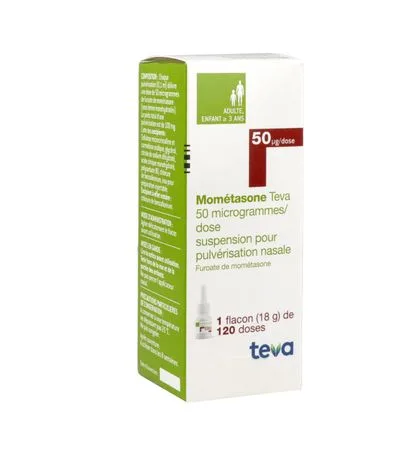
MOMETASONE TEVA 50 micrograms/dose, nasal spray suspension
Forms and presentations
Nasal spray suspension.
Opaque suspension, white to off-white in colour.
pH: between 4,3 and 4,9.
Osmolality: between 270 and 330 mOsm/kg.
Composition
Each spray (0,1 mL) delivers a dose of 50 micrograms of mometasone furoate (as monohydrate). The total weight of one spray is 100 mg.
Excipient with known effect:
Each spray (0,1 mL) contains 20 micrograms of benzalkonium chloride.
For the full list of excipients, see section Composition.
Microcrystalline cellulose and carmellose sodium (Avicel C - 591), glycerol, sodium citrate dihydrate, citric acid monohydrate, polysorbate 80, benzalkonium chloride, water for injections.
Indications
Mometasone furoate nasal spray suspension is indicated in adults and children aged over 3 years for the treatment of the symptoms of seasonal allergic rhinitis or perennial rhinitis.
Mometasone furoate nasal spray suspension is indicated for the symptomatic treatment of nasal polyposis in adults from 18 years of age.
Dosage and administration
After initial priming of the spray bottle pump, each spray delivers approximately 100 mg of mometasone furoate suspension, equivalent to 50 micrograms of mometasone furoate as monohydrate in each nostril.
Dosage
Seasonal or perennial rhinitis
Adults (including the elderly) and children aged 12 years and over: the usually recommended dose is 2 sprays (50 micrograms/spray) in each nostril once daily (i.e. a total dose of 200 micrograms). When symptoms are stabilised, the reduced dose of 1 spray per nostril (i.e. a total dose of 100 micrograms) may be effective as maintenance treatment.
If symptoms are not adequately controlled, the dose may be increased to a maximum daily dose of four sprays per nostril (i.e. a total dose of 400 micrograms). A dose reduction is recommended once symptoms are stabilised.
Children aged 3 to 11 years: the usual recommended dose is one spray (50 micrograms/spray) in each nostril once daily (i.e. a total dose of 100 micrograms).
In patients with seasonal allergic rhinitis, a significant clinical effect was observed within 12 hours of the first dose of mometasone furoate nasal spray suspension. Nevertheless, the full benefit of treatment may not be achieved within the first 48 hours. Therefore, the patient should continue regular treatment to obtain the full therapeutic benefit.
In patients with a history of moderate to severe seasonal allergic rhinitis symptoms, treatment with mometasone furoate nasal spray suspension may be initiated a few days before the anticipated start of the pollen season.
Nasal polyposis
The usual initial recommended dose for polyposis is 2 sprays (50 micrograms/spray) in each nostril once daily (i.e. a total daily dose of 200 micrograms). If symptoms are not adequately controlled after 5 to 6 weeks of treatment, the dose may be increased to 2 sprays in each nostril twice daily (i.e. a total daily dose of 400 micrograms). The maintenance dose may be reduced to the minimum effective dose. If no improvement in symptoms is observed after 5 to 6 weeks of twice-daily administration, alternative treatments should be considered.
Efficacy and tolerability studies of mometasone furoate nasal spray suspension in the treatment of nasal polyposis were conducted with four months of treatment.
Paediatric population
Seasonal allergic rhinitis or perennial rhinitis
The safety and efficacy of mometasone furoate nasal spray suspension have not been studied in children under 3 years of age.
Nasal polyposis
The safety and efficacy of mometasone furoate nasal spray suspension have not been studied in children and adolescents under 18 years of age.
Method of administration
Before the first dose, shake the vial well and actuate the pump 10 times until a uniform spray is obtained. If the spray bottle was last used at least 14 days ago, prime the bottle by pressing the pump 2 times until a uniform spray is obtained before using it again.
Shake the vial well before each use. The vial must be discarded when the indicated number of doses has been reached, or within 2 months after first use.
Contraindications
• Hypersensitivity to the active substance, mometasone furoate, or to any of the excipients listed in section Composition.
• Untreated localised infection of the nasal mucosa, such as herpes.
• Recent history of nasal surgery or nasal trauma, until healing, due to the possible delay in healing induced by the corticosteroid.
Warnings and precautions
Immunosuppression
Mometasone furoate nasal spray suspension should be used with caution, or even avoided, in cases of active or latent pulmonary tuberculosis, in cases of untreated systemic viral, bacterial or fungal infections.
Patients receiving corticosteroids, who are potentially immunosuppressed, must be warned of the risk of exposure to certain infections (e.g., chickenpox, measles) and of the importance of seeking medical advice if such exposure occurs.
Local effects in the nasal passages
In a study conducted in patients suffering from perennial rhinitis, after 12 months of treatment with mometasone furoate nasal spray suspension, no atrophy of the nasal mucosa was demonstrated; moreover, mometasone furoate tended to restore the appearance of the nasal mucosa to a state closer to that of a normal mucosa. However, patients using mometasone furoate nasal spray suspension for several months or for a longer duration must be examined regularly in order to detect any change in the nasal mucosa.
If a localised nasal or pharyngeal fungal infection occurs, discontinuation of treatment with mometasone furoate nasal spray suspension and use of an alternative therapy should be considered. Persistence of rhinopharyngeal irritation may require interruption of treatment with mometasone furoate.
Mometasone furoate nasal spray suspension is not recommended in cases of perforation of the nasal septum (see section Adverse effects).
In clinical studies, cases of epistaxis occurred with a higher incidence than with placebo. Epistaxis was generally self-limiting and of mild intensity (see section Adverse effects).
Systemic effects of corticosteroids
Systemic effects of nasal corticosteroids may occur, particularly with high doses prescribed over prolonged periods. These effects are much less likely to occur than with oral corticosteroids and may vary from patient to patient and from one corticosteroid preparation to another. Potential systemic effects may include Cushing's syndrome, cushingoid features, adrenal suppression, growth retardation in children and adolescents, cataract, glaucoma and, more rarely, a range of psychological or behavioural effects including psychomotor hyperactivity, sleep disorders, anxiety, depression or aggression (particularly in children).
Following administration of intranasal corticosteroids, cases of increased intraocular pressure have been reported (see section Adverse effects).
Switching from prolonged systemic corticosteroid treatment to mometasone furoate nasal spray suspension requires particular attention. Interruption of systemic corticosteroids in these patients may lead to adrenal insufficiency for several months, until recovery of the function of the hypothalamic-pituitary-adrenal (HPA) axis. If these patients present signs and symptoms of adrenal insufficiency or withdrawal symptoms (e.g., joint and/or muscle pain, fatigue and, initially, depression), despite relief of nasal symptoms, systemic corticosteroid administration must be resumed and recourse to other treatment modalities and appropriate measures will be necessary. Such a switch may also unmask pre-existing allergic conditions such as allergic conjunctivitis and eczema, previously suppressed by systemic corticosteroid therapy.
Administration of doses higher than those recommended may result in significant inhibition of adrenal function. If doses higher than those recommended are used, then systemic corticosteroid supplementation should be considered during periods of stress or when a surgical procedure is planned.
Visual disorders
Visual disturbances may occur during systemic or local corticosteroid therapy. In case of blurred vision or the onset of any other visual symptom during corticosteroid therapy, an ophthalmological examination is required to look in particular for cataract, glaucoma, or a rarer lesion such as central serous chorioretinopathy (CSCR), described with systemic or local corticosteroid administration.
Nasal polyps
The safety and efficacy of mometasone furoate nasal spray suspension have not been studied in the treatment of unilateral nasal polyps, polyps associated with cystic fibrosis, or polyps that completely obstruct the nasal cavities.
Unilateral polyps with an unusual or irregular appearance, particularly in cases of ulceration or bleeding, must undergo thorough examination.
Effects on growth in the paediatric population
It is recommended to regularly monitor the height of children receiving prolonged treatment with nasal corticosteroids. If growth is slowed, treatment should be reviewed in order to reduce the dose of nasal corticosteroid, bringing it back if possible to the lowest dose that maintains effective symptom control. In addition, referral of the patient to a paediatric specialist should be considered.
Symptoms other than nasal
Although mometasone furoate nasal spray suspension controls nasal symptoms in most patients, concomitant use of an appropriate additional treatment may relieve other symptoms, including ocular symptoms.
Excipient(s)
Benzalkonium chloride
Benzalkonium chloride may cause irritation or swelling inside the nose, especially if used over a long period.
Interactions
(See section Warnings and precautions "Special warnings and precautions for use" regarding the use of systemic corticosteroids.)
A clinical interaction study with loratadine was conducted. No interaction was observed.
In case of concomitant administration with CYP3A inhibitors, including products containing cobicistat, an increased risk of systemic side effects can be expected. The combination should be avoided, unless the benefits outweigh the increased risk of systemic corticosteroid side effects; in this case, patients should be monitored for possible systemic corticosteroid side effects.
Paediatric population
Interaction studies have only been performed in adults.
Fertility, pregnancy and breastfeeding
Pregnancy
There are no data, or only limited data, regarding the use of mometasone furoate in pregnant women. Animal studies have demonstrated reproductive toxicity (see section Preclinical safety). As with other nasal corticosteroids, mometasone furoate nasal spray suspension should not be used in pregnant women unless the potential benefit to the mother justifies the potential risk to the mother, the fetus or the infant. Infants whose mothers received corticosteroids during pregnancy should be closely monitored because of the risk of adrenal insufficiency.
Breast-feeding
It is not known whether mometasone furoate is excreted in human milk. As with other nasal corticosteroid preparations, a decision must be made either to discontinue breastfeeding or to discontinue/suspend treatment with mometasone furoate nasal spray suspension taking into account the benefit of breastfeeding for the child and the benefit of treatment for the woman.
Fertility
There are no clinical data on the effect of mometasone furoate on fertility. Animal studies have shown reproductive toxicity but no effect on fertility (see section Preclinical safety).
Driving and using machines
Mometasone furoate nasal spray suspension has no or negligible effect on the ability to drive and use machines.
Adverse effects
Summary of the safety profile
In general, epistaxis was self-limiting and of low intensity, and occurred with a higher incidence than placebo (5 %), but with an incidence comparable to or lower than that observed with active nasal corticosteroids used as controls (up to 15 %) in clinical studies in patients with allergic rhinitis. The incidence of all other effects was comparable to that of placebo.
In patients treated for nasal polyposis, the overall incidence of adverse effects was similar to that observed in patients with allergic rhinitis.
Systemic effects following nasal corticosteroid administration may occur, particularly when prescribed at high doses over long periods.
Tabulated list of adverse reactions
Treatment-related adverse effects (≥ 1 %) reported in clinical studies in patients with allergic rhinitis or nasal polyposis, and adverse effects reported following marketing of the product – regardless of indication – are presented in table 1. Adverse effects are listed by MedDRA system organ class. Within each system organ class, adverse effects are ranked by frequency. Frequencies are defined as follows: very common (≥ 1/10); common (≥ 1/100, < 1/10); uncommon (≥ 1/1 000, < 1/100). The frequency of adverse effects reported following marketing of the product is considered "not known", i.e., it cannot be determined from the available data.
|
Table 1: treatment-related adverse effects, by system organ class and frequency |
|||
|
|
Very common |
Common |
Frequency not known |
|
Infections and infestations |
|
Pharyngitis Upper respiratory tract infection** |
|
|
Immune system disorders |
|
|
Hypersensitivity, including anaphylactic reactions, angioedema, bronchospasm and dyspnoea |
|
Nervous system disorders |
|
Headache |
|
|
Eye disorders |
|
|
Glaucoma Increased intraocular pressure Cataracts Blurred vision (see section Warnings and precautions) |
|
Respiratory, thoracic and mediastinal disorders |
Epistaxis* |
Epistaxis Nasal burning Nasal irritation Nasal ulceration |
Nasal septum perforation |
|
Gastrointestinal disorders |
|
Throat irritation* |
Alterations of taste and smell |
* effect reported in the treatment of nasal polyposis (two doses per day)
** effect reported at an undetermined frequency in the treatment of nasal polyposis (two doses per day)
Paediatric population
In children, the incidence of adverse events reported during clinical studies with mometasone furoate, such as epistaxis (6 %), headache (3 %), nasal mucosal irritation (2 %) and sneezing (2 %), is similar to that reported with placebo.
Reporting of suspected adverse reactions
Reporting suspected adverse reactions after authorisation of the medicinal product is important. It allows continued monitoring of the benefit/risk balance of the medicinal product. Healthcare professionals are asked to report any suspected adverse reaction via the national reporting system: National Agency for the Safety of Medicines and Health Products (ANSM) and the network of Regional Centres of Pharmacovigilance - Website: https://signalement.social-sante.gouv.fr.
Overdose
Symptoms
Inhalation or oral administration of excessive doses of corticosteroids may lead to inhibition of the hypothalamic-pituitary-adrenal axis.
Management
Due to the systemic bioavailability < 1 % of mometasone furoate in nasal spray suspension, an overdose is unlikely to require any measures other than simple observation, followed by the institution of the appropriate prescribed dose.
Pharmacodynamics
Pharmacotherapeutic class: Decongestants and other nasal preparations for topical use - Corticosteroids, ATC code: R01A D09.
Mechanism of action
Mometasone furoate is a glucocorticosteroid that exerts a topical anti-inflammatory effect with less systemic impact.
The mechanism of action concerning the antiallergic and anti-inflammatory effects of mometasone furoate probably resides largely in its ability to inhibit the release of mediators of allergic reactions. Mometasone furoate significantly inhibits the release of leukotrienes by leukocytes from allergic patients.
In cell culture, mometasone furoate very strongly inhibited the synthesis and release of IL-1, IL-5, IL-6 and TNFα ; it is also a potent inhibitor of leukotriene production. Mometasone furoate is furthermore a very potent inhibitor of the production of Th2 cytokines, IL-4 and IL-5 by human CD4+ T lymphocytes.
Pharmacodynamic effects
In studies using a nasal antigen challenge test, mometasone furoate nasal spray showed anti-inflammatory activity on early and late allergic responses. This effect corresponded to a decrease, compared with placebo, in histamine activity and eosinophils, and, compared with baseline values, a decrease in eosinophils, neutrophils and epithelial cell adhesion proteins.
In 28% of patients with seasonal allergic rhinitis, a significant clinical effect was observed within 12 hours following the first dose of mometasone furoate nasal spray suspension. The median time (50% of the studied population) to obtain relief was 35,9 hours.
Paediatric population
In a placebo-controlled clinical trial, no growth retardation was observed in pediatric patients (n = 49/group) receiving a dose of 100 micrograms of mometasone furoate as nasal spray suspension per day for one year.
Tolerability data and the efficacy of mometasone furoate as nasal spray suspension in children aged 3 to 5 years are limited; an appropriate dosage could not be established. In a study conducted in 48 children aged 3 to 5 years receiving 50, 100 or 200 micrograms of mometasone furoate nasally per day for 14 days, no significant difference was observed compared with placebo regarding the mean change in plasma cortisol after an ACTH stimulation test (tetracosactide test).
The European Medicines Agency has waived the obligation to submit the results of studies conducted with mometasone furoate as nasal spray suspension in all subgroups of children with seasonal allergic rhinitis or perennial rhinitis (see section Dosage and administration for information on use of the medicine in children)
Pharmacokinetics
Absorption
Mometasone furoate administered as an aqueous nasal spray has a systemic bioavailability < 1% in plasma with a sensitive assay method having a lower limit of quantification of 0,25 pg/mL.
Distribution
Not applicable, insofar as mometasone is poorly absorbed nasally.
Biotransformation
The small amount that could be swallowed and absorbed undergoes a significant hepatic first-pass effect.
Elimination
Absorbed mometasone furoate is extensively metabolised and the metabolites are excreted in urine and bile.
Preclinical safety
No specific toxicological effect related to exposure to mometasone furoate has been identified. All observed effects are characteristic of this class of medicines and correspond to an exacerbation of the pharmacodynamic activity of glucocorticoids.
Preclinical studies show that mometasone furoate is devoid of androgenic, antiandrogenic, estrogenic and antiestrogenic effects. However, as with other glucocorticoids, in experimental animal models, oral administration of high doses of 56 mg/kg/day and 280 mg/kg/day exerts some anti-uterotrophic action and a delay in vaginal opening.
Like other glucocorticoids, mometasone furoate shows clastogenic potential in vitro at high concentrations. However, no mutagenic effect is expected at the recommended therapeutic doses.
In reproductive function studies, subcutaneous injection of mometasone furoate at a dose of 15 micrograms/kg resulted in prolonged gestation and complications during labour with reduced survival and weight of offspring or weight gain. There was no effect on fertility.
Like other glucocorticoids, mometasone furoate is teratogenic in rodents and rabbits. The effects observed were the occurrence of umbilical hernias in rats, cleft palate in mice, and agenesis of the gallbladder, umbilical hernias and forelimb flexion in rabbits. A decrease in maternal weight gain, an impact on fetal growth (fetal weight below normal and/or delayed ossification), as well as a decrease in offspring survival in mice, were also observed in rats, rabbits and mice.
The carcinogenic potential of mometasone furoate by inhalation (aerosol delivered from a pressurised container with a CFC propellant gas and a surfactant) at concentrations ranging from 0,25 to 2,0 micrograms/L was studied for 24 months in mice and rats. Effects characteristic of glucocorticoids, including the occurrence of several non-neoplastic lesions, were observed. It was not possible to establish a statistically significant dose-response relationship for any of the tumours studied.
SPECIAL PRECAUTIONS FOR DISPOSAL AND OTHER HANDLING
No special requirements for disposal.
Any unused medicinal product or waste material should be disposed of in accordance with local requirements.
Prescription, supply and reimbursement
| Marketing authorisation (AMM) |
|
| Price: |
|
- Indication(s) appearing in the marketing authorisation at the date of publication of this decree
Collection.
COEUR DEFENSE 100-110 ESPLANADE DU GAL DE GAULLE
92931 PARIS LA DEFENSE CEDEX
Tel: 01 55 91 78 00 www.teva-sante.fr
Source: VIDAL · Updated on 11/11/2026. This information does not replace advice from a healthcare professional.