
Medicines
SmPC of 02/10/2026
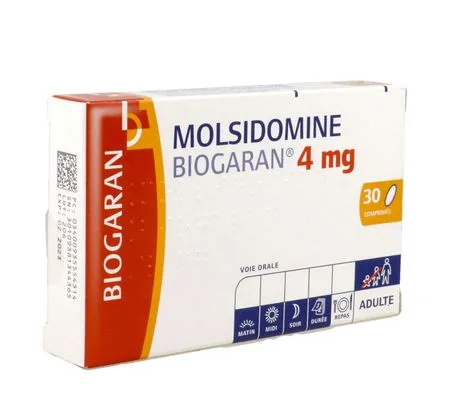
MOLSIDOMINE BIOGARAN 4 mg, tablet
Composition
Molsidomine.................................................................................................................................................... 4 mg
For one tablet.
Excipient with known effect: lactose monohydrate.
Anhydrous colloidal silica, lactose monohydrate, maize starch, hypromellose, mannitol, magnesium stearate.
Indications
Severe angina, refractory to usual doses of molsidomine.
MOLSIDOMINE BIOGARAN tablets are not suitable for the treatment of an angina attack.
Dosage and administration
Dosage
Severe angina : 1 tablet, 3 times a day (i.e. 12 mg of molsidomine).
A 4 tablet may be necessary in certain refractory unstable angina (i.e. 16 mg of molsidomine).
The effective dose should be reached gradually due to the risk of headaches in some subjects.
Method of administration
The daily dose must be divided and adjusted according to the observed efficacy and the patient's activity rhythm.
Contraindications
This medicine must not be prescribed in the following cases:
• Marked hypotension with shock state.
- Association with phosphodiesterase type 5 inhibitors (sildenafil, tadalafil, vardenafil) (see sections Interactions and Warnings and precautions): in any patient treated with molsidomine, phosphodiesterase type 5 inhibitors must not be prescribed while the patient is under the effect of molsidomine.
- In case of treatment with phosphodiesterase type 5 inhibitors, molsidomine is contraindicated.
In a patient with no coronary history presenting a first angina episode following sexual activity, the history should be checked for possible intake of phosphodiesterase type 5 inhibitors (most often, within the hour preceding sexual activity) and if so, treatment with molsidomine should be avoided.
In general, according to available data, the interval to be observed before administering molsidomine to a patient exposed to phosphodiesterase type 5 inhibitors is not precisely known, but can be estimated at a minimum of 24 hours.
• The combination of nitric oxide (NO) donors in any form and soluble guanylate cyclase (sGC) stimulators is contraindicated due to a high risk of hypotension (see section Interactions) ;
• Hypersensitivity to the active substance or to any of the excipients listed in section Composition.
This medicine is generally not recommended during breastfeeding (see section Fertility, pregnancy and breastfeeding).
Warnings and precautions
Association of molsidomine with phosphodiesterase type 5 inhibitors (sildenafil, tadalafil, vardenafil):
The combination of molsidomine with phosphodiesterase type 5 inhibitors risks causing a significant and sudden drop in blood pressure, which may in particular lead to lipothymia, syncope or acute coronary accident (see sections Interactions and Contraindications).
Due to the presence of lactose, this medicine is contraindicated in cases of congenital galactosaemia, glucose-galactose malabsorption syndrome or lactase deficiency.
Precautions for use
• A slight drop in blood pressure is usual under molsidomine. Caution is necessary in hypotensive patients, particularly in elderly subjects and/or hypovolaemic subjects (acute or chronic hydrosodium depletion) and in patients already treated with a vasodilator substance.
• A progressive dosage is recommended in cases of hepatocellular insufficiency.
• Devoid of any myocardial depressant effect, molsidomine may be combined with beta-blockers. It has no effect on the conduction tissue.
• Substitution with sustained-release nitrates is more logical than combination, due to a common action on preload. It is not logical to combine molsidomine with long-acting nitrates insofar as their mechanism of action is similar.
• Ergot alkaloids: A pharmacodynamic interaction (antagonistic effect) between nitric oxide (NO) donors and ergot alkaloids is possible. The combination of nitric oxide donors with ergot alkaloids is not recommended.
Interactions
Contraindicated combinations
+ Phosphodiesterase type 5 inhibitors (sildenafil, tadalafil, vardenafil).
Risk of significant hypotension (synergistic effect) which may worsen the state of myocardial ischaemia and in particular cause acute coronary accident.
+ Riociguat
Risk of significant hypotension (synergistic effect).
+ The association of molsidomine and soluble guanylate cyclase (sGC) stimulators, nitric oxide (NO) receptor, is contraindicated due to a high risk of hypotension (see section Contraindications).
Associations requiring precautions for use
Molsidomine should be used with caution with other medicines that lower blood pressure (antihypertensives or other medicines having a hypotensive effect such as tricyclic antidepressants, neuroleptics…) and alcohol. Indeed, the hypotensive effects may be increased.
Associations to be taken into account
+ Dapoxetine
Risk of increased adverse effects, notably dizziness or syncope.
+ Medicines lowering blood pressure
Increased risk of hypotension, particularly orthostatic hypotension.
Fertility, pregnancy and breastfeeding
Pregnancy
Animal studies have not shown any teratogenic effect. In the absence of a teratogenic effect in animals, a malformative effect in humans is not expected. Indeed, to date, substances responsible for malformations in humans have been shown to be teratogenic in animals in well-conducted studies in two species.
Clinically, there are currently no sufficiently relevant data to assess a possible malformative or foetotoxic effect of molsidomine when administered during pregnancy.
Consequently, as a precautionary measure, it is preferable not to use molsidomine during pregnancy.
Breast-feeding
Breastfeeding is not recommended due to the absence of data on passage into milk.
Fertility
Not applicable.
Adverse effects
Headaches, usually moderate, and a slight drop in blood pressure may appear at the start of treatment.
Headaches generally regress spontaneously within a few days. These effects may be increased by the simultaneous intake of other vasodilators. A progressive dosage makes it possible to reduce their frequency.
Exceptionally, orthostatic hypotension, digestive disorders, dizziness or pruritus have been reported.
Rare cases of thrombocytopenia have been reported.
Reporting of suspected adverse reactions
Reporting suspected adverse reactions after authorisation of the medicinal product is important. It allows continued monitoring of the benefit/risk balance of the medicinal product. Healthcare professionals are asked to report any suspected adverse reaction via the national reporting system: National Agency for the Safety of Medicines and Health Products (ANSM) and the network of Regional Centres of Pharmacovigilance - Website: https://signalement.social-sante.gouv.fr/.
Overdose
Severe hypotension can be countered by placing the patient supine, head down, with the lower limbs elevated and, if necessary, by intravenous infusion of isotonic saline or any other means of volume expansion.
Pharmacodynamics
Pharmacotherapeutic class: Other vasodilator in cardiology, ATC code: C01DX12.
Molsidomine is the first representative of a new family of antianginal agents, the sydnonimines.
In animals :
Molsidomine sustainably increases venous capacitance, thereby inducing a reduction in venous return. Systemic arterial pressure tends to fall, and this phenomenon, together with the reduction in venous return, results in a decrease in left ventricular wall tension and therefore in myocardial oxygen consumption.
Furthermore, it causes a redistribution of blood from the epicardium to the endocardium, particularly in ischaemic zones.
It induces relaxation of vascular smooth muscle fibres, thereby causing dilation of the large epicardial vessels.
At therapeutic doses, molsidomine does not affect inotropism and increases heart rate only slightly or not at all, despite a slight reduction in peripheral resistance.
Molsidomine does not act on calcium conductances and has no effect on the autonomic nervous system.
In animals, molsidomine exerts antithrombotic properties at the coronary level and is capable of limiting the size of experimental infarction.
In vitro, The action of molsidomine occurs at two levels:
Smooth muscle fibre:
- Relaxation of the vascular smooth muscle fibre;
- Without prior metabolic transformation involving cysteine, which does not expose to the phenomenon of tachyphylaxis or therapeutic escape;
- Accompanied by an increase in the cyclic GMP level.
Platelet:
Inhibition of the early phases of platelet activation, with the consequence of a decrease in the secretion (or synthesis) of the main platelet pro-aggregant and/or vasoconstrictor agents (serotonin, PAF acether, thromboxane) without modification of the endothelial secretion of prostacyclin, which is vasodilatory and antiaggregant.
These actions are analogous to those described for the NO radical, one of the main relaxing factors released by the vascular endothelium (EDRF). They are probably due to the direct release of this radical during the biotransformations undergone by molsidomine.
These pharmacological properties are also found in humans. They explain why molsidomine prevents the manifestations of exertional or rest angina.
Molsidomine is a NO (nitric oxide) donor. Nitric oxide stimulates the formation of cyclic GMP; this results in a decrease in intracellular calcium levels and vascular relaxation.
Pharmacokinetics
Absorption
Intestinal absorption of molsidomine is rapid and almost complete in humans: detectable serum levels are obtained between the 5th and the 10th minute following administration, and 90 % of the ingested dose crosses the intestinal barrier. Sublingual absorption shows the same kinetics.
Distribution
The half-life of unchanged molsidomine varies between 1 and 2 hours, that of its metabolites between 4 and 5 hours. It remains unchanged in cases of renal failure and increases in cases of hepatocellular failure.
Biotransformation
The high bioavailability without major interindividual variations is explained by the absence of inactivation on first hepatic pass. Molsidomine is transformed in the liver into its active metabolites (SIN-1, SIN-1A), which are themselves secondarily metabolised into inactive compounds. The maximum plasma concentration is reached in 30 to 60 minutes.
Protein binding of molsidomine is very low, less than 10%.
Elimination
Elimination of molsidomine and its metabolites occurs via the renal route: 90% of the ingested dose is found in the urine, the majority within the first 24 hours. Biliary excretion is low. There is no plasma or tissue accumulation with repeated administration.
Linearity/non-linearity
There is a linear relationship between plasma concentrations and the pharmacological effect.
Pharmacokinetic/pharmacodynamic relationships
The action of molsidomine manifests within 20 minutes orally; sublingually, it appears as early as the 10th minute with the same intensity.
Prescription, supply and reimbursement
| Marketing authorisation (AMM) |
|
| Price: |
|
Collection.
15 BOULEVARD CHARLES DE GAULLE
92707 COLOMBES CEDEX
Tel: 01 55 72 41 00 contact@biogaran.fr
https://www.biogaran.fr
Source: VIDAL · Updated on 11/11/2026. This information does not replace advice from a healthcare professional.