
Medicines
SPC of 27/11/2020
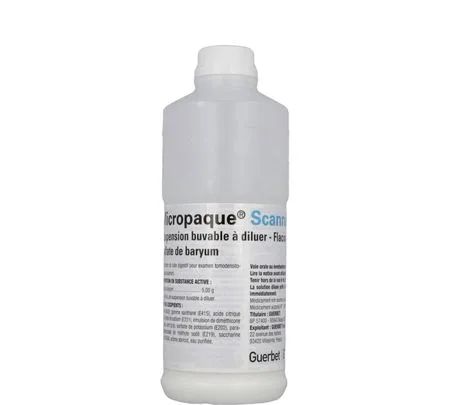
MICROPAQUE SCANNER, oral suspension to dilute
Composition
Barium sulfate.........................................................................................................................................5,00 g
Excipients with known effect:
Sorbitol (E420)...............................................................................................................................................3,33 g
Sodium citrate (E331).............................................................................................................................0,50 g
Potassium sorbate (E202)......................................................................................................................0,14 g
Sodium methyl parahydroxybenzoate (E219).......................................................................................0,14 g
Sodium saccharin (E954)..........................................................................................................................0,03 g
For 100 mL of oral suspension to dilute.
Sorbitol (E420), xanthan gum (E415), citric acid (E330), sodium citrate (E331), dimethicone emulsion at 30 percent (w/w), potassium sorbate (E202), sodium methyl parahydroxybenzoate (E219), sodium saccharin (E954), apricot flavouring*, purified water.
* Apricot flavouring: Acetic acid, triacetin, isobutyric acid, gamma-decalactone, ethyl citrate, redistilled propionic acid, ethyl malonate, ethyl acetate, hexanoic acid, ethyl formate, linalyl formate, 1-butanol, delta-undecalactone, gamma-dodecalactone, linalool, linalyl oxide, ethyl acetoacetate, amyl butyrate, geraniol, delta-decalactone, 2-hexenyl acetate, furaneol, delta-dodecalactone, green wine lees essence, terpeneless nutmeg essence, terpineol
Indications
This medicinal product is for diagnostic use only.
Opacification of the digestive tract during CT examinations.
In cases of contraindication to iodinated products, MICROPAQUE SCANNER may be used.
Dosage and administration
Dosage
Abdominal-pelvic examinations: 1000 mL of diluted suspension
Examinations of the supramesocolic region, pancreas: 500 mL of diluted suspension
Elderly patients
No dose adjustment is necessary for this patient population. However, particular attention must be paid to the contraindications and warnings listed below.
Paediatric population
For infants and children, the physician will adjust the dose according to the child's age and weight, taking into account the particularities of the paediatric radiological diagnosis.
Method of administration
Oral or, if necessary, rectal route.
Preparation of the ready-to-use suspension:
To 150 mL of suspension, add 350 mL of water, shake thoroughly for 30 seconds. This yields 500 mL of ready-to-use suspension containing 1,5 percent barium sulfate.
Abdominopelvic examinations:
- About 60 minutes before the scheduled examination time, the patient will take a first portion of 250 mL of diluted barium suspension, then, about 45 minutes and 30 minutes before the examination, 2 further portions of 250 mL.
- Just before the examination, the patient will take the remaining 250 mL, for a total volume of 1 000 mL of diluted suspension.
Examinations of the supramesocolic region, pancreas:
- About 30 minutes before the scheduled examination time, the patient will take 250 mL of diluted suspension.
- At the start of the examination, 250 additional mL must be taken by the patient, for a total volume of 500 mL of diluted suspension.
Contraindications
This medicine is contraindicated in cases of:
- Hypersensitivity to the active substance or to any of the excipients
- Confirmed or suspected intestinal perforation or obstruction, including pyloric stenosis.
- Peritonitis or suspected fistula in the digestive tract
- Recent wounds or erosions of the esophagus or digestive tract, or gastrointestinal haemorrhage
- Ischaemia of the intestinal wall
- Necrotising enterocolitis
- Megacolon or toxic megacolon
- Postoperative suture dehiscence. Barium sulfate must not be administered immediately before, and up to seven days after, gastrointestinal surgery, including endoscopic resection, snare polypectomy, or hot biopsy of the colon. The medicine must not be used if postoperative leaks are foreseeable. Do not use the product during radiotherapy of the neck, thorax (if used orally) or abdomen, and up to four weeks after radiotherapy.
Warnings and precautions
Special warnings
Do not inject parenterally.
Serious adverse effects associated with the administration of barium sulfate-based products have been reported: inhalation, intravasation, perforation, anaphylaxis that may be life-threatening or lead to a fatal outcome. These adverse effects are often related to the administration technique, the underlying condition and/or patient hypersensitivity.
The product must be administered under medical supervision. Potentially serious adverse effects must be detected, assessed and diagnosed promptly so that effective treatment can be initiated. Imaging department staff must be trained and able to manage the diagnosis and treatment of hypersensitivity reactions. Specific emergency medical measures must be taken in case of inhalation, intravasation or perforation (intensive care, surgery).
To prevent serious adverse effects, barium sulfate should be prevented from passing into parenteral regions such as tissues, the intravascular space or body cavities, as well as into the respiratory tract.
Paediatric population
The indication must be carefully weighed in young children with multiorgan failure, particularly of the cardiovascular system, as the examination and preparation may be stressful.
Elderly patients
The indication must be carefully weighed in elderly patients with multiorgan failure, particularly of the cardiovascular system, as the examination and preparation may be stressful.
Double-contrast colon examination is sometimes poorly tolerated in elderly or plethoric subjects who are difficult to mobilise.
Precautions for use
Perforation
Given the increased risk of perforation, the benefit/risk ratio must be carefully assessed in patients with oesophageal atresia or severe stenosis (specifically downstream of the stomach), as well as in patients with conditions and diseases carrying an increased risk of perforation, such as intestinal carcinoma, inflammatory bowel disease, diverticulosis, diverticulitis and parasitic infestation.
In cases of oesophageal atresia, opacification of the pouch should be avoided as far as possible. If it is performed, the smallest possible quantity of contrast medium should be administered and then aspirated.
Leakage of barium into the retroperitoneum or mediastinum may present with a few immediate symptoms, but delayed endotoxic shock, which is frequently fatal, may occur 12 hours later.
In cases of intestinal perforation, the passage of barium sulfate into the abdominal cavity may cause abscesses, inflammation, peritonitis, granulomas and adhesions, which may be fatal and require surgical intervention.
Inhalation
If the product is used orally, patients with respiratory disorders and swallowing disorders such as dysphagia, as well as impaired alertness, should be closely monitored, as there is a risk of aspiration.
Vomiting after oral administration of barium sulfate may cause aspiration pneumonia.
Barium should not be administered to patients with a history of food aspiration. If the use of barium is absolutely necessary in these patients, particular caution is required. If the product passes into the larynx, administration must be stopped immediately.
Paediatric population
In patients highly predisposed to aspiration (newborns), the procedure should begin with a low oral dose.
Aspiration into the tracheobronchial tree may occur when administering bottled oral barium sulfate suspension to infants and when administering large quantities via catheter. In infants, aspiration may lead to cardiorespiratory arrest with a fatal outcome. Aspiration of small quantities may cause inflammation of the airways and pneumopathy.
Elderly patients
In patients highly predisposed to aspiration (elderly subjects and those who have had a stroke), the procedure should begin with a low oral dose.
Fluid overload
Fluid overload due to absorption of water contained in barium sulfate suspensions has been reported. Children, patients with renal insufficiency, and children with Hirschsprung's disease are more exposed to water intoxication.
Paediatric population
In children with Hirschsprung's disease, it is preferable not to fill the colon completely, but to use only the volume of liquid required for diagnosis.
Intravasation
Barium sulfate can cross the intestinal wall and enter the venous drainage of the colon, thereby allowing a barium embolism to reach the circulatory system. The introduction and positioning of the equipment used to administer the contrast product must be done carefully and correctly, limiting the use of balloon catheters, in order to avoid wall injury.
Intravasation is very rare but may have fatal complications: systemic and pulmonary embolism, disseminated intravascular coagulation, septicemia and persistent severe arterial hypotension. This complication is more frequent in elderly patients whose rectal and vaginal walls are thinner, as well as in patients with colorectal conditions, in whom intraluminal pressure is greater than the resistance of the colon wall in cases of colitis, diverticulitis and intestinal obstruction. This complication has also been observed due to accidental positioning of a rectal catheter in the vagina. It is therefore advisable to verify the correct positioning of the rectal catheter before starting the enema.
This diagnosis should be considered for all patients who faint during or after barium administration and for patients experiencing malaise in the first hours following the examination. It may be confirmed by a radiological examination without contrast product. A CT scan may allow detection of the dissemination of barium sulfate.
Barium impaction
Caution is required in cases of pre-existing constipation, gastric emptying disorders, colonic stenosis, diverticulosis and colonic atony, due to the risk of barium impaction, particularly in elderly persons.
Barium sulfate may be retained in colonic diverticula, where it may maintain or intensify infections.
Barium impactions develop from barium compacted in the feces. They are often asymptomatic but may cause abdominal pain, appendicitis, intestinal obstruction or perforation.
Barium sulfate may cause or worsen pre-existing constipation.
To prevent severe constipation and the formation of barium impaction, good prior hydration should be ensured and mobilization after the examination should be encouraged. The use of laxatives should be considered (particularly in cases of constipation). Patients presenting with constipation before the examination should be specifically monitored, due to the risk of impaction.
Elderly patients
The risk of developing barium impactions is higher in elderly patients with intestinal motility disorders, ileus, electrolyte imbalance, dehydration, or whose diet is deficient in fiber. To prevent damage to the intestinal wall, barium impactions should be removed.
Other possible complications
Administration of barium sulfate may cause vasovagal reactions, episodes of syncope, arrhythmia and other cardiovascular complications. These reactions are generally unpredictable and are better managed if the patient remains under observation for 10 to 30 minutes after the examination.
Excipients
This medicine contains sorbitol. Its use is not recommended in patients with fructose intolerance (a rare hereditary disease).
This medicine contains 208,5 mg of sodium per 150 ml of suspension, which is equivalent to 10% of the WHO-recommended maximum daily dietary intake of 2 g of sodium per adult. To be taken into account in patients on a strict low-sodium diet.
This medicine contains 55 mg of potassium per 150 ml of suspension. To be taken into account in patients with renal insufficiency or in patients on a low-potassium diet.
This medicine contains "Parahydroxybenzoate" and may cause allergic reactions (possibly delayed).
Interactions
As barium sulfate is used alone as a contrast agent and is not absorbed, no drug interactions are expected. However, the simultaneous administration of other medicines is not recommended, as adsorption by barium sulfate could reduce their effects. Caution is required when barium sulfate is administered concomitantly with other medicines having a narrow therapeutic index.
Slow elimination of barium results in the presence of opaque residues that may interfere with other radiographic examinations such as urography or computed tomography in the following days.
Fertility, pregnancy and breastfeeding
Pregnancy
There are no data on the use of barium sulfate in pregnant women. Furthermore, as a general rule, any gastrointestinal radiological examination should be avoided in pregnant women.
Breast-feeding
No theoretical reason suggests passage into milk. Micropaque Scanner may be used during breastfeeding.
Driving and using machines
The effects on the ability to drive vehicles and use machines have not been studied. However, the pharmacodynamic and pharmacokinetic properties of barium sulfate are not such as to have an effect on the ability to drive vehicles and use machines.
Adverse effects
The adverse reactions related to the use of Micropaque Scanner are presented in the table below by System Organ Class and by frequency using the following categories: very common (≥ 1/10), common (≥1/100 to 1<1/10), uncommon (≥1/1 000 to 1<1/100), rare (≥1/10 000 to <1/1 000), very rare (<1/10 000), frequency not known (cannot be estimated from the available data).
|
System Organ Class |
Frequency: adverse effect |
|
Blood and lymphatic system disorders |
Frequency not known: In case of intravasation: disseminated intravascular coagulation |
|
Immune system disorders |
Frequency not known: anaphylactic reaction, anaphylactoid reaction, hypersensitivity |
|
Gastrointestinal disorders |
Frequency not known: intestinal obstruction, vomiting, diarrhoea, abdominal pain, faecaloma, abdominal distension, constipation, nausea, flatulence; in case of intestinal perforation: peritonitis |
|
Respiratory, thoracic and mediastinal disorders |
Frequency not known: aspiration pneumonia, pulmonary fibrosis |
|
Nervous system disorders |
Frequency not known: presyncope |
|
Skin and subcutaneous tissue disorders |
Frequency not known: urticaria, generalised rash |
Sodium methyl parahydroxybenzoate may cause immediate and delayed hypersensitivity reactions.
Contrast media containing barium sulfate may cause hypersensitivity reactions of variable intensity. Very rare, these reactions may however appear at the first administration. Administration of the product must then be stopped immediately and specific treatment must be initiated.
In very rare cases, administration of barium sulfate may cause the formation of barium-impacted faecalomas.
In case of intestinal perforation, the passage of barium sulfate into the abdominal cavity causes abscesses, inflammation, peritonitis, granulomas and adhesions, the course of which may be fatal and which require surgical intervention.
In case of extraluminal passage of barium sulfate, exceptional cases of intravasation accompanied by systemic spread of barium sulfate and potentially fatal may occur. Intravasation of barium sulfate may be responsible for deep venous thromboembolism, shock, respiratory distress and disseminated intravascular coagulation.
Reporting of suspected adverse reactions
Reporting suspected adverse reactions after authorisation of the medicinal product is important. It allows continued monitoring of the benefit/risk balance of the medicinal product. Healthcare professionals are asked to report any suspected adverse reaction via the national reporting system: National Agency for the Safety of Medicines and Health Products (ANSM) and the network of Regional Centres of Pharmacovigilance - Website: www.signalement-sante.gouv.fr.
Overdose
Rare cases of overdose have been reported following ingestion of barium sulfate. The cases are generally asymptomatic. However, some cases of abdominal pain have been reported.
Oral overdose carries a risk of constipation with, in some extreme cases, the formation of barium-impacted faecalomas. Treatment consists of evacuant enemas and/or saline laxatives.
Pharmacodynamics
Pharmacotherapeutic class: Barium-based contrast agent; ATC code: V 08 BA 01
Barium sulfate is used as a radiological opacifying agent for the digestive tract. Natural contrasts are sufficient to explore the skeleton or lungs radiologically; examinations of other organs require artificial contrasts obtained by using a solution or suspension of high atomic mass elements such as barium, in which case it is positive contrast, or by gases: negative contrast. Both can be combined in the double contrast technique, for example.
Barium, with atomic mass 137, has the property of greatly increasing the absorption of X-rays. Used either orally or rectally, it coats the digestive tract, allowing its precise localisation on radiological images.
Pharmacokinetics
Barium sulfate, practically insoluble in water and organic solvents, is not absorbed from the digestive tract.
Preclinical safety
Non-clinical data from conventional toxicology studies in single or repeated administration did not reveal any particular risk for humans.
INCOMPATIBILITIES
In the absence of incompatibility studies, this medicine must not be mixed with other medicines.
SPECIAL PRECAUTIONS FOR DISPOSAL AND OTHER HANDLING
Any unused medicinal product or waste material should be disposed of in accordance with local requirements.
Prescription, supply and reimbursement
| Marketing authorisation (AMM) |
|
Collection.
IMMEUBLE RIMBAUD 22 AVENUE DES NATIONS
93420 VILLEPINTE
Tel: 01 45 91 50 00 ww.guerbet.com/fr-fr
Source: VIDAL · Updated on 11/11/2026. This information does not replace advice from a healthcare professional.