
Medicines
SmPC of 01/12/2025
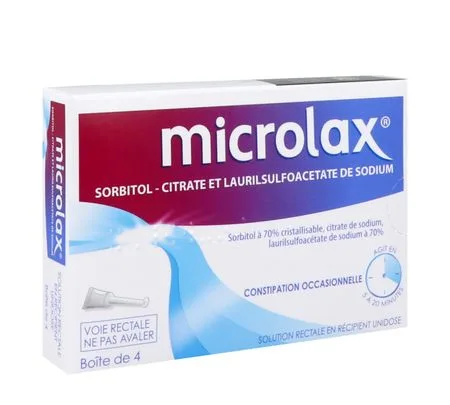
MICROLAX SORBITOL CITRATE AND SODIUM LAURILSULFOACETATE, rectal solution in single-dose container
Composition
Crystallisable sorbitol at 70 %.................................................................................................................. 4,4650 g
Sodium citrate..................................................................................................................................... 0,4500 g
Sodium laurilsulfoacetate at 70 %.................................................................................................... 0,0645 g
For one single-dose container.
6,45 g = 5 ml of rectal solution
Excipient(s) with known effect: sorbic acid
Sorbic acid, glycerol, purified water.
Dosage and administration
Reserved for adults.
Dosage
1 single-dose container per day.
The dose must be administered 5 to 20 minutes before the expected effect.
Method of administration
Rectal route.
Break the nozzle.
Insert the entire length of the cannula into the rectum and empty the entire contents of the tube by pressure, withdraw the cannula without releasing pressure on the tube.
Contraindications
• Hypersensitivity to the active substances or to any of the excipients listed in section Composition.
• Intestinal obstruction and abdominal pain of unknown aetiology.
• Concomitant treatment with sodium catiorésine sulfonate (see section Interactions).
• Concomitant treatment with calcium catiorésine sulfonate (see section Interactions).
Warnings and precautions
Warnings
Prolonged use is not recommended. If symptoms persist for more than a few days or worsen, medical advice is necessary.
Drug treatment of constipation is only an adjunct to hygienic-dietary treatment:
• enrichment of the diet with vegetable fibres and fluids;
• advice on physical activity and re-education of defecation.
Precautions for use
It is recommended to avoid using this medicine in cases of haemorrhoidal flare-ups, anal fissures or haemorrhagic proctocolitis.
It is recommended to exercise extreme caution in patients with inflammatory or ulcerative diseases affecting the colon or in patients suffering from acute gastrointestinal disorders.
This medicine contains sorbic acid, which may cause local skin reactions (for example contact dermatitis).
Interactions
Contraindicated combinations
+ Sodium sulfo-cationic resin (oral and rectal routes of sorbitol or resin)
Risk of colonic necrosis, possibly fatal.
+ Calcium sulfo-cationic resin (oral and rectal routes of sorbitol or resin)
Risk of colonic necrosis, possibly fatal.
Any other medicine administered rectally should be used at a distance from MICROLAX, as it may be eliminated by the gastrointestinal tract without having been absorbed.
Fertility, pregnancy and breastfeeding
Pregnancy
There are no adequate data on pregnant women, and no well-controlled clinical study has been conducted in these patients.
Under normal conditions of use, no effect on pregnancy is expected, as systemic exposure to the product is likely to be limited.
As a result, use of this medicine should only be considered during pregnancy if necessary.
Breast-feeding
There is no data to determine whether sorbitol, sodium citrate and sodium laurilsulfoacetate are excreted in breast milk.
Under normal conditions of use, no effect on breastfed newborns/infants is expected, as systemic exposure to the product is likely to be limited.
Consequently, use of this medicine during breastfeeding should only be considered if necessary.
Fertility
Studies conducted in rats and rabbits (only with sorbitol) showed no effect on fertility (see section Preclinical safety).
Driving and using machines
This medicine has no or negligible influence on the ability to drive and use machines.
Adverse effects
The following table describes the adverse effects that have been reported during post-marketing use with sorbitol, sodium citrate and sodium laurilsulfoacetate. The frequency of adverse effects is defined using the following convention:
• Very common (≥ 1/10)
• Frequent (≥1/100, < 1/10)
• Uncommon (≥ 1/1000, < 1/100)
• Rare (≥ 1/10000, < 1/1000)
• Very rare (< 1/10000)
• Frequency not known (cannot be estimated from the available data).
|
System organ |
Adverse effects |
|
Frequency |
|
|
Immune system disorders |
|
|
Frequency not known |
Anaphylactic reaction |
|
Hypersensitivity reactions (such as urticaria) |
|
|
Gastrointestinal disorders |
|
|
Frequency not known |
Abdominal paina |
|
|
Anorectal discomfort |
|
|
Liquid stools |
a : includes abdominal discomfort, abdominal pain and upper abdominal pain.
Reporting of suspected adverse reactions
Reporting suspected adverse reactions after authorisation of the medicinal product is important. It allows continued monitoring of the benefit/risk balance of the medicinal product. Healthcare professionals are asked to report any suspected adverse reaction via the national reporting system: National Agency for the Safety of Medicines and Health Products (ANSM) and the network of Regional Centres of Pharmacovigilance - Website:https://signalement.social-sante.gouv.fr/.
Overdose
No cases of overdose have been reported during post-marketing use or in the scientific literature. However, prolonged use may give rise to sensations of anal burning and, exceptionally, congestive proctitis.
Pharmacodynamics
Pharmacotherapeutic class: ENEMA, ATC code: A06AG11 (A: alimentary tract and metabolism).
Mechanism of action
Sodium citrate has an emollient effect on hard faecal matter, linked to its penetration into the faecal bolus and the release of water. Sodium lauryl sulfoacetate improves the wetting and penetration capacity of the solution, and sorbitol increases the water-releasing effect of sodium citrate.
Pharmacokinetics
Onset of action: 5 to 20 minutes.
The active substances are probably of limited systemic absorption and are eliminated in the stools.
Absorption
Sodium citrate
There is no study describing the absorption of sodium citrate following rectal administration in humans.
Sodium lauryl sulfoacetate
There is no study describing the absorption of sodium lauryl sulfoacetate following rectal administration in humans.
Sorbitol
Sorbitol is poorly absorbed by the gastrointestinal tract following rectal administration.
Distribution
There is no study describing the distribution of sodium citrate, sodium lauryl sulfoacetate and sorbitol following rectal administration in humans.
Biotransformation
There is no study describing the biotransformation of sodium citrate, sodium lauryl sulfoacetate and sorbitol following rectal administration in humans.
Elimination
Sodium citrate, sodium lauryl sulfoacetate and sorbitol are mainly eliminated in the faeces.
Preclinical safety
The medicinal product showed negligible toxicity in dogs following repeated clinical (rectal) administration. A safety pharmacology study in dogs was carried out following intravenous administration of 1,33 mmol/kg/h of citrate solution (composed of a mixture of citric acid and sodium citrate with a molar ratio of 1 : 5,25). A decrease in blood pressure and a prolongation of the QT interval were observed: these are explained by a reduction in blood Ca2+ level due to the chelating action of citrate (the citrate level tolerated intravenously in conscious dogs is 0,33 mmol/kg/h). Given the posology of the medicinal product, it is considered that chelation of blood Ca2+ does not represent a clinical risk for patients.
Data available in the literature have shown that the active substances generally presented low toxicity in repeated-dose oral administration studies.
No adverse effects were reported for sodium citrate during repeated dose toxicity studies at doses up to 1 500 mg/kg/day. The repeated dose toxicity study of sodium laurilsulfoacetate in rats revealed no signs of systemic toxicity at doses up to 75 mg/kg/day. Repeated dose toxicity studies conducted in rats demonstrated that sorbitol was well tolerated.
Sodium citrate and sorbitol showed no genotoxic effect in in vitro and in vivo tests. Sodium laurilsulfoacetate showed no genotoxic effect in in vitro tests.
Sodium citrate and sodium laurilsulfoacetate had no carcinogenic effect in rats. According to long-term dietary studies conducted in rats, sorbitol had no carcinogenic effect.
Sodium citrate did not cause a teratogenic effect in rats. No teratogenic effect was reported following oral administration of 1 000 mg/kg/day of sodium laurilsulfoacetate in rats. Sorbitol did not cause a teratogenic effect in rabbits and rats after incorporation into food (up to 20% sorbitol).
Oral treatment with sodium citrate showed no reproductive toxicity in rats. In a reproductive and developmental toxicity study conducted in rats, no effect on growth, fertility and reproductive capacity was observed after oral administration of doses of sodium laurilsulfoacetate up to 1 000 mg/kg/day. In non-clinical studies conducted in rats exposed to sorbitol through food, no treatment-related effect was reported in terms of mating capacity, pregnancy, reproductive capacity, newborns or histopathology.
SPECIAL PRECAUTIONS FOR DISPOSAL AND OTHER HANDLING
Any unused medicinal product or waste material should be disposed of in accordance with local requirements.
Prescription, supply and reimbursement
| Marketing authorisation (AMM) |
|
Hospital model(s) (50 single-dose containers/5 mL).
Collection.
41 RUE CAMILLE DESMOULINS
92130 ISSY-LES-MOULINEAUX CEDEX 9
Tel: 00 800 555 22 000 https://www.kenvuecontact.com/
Source: VIDAL · Updated on 11/11/2026. This information does not replace advice from a healthcare professional.