Medicines
Updated on 16/09/2025
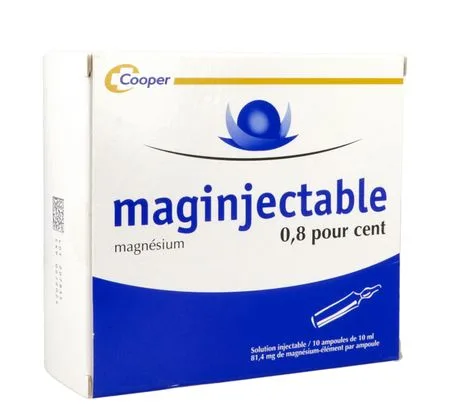
MAGINJECTABLE®
magnesium pidolate
Forms and presentations
Injectable solution at 0,8 % : Ampoules of 10 ml, box of 10.Composition
| per ampoule | |
| Magnesium pidolate*
|
1 g |
| (i.e. as elemental magnesium: 81,4 mg or 3,37 mmol/amp) | |
Total osmolarity: 925,6 mOsm/l.
* Magnesium pyrrolidone carboxylate.Indications
Magnesium supplementation during parenteral nutrition.Dosage and administration
DosageAdult : 6 to 8 mmol (150 to 200 mg) per day according to needs, i.e. 2 to 3 ampoules per day.
Child and infant over 8 kg (i.e. approximately 8 months) : 0,30 to 0,40 mmol/kg/day (7 to 10 mg/kg/day).
Method of administration :
- Slow intravenous injection or intramuscular injection.
- Intravenous infusion, diluted in a glucose or saline solution.
Contraindications
- Severe renal insufficiency (creatinine clearance < 30 ml/min/1,73 m2).
- Hypersensitivity to magnesium pidolate or to glutamates (related substances).
Warnings and precautions
Hypertonic solution to be injected slowly.- The first intravenous administrations are to be performed in a hospital setting.
- Recommended infusion rate: 1 mmol/min i.e. 24 mg/min (2 to 3 ml/min) without exceeding 6 mmol/min i.e. 150 mg/min.
- Monitoring of blood pressure during intravenous injection and continuous infusion.
- Monitoring of magnesemia: discontinue treatment as soon as normalisation occurs.
- Reduce the dosage in patients with renal impairment with increased monitoring of renal function, blood pressure and magnesemia.
- To be administered preferably in the supine position.
Fertility, pregnancy and breastfeeding
Pregnancy:In clinical practice, the use of magnesium during a limited number of pregnancies has apparently not revealed any particular malformative or fetotoxic effect to date. However, additional studies are necessary to assess the consequences of exposure during pregnancy.
Consequently, the use of magnesium can only be considered during pregnancy if necessary.
Breastfeeding:
Due to the passage of magnesium into breast milk, avoid breastfeeding during treatment.
Adverse effects
- Pain at the injection site, vasodilation with sensation of warmth, metallic taste.
- Potentially lethal hypermagnesemia in case of severe renal impairment or too rapid injection.
- Allergic-type reactions.
Overdose
The first signs of hypermagnesemia are inhibition of patellar reflexes, a sensation of warmth, drowsiness, speech disorders, muscle paralysis with respiratory difficulties, and, at most, respiratory and cardiac arrest.
Treatment:- rehydration, forced diuresis;
- IV injection of 1 g of calcium gluconate;
- hemodialysis or peritoneal dialysis in case of renal impairment.
Pharmacodynamics
Pharmacotherapeutic class: mineral supplement (ATC code: A12CC08).
- From a physiological standpoint:
- Magnesium is a primarily intracellular cation. It decreases neuronal excitability and neuromuscular transmission, and is involved in numerous enzymatic reactions.
- As a constitutive element, half of the magnesium stores are bony.
- From a clinical standpoint:
- A serum magnesemia between 12 and 17 mg/l (1 to 1,4 mEq/l or 0,5 to 0,7 mmol/l) indicates moderate magnesium deficiency.
- A serum magnesemia below 12 mg/l (1 mEq/l or 0,5 mmol/l) indicates severe magnesium deficiency.
-
Magnesium deficiency can be:
- primary due to congenital metabolic abnormality (chronic congenital hypomagnesemia),
- secondary due to: insufficient intake (severe malnutrition, alcoholism, exclusive parenteral nutrition); digestive malabsorption (chronic diarrhea, digestive fistulas, hypoparathyroidism); exaggeration of renal losses (tubulopathies, significant polyuria, diuretic abuse, chronic pyelonephritis, primary hyperaldosteronism, treatment with cisplatin).
- primary due to congenital metabolic abnormality (chronic congenital hypomagnesemia),
Pharmacokinetics
Excretion is primarily urinary.
INCOMPATIBILITIES
This medicine must not be mixed with other medicines except those mentioned in the section Dosage and administration.
Storage conditions
- Shelf life
- 3 years.
No special storage precautions.
- After opening:
- The product must be used immediately.
HANDLING/DISPOSAL MODALITIES
No particular requirements.
Prescription, supply and reimbursement
| MA | 3400932234622 (1973/97, SmPC rev 16.09.2010). |
| Price: | 7,40 euros (10 ampoules). |
| Soc. Sec. reimb. at 65 %. Collect. | |
COOPER
Coopération Pharmaceutique Française
Place Lucien-Auvert. 77020 Melun cdx
Tel : 01 64 87 20 00
Source: VIDAL · Updated on 10/11/2026. This information does not replace advice from a healthcare professional.