
Medicines
SmPC of 17/10/2023
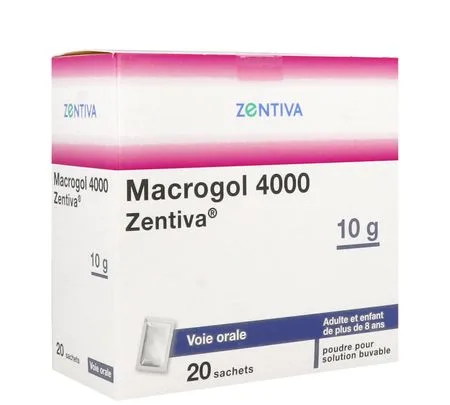
MACROGOL 4000 ZENTIVA 10 g, powder for oral solution in sachet
Composition
Macrogol 4000...................................................................................................................................................10 g
None.
Indications
Symptomatic treatment of constipation in adults and children from 8 years of age.
An organic cause should be ruled out before initiating treatment. MACROGOL 4000 ZENTIVA must remain a temporary treatment for constipation, for a duration not exceeding 3 months in children, in combination with appropriate dietary and lifestyle measures. Persistence of symptoms despite the associated dietary and lifestyle measures should prompt investigation and treatment of an underlying condition.
Dosage and administration
Oral use.
Dosage
The dose is 1 to 2 dose sachets per day (10 to 20 g) to be taken preferably in a single dose, in the morning.
The daily dose should be adjusted according to the clinical effects obtained and may range from 1 sachet every other day (particularly in children) to 2 sachets per day.
The effect of MACROGOL 4000 ZENTIVA occurs within 24 to 48 hours following its administration.
Paediatric population
In children, given the absence of clinical data beyond 3 months, the duration of treatment should not exceed 3 months.
The improvement in intestinal transit induced by treatment will be maintained by dietary and lifestyle measures.
Method of administration
The contents of each sachet must be dissolved in approximately 50 ml of water just before being administered and taken in the morning. The resulting solution will be clear and transparent like water.
Contraindications
• Hypersensitivity to the active substance
• Severe inflammatory bowel diseases (ulcerative colitis, Crohn's disease) or toxic megacolon;
• Gastrointestinal perforation or risk of gastrointestinal perforation;
• Ileus or suspicion of intestinal obstruction, symptomatic stenosis;
• Abdominal pain syndromes of undetermined cause.
Warnings and precautions
Drug treatment of constipation is only an adjunct to hygienic and dietary treatment such as:
• enrichment of the diet with vegetable fibers and fluids,
• advice on appropriate physical activity and re-education of defecation.
An organic cause must be ruled out before initiating treatment.
This medicine contains macrogol (polyethylene glycol). Hypersensitivity reactions (anaphylactic shock, angioedema, urticaria, rash, pruritus, erythema) have been reported with medicinal products containing macrogol, see section Adverse effects. In case of diarrhoea, patients at risk of fluid and electrolyte imbalance (for example elderly patients or patients with hepatic or renal insufficiency or those on diuretic treatment) should be monitored, and monitoring of electrolytes should be considered.
Use with caution in patients with impaired gag reflex and in patients prone to regurgitation or aspiration. Cases of inhalation have been reported when large volumes of polyethylene glycol and electrolytes were administered via nasogastric tube. Children with neurological impairment and oromotor disorders are particularly exposed to this risk of inhalation.
In patients with swallowing problems who need to add a thickener to solutions to ensure appropriate intake, interactions should be considered, see section Interactions.
Special precautions for use
MACROGOL 4000 ZENTIVA does not contain a significant amount of sugar or polyol, so it may be prescribed to diabetic patients or to patients on a galactose-free diet.
Interactions
Absorption of other medicines may be transiently reduced when MACROGOL 4000 ZENTIVA is used, particularly medicines with a narrow therapeutic index or a short half-life such as digoxin, antiepileptics, coumarins and immunosuppressants, resulting in decreased efficacy.
MACROGOL 4000 ZENTIVA may potentially interact with starch-based food thickeners. The active substance macrogol neutralises the thickening effect of starch, leading to liquefaction of preparations that must remain thickened for people with swallowing disorders.
Fertility, pregnancy and breastfeeding
Pregnancy
Animal studies have not shown direct or indirect harmful effects on reproduction (see section Preclinical safety). There are limited data (fewer than 300 pregnancies) on the use of MACROGOL 4000 ZENTIVA in pregnant women.
No effect during pregnancy is expected since systemic exposure to MACROGOL 4000 ZENTIVA is negligible. MACROGOL 4000 ZENTIVA may be used during pregnancy.
Breast-feeding
There is no data on the excretion of MACROGOL 4000 ZENTIVA into human milk.
No effect on breastfed newborns/infants is expected since systemic exposure of the breastfeeding woman to MACROGOL 4000 ZENTIVA is negligible. MACROGOL 4000 ZENTIVA may be used during breastfeeding.
Fertility
No fertility study has been performed with MACROGOL 4000 ZENTIVA. However, since macrogol 4000 is not significantly absorbed, no effect on fertility is expected
Driving and using machines
No studies on the effects of MACROGOL 4000 ZENTIVA on the ability to drive vehicles and use machines have been performed.
Adverse effects
The frequency of undesirable effects may be classified as follows:
Very common (≥ 1/10), common (≥ 1/100 to < 1/10), uncommon (≥ 1 000 to < 1/100), rare (≥ 1/10 000 to <1/1 000), very rare (< 1/10 000), frequency not known (cannot be estimated from the available data).
In adults
The undesirable effects listed in the table below have been reported during clinical studies (including approximately 600 patients) and during marketing of the product. In general, these undesirable effects have always been mild and transient, and have mainly concerned the digestive system:
|
System organ |
Adverse effects |
|
Gastrointestinal disorders |
|
|
Common |
Abdominal pain
Diarrhea* Nausea |
|
Uncommon |
Vomiting Urgent defecation Faecal incontinence |
|
Metabolism and nutrition disorders |
|
|
Frequency not known |
Electrolyte disturbances (hyponatraemia, hypokalaemia) and/or dehydration, particularly in the elderly |
|
Immune system disorders |
|
|
Frequency not known |
Hypersensitivity: anaphylactic shock, angioedema, urticaria, rash, pruritus, erythema. |
In children :
The adverse effects listed in the table below were reported during clinical studies involving 147 children aged 6 months to 15 years and during marketing of the product. As in adults, these adverse effects were generally mild and transient and mainly affected the digestive system:
|
System organ |
Adverse effects |
|
Gastrointestinal disorders |
|
|
Common |
Abdominal pain |
|
Diarrhea* |
|
|
Uncommon |
Vomiting |
|
Abdominal distension |
|
|
Nausea |
|
|
Immune system disorders |
|
|
Frequency not known |
Hypersensitivity (anaphylactic shock, angioedema, urticaria, rash, pruritus) |
*Diarrhoea may cause perianal pain.
Reporting of suspected adverse reactions
Reporting suspected adverse reactions after authorisation of the medicinal product is important. It allows continued monitoring of the benefit/risk balance of the medicinal product. Healthcare professionals are asked to report any suspected adverse reaction via the national reporting system: National Agency for the Safety of Medicines and Health Products (ANSM) and the network of Regional Centres of Pharmacovigilance - Website: https://signalement.social-sante.gouv.fr/ .
Overdose
Diarrhoea, abdominal pain and vomiting have been reported. In cases of severe diarrhoea, weight loss and hydroelectrolytic imbalance may occur. Diarrhoea, due to an excessive dose, disappears when treatment is temporarily stopped, or after reduction of the dosage.
In cases of significant fluid loss secondary to diarrhoea or vomiting, it may be necessary to correct the hydro-electrolytic disorders.
Pharmacodynamics
Pharmacotherapeutic class: OSMOTIC LAXATIVE, ATC code: A06AD15 (A: alimentary tract and metabolism).
High molecular weight macrogols (4000) are long linear polymers to which water molecules are retained by hydrogen bonds. Administered orally, they cause an increase in the volume of intestinal fluids.
The volume of unabsorbed intestinal fluid is responsible for the laxative properties of the solution.
Pharmacokinetics
Pharmacokinetic data confirm the absence of intestinal absorption and biotransformation of macrogol 4000 after oral ingestion.
Preclinical safety
Toxicological studies carried out in different animal species revealed no sign of systemic toxicity or local gastrointestinal toxicity. Macrogol 4000 did not reveal any teratogenic or mutagenic effect.
Studies of potential interactions, carried out in rats with certain NSAIDs, anticoagulants, gastric antisecretory agents and a hypoglycaemic sulfonamide, did not show any interference of MACROGOL 4000 ZENTIVA with the gastrointestinal absorption of the substances studied.
No carcinogenicity study has been conducted.
Prescription, supply and reimbursement
| Marketing authorisation (AMM) |
|
| Price: |
|
- Indication(s) appearing in the marketing authorisation at the date of publication of this decree
Collection.
35 RUE DU VAL DE MARNE CS 91439
75214 PARIS CEDEX 13
Tel: 0 800 089 219 https://www.zentiva.com/
Source: VIDAL · Updated on 11/11/2026. This information does not replace advice from a healthcare professional.